When the doctrine of allegiance to party can utterly up-end a man's moral constitution and make a temporary fool of him besides, what excuse are you going to offer for preaching it, teaching it, extending it, perpetuating it? say, the best good of the country demands allegiance to party? Shall you say, the best good of the country demands allegiance to party? Shall you also say it demands that a man kick his truth and his conscience into the gutter and become a mouthing lunatic, besides?
~ Mark Twain (1835-1910) ("Consistency," a paper read at Hartford, Connecticut in 1884)
I always try to make myself as widely understood as possible; and if I don't succeed, I consider it my own fault.
~ Dmitri Shostakovich (quoted in Machlis, Introduction to Contemporary Music)
The composer apparently does not set himself the task of listening to the desires and expectations of the Soviet public. He scrambles sounds to make them interesting to formalist elements who have lost all taste... The power of good music to affect the masses has been sacrificed to a petty-bourgeois, "formalist" attempt to create originality through cheap clowning. It is a game of clever ingenuity that may end very badly.*
~ Pravda (on the Shostakovich opera Lady MacBeth of Mtsensk, "Muddle Instead of Music," January 1936)
Shostakovich told me: "I finished the Fifth Symphony in the major and fortissimo... It would be interesting to know what would have been said if I finished it pianissimo and in the minor." Only later did I understand the full significance of these words, when I heard the Fourth Symphony, which does finish in the minor and pianissimo. But in 1937, nobody knew the Fourth Symphony.**
~ Boris Khaikin (1904-1978) (Discourses on Conducting)
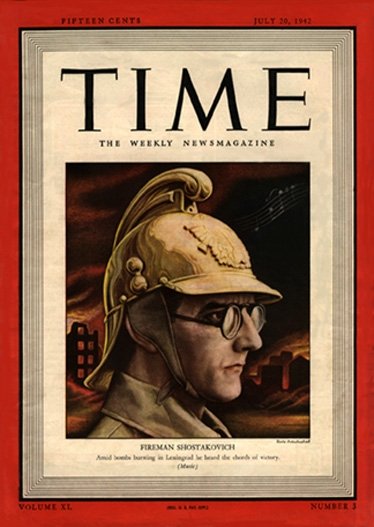
The cover of a 1942 issue of Time Magazine with the caption "Fireman Shostakovich: 'Amid bombs burning in Leningrad, he heard the chords of victory.' Refers to the Battle of Leningrad in which he served as a volunteer in the anti-fire brigades
There may be few notes, but there's lots of music.
Particularly during the Cold War, Shostakovich was anathema to many Western critics:
The Fifth Symphony of Shostakovich always has been singularly irritating to this chronicler... Whenever I hear one of his marches, my imagination fastens upon a picture of the parades in Red Square and the banners of Uncle Joe, and my irritation becomes powerful.
~ Cyrus Durgin (? - 1962) (Boston Globe, 25 October 1952)
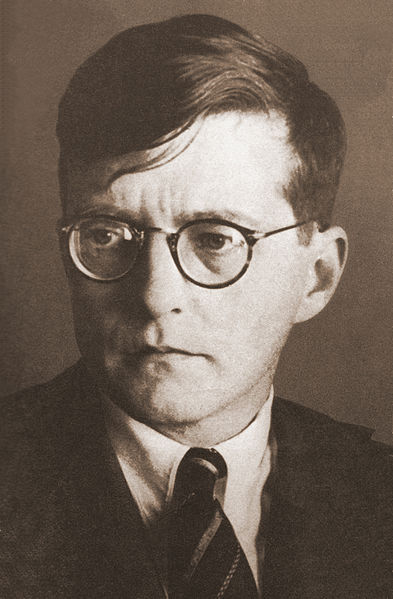
To anyone who knew his music, a first encounter with Dmitri Shostakovich could not fail to be startling. In contrast to the elemental force, bombast, grandeur of his works, he was a chétif*** figure, the perennial student, unassertive and shy, who looked as though all the music could be wrung out of him in a couple of song cycles.
~ Yehudi Menuhin (1916-1999) (Unfinished Journey)
September 25 is the anniversary of the birth of Soviet composer Dmitri Shostakovich (wiki) (1906-1975), considered by some as the greatest symphonist of the 20th century. Born in St. Petersburg, Shostakovich was an early piano prodigy and studied composition at the St. Petersburg Conservatory during the early Soviet era.
At first recognized internationally as an exemplar of the best of Soviet musicianship, he ran afoul of the regime with his modernistic opera, Lady MacBeth of Mtsensk, which so outraged Stalin that he is said to have had a personal hand in writing the infamous Pravda editorial, "Muddle Instead of Music" that literally put the composer's life in jeopardy during the "Great Purge" of the late 1930s.
Shostakovich somehow survived, even though he was recurrently criticized by the regime for his “modernist” tendencies. During his subsequent tumultuous career, he produced an enormous oeuvre: 15 symphonies, concertos, a great quantity of chamber music, song cycles, piano music, and several operas. Generally considered a serious - almost tragic - composer, Shostakovich nonetheless wrote a large amount of “light” music, including even a stage work – Moscow Cheryomushki (1959) – that might be described as a Russian musical comedy.
For newcomers to the music of Shostakovich, I would recommend his 4th, 5th, and 10th symphonies, the two piano concertos, the "autobiographical" 8th strinq quartet, his several "jazz" and "ballet" suites compiled from light works of the 1930s, and his film score for The Gadfly, whose "Romance" was used to great effect as the principal theme of the TV series, "Riley, Ace of Spies."
During the last two decades, there has been a raging musicological debate about whether the music of Shostakovich reveals him as a loyal Soviet citizen or a closet dissident whose works portray a tormented man. No one really knows. He was clearly a quirky guy. In contradiction to the opening quotation above, he noted late in life,
"I've said what I said. Either you have it in you to understand, or if not, then it would be fruitless to try to explain anyway."
* N.B. In the first year of the Great Purge, this last sentence was a terrifying threat.
** After the uproar caused by Lady MacBeth of Mtsensk, Shostakovich "redeemed" himself with his Fifth Symphony (1937), designated "A Soviet Artist's Response to Just Criticism," still one of his most successful and popular works. However, his iconoclastic Fourth Symphony, which had been in rehearsal at the time of the debacle, was withdrawn and did not emerge again until 1961. It is now considered one of the master's most original works and a fascinating indicator of "the road not taken." By the way, Boris Khaikin was a Soviet-Jewish conductor.
*** Chétif - a French word meaning "puny."
Here is the romance from The Gadfly:
More typical of Shostakovich is the opening of his 4th symphony:
The composer does not sit around and wait for an inspiration to walk up and introduce itself ... Making music is actually little else than a matter of invention aided and abetted by emotion. In composing we combine what we know of music with what we feel.
- George Gershwin (quoted in Goldberg, Tin Pan Alley)
Not many composers have ideas. Far more of them know how to use strange instruments which do not require ideas.
- Gershwin (The Composer in the Machine Age (1933))
My people are American, my time is today ... music must repeat the thought and aspirations of the times.
- Gershwin (quoted in Armitage, Accent on America)
Many musicians do not consider George Gershwin a serious composer. But they should understand that, serious or not, he is a composer - that is, a man who lives in music and expresses everything, serious or not, sound or superficial, by means of music, because it is his native language.
- Arnold Schoenberg (1874-1951) (quoted in Kimball and Simon, The Gershwins)
Today is the anniversary of the birth of American composer George Gershwin (wiki) (1898-1937), born Jacob Gershowitz in Brooklyn to Jewish parents of Russian/Ukrainian descent. Gershwin started piano lessons at an early age, left school at 15, first worked as a "song plugger" on Tin Pan Alley, and published his own first song in 1916. Later, while working as a piano-roll arranger, he began a series of Broadway collaborations, leading to his first show with brother Ira Gershwin (1896-1983), Lady Be Good (1924). This was followed by (among others) Oh, Kay! (1926), Funny Face (1927), Strike Up the Band (1927), Show Girl (1929), and Girl Crazy (1930). In 1924, Gershwin also wrote his quasi-classical Rhapsody in Blue for Paul Whiteman's band, and it has remained his most popular work in that vein. That same year, he traveled to Paris, hoping to study composition with Nadia Boulanger or Maurice Ravel - they demurred - but while there he did compose another of his well-known semi-classical works, An American in Paris. Following a brief Hollywood stint, Gershwin wrote his most ambitious work, the "folk opera" Porgy and Bess (1935), based on a novel by DuBose Heyward, and it has been an American classic ever since.* Gershwin's shows became the source of countless popular hits, including "I Got Rhythm," "Strike Up the Band," "Swanee," "Summertime," and "Someone," and his classical compositions raise intriguing questions about "what might have been" had he not been felled by a brain tumor in 1937. On his death, American novelist John O'Hara (1905-1970) wrote,
"George died on July 11, 1937, but I don't have to believe it if I don't want to."
Mark Steyn has an excellent post on Summertime here - very informative and highly recommended!
* N.B. Of Porgy and Bess, American composer Virgil Thomson 1896-1989) wrote,
"Porgy is ... an interesting example of what can be done by talent in spite of a bad set-up. With a libretto that should never have been accepted on a subject that should never have been chosen, a man who should never have attempted it has written a work that has a considerable power."
Rare old footage (I don 't know when this was recorded, but he died in 1937, so a while before that...) of Gershwin himself playing I Got Rhythm: