Via
Priceonomics: In the third season of The Big Bang Theory, two supposedly nerdy fellows -- Howard and Sheldon -- get into a heated argument (video clip below) over a cricket. After timing the cricket’s “chirps” and noting the temperature in the room, Sheldon concludes, with utmost certainty, that the insect is a snowy tree cricket. Howard adamantly disagrees: “How could you possibly know that,” he asks, “without seeing the cricket?”
The answer? Dolbear’s Law -- a totally awesome, totally real formula from the late 19th century that can be used to accurately estimate the temperature based on the number of chirps a cricket emits. Though Sheldon eventually ends up being wrong about the species of cricket he identifies, scientists have had better luck: for decades, they’ve worked to validate the method of using crickets as natural thermometers.
Here's the basic premise:
Crickets are cold-blooded and, as such, assume the temperature of their surrounding environment. Like other cold-blooded critters, crickets are enslaved to the Arrhenius equation (1889), which stipulates that a certain amount of “activation energy” is required for an insect to “induce a chemical reaction.” Chirping requires many muscle contractions (sparked by chemical reactions), and is thus dependant on the weather: at lower temperatures, the rate of chemical reactions in a cricket’s body slows, its muscle contraction frequency decreases, and, as a result, its chirping frequency diminishes.
In an 1897 copy of the
American Naturalist, physicist
Amos Emerson Dolbear (
wiki) (who had also developed, but failed to patent, the scientific foundation for some of the biggest inventions in American history, including the telephone and radio*) published an extremely brief, curious nugget of information, titled “
The Cricket as a Thermometer.” In it, he noted an observation:
The rate of [a cricket’s] chirp seems to be entirely determined by the temperature and this to such a degree that one may easily compute the temperature when the number of chirps is known.
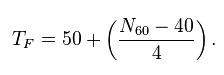
Listening to the crickets in a meadow outside his home, Dolbear made a series of three observations: At 60 degrees Fahrenheit, the crickets chirped at a rate of 80 per minute, at 70 degrees, they chirped at 120 per minute, and at temperatures below 50 degrees, “the crickets had no energy to waste in music,” and retained a rate of 40 chirps per minute. From this, he gathered the following equation (where T represents temperature in degrees Fahrenheit, and N represents the number of chirps per minute):
Though Dolbear’s “study” lacked crucial details -- he didn’t specify the species of cricket,the number of observations, or variability -- is was, for some reason, universally accepted by biologists and entomologists. A slew of follow-up studies followed.
When a renowned entomologist included Dolbear’s formula in his
textbook in 1907, it suddenly became regarded as 100% scientific truth; the snowy tree cricket, which many assumed Dolbear had used, became known as the “temperature cricket,” and was referenced by hundreds of scholars in the field. By 1948, the formula was officially declared “Dolbear’s Law.
”
A short version of the calculation - to convert cricket chirps to degrees Fahrenheit, count number of chirps in 14 seconds then add 40 to get temperature.
Example: 30 chirps + 40 = 70° F
 |
| Field crickets are the most common species in the US) -- they're probably what you're hearing |
Here's a brief video explanation:
* When Alexander Graham Bell patented the telephone in 1876, Dolbear argued he’d invented it first; his case against American Bell Telephone was so convincing that it made it all the way to the US Supreme Court before being dismissed. “Had he been observant of patent office formalities,” wrote
The Scientific American in 1881, "it is possible that the speaking telephone would be garnered among his laurels.” In 1885, Dolbear
patented a wireless telegraphy system that was extensively used by Guglielmo Marconi to “invent” the radio (to this day, Dolbear’s role in the device is mostly neglected).
Additional information: Those chirps you hear when you’re laying in bed at night aren’t just produced for kicks -- they’re
mating calls. When crickets are on the prowl, they let the entire neighborhood know about it.
A common (and horribly incorrect) myth is that a cricket produces its signature “chirp” by rubbing its legs together. In actuality, the noise occurs when the insect strokes its stridulatory organ, a large, comb-like vein running along the bottom of each wing. In the process, the cricket spreads its wings up and out and they act as “acoustical sails,” amplifying the noise for all to hear -- including his sonically-attuned mate (about 95% of crickets that make the noise are male).