September 18 is the anniversary of the birth in 1709 of that quintessential 18th-century curmudgeon
Dr. Samuel Johnson (
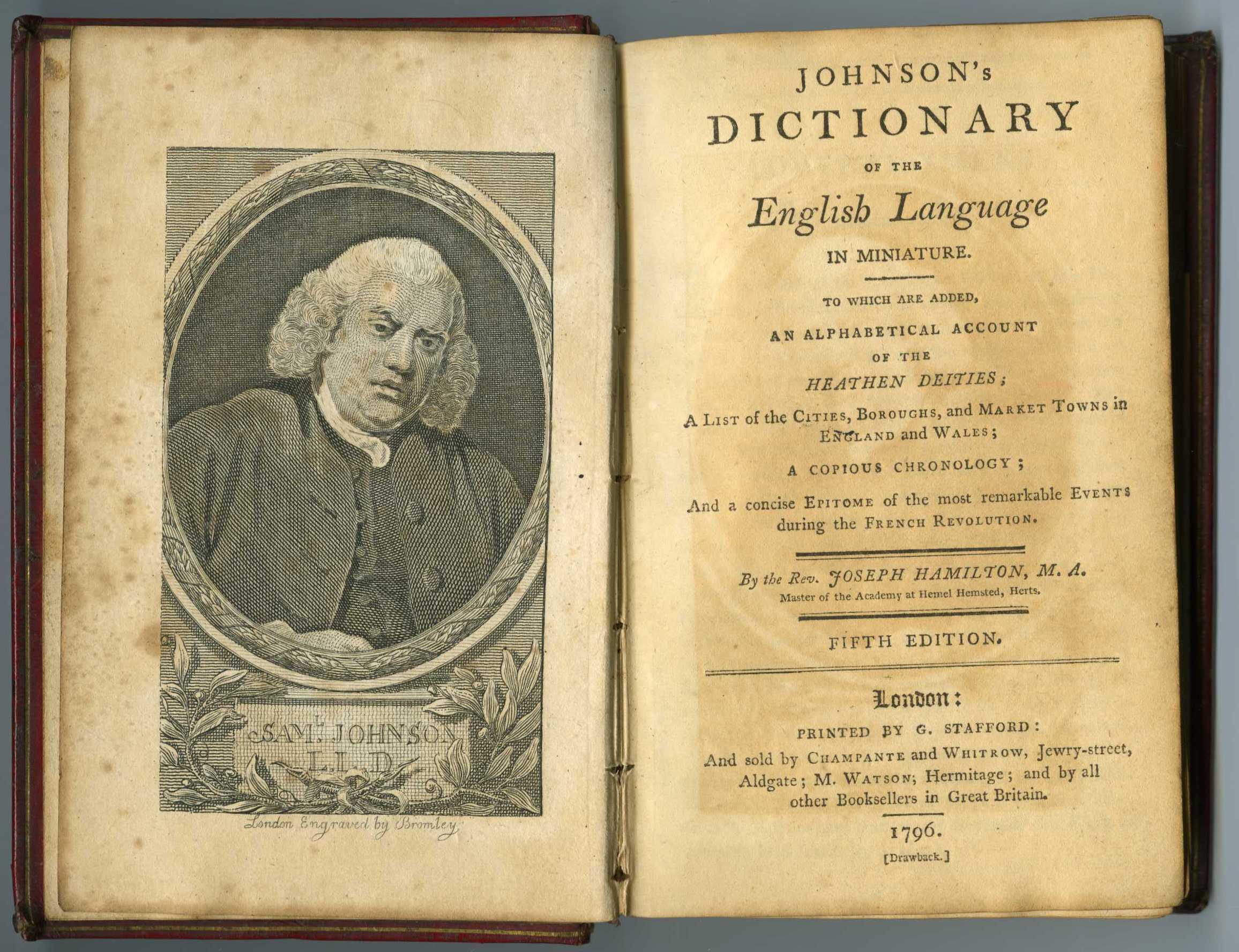
wiki), the literary lion of Georgian London for much of his lifetime (1709-1784). A poet, critic, lexicographer, and wit, Johnson compiled the first respectable English dictionary between 1747 and 1755, following several years of writing critical articles for London magazines such as
The Idler.
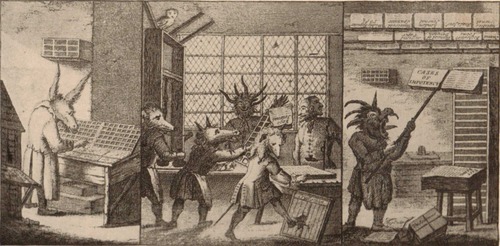 |
From The Grub Street Journal (Oct 30, 1732), this cartoon depicts the “literatory,” a sort of publishing factory driven by beasts without artistic inspiration. Such was the perception of Grub Street writers like Johnson and Savage, who did indeed scrape together a living from commissioned writing.
|
Born in Lichfield the son of a book dealer, Johnson studied at Oxford and ran his own private school - where the actor David Garrick was a student - before removing to London and its literary milieu in 1737. There, in 1763, he met his companion and biographer, the Scot,
James Boswell (1740-1795), to whom we owe the recording of most of Johnson's voluminous observations.
He was no fan of Scotland:
"The noblest prospect which a Scotchman ever sees, is the high road that leads him to England!"
I having said that England was obliged to us for gardeners, almost all their gardeners being Scotchmen; Johnson: "Why, Sir, that is because gardening is much more necessary amongst you than with us, which makes so many of your people learn it. It is all gardening with you. Things which grow wild here, must be cultivated with great care in Scotland. Pray now," throwing himself back in his chair, and laughing, "are you ever able to bring the sloe to perfection?"
He would not allow Scotland to derive any credit from Lord Mansfield; for he was educated in England. "Much may be made of a Scotchman, if he be caught young."
"There is in Scotland a diffusion of learning, a certain portion of it widely and thinly spread. A merchant has as much learning as one of their clergy."
"What enemy would invade Scotland, where there is nothing to be got?"
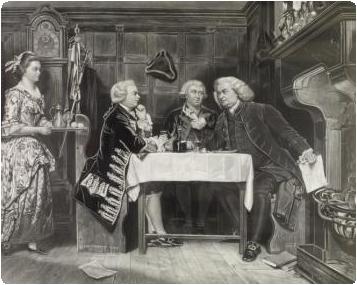 |
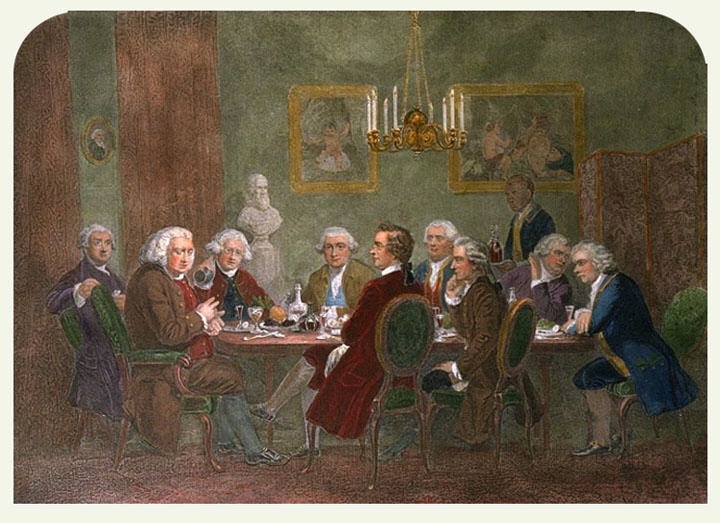
In “The Mitre Tavern” (1880), Samuel Johnson (far right) converses with James Boswell (center) and author Goldsmith. (source)
|
Asked by a Scot what Johnson thought of Scotland: "That it is a very vile country, to be sure, Sir" "Well, Sir! (replies the Scot, somewhat mortified), God made it." Johnson: "Certainly he did; but we must always remember that he made it for Scotchmen, and comparisons are odious, Mr. S------; but God made hell."
Mr. Arthur Lee mentioned some Scotch who had taken possession of a barren part of America, and wondered why they would choose it. Johnson: "Why, Sir, all barrenness is comparative. The Scotch would not know it to be barren." Boswell: "Come, come, he is flattering the English. you have now been in Scotland, Sir, and say if you did not see meat and drink enough there." Johnson:"Why yes, Sir; meat and drink enough to give the inhabitants sufficient strength to run away from home."
 |
| Johnson and Boswell in Edinburgh |
"Your country consists of two things, stone and water. There is, indeed, a little earth above the stone in some places, but a very little; and the stone is always appearing. It is like a man in rags; the naked skin is still peeping out."
"A tree might be a show in Scotland as a horse in Venice. At St. Andrews Mr. Boswell found only one, and recommended it to my notice; I told him it was rough and low, or looked as if I thought so. This, said he, is nothing to another a few miles off. I was still less delighted to hear that another tree was not to be seen nearer. Nay, said a gentleman that stood by, I know but of this and that tree in the county."
[Of an inn in Scotland, SJ wrote...] "Of the provisions the negative catalogue was very copious. Here was no meat, no milk, no bread, no eggs, no wine. We did not express much satisfaction."
"He that travels in the Highlands may easily saturate his soul with intelligence, if he will acquiesce in the first account. The highlander gives to every question an answer so prompt and peremptory, that skepticism itself is dared into silence, and the mind sinks before the bold reporter in unresisting credulity; but, if a second question be ventured, it breaks the enchantment; for it is immediately discovered, that what was told so confidently was told at hazard, and that such fearlessness of assertion was either the sport of negligence, or the refuge of ignorance."
(Written by an Irishman) The author of these memoirs will remember, that Johnson one day asked him, 'Have you observed the difference between your own country impudence and Scottish impudence?' The answer being in the negative: 'Then I will tell you,' said Johnson. 'The impudence of an Irishman is the impudence of a fly, that buzzes about you, and you put it away, but it returns again, and flutters and teazes you. The impudence of a Scotsman is the impudence of a leech, that fixes and sucks your blood.'
Johnson also, of course, had little use for America or Americans:
"Sir, they are a race of convicts, and ought to be thankful for anything we allow them short of hanging."
"To a man of mere animal life, you can urge no argument against going to America, but that it will be some time before he will get the earth to produce. But a man of any intellectual enjoyment will not easily go and immerse himself and his posterity for ages in barbarism."
"I am willing to love all mankind, except an American"
Here's a very well done bio of Johnson by the BBC:
A selection of his legendary insults:
 |
| Dr. Johnson in the ante-room of Lord Chesterfield. |
Of Lord Chesterfield:
"This man I thought had been a Lord among wits; but I find, he is only a wit among Lords."
"They teach the morals of a whore; and the manners of a dancing-master."
Of Thomas Sheridan:
"Why, Sir, Sherry is dull, naturally dull; but it must have taken him a great deal of pains to become what we now see him. Such an excess of stupidity, Sir, is not in nature."
Of the respective merits of the poets Derrick and Smart:
"Sir, there is no settling the point of precedence between a louse and a flea."
Of the criticism of one critic (Edwards) of another (Warburton):
"A fly, Sir, may sting a stately horse and make him wince; but the one is but an insect and the other is a horse still."
Of Lady Macdonald of Sleat:
"...she was as bad as negative badness could be, and stood in the way of what was good; that insipid beauty would not go a great way... and such a woman might be cut out of a cabbage, if there was a skilful artificer."
Of two disputants:
"One has ball without powder; the other powder without ball."
Of a man hired to sit with him during a convalescence:
"The fellow's an idiot; he is as awkward as a turn-spit when first put to the wheel, and as sleepy as a dormouse."
Of James Macpherson:
"He wants to make himself conspicuous. He would tumble in a hogstye, as long as you looked at him and called him to come out."
Of the new rich:
"Sir, they have lost the civility of tradesmen, without acquiring the manners of gentlemen."
Despite his legendary bile, Johnson did remark later in life,
"As I know more of mankind I expect less of them, and am ready to call a man a good man upon easier terms than I was formerly."
* My favorite quote from Lord Chesterfield's
Letters to His Son (to his illegitimate son, that is; he (Chesterfield) was trying to raise him (the son) above his (the son's) lowly origins and inferior blood):
"I knew a gentleman, who was so good a manager of his time, that he would not even lose that small portion of it, which the calls of nature obliged him to pass in the necessary-house; but gradually went through all the Latin poets, in those moments. He bought, for example, a common edition of Horace, of which he tore off gradually a couple of pages, carried them with him to that necessary place, read them first, and then sent them down as a sacrifice to Cloacina*: this was so much time fairly gained; and I recommend you to follow his example.
It is better than only doing what you cannot help doing at those moments; and it will made any book, which you shall read in that manner, very present in your mind. Books of science, and of a grave sort, must be read with continuity; but there are very many, and even very useful ones, which may be read with advantage by snatches, and unconnectedly; such are all the good Latin poets, except Virgil in his "Aeneid": and such are most of the modern poets, in which you will find many pieces worth reading, that will not take up above seven or eight minutes."