Amazon Deals

New at Amazon

Showing posts with label equinox. Show all posts

Tuesday, March 26, 2024

Why does the date of Easter move around?

As we all know (not), Easter is celebrated on the first Sunday after the first astronomical full moon after the vernal equinox. So what's that all about? There have been entire books written on this subject, so this will be rather cursory, but let me see if I can provide a few basics and links to more.

Last Supper by Valentin de Boulogne
Jesus celebrated a Passover (wiki) meal with his followers the day before his crucifixion, marked on the Thursday before Easter Sunday.  He was crucified on a Friday, known as Good Friday, but rose from the dead on the third day, which was a Sunday, and which Christians decided to celebrate with a feast day.

Their celebrations crossed over with the Jewish festival of Passover, which was fixed by the first full moon following the vernal equinox, the spring date when day and night are of equal length.

Here are some excerpts from Wikipedia:

Easter and the holidays that are related to it are moveable feasts, in that they do not fall on a fixed date in the Gregorian or Julian calendars (both of which follow the cycle of the sun and the seasons). Instead, the date for Easter is determined on a lunisolar calendar similar to the Hebrew calendar. 

The First Council of Nicaea (325 AD) established two rules, independence of the Jewish calendar and worldwide uniformity, which were the only rules for Easter explicitly laid down by the Council. No details for the computation were specified; these were worked out in practice, a process that took centuries and generated a number of controversies.

In Western Christianity*, using the Gregorian calendar, Easter always falls on a Sunday between 22 March and 25 April inclusive, within about seven days after the astronomical full moon. 
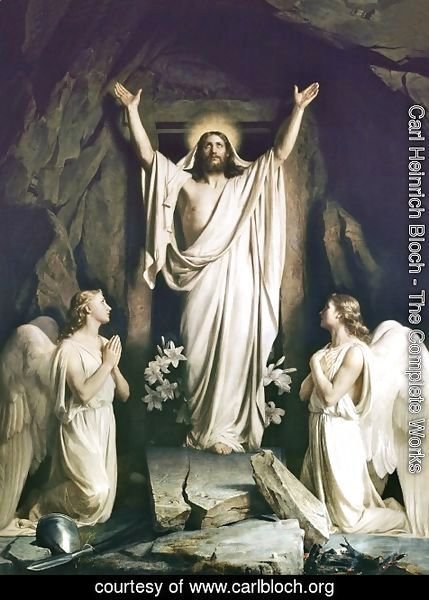
"The Resurrection of Christ" by Bloch
Chambers' Book of Days has an interesting post on the background controversy, and describes this attempt to resolve it:

At the beginning of the fourth century, matters had gone to such a length, that the Emperor Constantine thought it his duty to take steps to allay the controversy, and to insure uniformity of practice for the future. For this purpose, he got a canon passed in the great (Ecumenical Council of Nice (A.D. 325), That everywhere the great feast of Easter should be observed upon one and the same day; and that not the day of the Jewish Passover, but, as had been generally observed, upon the Sunday afterwards.' 

And to prevent all future disputes as to the time, the following rules were also laid down:
'That the twenty-first day of March shall be accounted the vernal equinox.'
'That the full moon happening upon or next after the twenty-first of March, shall be taken for the full moon of Nisan.'
'That the Lord's-day next following that full moon be Easter-day.'
'But if the full moon happen upon a Sunday, Easter-day shall be the Sunday after.'
Of course, it wasn't that easy - the full moon (called the Paschal full moon) is not an astronomical full moon, but the 14th day of a calendar lunar month. Another difference is that the astronomical equinox is a natural astronomical phenomenon, which can fall on March 19th, 20th or 21st, while the ecclesiastical date is fixed by convention on March 21st.

The write-up at Wikipedia is the best I've seen, if you want more particulars on all of this, and the online version of Chamber's Book of Days has some other details.

*Eastern Christianity bases its calculations on the Julian Calendar. Because of the 13-day difference between the calendars between 1900 and 2099, 21 March corresponds, during the 21st century, to 3 April in the Gregorian Calendar. Easter therefore varies between 4 April and 8 May on the Gregorian calendar (the Julian calendar is no longer used as the civil calendar of the countries where Eastern Christian traditions predominate). Also, because the Julian "full moon" is always several days after the astronomical full moon, the eastern Easter is often later, relative to the visible moon's phases, than western Easter.

Among the Oriental Orthodox some churches have changed from the Julian to the Gregorian calendar and the date for Easter as for other fixed and moveable feasts is the same as in the Western church.

Tuesday, September 21, 2021

It's the first day of Fall - autumnal equinox science, videos, poetry, music

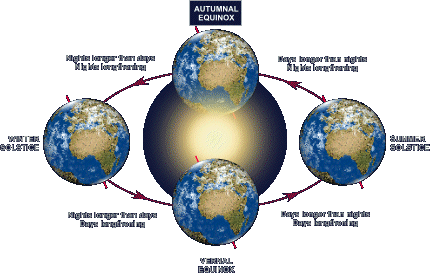
Here on the east coast, this year's autumnal equinox (wiki) occurs on September 22 at 3:20 pm EDT, according to the Old Farmer's Almanac. The equinox is the moment at which the sun appears to cross the celestial equator from north to south - or more simply, the first day of fall, with equal hours of light and darkness. In Latin, the word equinox is composed of two words meaning "equal" and "night."

I seem to remember that when I was a kid, the first day of each new season was always considered to be the 21st (of March for Spring, June for Summer, September for Autumn, and December for Winter). I guess it's more accurate now.

Mechanics of the equinox:


Science of the equinox. More here and here.

More science - why leaves turn different colors.

The 1869 version of Chambers' Book of Days has a post on the equinox (you may need to scroll down), including this interesting comment on the science of equinox-related weather:
As is well known, both the autumnal and vernal equinoxes are distinguished over the world by the storms which prevail at these seasons. The origin of such atmospheric commotions has never yet been very satisfactorily explained, but is sup-posed, as stated by Admiral Fitzroy, to arise from the united tidal action of the sun and moon upon the atmosphere; an action which at the time of the equinoxes is exerted with greater force than at any other period of the year.
Here's a 2 minute Nat Geo video:


No, you can't balance an egg on the equinox.

The falling leaves drift by the window
The autumn leaves of red and gold....
I see your lips, the summer kisses
The sunburned hands, I used to hold
Since you went away, the days grow long
And soon I'll hear ol' winter's song.
But I miss you most of all my darling,
When autumn leaves start to fall.

~Johnny Mercer, Autumn Leaves (see Nat King Cole singing this, below)

Mark Steyn has a long, comprehensive article on Autumn Leaves.

Nat King Cole singing it.


Youth is like spring, an over praised season more remarkable for biting winds than genial breezes. Autumn is the mellower season, and what we lose in flowers we more than gain in fruits.

~ Samuel Butler

Autumn wins you best by this, its mute
Appeal to sympathy for its decay.

~ Robert Browning

Autumn is a second spring where every leaf is a flower.

~ Albert Camus

You expected to be sad in the fall. Part of you died each year when the leaves fell from the trees and their branches were bare against the wind and the cold, wintery light.

~ Hemingway (A Movable Feast)


To be interested in the changing seasons is a happier state of mind than to be hopelessly in love with spring.

~ George Santayana

The teeming Autumn big with rich increase,
Bearing the wanton burden of the prime
Like widowed wombs after their lords' decease.

~ William Shakespeare

It's not generally appreciated that perhaps the best-known of all works of baroque music, Le Quattro Stagioni ("The Four Seasons") (wiki) by Venetian composer Antonio Vivaldi (ca. 1675-1741), was first published with four Italian poems - likely by Vivaldi himself - that describe the several scenarios represented in the music. 

Below is Vivaldi's poem Autumn, and here's a performance of the third movement of "Autumn" in Venice's foggy Piazza San Marco:


Allegro

Celebra il Vilanel con balli e Canti
Del felice raccolto il bel piacere
E del liquor de Bacco accesi tanti
Finiscono col Sonno il lor godere

The peasant celebrates with song and dance,
The harvest safely gathered in.
The cup of Bacchus flows freely,
And many find their relief in deep slumber.

Adagio molto

Fà ch' ogn' uno tralasci e balli e canti
L' aria che temperata dà piacere,
E la Staggion ch' invita tanti e tanti
D' un dolcissimo Sonno al bel godere.

The singing and the dancing die away
As cooling breezes fan the pleasant air,
And the season invites each and all
To a sweet sleep, without a care.

Allegro

I cacciator alla nov'alba à caccia
Con corni, Schioppi, e canni escono fuore
Fugge la belua, e Seguono la traccia;
Già Sbigottita, e lassa al gran rumore
De' Schioppi e canni, ferita minaccia
Languida di fuggir, mà oppressa muore.

The hunters emerge at dawn
With horns, shotguns, and dogs baying.
The quarry flees while they give chase.
Terrified by the dogs and wounded by the guns
The prey struggles on,
But harried, dies.

The two revolutions, I mean the annual revolutions of the declination and of the centre of the Earth, are not completely equal; that is the return of the declination to its original value is slightly ahead of the period of the centre. Hence it necessarily follows that the equinoxes and solstices seem to anticipate their timing, not because the sphere of the fixed stars moves to the east, but rather the equatorial circle moves to the west, being at an angle to the plane of the ecliptic in proportion to the declination of the axis of the terrestrial globe.

~Nicolaus Copernicus

Monday, March 19, 2018

Spring is here! Here's Vivaldi, science, myths, "spring spheres" and more

Spring is here! Some miscellaneous stuff:

Science of the equinox. More here and here (this one is from 2013, so the time is wrong).


This video on the mechanism of the seasons is kinda grade-school level, but for that reason it's simple and complete:


Informative 2 minute NatGeo video:


The Four Seasons - "Spring" - Concerto # 1 in E major, Op. 8, RV 269, played by Itzhak Perlman:


     Allegro
        Giunt' è la Primavera e festosetti                    Here comes the Spring, and festively
        La Salutan gl' Augei con lieto canto,               The birds salute her with a merry song
        E i fonti allo Spirar de' Zeffiretti                      And fountains, to the whispering Zephyrs,
        Con dolce mormorio Scorrono intanto:            With sweet murmurings flow all the while.
        Vengon' coprendo l' aer di nero amanto           Advancing o'er the heavens is a black canopy
        E Lampi, e tuoni ad annuntiarla eletti              With lightning and thunder to announce her.
        Indi tacendo questi, gl' Augelletti;                   Then, when they go silent, the little birds
       Tornan' di nuovo al lor canoro incanto.             Return anew to their cheerful song.
                               
    Largo
       E quindi sul fiorito ameno prato                       And later in the lovely flowering fields
       Al caro mormorio di fronde e piante                 To murmurings of fronds and leaves
       Dorme 'l Caprar col fido can' à lato."                The goatherd sleeps, his faithful dog beside.
                   
    Allegro
       Di pastoral Zampogna al suon festante            To the rustic bagpipe's festive sound
       Danzan Ninfe e Pastor nel tetto amato             Nymphs and shepherds dance
       Di primavera all' apparir brillante.                     'Neath heaven's canopy,
                                                                                 And Spring appears so brilliantly.
                     
                                         - Antonio Vivaldi (1678-1741)
                                           (Le quattro stagioni, "Primavera")* 


Live in each season as it passes; breathe the air, drink the drink, taste the fruit, and resign yourself to the influences of each. Let them be your only diet, drink, and botanical medicines. 

~ Henry David Thoreau (1817-1862) (Journals, entry for 23 August 1853)
  
Today is the vernal equinox, heralding the coming of spring in the Northern Hemisphere. At the vernal equinox, the sun appears to cross the celestial equator from south to north, and for a brief period shines directly on the equator, yielding equal length for day and night in virtually all parts of the world. Although most people my age grew up thinking that spring always began on 21 March, none of the vernal equinoxes for the rest of this century will occur in the Americas after the 20th of the month. American humorist Ogden Nash (wiki) noted in "Like a Rat In a Trap,"

After various guesses at last I've guessed
Why in spring, I feel depressed.
When the robins begin to play
Summer is just a step away.

Then hardly the summer has commenced
When autumn is what you're up against,
And once that autumn has muscled in on you
Winter is waiting to begin on you.

So spring isn't spring, but otherwise,
Just a prelude to winter, which I despise.

The two revolutions, I mean the annual revolutions of the declination and of the centre of the Earth, are not completely equal; that is the return of the declination to its original value is slightly ahead of the period of the centre. Hence it necessarily follows that the equinoxes and solstices seem to anticipate their timing, not because the sphere of the fixed stars moves to the east, but rather the equatorial circle moves to the west, being at an angle to the plane of the ecliptic in proportion to the declination of the axis of the terrestrial globe.


My personal favorite "spring" story:
                                   
Seattle school renames Easter eggs 'Spring Spheres': This is actually from a couple of years ago, but it's still great. On top of all the additional ways in which this is ridiculous, eggs are, of course, not spherical.

Monday, March 20, 2017

Monday links

Spring is here - The vernal equinox is on March 20th at 6:29 a.m. EDT. Here's Vivaldi, science, myths, "spring spheres" and more.


A gallery of vintage armored cars.

ICYMI, Friday's links are here, and include a map of New York’s earliest skyscrapers, dozens of nuclear test videos that have been declassified and uploaded to YouTube, forged art that fooled the Metropolitan Museum for decades, and lots of information on Saint Patrick. 

Monday, March 21, 2016

Monday links

Instructions from 1984: how to send an 'E mail'.

10 Things School Didn’t Tell You About Amelia Earhart’s Disappearance.

Spring is here (although it doesn't feel like it in the DC area): equinox science, myths, and music, and here's Richard Feynman’s Ode to a Flower (and science).

How a Ragtag Gang of Retirees Pulled Off the Biggest Jewel Heist in British History.

Amsterdam’s Floating Sanctuary for Cats.

ICYMI, Friday's links are here, including the Batmobile Parachute Pickup Service van, borderline nations between the US and Canada, and disease-fighting beer.