Amazon Deals

New at Amazon

Monday, January 2, 2017

Monday links

A very Happy New Year to you all!

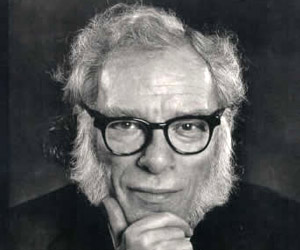
Today is Isaac Asimov's birthday. Here's his 1964 essay predicting life in 2014 and a recently published paper on creativity he wrote in 1959 for DARPA.


Which Actor Has Died The Most On Screen? Surprisingly, it's not Sean Bean.

What is a leap second, anyway?

11 Foot 8 Inches: The Infamous ‘Can Opener’ Bridge.

Here's a Life-Size T-Rex Balloon Animal.

ICYMI, Friday's links are here, and include Dave Barry's 2016 Year In Review, top 2016 science stories, lots of hangover science and cures, a warning from 700 AD on what not to do on New Year's Day, Mark Steyn singing and explaining What Are You Doing New Year's Eve?, and my favorite New Year's resolution story.

Isaac Asimov's birthday

A robot may not injure a human being, or, through inaction, allow a human being to come to harm.
A robot must obey the orders given it by human beings except where such orders would conflict with the First Law.
A robot must protect its own existence as long as such protection does not conflict with the First or Second Laws.
~ Isaac Asimov (wiki), from "Runaround," Amazing Science Fiction, March 1942

There is a cult of ignorance in the United States, and there always has been. The strain of anti-intellectualism has been a constant thread winding its way through our political and cultural life, nurtured by the false notion that democracy means that "my ignorance is just as good as your knowledge." 

~ Asimov ("A Cult of Ignorance," Newsweek, 21 January 1980) 

It has always been my ambition to die in harness with my head face down on a keyboard and my nose caught between two of the keys. 

~ Asimov (in Farewell - Farewell) 

Today is the anniversary* of the birth of Russian-born American writer and scientist, Isaac Asimov (wiki) (1920-1992), particularly known for his works of science fiction and his books on science for non-scientists. Born Isaak Yudovich Ozimov to a family of Jewish millers in Petrovichi, Russia, he emigrated with his family to Brooklyn, New York in 1923 and became a naturalized U.S. citizen in 1928. Azimov later attended Columbia University, eventually earning an MA in chemistry and a Ph.D. in biochemistry in 1948.** Upon completing his doctorate, he taught biochemistry at Boston University and remained affiliated with that institution for most of the rest of his life.

However, Asimov's writing soon became his primary focus and the engine of his growing fame. As a youth, he had discovered an intense interest in pulp science fiction, by 11 was writing his own stories, and at 19 was a regular contributor to various science fiction magazines. Eventually, he published over 300 books on an astounding variety pf topics, including first-rate science fiction novels and stories, such as the Foundation trilogy (1951-53) and I, Robot (if you don't feel like reading it, the Will Smith movie version will give you a good sense of this one), and factual books on science for the layperson, such as The Human Brain (1964) and The Collapsing Universe (1977), He also wrote on humanistic topics such as literature, religion, and history and by the end of his life was perhaps the most famous popular-science writer in the world. 

* N.B. Asimov's actual birth was sometime between 4 October 1919 and the following 2 January, but he always considered the later date to be his birthday:
In Memory Yet Green: The date of my birth, as I celebrate it, was January 2, 1920. It could not have been later than that. It might, however, have been earlier. Allowing for the uncertainties of the times, of the lack of records, of the Jewish and Julian calendars, it might have been as early as October 4, 1919. There is, however, no way of finding out. My parents were always uncertain and it really doesn't matter. I celebrate January 2, 1920, so let it be.
** Asimov's studies were interrupted for three years by World War II, when he worked as a civilian in the Philadelphia Navy Yard and then spent nine months in the Army. 

Related posts and links:

In 1959 Issac Asimov wrote a paper for DARPA on creativity. It was just published recently.


Saturday, December 31, 2016

What's A Leap Second?

Screenshot of the UTC clock from www.time.gov during
 the leap second on December 31, 2016.
Every now and then a leap second is added to Coordinated Universal Time (UTC) in order to synchronize clocks worldwide with the Earth's ever slowing rotation.

Atomic Time vs. Universal Time - two components are used to determine Coordinated Universal Time (UTC):

International Atomic Time (TAI): A time scale that combines the output of some 200 highly precise atomic clocks worldwide, and provides the exact speed for our clocks to tick.

Universal Time (UT1), also known as Astronomical Time, refers to the Earth's rotation around its own axis, which determines the length of a day.

Here're some excerpts from WhatIf's excellent explanation - go there and read the whole thing:
Half a billion years ago (when the Earth was 4 billion years old, instead of 4.5), each day was 22 hours long instead of 24. The day has gotten longer because of tidal forces from the Moon.
Loosely speaking, here’s how tidal drag works: The Moon’s tides raise bulges in the Earth, but the Earth’s rotation moves those bulges out of line with the Moon. The Moon’s gravity tries to tug the bulges back into line, which exerts a twisting force on the Earth, slowing it down.
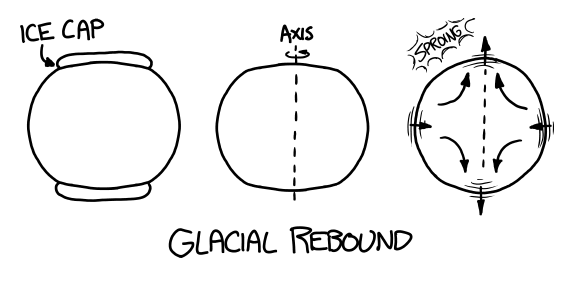
Strangely, the Earth is actually not slowing down as much as you’d expect from tidal drag. The biggest reason for the discrepancy is that during the last ice age, the continents were pushed down by the weight of the glaciers, and they’re still springing back into place. This has the effect of shifting mass toward the poles, closer to the axis of rotation: 
At the moment, each day is about 0.8 milliseconds longer than the 86,400 seconds it needs to be to avoid adding leap seconds.
This difference fluctuates over time based on weather and other effects (it’s actually shortened a bit since the early 1990s), although in the long run, it will definitely get larger as the Earth slows.
If we wanted to get rid of leap seconds, we’d need to keep the Earth spinning at a more constant rate. This means speeding up the Earth and shortening each day by about 0.8 milliseconds. 

This is a tough problem. Here are a few things that won’t work:

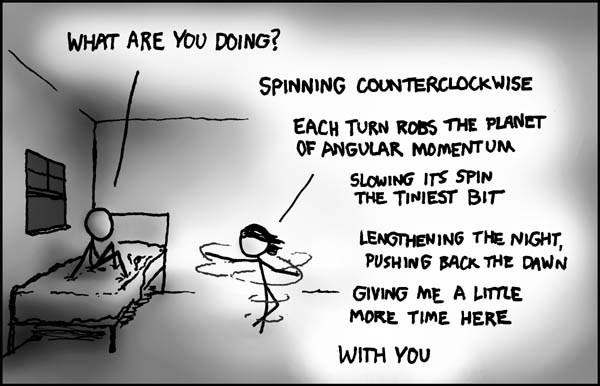
Spinning counterclockwise in a chair. It temporarily alters the Earth’s rate of rotation, but not enough to matter.

Putting rocket engines on the Equator. This won’t work because the exhaust would go into the atmosphere, which transmits the force back to the ground as wind drag—it’d be like making a bike go forward by pushing on the handlebars. If the engines were somehow mounted above the atmosphere, they’d be able to slow the Earth, but not by enough to accomplish our goal.

Triggering big earthquakes. This can alter the length of the day, but even those aren’t big enough to make a difference.

In the end, there’s only one solution: Hitting the Earth with asteroids.
More science, from TimeandDate.com:
A normal day has 86,400 seconds, but in the atomic time scale 1 second is not defined as one 86,400th of the time it takes Earth to rotate around its axis but rather as the time it takes a Cesium-133 atom at the ground state to oscillate precisely 9,192,631,770 times.

The advantage of this definition is that it is extremely precise: atomic clocks deviate only 1 second in up to 100 million years. On the other hand, the Earth's rotation, which is expressed by the time standard UT1, is far less reliable. It slows down over time, which means that days get longer. On average, an Earth day is about 0.002 seconds longer than the daily sum of the 86,400 seconds measured by the atomic clocks. This makes for a discrepancy between TAI and UT1 of around 1 second every 1.5 years.
Leap seconds are added to our clocks (UTC) so this discrepancy does not get too large over time and the time we use is synchronized as much as possible with the Earth's rotation.
When the difference between UTC and UT1 approaches 0.9 seconds, a leap second is added to UTC and to clocks worldwide. By adding an additional second to the time count, our clocks are effectively stopped for that second to give Earth the opportunity to catch up with atomic time.

More at TimeandDate and WhatIf.

Friday, December 30, 2016

New Year's links

Advice from 1862: How to Tell Your Fortune for the New Year.

List of lists: the lists of top 2016 science stories from 24 different sources.

Dave Barry's 2016 Year In Review. Previous such columns are available here.

How (Not) to Celebrate the New Year: Advice from 700 AD (or thereabouts).

Strange New Year traditions around the world.

Some links to avoid becoming philogrobolized:
Your Complete Guide to the Science of Hangovers.
Infographic on the Anatomy of a Hangover.
Hangover Cures From Famous Heavy Drinkers.
5 Really Strange Ways to Cure a Hangover.
Scientists Find a Way to Cut Wine Hangovers.
Dark Liquor Makes For Worse Hangovers.
How to Cure a Hangover.
According to a study in the Journal of Food Science, the amino acids and minerals found in asparagus extract may alleviate alcohol hangover and protect liver cells against toxins.

Why We Sing Auld Lang Syne on New Year’s Eve, and here's Mark Steyn singing and explaining What Are You Doing New Year's Eve?

Eat your heart out, New York: Boise, Idaho drops a giant potato downtown on New Year's Eve.

Sunday, December 25, 2016

Merry Christmas!

Nativity, Gerard van Honthorst, 1622
For unto Us a Child is born
Unto Us a Son is given
And the government shall be upon His shoulder
And His name shall be called Wonderful, Counsellor,
The mighty God, The everlasting Father, The Prince of Peace.


May your Christmas be filled with joy.