ICYMI, most recent links are here, and include awkward fashion ads from the 1970s, when George Soros broke the British pound, why pigeons bob their heads, and the Swiss town where residents spent a lifetime aging a wheel of cheese for their own funeral.
Remember, remember the Fifth of November,
Gunpowder Treason and Plot,
I know of no reason
Why Gunpowder Treason
Should ever be forgot.
Guy Fawkes, Guy Fawkes, t'was his intent
To blow up the King and Parliament.
Three-score barrels of gunpowder below
To prove old England's overthrow;
By God's providence he was catch'd
With a dark lantern and burning match.
Holloa boys, holloa boys, let the bells ring.
Holloa boys, holloa boys, God save the King!
~ Traditional English children's rhyme for Guy Fawkes Day*
O God, whose name is excellent in all the earth, and thy glory above the heavens; who on this day didst miraculously preserve our Church and State from the secret contrivance and hellish malice of Popish Conspirators; and on this day also didst begin to give us a mighty deliverance from the open tyranny and oppression of the same cruel and blood-thirsty enemies...
~ The Book of Common Prayer (1771 Cambridge version) (opening passage of "A Form of Prayer and Thanksgiving, to be used yearly upon the fifth day of November; for the happy Deliverance of King JAMES I, and the Three Estates of England, from the most traitorous and bloody intended Massacre by Gunpowder..." This section, added in 1662, was removed only in 1859.)
November 5th is Guy Fawkes Day (wiki) in England, an unofficial holiday commemorating the failure of the so-called "Gunpowder Plot" on this date in 1605. A conspiracy of disgruntled English Catholics under the leadership of one Robert Catesby had succeeded in planting a large quantity of gunpowder in the cellar of the House of Lords with the intention of blowing up Parliament on its opening day, when King James I would have been present.
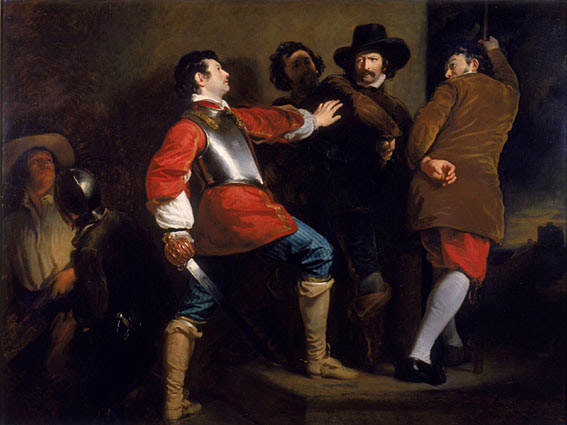
After one of the plotters warned a relative to stay away from Parliament that day, the scheme was discovered, and one of the key conspirators, Guy Fawkes, was essentially caught in the act.
'The Discovery of the Gunpowder Plot and the Taking of Guy Fawkes' by Henry Perronet Briggs, circa 1823
All the plotters were apprehended and executed savagely, but the Gunpowder Plot had the unfortunate effect of perpetuating a deep distrust of "popery" and Roman Catholicism in England for centuries. (Catholics were barred from serving in Parliament for 224 years.) Today, the occasion is celebrated with bonfires, fireworks, and the construction of effigies of Guy Fawkes, carried about by bands of children begging "a penny for the Guy" from all they encounter.**
* N.B. An additional verse, rather scurrilous, and thus less often sung, goes:
** Curiously, Guy Fawkes Day - called "Pope Day" - was the only English holiday permitted in Puritan New England, and effigies of Fawkes, the pope, and the devil were carried in procession, burned, and dismembered. Because of the violence it provoked, the custom was forbidden by the Massachusetts Legislature in 1752. After George Washington publicly denounced the holiday as offensive to Canadian Catholic allies, the tradition died altogether in the Americas, while the effigy of Fawkes became the main one burned in England.
At History Today, this article has a comprehensive description of the events, and this one looks at the tradition of cartoons and caricatures inspired by the Gunpowder Plot: Drawing on History: The Gunpowder Plot.
The traditional Guy Fawkes mask was intended to resemble him:
The 2006 movie V for Vendetta, based on the comic book series written by Alan Moore and illustrated by David Lloyd, popularized a stylized Guy Fawkes mask. In the movie, V is a freedom fighter attempting to start a revolution against the fascist regime. The mask has since become associated with the group Anonymous.
BBC Video - The Gunpowder Plot: The Conspirators:
BBC Video - The Gunpowder Plot: Treason & Torture:
My favorite DST story - this guy got two DUIs an hour apart at the same time:
The end of daylight saving time caused a unique situation in Urbana on Sunday morning. Police there arrested a man twice in one day, but at the same exact time.
Chief Matt Lingrell explained that Niles Gammons of Urbana was arrested for operating a vehicle while intoxicated at 1:08 a.m., then released with a summons to appear in court this week. An hour later, it was again 1:08 a.m. and police caught Gammons driving under the influence once again.
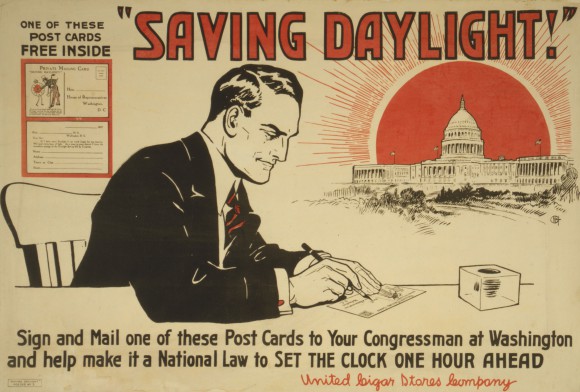
Can we please slow down and get something straight? There is simply no way to “save daylight.” People can spin the hands of their clocks like roulette wheels, but come Monday here in Washington, D.C., we’re still going to have sunshine for about 12 hours and 45 minutes. The sun can rise at a time of day we call dawn or Howdy Doody Time or whatever–but the stubborn facts of astronomy are at work here and they can’t be wished away.
The reason we have Daylight Saving Time (DST), of course, is because the politicians have mandated it. Washington is much better at wasting things than saving them, but federal lawmakers nevertheless spent much of the 20th century insisting, with typical modesty, that they could “save daylight.”
I recently wondered exactly why we observe Daylight Saving Time (DST). For some reason, I had harbored a vague notion that it had to do with farmers.
Well, it turns out that DST had nothing to do with farmers, who traditionally haven’t cared much for it. They care a lot less nowadays, but when the first DST law was making its way through Congress, farmers actually lobbied against it.
Dairy farmers were especially upset because their cows refused to accept humanity’s tinkering with the hands of time. The obstinate cud-chewers wanted to be milked every twelve hours, and had absolutely no interest in resetting their biological clocks–even if the local creameries suddenly wanted their milk an hour earlier.
As Michael Downing points out in his book, Spring Forward: The Annual Madness of Daylight Saving Time, urban businessmen were a major force behind the adoption of DST in the United States. They thought daylight would encourage workers to go shopping on their way home. They also tried to make a case for agriculture, though they didn’t bother to consult any actual farmers. One pamphlet argued that DST would benefit the men and women who worked the land because “most farm products are better when gathered with dew on. They are firmer, crisper, than if the sun has dried the dew off.” At least that was the claim of the Boston Chamber of Commerce, chaired by department-store magnate A. Lincoln Filene. This was utter nonsense. A lot of crops couldn’t be harvested until the morning dew had evaporated. What’s more, morning dew has no effect whatsoever on firmness or crispness.
Perhaps farmers should take one for the team–i.e., put up with DST even though they don’t like it because it keeps city cash registers chinging into the twilight. Yet the contention that DST is good for business is doubtful. It may help some businesses, but it also stands to reason that other ones suffer. If people are more likely to browse the racks at Filene’s Basement in the daylight, then they’re probably also less likely to go to the movies or take-out restaurants. And in the morning, when it’s darker during rush hour, commuters are perhaps disinclined to stop at the corner store for a newspaper or the coffee bar for a latte. Although it’s impossible to know the precise economic effects of DST, any attempt to calculate them carries the malodorous whiff of industrial policy.
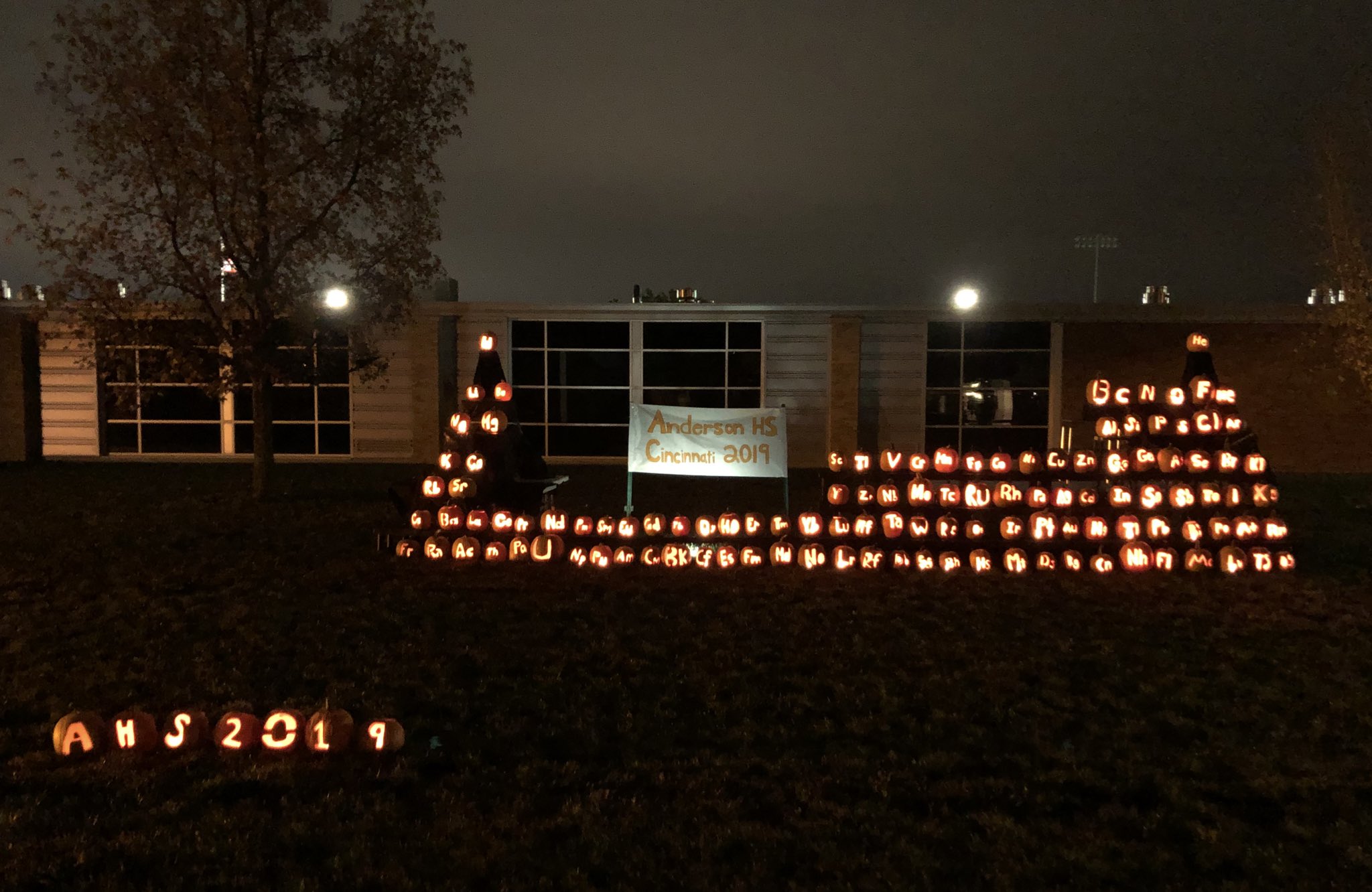
Apparently Anderson High School in Cincinnati has done one of these each year for the last several years. This story is from last year's version, but the picture (click here to embiggen) is this year's.
ICYMI, most recent links are here, and include the physics of juggling, scientists investigating the secrets of smelly cat butts, a 1918 prostate warmer to restore your manly vigor (or radium suppositories if that doesn't work), and the history of toilet paper.