Amazon Deals

New at Amazon

Showing posts with label time. Show all posts

Saturday, November 2, 2019

Daylight Saving Time: Here's DST history (including Ben Franklin's proposal), stories and video

My favorite DST story - this guy got two DUIs an hour apart at the same time:
The end of daylight saving time caused a unique situation in Urbana on Sunday morning. Police there arrested a man twice in one day, but at the same exact time.
Chief Matt Lingrell explained that Niles Gammons of Urbana was arrested for operating a vehicle while intoxicated at 1:08 a.m., then released with a summons to appear in court this week. An hour later, it was again 1:08 a.m. and police caught Gammons driving under the influence once again.
Also:

Here are excerpts from John Miller's classic rant:
Can we please slow down and get something straight? There is simply no way to “save daylight.” People can spin the hands of their clocks like roulette wheels, but come Monday here in Washington, D.C., we’re still going to have sunshine for about 12 hours and 45 minutes. The sun can rise at a time of day we call dawn or Howdy Doody Time or whatever–but the stubborn facts of astronomy are at work here and they can’t be wished away.
The reason we have Daylight Saving Time (DST), of course, is because the politicians have mandated it. Washington is much better at wasting things than saving them, but federal lawmakers nevertheless spent much of the 20th century insisting, with typical modesty, that they could “save daylight.” 
I recently wondered exactly why we observe Daylight Saving Time (DST). For some reason, I had harbored a vague notion that it had to do with farmers.
Well, it turns out that DST had nothing to do with farmers, who traditionally haven’t cared much for it. They care a lot less nowadays, but when the first DST law was making its way through Congress, farmers actually lobbied against it.
Dairy farmers were especially upset because their cows refused to accept humanity’s tinkering with the hands of time. The obstinate cud-chewers wanted to be milked every twelve hours, and had absolutely no interest in resetting their biological clocks–even if the local creameries suddenly wanted their milk an hour earlier.
As Michael Downing points out in his book, Spring Forward: The Annual Madness of Daylight Saving Time, urban businessmen were a major force behind the adoption of DST in the United States. They thought daylight would encourage workers to go shopping on their way home. They also tried to make a case for agriculture, though they didn’t bother to consult any actual farmers. One pamphlet argued that DST would benefit the men and women who worked the land because “most farm products are better when gathered with dew on. They are firmer, crisper, than if the sun has dried the dew off.” At least that was the claim of the Boston Chamber of Commerce, chaired by department-store magnate A. Lincoln Filene. This was utter nonsense. A lot of crops couldn’t be harvested until the morning dew had evaporated. What’s more, morning dew has no effect whatsoever on firmness or crispness.
Perhaps farmers should take one for the team–i.e., put up with DST even though they don’t like it because it keeps city cash registers chinging into the twilight. Yet the contention that DST is good for business is doubtful. It may help some businesses, but it also stands to reason that other ones suffer. If people are more likely to browse the racks at Filene’s Basement in the daylight, then they’re probably also less likely to go to the movies or take-out restaurants. And in the morning, when it’s darker during rush hour, commuters are perhaps disinclined to stop at the corner store for a newspaper or the coffee bar for a latte. Although it’s impossible to know the precise economic effects of DST, any attempt to calculate them carries the malodorous whiff of industrial policy.
Read the whole thing.
Here's a recording of an anti-DST song from 1909 entitled We Don't Want More Daylight.

Some general information about the history of and rationale for DST.

Video: The history and effects of DST:


Daylight Saving -The Movie (because twice a year, there comes a time when... time doesn't come):


Ben Franklin’s satirical proposal of something like daylight saving time is an excellent read.

That time an Irish bomber accidentally blows himself up because he forgot about Daylight Saving Time.

Thursday, November 1, 2018

Ben Franklin’s satirical proposal of something like daylight saving time

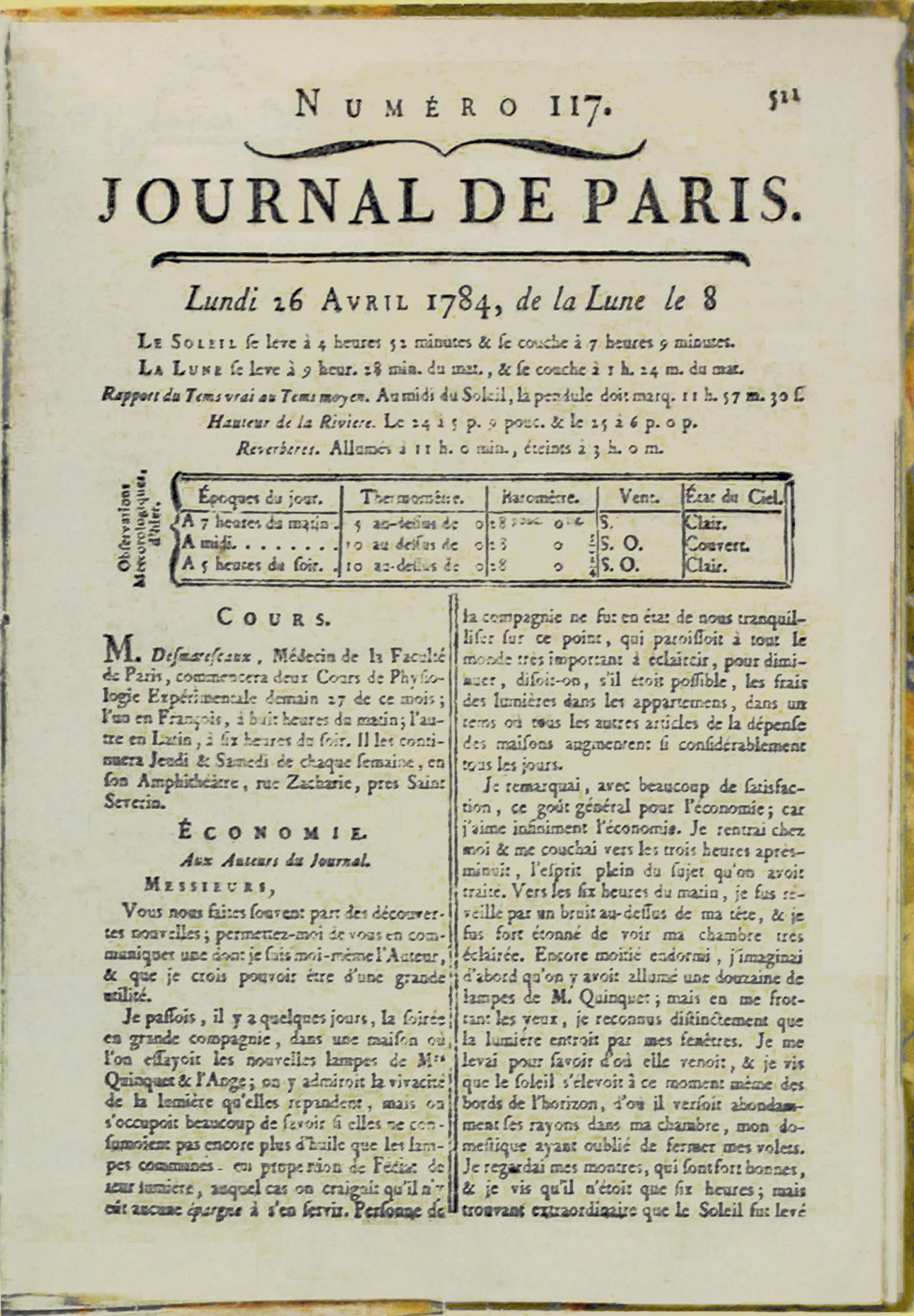
In a comedic letter he wrote, An Economical Project (published in 1784), ”to the authors of the journal of Paris”, Ben Franklin (wiki) mentions something like daylight saving time; instead of changing clocks, though, he suggested ringing church bells and firing cannons, among other things, as the sun rises to maximize the amount of time people would be awake during times when the sun is providing free light. The letter was meant to be a satire, rather than actually suggesting these changes be made.

Here’s an excerpt of the letter:
You often entertain us with accounts of new discoveries. Permit me to communicate to the public, through your paper, one that has lately been made by myself, and which I conceive may be of great utility.
I was the other evening in a grand company, where the new lamp of Messrs. Quinquet and Lange was introduced, and much admired for its splendor; but a general inquiry was made, whether the oil it consumed was not in proportion to the light it afforded, in which case there would be no savoring in the use of it. No one present could satisfy us in that point, which all agreed ought to be known, it being a very desirable thing to lessen, if possible, the expense of lighting our apartments, when every other article of family expense was so much augmented… 
Zoomable version at Wikipedia.
I went home, and to bed, three or four hours after midnight, with my head full of the subject. An accidental sudden noise waked me about six in the morning, when I was surprised to find my room filled with light; and I imagined at first, that a number of those lamps had been brought into it; but, rubbing my eyes, I perceived the light came in at the windows. I got up and looked out to see what might be the occasion of it, when I saw the sun just rising above the horizon, from whence he poured his rays plentifully into my chamber, my domestic having negligently omitted, the preceding evening, to close the shutters.
I looked at my watch, which goes very well, and found that it was but six o’clock; and still thinking it something extraordinary that the sun should rise so early, I looked into the almanac, where I found it to be the hour given for his rising on that day. I looked forward, too, and found he was to rise still earlier every day till towards the end of June; and that at no time in the year he retarded his rising so long as till eight o’clock. Your readers, who with me have never seen any signs of sunshine before noon, and seldom regard the astronomical part of the almanac, will be as much astonished as I was, when they hear of his rising so early; and especially when I assure them that he gives light as soon as he rises. I am convinced of this…
Yet it so happens, that when I speak of this discovery to others, I can easily perceive by their countenances, though they forbear expressing it in words, that they do not quite believe me. One, indeed, who is a learned natural philosopher, has assured me that I must certainly be mistaken as to the circumstances of the light coming into my room; for it being well known, as he says, that there could be no light abroad at that hour, it follows that none could enter from without; and that of consequence, my windows being accidentally left open, instead of letting in the light, had only served to let out the darkness…
This event has given rise in my mind to several serious and important reflections. I considered that, if I had not been awakened so early in the morning, I should have slept six hours longer by the light of the sun, and in exchange have lived six hours the following night by candle-light; and, the latter being a much more expensive light than the former, my love of economy induced me to muster up what little arithmetic I was master of, and to make some calculations, which I shall give you, after observing that utility is, in my opinion the test of value in matters of invention, and that a discovery which can be applied to no use, or is not good for something, is good for nothing… [From The Writings of Ben Franklin: An Economic Project]
Much more at the always-interesting Today I Found Out* including this:

Although it’s quite clear he’s joking around in this letter, Franklin was known for putting more subtle jokes in many of his other papers that only the most astute would spot. He was so famous for this that, according to Ormand Seavey, editor of Oxford’s edition of Ben Franklin’s autobiography, when they were deciding who should write the Declaration of Independence, they partially chose Jefferson over the significantly more qualified and respected Franklin, as some feared Franklin would embed subtle humor and satire in it that wouldn’t be recognized until it was too late to change. Knowing this document would likely be examined closely by the nations of the world at that time, they chose to avoid the issue by having the much less gifted writer, Jefferson, write it instead, with Franklin and three others to help Jefferson draft it.

Previous posts:

January 17 is Ben Franklin's birthday - bio, quotes, videos, his 200 synonyms for drunk, the bodies found in his basement, and more.


Much more on Daylight Saving Time

* By the way, of you're starting to think about Christmas presents, I highly recommend Today I Found Out's book - I've given out several and they're consistently a big hit. 

Friday, October 31, 2014

Friday links

Daylight Saving Time ends this weekend: some DST history (including Ben Franklin's proposal), stories and video, including my personal favorite time change story - the guy who got two DUI tickets, each at 1:08 AM, but an hour apart.

For $100,000, You Can Clone Your Dog.

2014 National Geographic Photo Contest Contenders, Part 1 and Part 2. If you want to participate, by the way, the deadline for submissions is today (October 31).


Know how many kids have been poisoned by Halloween candy? Zero. Ever.


ICYMI, Tuesday's links are here, and are entirely Halloween related: why witches fly broomsticks, costume ideas from the 1880's, scary makeup, pumpkin carving tricks, and the Sexy Ebola Containment Suit costume (plus resources for intelligent costumes). Also, Dave Barry's Halloween column from 1996: Night Of The Living Chocolate.