Amazon Deals

New at Amazon

Showing posts with label art. Show all posts

Saturday, March 27, 2021

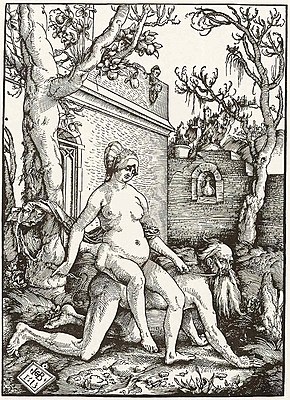
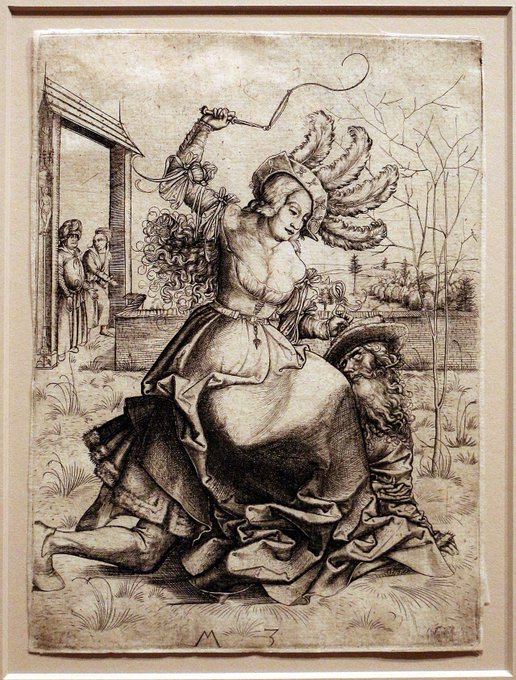
That Time a Woman Named Phyllis Rode Aristotle Around Like a Horse

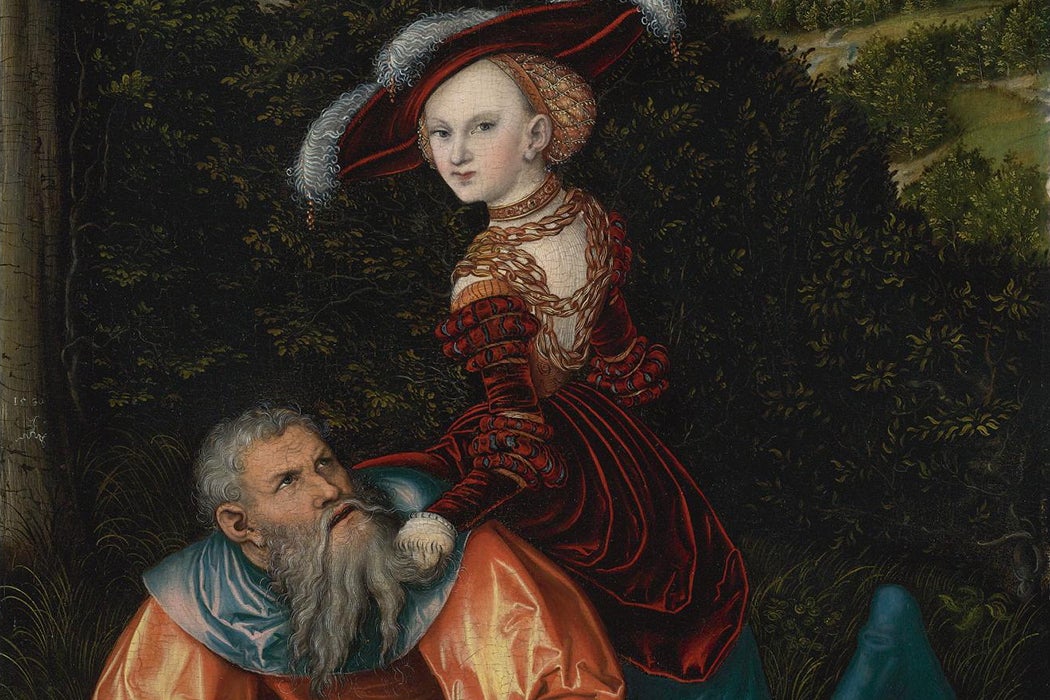
You learn something new every day, if you aren't careful. I was not aware of the Medieval trend of depicting Aristotle being ridden and whipped by a dominatrix named Phyllis. From JSTOR - go there to read the whole thing. More links below.

Alexander the Great (wiki), Aristotle’s (wiki) pupil, fell in love with a young woman named Phyllis. Aristotle, concerned that Phyllis was distracting Alexander from his kingly duties, cautioned him and advised him to spend less time with his love. Hurt, Phyllis decided to take her revenge. The next morning, she told Alexander to look out for her from the palace roof. She let down her hair, hiked up her skirts, and ran barefoot through the morning dew in the garden outside the window of Aristotle’s study. The philosopher looked up from his books to see a vision of beauty. Enchanted, he called her to him and begged her to be his.
“Certainly—on one condition,” Phyllis told the philosopher, and demanded that he put on saddle and bridle and give her a ride through the garden. Alexander, up on the battlements, was shocked to see his dignified old tutor with a bit in his mouth, while Phyllis brandished a whip over his back.

So, apparently there's a whole slew of art from over the last few hundred years depicting this story - I've picked a few favorites, but you can find more here. The first image below is not the clearest, but it's Leonardo DaVinci, for goodness sake.


Many more images at Google images.

More about this legend at the JSTOR article, and

http://dhayton.haverford.edu/blog/2016/02/19 (including a thorough retelling, changes through history, and a partial Latin translation of the story)


Friday, May 24, 2019

Friday links

Fans of Hitchhiker's Guide to the Galaxy: don't panic - May 25th is Towel Day!

Napoleon’s Looted Art: he and his troops pillaged art on a vast scale. What did they take and what happened to it?


The Tactical Order of Dressing: An Illustrated Guide (as taught to military and emergency personnel). Related: Because it's important to always be battle-ready: How to Poop Like a Samurai.


ICYMI, most recent links are here, and include turning everyday items into improvised weapons, treating depression by smoking psychedelic toad milk, and why car keys stopped working in one small Ohio town.

Saturday, May 11, 2019

May 12 is the birthday of Victorian poet and artist Dante Gabriel Rossetti

One of many self-portraits
The blessed damozel leaned out
From the gold bar of Heaven;
Her eyes were deeper than the depth
Of waters stilled at even;
She had three lilies in her hand,
And the stars in her hair were seven.
 
~ Dante Gabriel Rossetti ("The Blessed Damozel," st. 1) 
 
If you paint as well as you write you may be a rich man, or at all events, if you do not wish to be rich, may get leisure enough to cultivate your writing.  But I need hardly tell you that poetry, even the best... is not a thing for a man to live upon while he is in the flesh, however immortal it may render him in spirit. 
 
~ Leigh Hunt (1784-1859) (letter to Rossetti, March 1848) 

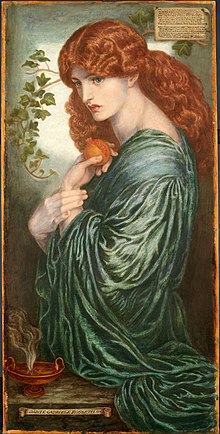
He produced several versions of Proserpine (wiki) (sometimes Proserpina), the Roman goddess who lives in the underworld during Winter, using Jane Morris* (wife of his friend and fellow pre-Raphaelite William Morris) as model. On the top right his sonnet, in Italian, is inscribed by the artist - the same sonnet in English is inscribed on the frame (see below).
 
The final of several iterations of Proserpine, the Roman
 goddess who lives in the underworld during Winter,
with Jane Morris as model.
Per Rossetti, on Perserpine: 

"She is represented in a gloomy corridor of her palace, with the fatal fruit in her hand. As she passes, a gleam strikes on the wall behind her from some inlet suddenly opened, and admitting for a moment the sight of the upper world; and she glances furtively towards it, immersed in thought."

The sonnet:

Afar away the light that brings cold cheer
Unto this wall, – one instant and no more
Admitted at my distant palace-door
Afar the flowers of Enna from this drear
Dire fruit, which, tasted once, must thrall me here.

Afar those skies from this Tartarean grey
That chills me: and afar how far away,
The nights that shall become the days that were.
Afar from mine own self I seem, and wing
Strange ways in thought, and listen for a sign:
And still some heart unto some soul doth pine,
(Whose sounds mine inner sense in fain to bring,
Continually together murmuring) —
'Woe me for thee, unhappy Proserpine'.

~ D. G. Rossetti

* Rossetti stayed with his lover Jane Morris, wife of William Morris, at Kelmscott Manor during the summer months each year - in winter she returned to stay with William Morris, thus paralleling, at least from Rosetti's point of view, Proserpine's freedom during summer.
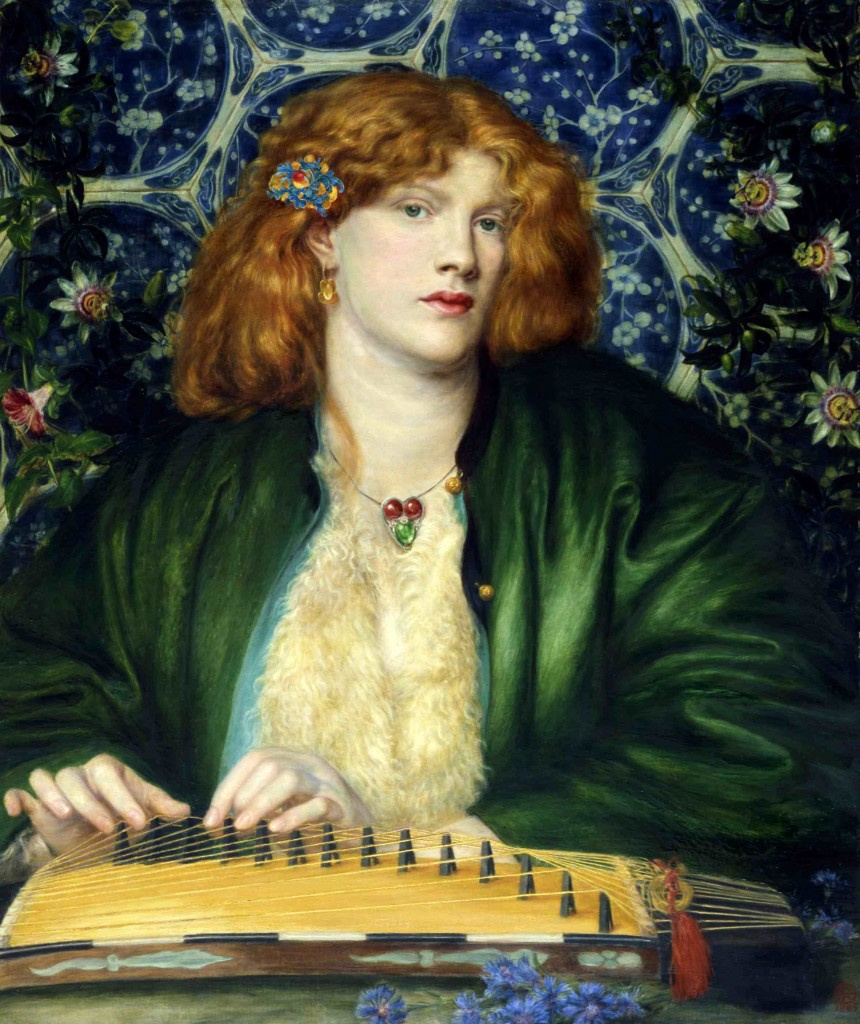
  
Blue Gazebo - larger version here. Note the medieval millefleur
("thousand flowers") style background - characteristic of the pre-
Raphaelites in general, although less so of Rossetti in particular.
May 12 is the anniversary of the birth of English poet and pre-Raphaelite painter Dante Gabriel Rossetti (wiki) (1828-1882).  Born in London, Rossetti founded the "Pre-Raphaelite Brotherhood" (wiki) in 1848 with Holman Hunt, John Millais, and others to protest low standards in British art - the Pre-Raphaelite movement sought to revitalize British art by returning to the spiritual qualities of medieval painting, with an emphasis on detailed observation of the natural world and the use of pictorial narrative to convey "truth". Some of his best paintings were done under the patronage of John Ruskin and the influence of William Morris and Edward Burne-Jones, all of whom Rossetti befriended early in his life.  

In both his paintings and his poetry (such as "The Blessed Damozel"), Rossetti presented idealized portrayals of womanhood. He was also a prolific translator of early Italian verse from Dante's circle - leading Ruskin to describe him as "a great Italian lost in the inferno of London."

Here's an archive of his art works and one of his poetry.

I'm a huge fan of pre-Raphaelite art, and, back in the 70s when I was into fantasy, I read everything William Morris ever wrote. About them as a group, though, and their weird interactions - I've run into a little bit as part of other articles, but every time I run into more I realize, once again, how weird they were. Here's a bit on insight into that:

On Dante Gabriel Rossetti and wombats. (London Review of Books) (There is a book on this, by the way: Rossetti's Wombat: Pre-Raphaelites and Australian Animals in Victorian London, in case you're interested. I'm not that interested.): an excerpt from the article is is below, but read the whole thing.
He had two, one named Top after William Morris, whose nickname ‘Topsy’ came from his head of tight curls. In September 1869, Rossetti wrote in a letter that the wombat had successfully interrupted a seemingly uninterruptable monologue by John Ruskin by burrowing its nose between the critic’s waistcoat and jacket. Rossetti drew the wombats repeatedly; he sketched his mistress – William Morris’s wife, Jane – walking one on a leash. In the image, both Jane and the wombat look irate. Both wear halos.

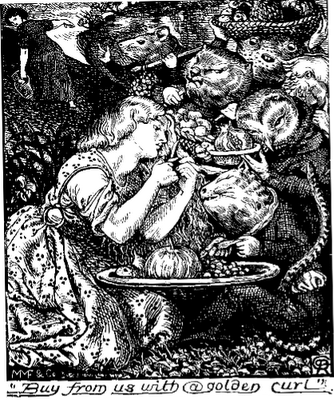
Rossetti's sister, Christina Rossetti (wiki) (1830-1894), who lived much of her life as a virtual recluse, is also remembered as a major Victorian lyric poet. Here's one of the illustrations he did for her poem "The Goblin Market" (wiki) (full poem online) - note all of the wombats:

Parts of the text above are adapted from Ed's Quotation of the Day, only available via email - leave your email address in the comments if you'd like to be added to his list. Ed is the author of Hunters and Killers: Volume 1: Anti-Submarine Warfare from 1776 to 1943 and Hunters and Killers: Volume 2: Anti-Submarine Warfare from 1943.

Thursday, March 14, 2019

Thursday links


This Italian Farmer is Returning Chickens to the Wild.

Seven videos on making medieval manuscripts.

Albert Einstein was born on March 14, 1879: here's a short bio, video, and the strange post-mortem travels of his brain. Related: Einstein's forgotten inventions.

To Conceive a Girl in Ancient Greece, Eat a Salad and Tie Your Right Testicle.

The Secrets of the World's Greatest Art Thief.

ICYMI, most recent links are here, and include Daylight Saving Time history, Washington DC in the 1820s, Chuck Norris' 79th birthday, and the island that was traded for Manhattan.

Monday, May 28, 2018

Monday links


They shall grow not old, as we that are left grow old:
Age shall not weary them, nor the years condemn.
At the going down of the sun and in the morning
We will remember them.


Inside JFK’s door-to-door search for a French call girl — and why she had to look like Jackie.

NASA's Atomic Fridge Will Make the ISS the Coldest Known Place in the Universe.

The evolution of "Beauty and the Beast."

ICYMI, Friday's links are here, and include how to ship a whale via UPS, why you wouldn't want to drink 19th century milk unless you knew it came straight from the cow., and, for fans of Hitchhiker's Guide to the Galaxy, all about Towel Day.

Monday, April 16, 2018

Monday links

How To Dress For Success And To Get A Man: A 1967 Guide. Related, "Women are teachable": 1940's booklet to “assist male bosses in supervising their new female employees"

Spring cleaning, 19th century style.

FBI recovers stolen Chagall 30 years after theft.


Predictions for the Year 2018 From the 20th Century

Shoplifter uses Play-Doh to cover up security camera lens, leaves perfectly pressed fingerprint behind.

ICYMI, Friday's links are here, and include tax-related stuff (history, cartoons, links, Dave Barry, Sci Fi tax revolts, the tax implications of the zombie apocalypse, and the 1967 cartoon version of The Beatles "Taxman"), and the anniversaries of Lincoln's assassination and the sinking of the Titanic (with eyewitness accounts of each).

Monday, April 9, 2018

Monday links

Infographic: The Flowchart of Medieval Penitent Sexual Decision-Making.

We missed Dog Farting Awareness Day yesterday, but Scientific American's article on the science of dog farts is still worthwhile.

When Does Work Actually Get Done? Work gets done at 11AM on a Monday in October. At all other times of day, we're basically slacking.


ICYMI, the most recent links are here, and are all April Fool's Day related.

Monday, January 22, 2018

Monday links

Animated map of the changing borders and population of Europe: every year since 400 BC.

Why all the actors from Hollywood’s Golden Age have such a distinct and strange accent.


Wave tank demonstration showing the impact of coastal defenses on flood risk.


Big Brother on wheels: Why your car company may know more about you than your spouse.

ICYMI, Friday's links are here, and include weird vintage beauty hacks, the birthdays of Buffy the Vampire Slayer and Stonewall Jackson (including the story of his left arm's separate grave), how apple pie became "American", and the anniversary of  French King Louis XVI's guillotining.

Monday, January 15, 2018

The Ultimate Paper Airplane

This isn't of the kind of paper airplane you fold from a sheet of notebook paper and throw across the room. It's a paper sculpture of a Boeing 777 and Luca Iaconi-Stewart has been building it for years, all from paper. He's recreating all the details of the real 777, including the passenger seats, wind struts, retractable landing gear, and hinged doors.


via Wired

Wednesday, June 14, 2017

Wednesday links

June 14 is Flag Day and the birthday of the U.S. Army.

How 'OK' took over the world.

How lemons gave rise to organized crime in Sicily.

Famous Works Of Art Recreated Using Marvel Action Figures.

A New Map Reveals Ships Buried Below San Francisco.

Most Embarrassing Landmark From Every State.

ICYMI, Monday's links are here, and include Anne Frank's birthday, technologies that replace super powers, the finalists for Shed of the Year 2017, and a selection of Adam West's Batman fight scenes.

Friday, June 9, 2017

Famous Works Of Art Recreated Using Marvel Action Figures

Some impressive photography:

The Creation of Adam, Michelangelo (Sistine Chapel, Vatican City), 1508–1512

Vitruvian Man, Leonardo Da Vinci 1490, Italy

The Discobolus of Myron (Circa 460-450 B.C.)

The Last Supper, Leonardo Da Vinci, Circa 1495-1497

Perseus with the Head of Medusa, Benvenuto Cellini, 1545

The Thinker (Le Penseur), Auguste Rodin, 1880

Pietà, Michelangelo (Basilica di San Pietro, Vaticano), 1498-1499

Wednesday, May 24, 2017

Classic Pin-Up Girls Before and After Editing: The Real Women Behind Gil Elvgren's Paintings

Before Photoshop, artist Gil Elvgren (wiki) relied on the technique of painting from a photograph of a model instead of from the live model. His classic pin-up pictures of curvy-girl-next-door types with their skirts billowing adorned the noses of bombers and the walls of soldiers barracks in the 1940s and '50s. In addition to dozens of calendars, he illustrated stories for a host of magazines (such as The Saturday Evening Post and Good Housekeeping) and also provided advertising images for Coca-Cola, General Electric and Sealy Mattress Company, among others. 

As the '70s approached and the pin-up girl craze started to die, Elvgren was down to one business account. When he died in 1980 he was broke, and his last work was published posthumously. In the last few years there has been a resurgence of interest in the pin-up girls, and Elvgren's work in both advertising and calendars has become highly collectible - in 2012 one of his classic pin-ups sold for $176K. In 1998 Elvgren's youngest son Drake produced a 200-page coffee table book includes hundreds of photos of Elvgren's work entitled Elvgren: His Life & Art. 

Even if you're too young to remember any of these specifically, they're so ubiquitous that they probably look familiar. Below are some of his paintings, alongside the photos on which each was based.


More pictures here, here, and here.

Thursday, March 30, 2017

Thursday links

It's Vincent Van Gogh’s birthday - here are his rarely-seen sketchbooks and the unexpected math behind Starry Night.

Who Owns Your Face? Advertising companies, tech giants, data collectors, and the federal government, it turns out.


On March 30, 1848, Niagara Falls Ran Dry. Bonus: Niagara Falls sketch by Abbott & Costello and The Three Stooges.

Great Migrations: Following human genes around the world.

The United States v. Paramount and How Movie Theater Concessions Got So Expensive.

ICYMI, Monday's links are here, and include how big land animals can get, where to hide from nuclear bombs, a collection of vintage celebrity endorsements, and the origin stories of famous sports.

Friday, March 17, 2017

Friday links

Saint Patrick’s Day: origin, history, videos, and how to make your own green beer. Related: From Slave to Saint, The Story of Patrick 

An Interactive Map of New York’s Earliest Skyscrapers.

When Medieval Monks Couldn't Cure the Plague, They Launched a Luxe Skincare Line.

Fan of mushroom clouds? Dozens of nuclear test videos declassified, uploaded to YouTube.

The Forged ‘Ancient’ Statues That Fooled the Met’s Art Experts for Decades.


ICYMI, Wednesday's links are here, and include intricately carved fruits and veggies, a video on the evolution of animation, how Russians In 1960 imagined the year 2017 would look, and the Ides of March. 

Monday, March 6, 2017

Monday links

It's Michelangelo's birthday - here's a brief bio, some art, and his illustrated grocery list.

The Forgotten Kingpins Who Conspired to Save California Wine.


Interesting vintage video: How a manual transmission works.

Human Echolocation - Humans' Hidden Ability to Navigate the World With Tongue Clicks.


ICYMI, Friday's links are here, and include the origins of popular insults, ways animals use poop, when bowling was for royalty only, and Churchill's Iron Curtain speech.

Michelangelo's birthday

Pieta, St. Peter's Basilica, Vatican City
The marble not yet carved can hold the form 

Of every thought the great artist has. 

~ Michelangelo Buonarrotti (wiki) (Sonnet 15, excerpt; translation by E. Jennings) 

I have only too much of a wife in this art of mine, who has always kept me in tribulation, and my children shall be the works which I leave, which even if they are naught, will live for a while. 

~ Michelangelo (in answer to being asked why he had not married and had children; in Vasari, Lives of the Artists) 

All his statues are so constrained by agony that they seem to wish to break themselves. They all seem ready to succumb to the pressure of the despair that fills them. 


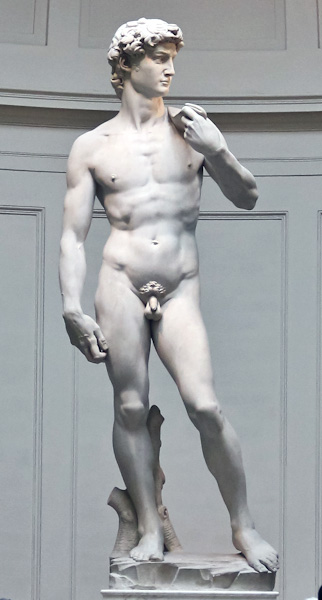
David, Galleria dell'Accademia, Florence
Today is the anniversary of the birth of Italian painter, sculptor, architect, and poet Michelangelo Buonarrotti (1475-1564) (wiki), arguably the greatest artist who ever lived. Born in Caprese, Michelangelo apprenticed under the painter Ghirlandaio but then developed his art under the patronage of Lorenzo de Medici in Florence, later departing for Bologna and Rome. In the latter, he produced his sublime Pietà before returning to Florence in 1501, where he created his colossal David.  

Ordered back to Rome in 1505 by Pope Julius II at first to begin work on the pope's tomb, Michelangelo, was instead commissioned to fresco the ceiling of the Sistine Chapel, which occupied him between 1508 and 1512. (He would paint his startling Last Judgment on the end wall of the Sistine Chapel two decades later.)

Many of Michelangelo's most celebrated works were sculpted for the abortive Julian monument and the Medici Chapel in Florence between 1515 and 1534, but at the same time, he produced a series of celebrated paintings, such as the Conversion of Paul and The Martyrdom of Peter. Late in life, Michelangelo was named the chief architect of St. Peter's basilica in Rome and was largely responsible for the present dome. His verse includes lyric poems, madrigals, and sonnets, some of which have been set to music by composers as diverse as Benjamin Britten and Dmitri Shostakovich.

From the sublime to the mundane, he was still an artist - below is one of his surviving grocery lists (via Open Culture):
“Because the servant he was sending to market was illiterate,” writes the Oregonian‘s Steve Duin in a review of a Seattle Art Museum show, “Michelangelo illustrated the shopping lists — a herring, tortelli, two fennel soups, four anchovies and ‘a small quarter of a rough wine’ — with rushed (and all the more exquisite for it) caricatures in pen and ink.”
Click here to embiggen
There are, of course, many books written about Michelangelo, but I remember feeling as though I understood both him and the times in which he lived much better when I first read The Agony and the Ecstasy: A Biographical Novel of Michelangelo. If, like me, you already have too many books in your queue, try the movie version (starring Charlton Heston as the artist).

Related posts and links:


NPR has translated Leonardo's To-Do List.

Friday, January 20, 2017

Friday links

For Buffy the Vampire Slayer's birthday, here's a list of her birthday catastrophes.

Picasso's Self-Portraits From 15 Years Old To 90 Years Old.


This weekend is Stonewall Jackson's birthday - here's the story of his left arm's separate grave (bonus: Lord Uxbridge's leg)


How A Dead Millionaire Convinced Dozens Of Women To Have As Many Babies As Possible.

ICYMI, Tuesday's links are here, and include self-medicating animals, a photo of Lincoln's first inauguration, Al Capone's investments in miniature golf, and, for Ben Franklin's birthday, his 200 synonyms for drunk and the bodies found in his basement.

Wednesday, November 30, 2016

Wednesday links

This is (almost) a public service announcement: if you get a free 30 day trial of Amazon Prime, you can use the unlimited 2 day shipping (plus streaming of TV shows, movies, and music) all though the holidays, and cancel afterward if you don't want to continue!

Winston Churchill was born on November 30, 1874: here he is on Islam, and here's the story of his "Iron Curtain" speech.

How Alchemy Has Been Depicted in Art Through the Ages.


A video tour of the (excellent) Museum of Bad Art.

How An Obscure British Comedy Sketch Became The World’s Most Repeated TV Program.

Do Polygraph Tests Actually Work?

ICYMI, Monday's links are here, and include World War 1 man-lifting kites (for aerial reconnaissance), nickname origins, how to modify your baseball bat into a zombie-killing weapon, and an airplane crash supercut.

Wednesday, October 12, 2016

Wednesday links


Circa 1890, it was pretty easy to end up in an insane asylum.

Will A Chicken That's Fed Lemons Taste Like Lemons?


ICYMI, Monday's links are here, and include senior moment science, UFO detectors, why people with bigger brains yawn longer, and, from 1930, a set of Information Tests To Try On Your Children.

Wednesday, May 25, 2016

Wednesday links

For fans of Hitchhiker's Guide to the Galaxy: don't panic - today is Towel Day!

From 32 starlings in the 1890s to 200 million now: The Shakespeare Fanatic Who Introduced the Bard’s Birds to America


The Science of Laziness: Is There a Couch-Potato Gene?


Romanian cave sealed for 5.5 million years is full of strange creatures.

ICYMI, Monday's links are here, and include advice from c. 1450 on soothing a teething baby, thelast tribe of headhunters, how to become a mutant, and survival tips from 100 years ago. Also, an answer to an age old question: could you get drunk from drinking a drunk person's blood?