Big Brother on wheels: Why your car company may know more about you than your spouse.
ICYMI, Friday's links are here, and include weird vintage beauty hacks, the birthdays of Buffy the Vampire Slayer and Stonewall Jackson (including the story of his left arm's separate grave), how apple pie became "American", and the anniversary of French King Louis XVI's guillotining.
ICYMI, Wednesday's links are here, and include an $800 belt with airbags to protect your hips, the anniversary of Julius Caesar crossing the Rubicon River, how illegal shipping containers reshaped the world economy, and (via video x-ray camera) how hamsters fit so much in their cheeks.
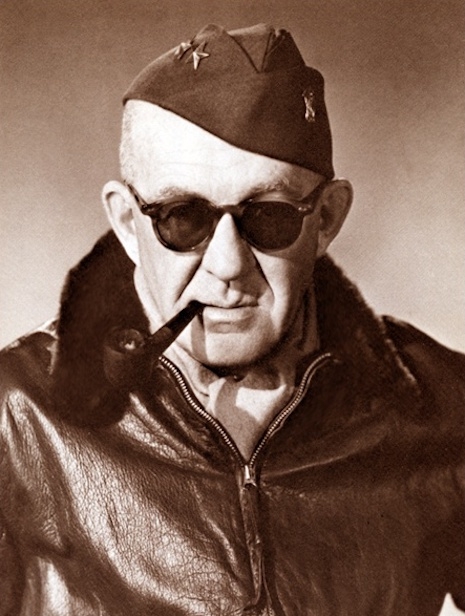
John Ford (February 1, 1894 – August 31, 1973) was an American film director. He is renowned both for Westerns such as Stagecoach (1939), The Searchers (1956), and The Man Who Shot Liberty Valance (1962), as well as adaptations of classic 20th-century American novels such as the film The Grapes of Wrath (1940). His four Academy Awards for Best Director (in 1935, 1940, 1941, and 1952) remain a record. One of the films for which he won the award, How Green Was My Valley, also won Best Picture.
Some of Ford’s wartime movies were exclusively for OSS consumption, such as 1943’s How to Operate Behind Enemy Lines, a/k/a Undercover, an instructional film about how to be a spy. Like most movies of its kind, it teaches by illustrating dos and don’ts—Ford appears in the only speaking role of his career as the pipe-smoking case officer assigned to the “don’t” agent—and lays heavy emphasis on a single lesson, here the supreme importance of maintaining a believable cover story. Agonizing sequences depict spies blowing their cover through inattention to detail: anything from paying the bar tab with bills no longer in circulation to using “hair grease” they can’t get in Enemytown since hostilities began.
I'm going to call this one NSFW because I can't imagine an employer would want it played at work:
When he went on active duty, Ford had already directed 1941’s Sex Hygiene, an Army training film with tips for avoiding the clap and syphilis while on leave (“I looked at it and threw up,” was the review Ford later gave Peter Bogdanovich). Youtube comment:
Several servicemen relax by playing pool, but one of them goes off to spend time with a prostitute. Later, he discovers he has contracted a venereal disease. A graphic and frank presentation of the types and treatment of venereal disease follows.
This 2 minute film was directed by French filmmaker Georges Melies (wiki). It starts off with a fat woman and a lean woman wrestling but then they morph into a fat man and a lean man (played by Melies). Obviously the standards of what is considered fat has changed since then.
The special effects are surprisingly good - Melies was a pioneer in the use of stop edits, dissolves, and double exposures in motion pictures. There are a couple of sequences, in which one of the men gets flattened or decapitated/dismembered before being brought back to life, that demonstrate some of these techniques.
Here's one of his most famous films, A Trip to the Moon (Le Voyage dans la lune) from 1902 - it will make more sense if you read Wikipedia's plot summary before watching:
Per YouTube, the video features Enrico Caruso singing "La donna e Mobile"* (from Rigoletto(wiki)) circa 1908 and clips of films taken in New York City dating from 1898 to 1906 from the Library of Congress.
"La donna e Mobile" translates as "woman is fickle". h/t Miss Cellania
On Tuesday, the Lawrence Livermore National Laboratory, a federally funded facility outside San Francisco that focuses on nuclear research, released 63 rare, restored and declassified films of nuclear testing that was done between 1945 and 1962.
The films were uploaded to the lab’s YouTube account, and are part of a trove of some 10,000 that have been in storage since they were originally shot.
The initial release is just a fraction of about 750 that Greg Spriggs, a physicist at the lab who has worked on the project for five years, declassified on Tuesday. And even that number is small compared to some 6,500 films that have been found of the 10,000 that were estimated to have been shot at the height of the Cold War.
Here's Greg Spriggs discussing the films:
This explosion was named Harlem, and occurred off Kiribati in 1962 in a series of tests known as Operation Dominic:
This one is part of a series of tests at the Nevada Test Site that took place in 1955 that was known as Operation Teapot. This particular explosion was called Tesla: