Amazon Deals

New at Amazon

Showing posts with label Leonardo. Show all posts

Saturday, April 13, 2019

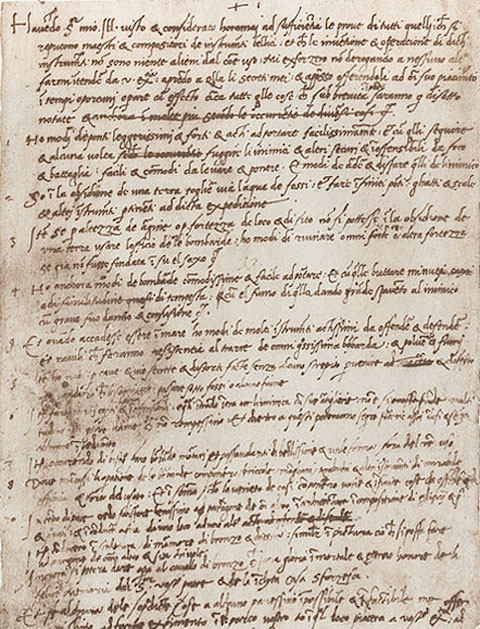
Leonardo da Vinci’s Handwritten Resume (1482)

Leonardo da Vinci (wiki) was born on April 15, 1452 and died on May 2, 1519. He was an Italian polymath whose areas of interest included invention, painting, sculpting, architecture, science, music, mathematics, engineering, literature, anatomy, geology, astronomy, botany, writing, history, and cartography. He has been variously called the father of paleontology, ichnology, and architecture, and is widely considered one of the greatest painters of all time. Sometimes credited with the inventions of the parachute, helicopter and tank, his genius epitomized the Renaissance humanist ideal.

Before he was famous, before he painted the Mona Lisa and the Last Supper, before he invented the helicopter, before he drew the most famous image of man, before he was all of these things, Leonardo was an artificer, an armorer, a maker of things that go ‘boom,’” writes Marc Cendella on his blog about job-searching and recruitment advice. “Like you, he had to put together a resume to get his next gig. So in 1482, at the age of 30, he wrote out a letter and a list of his capabilities and sent it off to Ludovico il Moro, Duke of Milan.” Having yet to establish his reputation as perhaps the Italian Renaissance’s most respected polymath, Leonardo spelled himself out, in translation, as follows:
Most Illustrious Lord, Having now sufficiently considered the specimens of all those who proclaim themselves skilled contrivers of instruments of war, and that the invention and operation of the said instruments are nothing different from those in common use: I shall endeavor, without prejudice to any one else, to explain myself to your Excellency, showing your Lordship my secret, and then offering them to your best pleasure and approbation to work with effect at opportune moments on all those things which, in part, shall be briefly noted below.
1. I have a sort of extremely light and strong bridges, adapted to be most easily carried, and with them you may pursue, and at any time flee from the enemy; and others, secure and indestructible by fire and battle, easy and convenient to lift and place. Also methods of burning and destroying those of the enemy.
2. I know how, when a place is besieged, to take the water out of the trenches, and make endless variety of bridges, and covered ways and ladders, and other machines pertaining to such expeditions.
3. If, by reason of the height of the banks, or the strength of the place and its position, it is impossible, when besieging a place, to avail oneself of the plan of bombardment, I have methods for destroying every rock or other fortress, even if it were founded on a rock, etc.
4. Again, I have kinds of mortars; most convenient and easy to carry; and with these I can fling small stones almost resembling a storm; and with the smoke of these cause great terror to the enemy, to his great detriment and confusion.
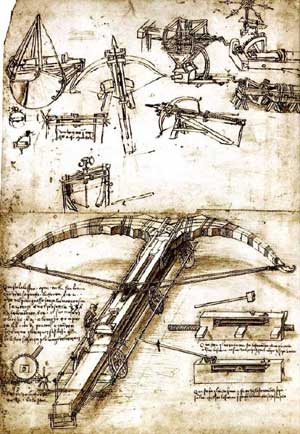
Giant crossbow (more here)
5. And if the fight should be at sea I have kinds of many machines most efficient for offense and defense; and vessels which will resist the attack of the largest guns and powder and fumes.
6. I have means by secret and tortuous mines and ways, made without noise, to reach a designated spot, even if it were needed to pass under a trench or a river.
7. I will make covered chariots, safe and unattackable, which, entering among the enemy with their artillery, there is no body of men so great but they would break them. And behind these, infantry could follow quite unhurt and without any hindrance.
8. In case of need I will make big guns, mortars, and light ordnance of fine and useful forms, out of the common type.
9. Where the operation of bombardment might fail, I would contrive catapults, mangonels, trabocchi, and other machines of marvellous efficacy and not in common use. And in short, according to the variety of cases, I can contrive various and endless means of offense and defense.
Water lifting devices (larger version)
10. In times of peace I believe I can give perfect satisfaction and to the equal of any other in architecture and the composition of buildings public and private; and in guiding water from one place to another.
11. I can carry out sculpture in marble, bronze, or clay, and also I can do in painting whatever may be done, as well as any other, be he who he may.
Again, the bronze horse may be taken in hand, which is to be to the immortal glory and eternal honor of the prince your father of happy memory, and of the illustrious house of Sforza.
And if any of the above-named things seem to anyone to be impossible or not feasible, I am most ready to make the experiment in your park, or in whatever place may please your Excellency – to whom I comment myself with the utmost humility, etc.
Even the densest fifteenth-century Duke, I wager, could see the use in a man able to make portable bridges, get water out of trenches, destroy rock built upon rock, fling a storm of stones, fortify vessels, pass under rivers, and make everything from “big guns,” catapults, mangonels, and trabocchi to unattackable covered chariots. Though Leonardo understandably concentrates on his wartime engineering skills, he also touches on the range of other disciplines — Renaissance man, remember — he has mastered, like architecture, sculpture, and painting. Perhaps most impressively of all, he rattles off all these points without seeming particularly boastful, a feat seemingly out of the reach of many college graduates today. “You’ll notice he doesn’t recite past achievements,” Cendella adds, “because those are about his achievements, and not about the Duke’s needs.” 

NPR has translated Leonardo's To-Do List.


Friday, September 22, 2017

Friday links

Watch this kid show his dad how to make Leonardo da Vinci’s self-supporting bridge.

How Nestlé Makes Billions Bottling Water It Pays Almost Nothing For.

It's the first day of Fall - autumnal equinox science, videos, poetry, music.


The book wheel: A rotating reading desk for 16th century, perfect for those "tormented by gout".

ICYMI, Wednesday's links are here, and include Alexander Graham Bell’s tetrahedral kites, the 1869 near-war between the United States and Britain, and Joshua Norton, Emperor of the United States.

Thursday, September 21, 2017

Watch this kid show his dad how to make Leonardo da Vinci’s self-supporting bridge

Using a series of wooden poles and beams, this kid shows his dad how to build Leonardo da Vinci's (wiki) self-supporting arch bridge, also known as the emergency bridge, without nails, screws, rope, glues, notches, or any other fasteners.

They've made this with 5 sections, but you could make it with many more - each section increases the height as well as the length. I'm sure there's an upper limit to the number of sections that would work, but I don't know what it is.


Here's a set of instructions for a popsicle stick version: Da Vinci Popsicle Stick Bridge, and here's a wooden kit.

In 1482, before he was famous, Da Vinci (April 15, 1452 - May 2, 1519) was looking for work. He sent his resume to the Duke of Milan, listing several useful skills he could provide, including the bridge:
I have a sort of extremely light and strong bridges, adapted to be most easily carried, and with them you may pursue, and at any time flee from the enemy; and others, secure and indestructible by fire and battle, easy and convenient to lift and place. Also methods of burning and destroying those of the enemy.
Related posts/links:


NPR has translated Leonardo's To-Do List.

Friday, August 11, 2017

Friday links

August 12 is Erwin Schrödinger's (he of the famous half-dead cat) birthday: explanation, quotes, jokes, video.


Browse the British Library’s online copy of Leonardo da Vinci’s 570-page notebook.

Roman roads of Britain.

The Tiny Island in New York That Nobody’s Allowed to Visit.

ICYMI, Wednesday's links are here, and include directly streaming music to your cochlear implant, the anniversary of the battle of Thermopylae, the 1814 beer flood that killed eight people, village sin-eaters, and Glen Campbell's Alzheimer's-related song.

Monday, March 6, 2017

Michelangelo's birthday

Pieta, St. Peter's Basilica, Vatican City
The marble not yet carved can hold the form 

Of every thought the great artist has. 

~ Michelangelo Buonarrotti (wiki) (Sonnet 15, excerpt; translation by E. Jennings) 

I have only too much of a wife in this art of mine, who has always kept me in tribulation, and my children shall be the works which I leave, which even if they are naught, will live for a while. 

~ Michelangelo (in answer to being asked why he had not married and had children; in Vasari, Lives of the Artists) 

All his statues are so constrained by agony that they seem to wish to break themselves. They all seem ready to succumb to the pressure of the despair that fills them. 


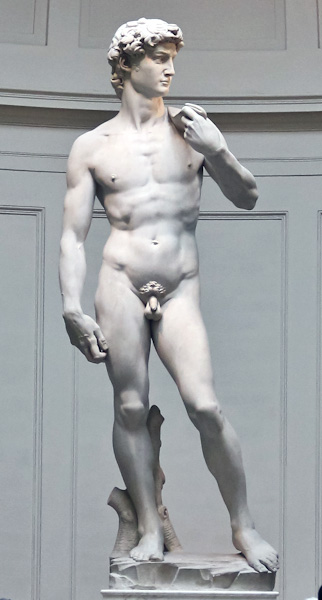
David, Galleria dell'Accademia, Florence
Today is the anniversary of the birth of Italian painter, sculptor, architect, and poet Michelangelo Buonarrotti (1475-1564) (wiki), arguably the greatest artist who ever lived. Born in Caprese, Michelangelo apprenticed under the painter Ghirlandaio but then developed his art under the patronage of Lorenzo de Medici in Florence, later departing for Bologna and Rome. In the latter, he produced his sublime Pietà before returning to Florence in 1501, where he created his colossal David.  

Ordered back to Rome in 1505 by Pope Julius II at first to begin work on the pope's tomb, Michelangelo, was instead commissioned to fresco the ceiling of the Sistine Chapel, which occupied him between 1508 and 1512. (He would paint his startling Last Judgment on the end wall of the Sistine Chapel two decades later.)

Many of Michelangelo's most celebrated works were sculpted for the abortive Julian monument and the Medici Chapel in Florence between 1515 and 1534, but at the same time, he produced a series of celebrated paintings, such as the Conversion of Paul and The Martyrdom of Peter. Late in life, Michelangelo was named the chief architect of St. Peter's basilica in Rome and was largely responsible for the present dome. His verse includes lyric poems, madrigals, and sonnets, some of which have been set to music by composers as diverse as Benjamin Britten and Dmitri Shostakovich.

From the sublime to the mundane, he was still an artist - below is one of his surviving grocery lists (via Open Culture):
“Because the servant he was sending to market was illiterate,” writes the Oregonian‘s Steve Duin in a review of a Seattle Art Museum show, “Michelangelo illustrated the shopping lists — a herring, tortelli, two fennel soups, four anchovies and ‘a small quarter of a rough wine’ — with rushed (and all the more exquisite for it) caricatures in pen and ink.”
Click here to embiggen
There are, of course, many books written about Michelangelo, but I remember feeling as though I understood both him and the times in which he lived much better when I first read The Agony and the Ecstasy: A Biographical Novel of Michelangelo. If, like me, you already have too many books in your queue, try the movie version (starring Charlton Heston as the artist).

Related posts and links:


NPR has translated Leonardo's To-Do List.