Amazon Deals

New at Amazon

Sunday, September 24, 2023

Composer Dimitri Shostakovich was born September 25, 1906: some quotes, history, and music

I always try to make myself as widely understood as possible; and if I don't succeed, I consider it my own fault.

Dmitri Shostakovich (quoted in Machlis, Introduction to Contemporary Music)

The composer apparently does not set himself the task of listening to the desires and expectations of the Soviet public. He scrambles sounds to make them interesting to formalist elements who have lost all taste... The power of good music to affect the masses has been sacrificed to a petty-bourgeois, "formalist" attempt to create originality through cheap clowning. It is a game of clever ingenuity that may end very badly.*

~ Pravda (on the Shostakovich opera Lady MacBeth of Mtsensk, "Muddle Instead of Music," January 1936)

Shostakovich told me: "I finished the Fifth Symphony in the major and fortissimo... It would be interesting to know what would have been said if I finished it pianissimo and in the minor." Only later did I understand the full significance of these words, when I heard the Fourth Symphony, which does finish in the minor and pianissimo. But in 1937, nobody knew the Fourth Symphony.**

~ Boris Khaikin (1904-1978) (Discourses on Conducting)
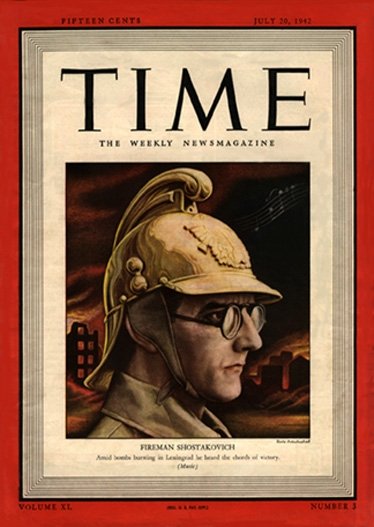
The cover of a 1942 issue of Time Magazine with the
caption "Fireman Shostakovich: 'Amid bombs burning
 in Leningrad, he heard the chords of victory.' Refers to
the Battle of Leningrad in which he served
 as a volunteer in the anti-fire brigades
There may be few notes, but there's lots of music.

~ Shostakovich (on his film music for King Lear; quoted in Wilson, Shostakovich, A Life Remembered)

Particularly during the Cold War, Shostakovich was anathema to many Western critics:

The Fifth Symphony of Shostakovich always has been singularly irritating to this chronicler... Whenever I hear one of his marches, my imagination fastens upon a picture of the parades in Red Square and the banners of Uncle Joe, and my irritation becomes powerful.

~ Cyrus Durgin (? - 1962) (Boston Globe, 25 October 1952)

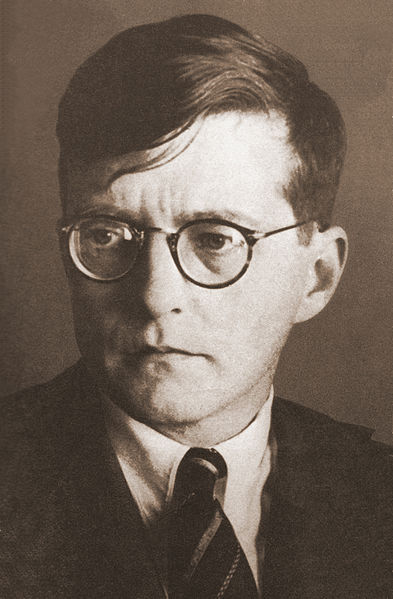
To anyone who knew his music, a first encounter with Dmitri Shostakovich could not fail to be startling. In contrast to the elemental force, bombast, grandeur of his works, he was a chétif*** figure, the perennial student, unassertive and shy, who looked as though all the music could be wrung out of him in a couple of song cycles.

~ Yehudi Menuhin (1916-1999) (Unfinished Journey)

September 25 is the anniversary of the birth of Soviet composer Dmitri Shostakovich (wiki) (1906-1975), considered by some as the greatest symphonist of the 20th century. Born in St. Petersburg, Shostakovich was an early piano prodigy and studied composition at the St. Petersburg Conservatory during the early Soviet era.
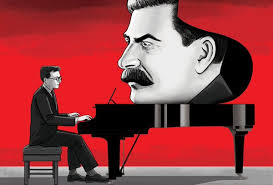
At first recognized internationally as an exemplar of the best of Soviet musicianship, he ran afoul of the regime with his modernistic opera, Lady MacBeth of Mtsensk, which so outraged Stalin that he is said to have had a personal hand in writing the infamous Pravda editorial, "Muddle Instead of Music" that literally put the composer's life in jeopardy during the "Great Purge" of the late 1930s. 

Shostakovich somehow survived, even though he was recurrently criticized by the regime for his “modernist” tendencies. During his subsequent tumultuous career, he produced an enormous oeuvre: 15 symphonies, concertos, a great quantity of chamber music, song cycles, piano music, and several operas. Generally considered a serious - almost tragic - composer, Shostakovich nonetheless wrote a large amount of “light” music, including even a stage work – Moscow Cheryomushki (1959) – that might be described as a Russian musical comedy.

Harry Potter looks exactly like
 a young Shostakovich
For newcomers to the music of Shostakovich, I would recommend his 4th, 5th, and 10th symphonies, the two piano concertos, the "autobiographical" 8th strinq quartet, his several "jazz" and "ballet" suites compiled from light works of the 1930s, and his film score for The Gadfly, whose "Romance" was used to great effect as the principal theme of the TV series, "Riley, Ace of Spies."

During the last two decades, there has been a raging musicological debate about whether the music of Shostakovich reveals him as a loyal Soviet citizen or a closet dissident whose works portray a tormented man. No one really knows. He was clearly a quirky guy. In contradiction to the opening quotation above, he noted late in life,
"I've said what I said. Either you have it in you to understand, or if not, then it would be fruitless to try to explain anyway."
* N.B. In the first year of the Great Purge, this last sentence was a terrifying threat.

** After the uproar caused by Lady MacBeth of Mtsensk, Shostakovich "redeemed" himself with his Fifth Symphony (1937), designated "A Soviet Artist's Response to Just Criticism," still one of his most successful and popular works. However, his iconoclastic Fourth Symphony, which had been in rehearsal at the time of the debacle, was withdrawn and did not emerge again until 1961. It is now considered one of the master's most original works and a fascinating indicator of "the road not taken." By the way, Boris Khaikin was a Soviet-Jewish conductor.

*** Chétif - a French word meaning "puny."

Here is the romance from The Gadfly:


More typical of Shostakovich is the opening of his 4th symphony:


Parts of the text above are adapted from the late, great Ed Whitman's Quotation of the Day. In addition to being my partner, my best friend, and Grandpa to the many kids who call me Grandma, Ed is also the author of Hunters and Killers: Volume 1: Anti-Submarine Warfare from 1776 to 1943 and Hunters and Killers: Volume 2: Anti-Submarine Warfare from 1943. Fair winds and following seas, Sailor. I miss you.

Tuesday, September 19, 2023

Hey, Firefly fans - September 20 is Unification Day

Here's Wikipedia on Firefly's Unification Day:
Unification Day is a holiday celebrated in the fictional universe of the science-fiction television series Firefly. It marks the day in which the Alliance forces defeated the resistance ("Browncoats") in the Unification War.
"The Train Job", the second episode of the series (although Fox originally aired it before the pilot episode "Serenity"), opens with Mal, Zoe, and Jayne in a bar during a Unification Day celebration. Malcolm's brown coat and his disinterest in celebrating Unification Day lead to a brawl.

Unification Day is a holiday mentioned in the backstory of the television series Firefly. According to Nathan Fillion (Mal), the holiday is on September 20th.

Sunday, September 17, 2023

Dr. Samuel Johnson was born on September 18, 1709: here's a selection of his insults and Scotland-bashing quotes.

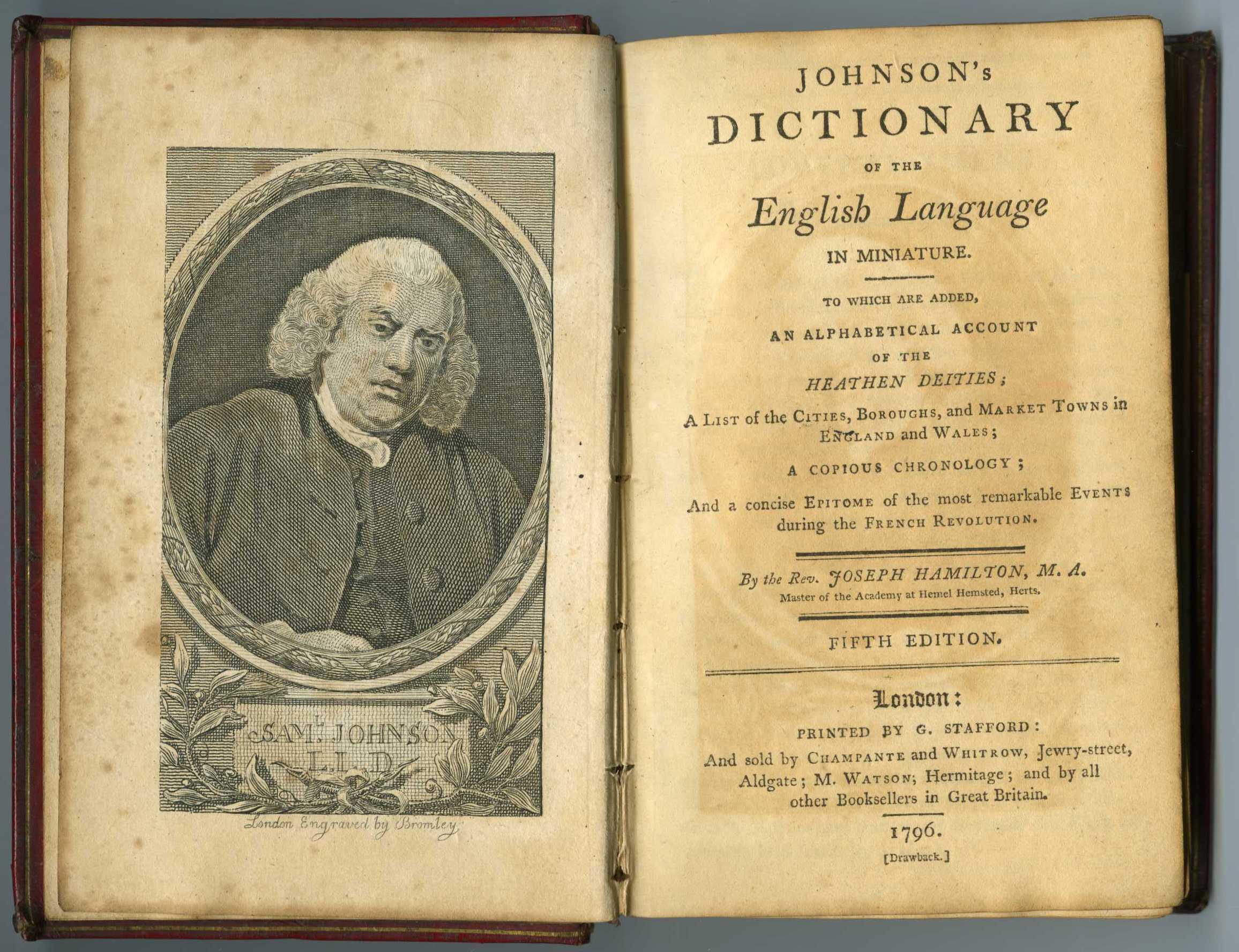
September 18 is the anniversary of the birth in 1709 of that quintessential 18th-century curmudgeon Dr. Samuel Johnson (wiki), the literary lion of Georgian London for much of his lifetime (1709-1784). A poet, critic, lexicographer, and wit, Johnson compiled the first respectable English dictionary between 1747 and 1755, following several years of writing critical articles for London magazines such as The Idler.

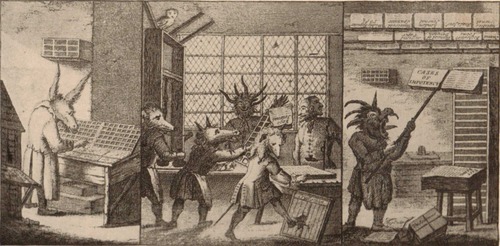
From The Grub Street Journal (Oct 30, 1732), this cartoon depicts the “literatory,” a sort of publishing factory driven by beasts without artistic inspiration. Such was the perception of Grub Street writers like Johnson and Savage, who did indeed scrape together a living from commissioned writing.
Born in Lichfield the son of a book dealer, Johnson studied at Oxford and ran his own private school - where the actor David Garrick was a student - before removing to London and its literary milieu in 1737. There, in 1763, he met his companion and biographer, the Scot, James Boswell (1740-1795), to whom we owe the recording of most of Johnson's voluminous observations. 

He was no fan of Scotland:

"The noblest prospect which a Scotchman ever sees, is the high road that leads him to England!"

I having said that England was obliged to us for gardeners, almost all their gardeners being Scotchmen; Johnson: "Why, Sir, that is because gardening is much more necessary amongst you than with us, which makes so many of your people learn it. It is all gardening with you. Things which grow wild here, must be cultivated with great care in Scotland. Pray now," throwing himself back in his chair, and laughing, "are you ever able to bring the sloe to perfection?"

He would not allow Scotland to derive any credit from Lord Mansfield; for he was educated in England. "Much may be made of a Scotchman, if he be caught young."

"There is in Scotland a diffusion of learning, a certain portion of it widely and thinly spread. A merchant has as much learning as one of their clergy."

"What enemy would invade Scotland, where there is nothing to be got?"

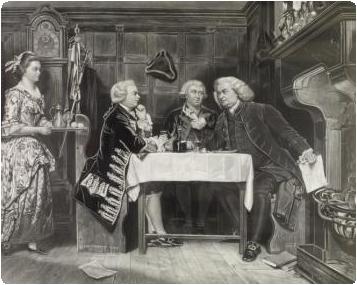
In “The Mitre Tavern” (1880), Samuel Johnson (far right) converses with James Boswell (center) and author Goldsmith. (source)


Asked by a Scot what Johnson thought of Scotland: "That it is a very vile country, to be sure, Sir" "Well, Sir! (replies the Scot, somewhat mortified), God made it." Johnson: "Certainly he did; but we must always remember that he made it for Scotchmen, and comparisons are odious, Mr. S------; but God made hell."

Mr. Arthur Lee mentioned some Scotch who had taken possession of a barren part of America, and wondered why they would choose it. Johnson: "Why, Sir, all barrenness is comparative. The Scotch would not know it to be barren." Boswell: "Come, come, he is flattering the English. you have now been in Scotland, Sir, and say if you did not see meat and drink enough there." Johnson:"Why yes, Sir; meat and drink enough to give the inhabitants sufficient strength to run away from home."

Johnson and Boswell in Edinburgh
"Your country consists of two things, stone and water. There is, indeed, a little earth above the stone in some places, but a very little; and the stone is always appearing. It is like a man in rags; the naked skin is still peeping out."

"A tree might be a show in Scotland as a horse in Venice. At St. Andrews Mr. Boswell found only one, and recommended it to my notice; I told him it was rough and low, or looked as if I thought so. This, said he, is nothing to another a few miles off. I was still less delighted to hear that another tree was not to be seen nearer. Nay, said a gentleman that stood by, I know but of this and that tree in the county."

[Of an inn in Scotland, SJ wrote...] "Of the provisions the negative catalogue was very copious. Here was no meat, no milk, no bread, no eggs, no wine. We did not express much satisfaction."

"He that travels in the Highlands may easily saturate his soul with intelligence, if he will acquiesce in the first account. The highlander gives to every question an answer so prompt and peremptory, that skepticism itself is dared into silence, and the mind sinks before the bold reporter in unresisting credulity; but, if a second question be ventured, it breaks the enchantment; for it is immediately discovered, that what was told so confidently was told at hazard, and that such fearlessness of assertion was either the sport of negligence, or the refuge of ignorance."

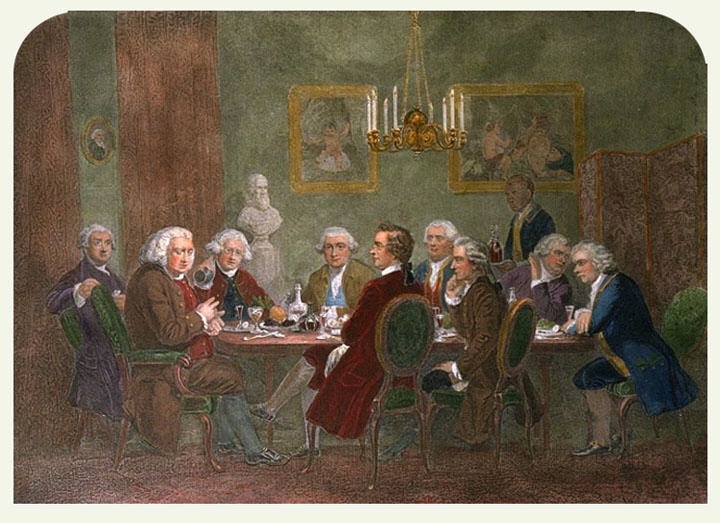
1781: Johnson (second from left), other members of "The Club".
(Written by an Irishman) The author of these memoirs will remember, that Johnson one day asked him, 'Have you observed the difference between your own country impudence and Scottish impudence?' The answer being in the negative: 'Then I will tell you,' said Johnson. 'The impudence of an Irishman is the impudence of a fly, that buzzes about you, and you put it away, but it returns again, and flutters and teazes you. The impudence of a Scotsman is the impudence of a leech, that fixes and sucks your blood.' 

Johnson also, of course, had little use for America or Americans:

"Sir, they are a race of convicts, and ought to be thankful for anything we allow them short of hanging."

"To a man of mere animal life, you can urge no argument against going to America, but that it will be some time before he will get the earth to produce. But a man of any intellectual enjoyment will not easily go and immerse himself and his posterity for ages in barbarism."

"I am willing to love all mankind, except an American"

A Blackadder clip on Johnson's Dictionary:


Here's a very well done bio of Johnson by the BBC:


A selection of his legendary insults:

Dr. Johnson in the ante-room of Lord Chesterfield. 
Of Lord Chesterfield:

"This man I thought had been a Lord among wits; but I find, he is only a wit among Lords."

And of Lord Chesterfield's Letters to His Son*:

"They teach the morals of a whore; and the manners of a dancing-master."

Of Thomas Sheridan:

"Why, Sir, Sherry is dull, naturally dull; but it must have taken him a great deal of pains to become what we now see him. Such an excess of stupidity, Sir, is not in nature."

Of the respective merits of the poets Derrick and Smart:

"Sir, there is no settling the point of precedence between a louse and a flea."

Of the criticism of one critic (Edwards) of another (Warburton):

"A fly, Sir, may sting a stately horse and make him wince; but the one is but an insect and the other is a horse still."

Of Lady Macdonald of Sleat:

"...she was as bad as negative badness could be, and stood in the way of what was good; that insipid beauty would not go a great way... and such a woman might be cut out of a cabbage, if there was a skilful artificer."

Of two disputants:

"One has ball without powder; the other powder without ball."

Of a man hired to sit with him during a convalescence:

"The fellow's an idiot; he is as awkward as a turn-spit when first put to the wheel, and as sleepy as a dormouse."

Of James Macpherson:

"He wants to make himself conspicuous. He would tumble in a hogstye, as long as you looked at him and called him to come out."

Of the new rich:

"Sir, they have lost the civility of tradesmen, without acquiring the manners of gentlemen."

Despite his legendary bile, Johnson did remark later in life,

"As I know more of mankind I expect less of them, and am ready to call a man a good man upon easier terms than I was formerly."

* My favorite quote from Lord Chesterfield's Letters to His Son (to his illegitimate son, that is; he (Chesterfield) was trying to raise him (the son) above his (the son's) lowly origins and inferior blood):
"I knew a gentleman, who was so good a manager of his time, that he would not even lose that small portion of it, which the calls of nature obliged him to pass in the necessary-house; but gradually went through all the Latin poets, in those moments. He bought, for example, a common edition of Horace, of which he tore off gradually a couple of pages, carried them with him to that necessary place, read them first, and then sent them down as a sacrifice to Cloacina*: this was so much time fairly gained; and I recommend you to follow his example.

It is better than only doing what you cannot help doing at those moments; and it will made any book, which you shall read in that manner, very present in your mind. Books of science, and of a grave sort, must be read with continuity; but there are very many, and even very useful ones, which may be read with advantage by snatches, and unconnectedly; such are all the good Latin poets, except Virgil in his "Aeneid": and such are most of the modern poets, in which you will find many pieces worth reading, that will not take up above seven or eight minutes."
Attribution for many of the quotes above can be found at the Samuel Johnson Sound Bite Page. More on Johnson here and here.

Further reading: 

The definitive source for all things Johnson is, of course Boswell's book The Life of Samuel Johnson


Parts of the text above are adapted from the late, great Ed Whitman's Quotation of the Day. In addition to being my partner, my best friend, and Grandpa to the many kids who call me Grandma, Ed is also the author of Hunters and Killers: Volume 1: Anti-Submarine Warfare from 1776 to 1943 and Hunters and Killers: Volume 2: Anti-Submarine Warfare from 1943. Fair winds and following seas, Sailor.

Sunday, September 10, 2023

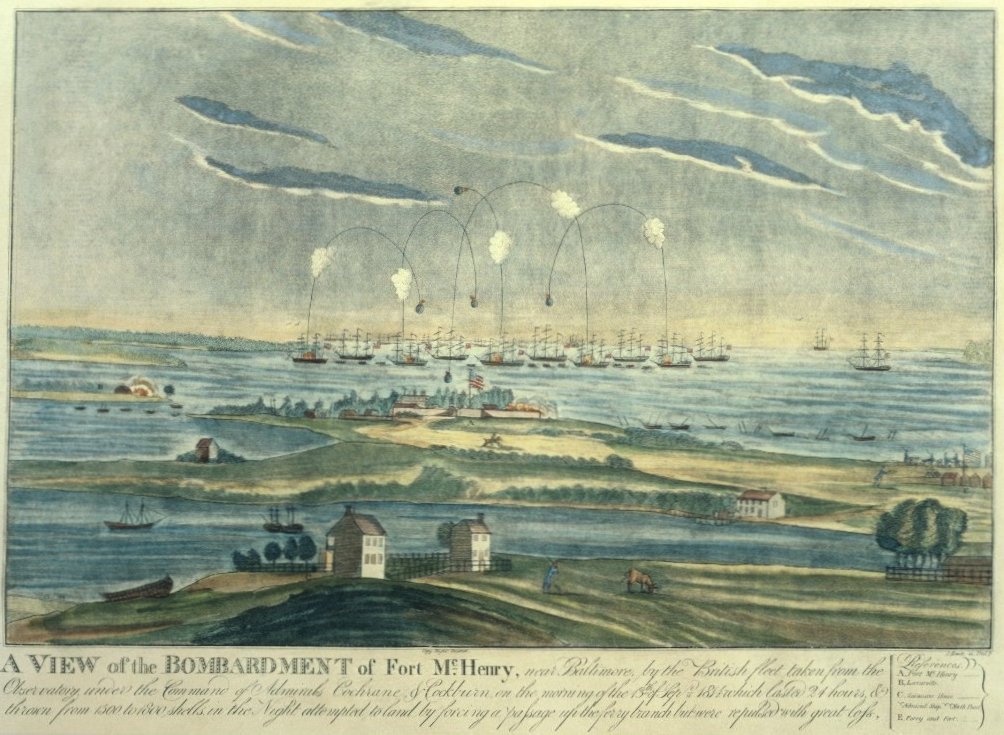
September 13 and 14: the anniversary of the battle of Baltimore, inspiration for the Star-Spangled Banner

Bombing of Fort McHenry by the British. Engraved by John Bower
It was a galling sight for British seamen to behold. And as the last vessel spread her canvas to the wind, the Americans hoisted a most superb and splendid ensign on their battery and fired at the same time a gun of defiance... When the squadron retreated from Baltimore, sullen discontent was displayed and malevolent aspersions cast upon our veteran chief... 

~ Midshipman Robert Barrett, RN (1799-1828) (on the British withdrawal from Baltimore, "Naval Recollections of the American War") 

Without any clash on the battlefield the young American republic had humbled the might of the British empire. The rebuff of Britain at Baltimore decisively demonstrated America's independence of its former master. And this explosion of national pride was only to be magnified by the events of the remaining months of the war.* 


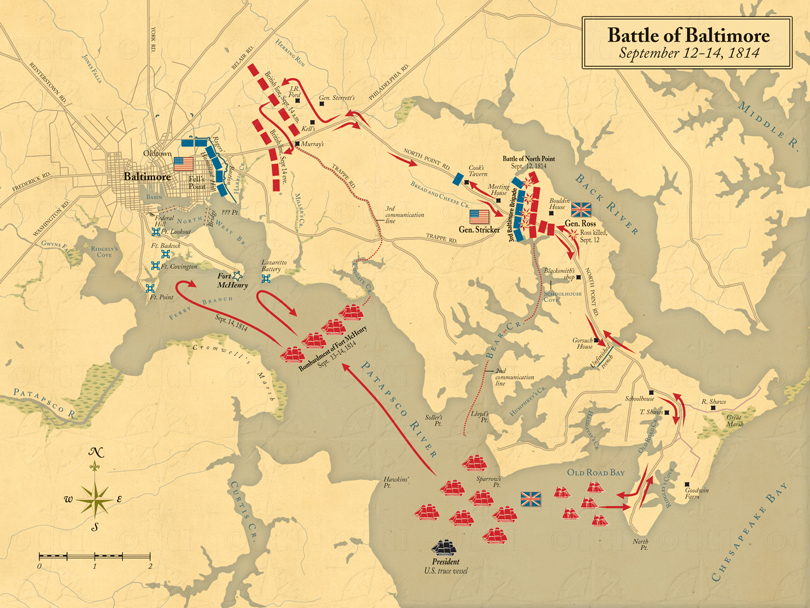
Larger version of map here
September 13th and 14th mark the anniversary of the Battle of Baltimore (wiki) during the War of 1812, remembered primarily for the unsuccessful British bombardment of Fort McHenry and Francis Scott Key's penning the words of "The Star-Spangled Banner" while interned on a British warship. 

President James Madison had declared war on Great Britain in June 1812 in response to interference with American shipping and the impressment of U.S. merchant seamen during the Napoleonic wars, as well as the British stirring up the Indians of the Ohio Valley to resist American settlement. Following an abortive American invasion of southern Canada, the British sent a modest naval and marine force - newly freed up from the Spanish campaign against Napoleon - to the Chesapeake in retaliation. 

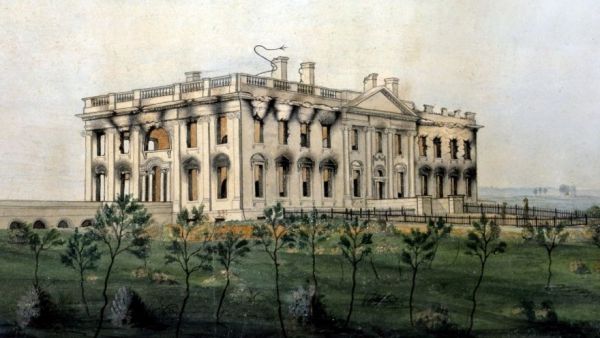
The burned White House by George Munger,
White House Historical Association
In mid-August 1814, an expeditionary force under Admirals Alexander Cochrane and George Cockburn landed on the lower Patuxent River and after routing U.S. militia at the Battle of Bladensburg on the 24th, occupied Washington that night and burned its major government buildings, including the White House and the Capitol, before withdrawing a day later. (Simultaneously, another Royal Navy flotilla maneuvered up the Potomac River to seize Alexandria and held that city for several days before retiring with significant plunder.) After returning to their ships, the British moved up the Chesapeake Bay to attack Baltimore with a naval penetration of the Patapsco River and an amphibious landing southeast of the city on 12 September. 

By then, however, the Americans had rallied their own forces, stopped the (outnumbered) British at the Battle of North Point, and fought off the Royal Navy's attempt to reduce Fort McHenry on the night of September 13th - 14th. In the face of these failures, the badly over-extended British expedition withdrew southward and departed the Chesapeake Bay to prepare for the New Orleans campaign. And as for "The Star-Spangled Banner," here's the verse we never sing:

Oh! thus be it ever, when freemen shall stand
Between their loved home and the war's desolation!
Blest with victory and peace, may the heav'n rescued land
Praise the Power that hath made and preserved us a nation.
Then conquer we must, when our cause it is just,
And this be our motto: "In God is our trust."
And the star-spangled banner in triumph shall wave
O'er the land of the free and the home of the brave!

Here's a rather well-done shortish documentary:


The U.S. Marine Band plays the National Anthem:


* The reference here is to the American victories on Lake Champlain (8-11 September 1814) and in the Battle of New Orleans, 8 January 1815, the second of which was actually fought two weeks after the Treaty of Ghent ended the war. 

** This recent book (St. Martin's Press, New York, 2013) presents a lively and readable account of the British invasion of Washington and the attack on Baltimore during the War of 1812. It should be remembered that all of this happened while Britain was deeply preoccupied with her struggle against Napoleon. He had been exiled to Elba as recently as April 1814 but would return to France on 20 March 1815 to fight the Hundred Days Campaign, which culminated in the Battle of Waterloo on 18 June.

John Farrier at Neatorama has an excellent article on the same subject.

Parts of the text above are adapted from the late, great Ed Whitman's Quotation of the Day. In addition to being my partner, my best friend, and Grandpa to the many kids who call me Grandma, Ed is also the author of Hunters and Killers: Volume 1: Anti-Submarine Warfare from 1776 to 1943 and Hunters and Killers: Volume 2: Anti-Submarine Warfare from 1943.

Wednesday, September 6, 2023

September 7 is the anniversary of the battle of Borodino, on which War and Peace and the 1812 Overture are based

French (blue) and Russian (red) troops
before start of battle. Source.

September 7  is the anniversary of the battle of Borodino (wiki) on 7 September 1812, at which Napoleon's (wiki) Grande Armée grappled bitterly with massed Russian forces defending Moscow under Marshal Mikhail Kutusov (1745-1813)* during Napoleon's invasion of Russia

Kutusov suffered significant losses, and the French occupied Moscow a week later, but in a month, Napoleon's disastrous retreat toward the west had begun. As Tolstoy noted in War and Peace,
"The cudgel of the people's war was lifted with all its menacing and majestic might, and caring nothing for good taste and procedure, with dull-witted simplicity but sound judgment, it rose and fell, making no distinctions."
Napoleon's own judgment has become more famous:

"Du sublime au ridicule il n'y a qu'un pas."

(From the sublime to the ridiculous is but a step.)

Here's the rousing cannon-punctuated finale of Tchaikovsky's 1812 Overture:


Tchaikovsky (1840-1893) was commissioned to write that staple of summer pops concerts, the 1812 Overture (actually Ouverture Solennelle 1812, Op. 49), for an exhibition of arts and industries at Moscow in 1881. It was intended to commemorate the battle of Borodino and Napoleon's ultimate defeat.**

* N.B. Earlier, at the battle of Smolensk, Kutusov had noted, "The battle has already been decided. It is like a river that runs downhill. I can only move it slightly to the right or left. But its outcome will not be changed by me."

** During the Soviet era, Russian performances of the 1812 Overture substituted an anonymous chorale-like tune for "God Preserve the Czar," the "Russian hymn" quoted by Tchaikovsky in the original.

A brief documentary:


Related post: the anniversary of the 1815 Battle of Waterloo: history, quotes and video (including a Lego re-enactment)

Parts of the text above are based on the late, great Ed Whitman's Quotation of the Day. Ed was my partner and love for 25 years, and the author of Hunters and Killers: Volume 1: Anti-Submarine Warfare from 1776 to 1943 and Hunters and Killers: Volume 2: Anti-Submarine Warfare from 1943.