Amazon Deals

New at Amazon

Saturday, April 6, 2024

Harry Potter author J.K. Rowling - What is a Woman?

Harry Potter author J.K. Rowling (wiki) defines women:

Ed: I've posted this here because I don't want to have to search for it whenever I want to share it with someone. The content belongs to her - I have no rights.

Original tweet here.

You’ve asked me several questions on this thread and accused me of avoiding answering, so here goes.

I believe a woman is a human being who belongs to the sex class that produces large gametes. It’s irrelevant whether or not her gametes have ever been fertilised, whether or not she’s carried a baby to term, irrelevant if she was born with a rare difference of sexual development that makes neither of the above possible, or if she’s aged beyond being able to produce viable eggs. She is a woman and just as much a woman as the others.

I don’t believe a woman is more or less of a woman for having sex with men, women, both or not wanting sex at all. I don’t think a woman is more or less of a woman for having a buzz cut and liking suits and ties, or wearing stilettos and mini dresses, for being black, white or brown, for being six feet tall or a little person, for being kind or cruel, angry or sad, loud or retiring. She isn't more of a woman for featuring in Playboy or being a surrendered wife, nor less of a woman for designing space rockets or taking up boxing. What makes her a woman is the fact of being born in a body that, assuming nothing has gone wrong in her physical development (which, as stated above, still doesn't stop her being a woman), is geared towards producing eggs as opposed to sperm, towards bearing as opposed to begetting children, and irrespective of whether she's done either of those things, or ever wants to.

Womanhood isn't a mystical state of being, nor is it measured by how well one apes sex stereotypes. We are not the creatures either porn or the Bible tell you we are. Femaleness is not, as trans woman Andrea Chu Long wrote, ‘an open mouth, an expectant asshole, blank, blank eyes,’ nor are we God’s afterthought, sprung from Adam’s rib.

Women are provably subject to certain experiences because of our female bodies, including different forms of oppression, depending on the cultures in which we live. When trans activists say 'I thought you didn't want to be defined by your biology,' it’s a feeble and transparent attempt at linguistic sleight of hand. Women don't want to be limited, exploited, punished, or subject to other unjust treatment because of their biology, but our being female is indeed defined by our biology. It's one material fact about us, like having freckles or disliking beetroot, neither of which are representative of our entire beings, either. Women have billions of different personalities and life stories, which have nothing to do with our bodies, although we are likely to have had experiences men don't and can't, because we belong to our sex class.

Some people feel strongly that they should have been, or wish to be seen as, the sex class into which they weren't born. Gender dysphoria is a real and very painful condition and I feel nothing but sympathy for anyone who suffers from it. I want them to be free to dress and present themselves however they like and I want them to have exactly the same rights as every other citizen regarding housing, employment and personal safety. I do not, however, believe that surgeries and cross-sex hormones literally turn a person into the opposite sex, nor do I believe in the idea that each of us has a nebulous ‘gender identity’ that may or might not match our sexed bodies. I believe the ideology that preaches those tenets has caused, and continues to cause, very real harm to vulnerable people.

I am strongly against women's and girls' rights and protections being dismantled to accommodate trans-identified men, for the very simple reason that no study has ever demonstrated that trans-identified men don't have exactly the same pattern of criminality as other men, and because, however they identify, men retain their advantages of speed and strength. In other words, I think the safety and rights of girls and women are more important than those men's desire for validation.

I sincerely hope that answers your questions. You may still disagree, but as I hope this shows, I’m more than happy to have this debate.

Wednesday, March 27, 2024

Creepy photos of Easter Bunnies with kids

More awkward photos:


No kids (yet), but what's with the "tail"?


And not the bunny, but is this a great Easter picture of your kids, or what?


Related posts:

Awkward glamour photos.

These awkward Christmas photos are a hoot.

Want more? There are a gazillion of these on the interwebs - the best (non-bunny-specific) roundup that I know of is Awkward Family Photos (and they have a book that make a great gift for that person who has everything).

Tuesday, March 26, 2024

Why does the date of Easter move around?

As we all know (not), Easter is celebrated on the first Sunday after the first astronomical full moon after the vernal equinox. So what's that all about? There have been entire books written on this subject, so this will be rather cursory, but let me see if I can provide a few basics and links to more.

Last Supper by Valentin de Boulogne
Jesus celebrated a Passover (wiki) meal with his followers the day before his crucifixion, marked on the Thursday before Easter Sunday.  He was crucified on a Friday, known as Good Friday, but rose from the dead on the third day, which was a Sunday, and which Christians decided to celebrate with a feast day.

Their celebrations crossed over with the Jewish festival of Passover, which was fixed by the first full moon following the vernal equinox, the spring date when day and night are of equal length.

Here are some excerpts from Wikipedia:

Easter and the holidays that are related to it are moveable feasts, in that they do not fall on a fixed date in the Gregorian or Julian calendars (both of which follow the cycle of the sun and the seasons). Instead, the date for Easter is determined on a lunisolar calendar similar to the Hebrew calendar. 

The First Council of Nicaea (325 AD) established two rules, independence of the Jewish calendar and worldwide uniformity, which were the only rules for Easter explicitly laid down by the Council. No details for the computation were specified; these were worked out in practice, a process that took centuries and generated a number of controversies.

In Western Christianity*, using the Gregorian calendar, Easter always falls on a Sunday between 22 March and 25 April inclusive, within about seven days after the astronomical full moon. 

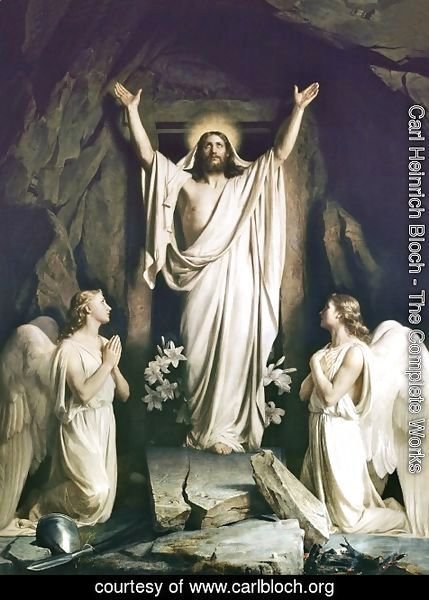
"The Resurrection of Christ" by Bloch
Chambers' Book of Days has an interesting post on the background controversy, and describes this attempt to resolve it:

At the beginning of the fourth century, matters had gone to such a length, that the Emperor Constantine thought it his duty to take steps to allay the controversy, and to insure uniformity of practice for the future. For this purpose, he got a canon passed in the great (Ecumenical Council of Nice (A.D. 325), That everywhere the great feast of Easter should be observed upon one and the same day; and that not the day of the Jewish Passover, but, as had been generally observed, upon the Sunday afterwards.' 

And to prevent all future disputes as to the time, the following rules were also laid down:
'That the twenty-first day of March shall be accounted the vernal equinox.'
'That the full moon happening upon or next after the twenty-first of March, shall be taken for the full moon of Nisan.'
'That the Lord's-day next following that full moon be Easter-day.'
'But if the full moon happen upon a Sunday, Easter-day shall be the Sunday after.'
Of course, it wasn't that easy - the full moon (called the Paschal full moon) is not an astronomical full moon, but the 14th day of a calendar lunar month. Another difference is that the astronomical equinox is a natural astronomical phenomenon, which can fall on March 19th, 20th or 21st, while the ecclesiastical date is fixed by convention on March 21st.

The write-up at Wikipedia is the best I've seen, if you want more particulars on all of this, and the online version of Chamber's Book of Days has some other details.

*Eastern Christianity bases its calculations on the Julian Calendar. Because of the 13-day difference between the calendars between 1900 and 2099, 21 March corresponds, during the 21st century, to 3 April in the Gregorian Calendar. Easter therefore varies between 4 April and 8 May on the Gregorian calendar (the Julian calendar is no longer used as the civil calendar of the countries where Eastern Christian traditions predominate). Also, because the Julian "full moon" is always several days after the astronomical full moon, the eastern Easter is often later, relative to the visible moon's phases, than western Easter.

Among the Oriental Orthodox some churches have changed from the Julian to the Gregorian calendar and the date for Easter as for other fixed and moveable feasts is the same as in the Western church.

Wednesday, March 13, 2024

3/14 Happy Pi Day

March 14 (3/14) is celebrated annually as Pi Day because the date resembles the ratio of a circle’s circumference to its diameter — 3.14159265359... or, rounded off, 3.1416. 2016, therefore, provided a particularly good reason to celebrate: 3/14/16. The year before (3.14.15) was significant because it matched the first four digits after the decimal point - now we're back to regular old Pi.

Archimedes (wiki) (circa 287–212 B.C.) is credited with doing the first calculation of Pi. British mathematician William Jones came up with the Greek letter and symbol for the figure in 1706, the use of which was later popularized by mathematician Leonhard Euler (wiki), beginning in 1737.

Here's a good general explanation of Pi (kid-oriented, but that makes it straightforward):


And here's what Pi sounds like:

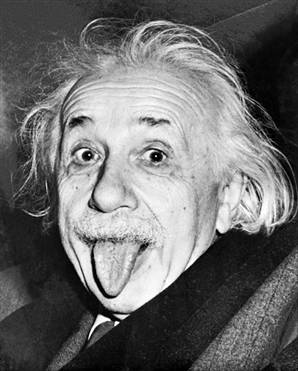
Albert Einstein was born on March 14, 1879: bio, video, and the post-mortem saga of his brain

The greatest aim of all science [is] to cover the greatest number of empirical facts by logical deduction from the smallest possible number of hypotheses or axioms.

Einstein with an Einstein puppet

To know that what is impenetrable to us really exists, manifesting itself as the highest wisdom and the most radiant beauty, which our dull faculties can comprehend only in the most primitive forms - this knowledge, this feeling, is at the center of true religiousness. In this sense, and in this sense only, I belong to the ranks of the devoutly religious men.

~ Albert Einstein (What I Believe)

Our defense is not in armaments, nor in science, nor in going underground. Our defense is in law and order.

~ Einstein (New York Times Magazine, 2 August 1964)

If my theory of relativity is proven correct, Germany will claim me as a German, and France will declare that I am as a citizen of the world. Should my theory prove untrue, France will say that I am a German, and Germany will declare me a Jew.

~ Einstein (address at the Sorbonne, December 1929*)

Worshipped today, scorned or even crucified tomorrow, that is the fate of people whom—God knows why—the bored public has taken possession of.

~ Einstein (letter to Heinrich Zangger, 1922)

Even though without writing each other, we are in mental communication, for we respond to our dreadful times in the same way and tremble together for the future of mankind ... I like it that we have the same given name.

~ Albert Schweitzer (wiki) (1875-1965) (of Einstein, letter, February 1955)

Quintessential theoretical physicist Albert Einstein (wiki) (1879-1955) was born on March 14, 1879 in Ulm, Germany. After an unpromising start in school, Einstein took Swiss citizenship at the age of 15 and while working as a patent examiner in the Swiss patent office in 1905, produced three seminal papers - on the photoelectric effect and the quantum theory of light, Brownian motion, and his theory of special relativity - that forever changed modern physics. 

The general theory of relativity (see video below on recent discovery of gravitational waves) followed in 1916, by which time he was professor of physics at the Kaiser Wilhelm Institute in Berlin, where he continued his theoretical work until 1934, when he fled Germany for the United States to escape Nazi persecution. He was among the prominent physicists who warned President Franklin Roosevelt in 1939 about the destructive potential of nuclear weapons, which led to the Manhattan Project and the atomic bomb. 

Awarded American citizenship in 1940, Einstein spent his last years at Princeton's Institute for Advanced Study, where he sought to develop the so-called "unified field theory" which still eludes physicists today. He is now recognized as the greatest physicist of the 20th century, if not of all time.

Here's a brief biography:


And an explanation of the recent discovery of gravitational waves (based on Einstein's general theory):


After his death in 1955, Einstein's brain (wiki) was removed - without permission from his family - by Thomas Stoltz Harvey, the Princeton Hospital pathologist who conducted the autopsy. Harvey took the brain home and kept it in a jar. He was later fired from his job for refusing to relinquish the organ.

Many years later, Harvey, who by then had gotten permission from Einstein's son Hans Albert to study the brain, sent slices to various scientists throughout the world. There's more here on the postmortem travels and travails of the brain, plus this: the first formal study of Albert Einstein's brain, which describes some differences in structure and morphology.

* N.B. An earlier variant of the same idea (in November 1919):
"By an application of the theory of relativity to the taste of readers, today in Germany I am called a German man of science, and in England, I am represented as a Swiss Jew. If I come to be regarded as a bête noire, the descriptions will be reversed, and I shall become a Swiss Jew for the Germans and a German man of science for the English!"
** This photo was taken by Harry Burnett at Cal Tech in Pasadena where Albert Einstein was teaching. Einstein saw the puppet perform at the Teato Torito and was quite amused. He reached into his jacket’s breast pocket, pulled out a letter and crumpled it up. Speaking in German, he said, “The puppet wasn’t fat enough!” He laughed and stuffed the crumpled letter up under the smock to give the puppet a fatter belly.

Further reading:


Prior to their divorce, Einstein had given to his first wife a rather stringent list of behaviors that he put into writing. He produced another set of criteria for their divorce, including a promise to give to her the proceeds of his not-yet-awarded Nobel Prize.

The plot to kill Einstein.


Parts of the text above is adapted from Ed's Quotation of the Day, only available via email - leave your email address in the comments if you'd like to be added to his list. Ed is the author of Hunters and Killers: Volume 1: Anti-Submarine Warfare from 1776 to 1943 and Hunters and Killers: Volume 2: Anti-Submarine Warfare from 1943.