ICYMI, Monday's links are here, and include and include nose hair extensions, body organs you can live without, Columbus Day, the 4.5 million pieces of undelivered mail that piled up in the Washington, D.C. Dead Letter Office during the Civil War. and some remastered and colorized images from the Civil War era (including Lincoln and Mark Twain).
A victorious line of march had been prolonged above a thousand miles from the rock of Gibraltar to the banks of the Loire. The repetition of an equal space would have carried the Saracens to the confines of Poland and the Highlands of Scotland; the Rhine is not more impassable than the Nile or Euphrates, and the Arabian fleet might have sailed without a naval combat into the mouth of the Thames.
Perhaps the interpretation of the Koran would now be taught in the schools of Oxford, and the pulpit might demonstrate to circumcised people the sanctity and truth of the revelations of Mahomet.
Modern historians have constructed a myth presenting the victory as having saved Christian Europe from the Muslims. Edward Gibbon, for example, called called Charles Martel the savior of Christendom and the battle near Poitiers an encounter that changed the history of the world... This myth has survived well into our own times... Contemporaries of the battle, however, did not overstate its significance. The continuators of Fredegar's chronicle, who probably wrote in the mid-eighth century, pictured the battle as just one of many military encounters between Christians and Saracens - moreover, as only one in a series of wars fought by Frankish princes for booty and territory.
~ Tomaz Mastnak (b. 1953) (Crusading Peace: Christendom, the Muslim World, and Modern Europe)
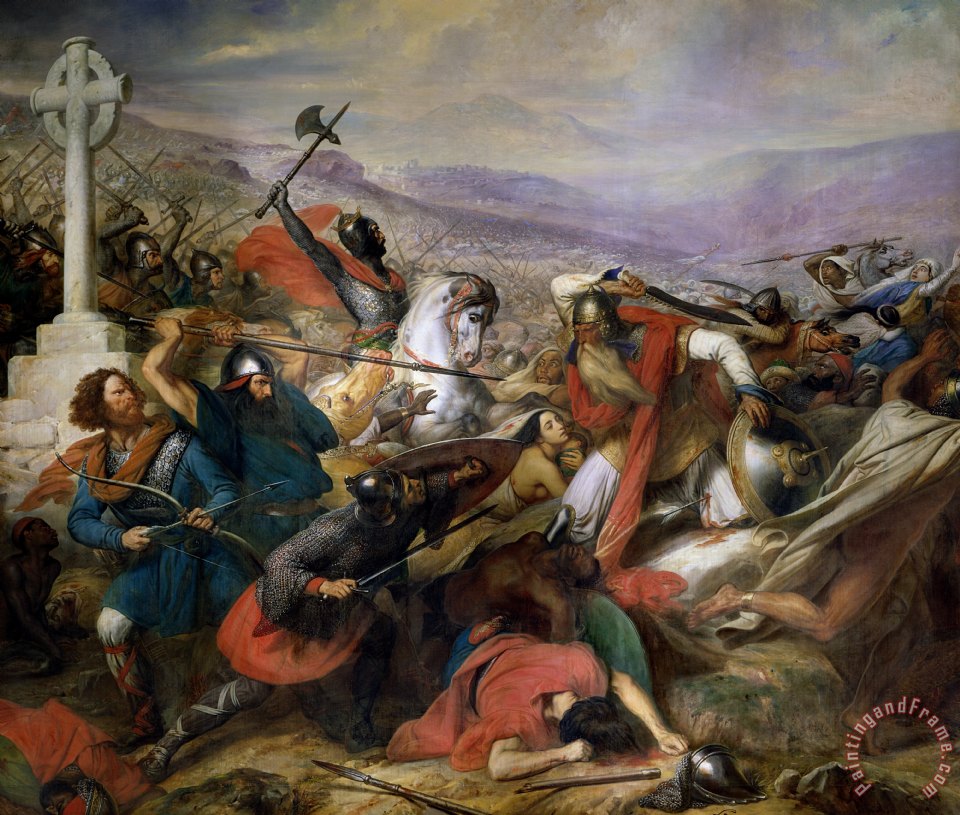
Charles Auguste Steuben, The Battle of Poitiers*
It produced Charles Martel, the soldier who turned the Arabs back at Tours, and the supporter of Saint Boniface the Evangelizer of Germany. This is a considerable double mark to have left on the history of Europe.
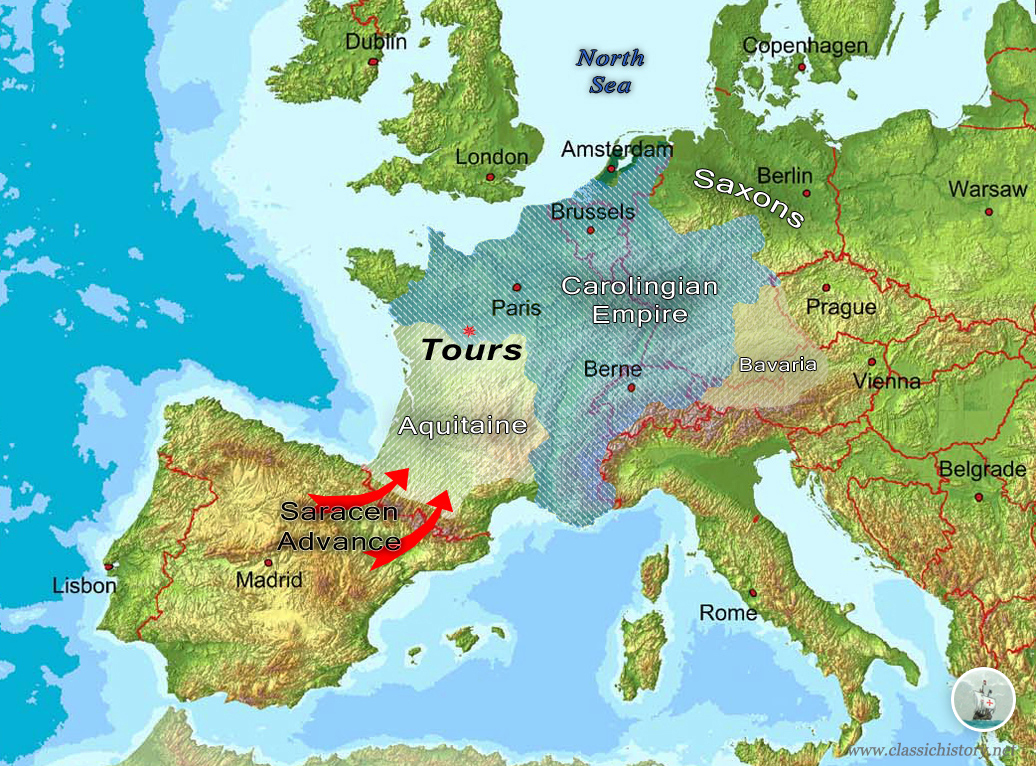
October 10 is the anniversary of the battle of Tours* (wiki) in central France in 732 A.D., when a Frankish army under Charles Martel (wiki)** defeated the Muslim Ummayad invasion of Gaul under Abdul Rahman Al Ghafig. Having conquered virtually all of Spain following their initial crossing from North Africa in 711, the Ummayads sought to extend their holdings farther northward and reached what might be called the "high-water mark" of Islam in Europe, only to be turned back at this encounter. Estimates vary, but it is believed that several tens of thousands fought on each side, with perhaps 12,000 Moorish losses, including their leader Abdul Rahman.
The battle of Tours has long been considered one of the most influential events in medieval history and is said to have "saved" Western Europe from Islamic conquest. Although many modern historians have minimized the importance of this battle in the final outcome, there's no doubting that it firmly established the descendants of Charles Martel - the Carolingian dynasty (wiki) - as the most powerful rulers in the region.
* N.B. The battle was fought between modern-day Tours and Poitiers, and thus is also known as the battle of Poitiers.
** Charles Martel (A.D. 686-741) was the Duke and Prince of the Franks and the Mayor of the Palace, which made him the effective ruler of Francia from 718 to his death. As a result of his victory, he was henceforth known as "the Hammer" and was succeeded by his son Pepin. Pepin's son - and hence Martel's grandson, was Charlemagne (wiki), the first Holy Roman Emperor.
The Battles of Tours was not a war of nations, but rather a battle of civilizations between Islam and Christian Europe. The Muslims had been conquering the remains of the Roman and Persian empires and were heading toward modern day France to continue their expansion. The Frankish King Charles (“The Hammer”) Martel wasn’t about to let that happen, so he gathered his forces at Tours as Abdul Rahman Al Ghafiqi, Governor-General of Moorish Spain, led his Army northward.
The army that Charles amassed was very different from the Arab fighting forces. It was also unlike the Barbarian horde the Muslims had engaged the last time they attacked the area, and had no doubt had expected to encounter again. Previously, the only thing standing between a Frankish soldier and death was a heavy shield – they were now sporting full body armor. Their army boasted a full infantry unit that was quite a contrast to the lightly armed Arab horsemen who relied upon their speed, mobility and fearsomeness to win the field.
Here's a concise description of the events leading up to the battle, and of the battle itself:
ICYMI, Friday's links are here, and include a gallery of bridges made from living roots, senior moment science, UFO detectors, and, from 1930, Information Tests To Try On Your Children.