ICYMI, most recent links are here, and include that time Columbus (using knowledge of an upcoming eclipse) tricked the Jamaicans into providing supplies, painting zebra stripes on cows to ward off biting flies, everything you wanted to know about eyebrow interpretation from the 16th century, and making a knife out of frozen human poop.
For those interested in the history of beer, the London Beer Flood (wiki) took place on October 17, 1814:
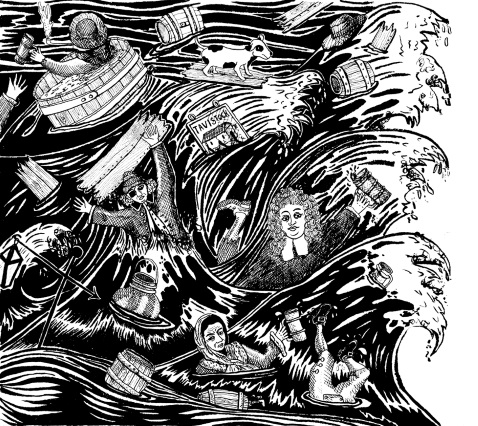
On Monday 17th October 1814, a terrible disaster claimed the lives of at least 8 people in St Giles, London. A bizarre industrial accident resulted in the release of a beer tsunami onto the streets around Tottenham Court Road.
The Horse Shoe Brewery stood at the corner of Great Russell Street and Tottenham Court Road.
In 1810 the brewery had had a 22 foot high wooden fermentation tank installed on the premises. Holding the equivalent of over 3,500 barrels of porter ale, it was held together by massive iron rings. At around 4:30pm on 17 October 1814, storehouse clerk George Crick inspected the tank and noticed that one of the 700-pound iron hoops had slipped off the cask, but, as this occurred two or three times a year, it did not seem unusual and he thought nothing of it. Despite the tank being full and pressure from the fermentation building inside, Crick’s boss told him that no harm would ensue from the broken ring and instructed him to write a letter to another brewery employee requesting it to be fixed at a later date.
Soon after, at around 5:30pm, Crick heard a massive explosion from inside the storeroom. The tank had ruptured, releasing the hot fermenting ale with such force that the vat burst into splinters and the back wall of the brewery collapsed. The blast also set off a chain reaction, breaking off the valve of an adjoining cask and breaking open more vats, adding their contents to the flood which had now burst out onto the street.
More than 320,000 gallons of beer were released into the area. This was St Giles Rookery, a densely populated London slum of cheap housing and tenements inhabited by the poor, the destitute, prostitutes and criminals.
19th century engraving of the event
The flood reached George Street and New Street within minutes, swamping them with a tide of alcohol. The 15 foot high wave of beer and debris inundated the basements of two houses, causing them to collapse. In one of the houses, Mary Banfield and her daughter Hannah were taking tea when the flood hit; both were killed.
In the basement of the other house, an Irish wake was being held for a 2 year old boy who had died the previous day. The four mourners were all killed. The wave also took out the wall of the Tavistock Arms pub, trapping the teenage barmaid Eleanor Cooper in the rubble. In all, eight people were killed. Three brewery workers were rescued from the waist-high flood and another was pulled alive from the rubble.
All this ‘free’ beer led to hundreds of people scooping up the liquid in whatever containers they could. Some resorted to just drinking it, leading to reports of the death of a ninth victim some days later from alcoholic poisoning.
The Horseshoe Brewery at the junction of Tottenham Court Road and Oxford Street. (source)
‘The bursting of the brew-house walls, and the fall of heavy timber, materially contributed to aggravate the mischief, by forcing the roofs and walls of the adjoining houses.‘ The Times, 19th October 1814.
Some relatives exhibited the corpses of the victims for money. In one house, the macabre exhibition resulted in the collapse of the floor under the weight of all the visitors, plunging everyone waist-high into a beer-flooded cellar.
The stench of beer in the area persisted for months afterwards.
The brewery was taken to court over the accident but the disaster was ruled to be an Act of God, leaving no one responsible.
The repaired Horse Shoe Brewery in 1830
The flood cost the brewery around £23000 (approx. £1.25 million today). However the company were able to reclaim the excise duty paid on the beer, which saved them from bankruptcy. They were also granted ₤7,250 (₤400,000 today) as compensation for the barrels of lost beer.
This unique disaster was responsible for the gradual phasing out of wooden fermentation casks to be replaced by lined concrete vats. The Horse Shoe Brewery was demolished in 1922; the Dominion Theatre now sits partly on its site.
The Heineken World Bottle was designed by architect John Habraken. When then-CEO Freddy Heineken was visiting the island of Curaçao, he was bothered by the mass amounts of trash and the lack of housing. His solution? Make a beer bottle that could serve as a brick when it's finished. It was a brilliant compromise, but Heineken's marketing department rejected it as effeminate. There's a photo of a house built with these at the bottom of this post, along with photos showing in more detail how they fit together.
There are a handful of houses in the US built of beer bottles, although not the brick style bottles - here's "The House of a Thousand Headaches" in Hillsville, VA - unlike other bottle houses, the bottles point outward so that the inner walls are flush:
And a Tonopah, Nevada house built in 1902 made from ~10,000 bottles of J. Hostetter’s Stomach Bitters (which consisted of various herbs in a solution of 47% alcohol, so not beer, but in the same spirit):
Building with empty vessels (including bottles) goes back a long way, of course, back at least to ancient Rome, where many structures used empty amphorae embedded in concrete. This was not done for aesthetic reasons, but to lighten the load of upper levels of structures and reduce concrete usage. It's more common to find a wall of bottles than an entire structure.
Here's a tutorial on making your own bottle bricks:
An additional tutorial is here, more on bottle walls here, and more on the Heineken bricks here and here.
ICYMI, Friday's links are here, and include what happened to Napoleon's looted art, why some countries drive on the left and others on the right, the pistachios that need police protection, composting dead family members, and illustrated guides to always being battle-ready - the tactical order of dressing and how to poop like a Samurai.
Sir... the Irish are not in a conspiracy to cheat the world by false representations of the merits of their countrymen. No, Sir, the Irish are a FAIR PEOPLE; - they never speak well of one another.
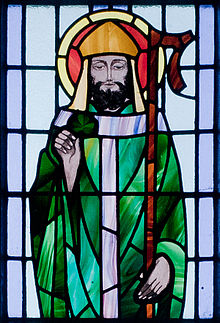
The 17th of March is St. Patrick's Day (wiki), commemorating the patron saint of Ireland, Padraig mac Caiprainn (ca. 390-461?). Much of Patrick's life is shrouded in legend, but he is said to have been born in Roman Britain and was captured and enslaved by Irish raiders until he managed to escape to Gaul. There, he entered the priesthood but returned to Ireland as a missionary and made many converts, reportedly by using the leaves of the shamrock to explain the three-in-one mystery of the Trinity.
In 445, with the approval of Pope Leo the Great (reigned 440-461), he established his arch-episcopal see at Armagh, and by the time of his death, Ireland was largely Christianized. Our principal source about St. Patrick's life is his own Confessions, written in his last years.
My personal favorite Irish joke:
"An Irishman walked out of a bar... " (that's all of it).
The story of St. Patrick:
Some of the stories and traditions associated with Saint Patrick (wiki) are actually probably from another man that preceded Patrick by a 1-3 decades (exactly how much isn’t known), Palladius. It has also been argued by some scholars that the blending of these two’s accomplishments was done purposefully to bolster the prestige of Saint Patrick. Palladius was one of the earliest missionaries to Ireland, ordained by Pope Celestine the first as the “First Bishop to the Irish believing in Christ”. However, accounts seem to indicate the Palladius and his companions’ mission was fairly unsuccessful and Palladius himself was eventually banished by the King of Leinster, at which point he went to Northern Britain to preach to the Scots. Nevertheless, much of what Palladius did accomplish while in Ireland has long since been credited to Saint Patrick instead and it’s difficult to tell in most cases exactly which of them accomplished what.
King George III in 1783 created a “Most Illustrious Order of Saint Patrick”, which is an order of knights of Saint Patrick given to certain people associated with Ireland who the monarchy wishes to honor. It’s been decades since the last person was inducted into this order and the last person in the order died in 1974, Prince Henry the Duke of Gloucester. Nevertheless, the order still technically exists with the Queen functioning as the Sovereign.
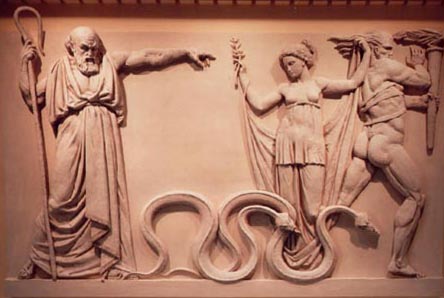
Saint Patrick, Druids, Snakes, and Popular Myths explains the pros and cons of the theory that the “snakes” that Patrick drove out of Ireland were the Druidic priests, who had serpents tattooed on their forearms.
The epic poem Ballad Of The White Horse (link is to a free Kindle version) tells the fascinating story of Alfred the Great's stand against the Danes in 878 - or read about the subject at Wikipedia. Per Amazon:
More than a thousand years ago, the ruler of a beleaguered kingdom saw a vision of the Virgin Mary that moved him to rally his chiefs and make a last stand. Alfred the Great freed his realm from Danish invaders in the year 878 with an against-all-odds triumph at the Battle of Ethandune. In this ballad, G. K. Chesterton equates Alfred's struggles with Christianity's fight against nihilism and heathenism—a battle that continues to this day.
One of the last great epic poems, this tale unfolds in the Vale of the White Horse, where Alfred fought the Danes in a valley beneath an ancient equine figure etched upon the Berkshire hills. Chesterton employs the mysterious image as a symbol of the traditions that preserve humanity. His allegory of the power of faith in the face of an invasive foe was much quoted in the dark days of 1940, when Britain was under attack by Nazis.
This Bill of Mortality shows the death tally of all city parishes in London for the week of Aug 15 - 22, 1665. The Plague is the number 1 cause of death, followed by various fevers, consumption, and Griping in the Guts.
ICYMI, Monday's links are here, and include Stonewall Jackson's birthday (and his left arm's separate grave), how duct tape is made, life in ancient Mongolia, Britain's worst ice skating accident,(which left 41 dead), and that time the doctors pumped 15 cans of beer into a patient's body.
ICYMI, Thursday's links are here, and include the science of mucus, how your brain creates dreams, why humans lost their fur, and Ben Franklin's birthday (including his 200+ synonyms for drunk and the bodies found in his basement,).
ICYMI, Thursday's links are here, and include high-tech forgery (a computer-generated 'Rembrandt' painting), Middle School reading lists 100 years ago vs. today (plus a 1912 test for eighth graders in Kentucky), the Florida town where people cut off their appendages for insurance money, and, for William Shatner's birthday a Star Trek/Monty Python mashup.
ICYMI, Monday's links are here, and include and include nose hair extensions, body organs you can live without, Columbus Day, the 4.5 million pieces of undelivered mail that piled up in the Washington, D.C. Dead Letter Office during the Civil War. and some remastered and colorized images from the Civil War era (including Lincoln and Mark Twain).
ICYMI, Friday's links are here, and include knitting as a patriotic duty in World War 1, early explosives (including cat and bird bombs) from 16th century illustrated manuscripts, the 1900 hurricane that left over 6,000 dead in Galveston, TX, and a look at Puzzlewood, Tolkien’s inspiration for Middle-earth.
ICYMI, Monday's links are here, and include Sir Arthur Conan Doyle's birthday, how to build your own medieval crossbow, when women started growing out and painting their nails, and the history of tea.
It's Girl Scout cookie time again - I always associate them with the beginning of Lent, when I' m contemplating giving up chocolate. Below, by cookie type, are wine pairing recommendations from Wine Club Reviews and Ratings and beer pairing recommendations from Beer and Brewing. Further below, an infographic with suggested whiskey pairings:
Thin Mints
Wine: There are two types of Thin Mints made today, but both combine a wafer, chocolate, and peppermint flavoring. To truly experience the mint & chocolate combination, however, don’t reach for the milk – try a Syrah instead.
Beer: These dark and roasty stouts deliver a mouthfeel that pairs well with the crisp, minty crunch of the wafer cookie (especially if you keep your Thin Mints in the freezer). Consider yourself warned, though, as these beers range from 9—13 percent ABV and you’ll likely find yourself reaching for a second sleeve of cookies in record time.
Perennial Artisan Ales 17
Alesmith Speedway Stout
Shipyard Mint Chocolate Stout
Epic Big Bad Baptist
Hardywood Sidamo Coffee Stout
Samoas (Caramel deLites)
Wine: Banyuls is a red dessert wine from Southwestern France, which pairs amazingly with the dark chocolate stripes on Samoas. For a Plan B, pick up a Port.
Beers: Match the toasted coconut of these cookies with even more toasted coconut and the roasted caramel flavors in these beers:
Creature Comforts Koko Buni
Oskar Blues Death By Coconut
Bruery Mash & Coconut
Funky Buddha Last Snow
Wormtown Norm Chocolate Coconut Stout
Tagalongs (Peanut Butter Patties)
Wine: You’re going to see a trend here: when the cookie has chocolate, grab a bottle of red wine. Tagalongs are no different – find a fruity red wine such as Beaujolais or Zinfandel.
Beer: The vanilla, chocolate, and peanut butter flavors from the Tagalongs sound like adjuncts in a stout. So grab these flavor-filled stouts to heighten the insanity of this pairing.
Off Color DinoS’mores
FiftyFifty Vanilla Eclipse
Prairie Artisan Ales Bomb!
Stone W00tstout
Terrapin Cinnamon Roll’d Wake-n-Bake
Trefoils (Shortbread)
Wine: Light and refreshing, a Trefoil shortbread should be paired with Pinot Noir or even Sparkling wine if the mood is right.
Beer: Stick with tradition by pairing these classic cookies with traditional beer styles such as Baltic porter’s cheek-warming notes of dark fruits and coffee or a Scottish ale with notes of cocoa and coffee and a dash of smoke.
Smuttynose Baltic Porter
Founders Dirty Bastard
Jack’s Abby Framinghammer
Central Waters Brewer’s Reserve Bourbon Barrel Scotch Ale
Oskar Blues Old Chub
Lemonades
Wine: When snacking on these shortbread cookies with lemon-flavored icing, grab a buttery Chardonnay like the 2009 Cambria Chardonnay from Uncorked Ventures.
Beer: The shortbread texture of the cookies and lemon flavors in the icing make an excellent contrasting duo for these citrusy IPAs.
Ballast Point Sculpin
Night Shift Santilli
10 Barrel Joe
Neshaminy Creek Shape of Hops to Come
Against the Grain Rico Sauvin
Thanks-A-Lot
Wine: Shortbread dipped in rich fudge. It’s a tough one, as it combines the light shortbread with the chocolatey fudge, but try a Pinot Noir from Gold Medal Wine Club.
Beer: These shortbread cookies have had one side dunked in chocolate fudge. Keep the two-faced theme going by pairing with a contrasting beer such as these imperial IPAs:
Odell Myrcenary
Bell’s Hopslam
Firestone Walker Double Jack
Or reinforce the cookie flavors with the roasted goodness and creamy mouthfeel of these milk stouts:
Left Hand Nitro Milk Stout
4 Hands Chocolate Milk Stout
Savannah Smiles:
Wine: These are a lemon-based cookie similar to the Lemonades but covered with powered sugar. Try a Pinot Grigio/Gris.
Beer: Push aside that lemon wedge you occasionally put in your beer and, if you must add a wedge, consider accenting your beer with the Savannah Smile instead. The lemon-flavored cookie wedges have been dusted with powdered sugar and pair well with these witbiers and bières de miel.
Allagash White
Westbrook White Thai
Jester King's Bière de Miel
Casey East Bank
Brasserie Dupont Bière De Miel Biologique
Cranberry Citrus Crisps
Wine: Both sweet and tangy because of the cranberry, a good match for these would be a Viognier or the more popular Riesling.
Beer: Try these bières de garde for toffee notes and a subtle spice from farmhouse ale yeast that plays off nicely with the cranberry inundated cookies. Make sure to let these beers warm up a little for maximum intensity.
Suggestions from the Brooklyn Brewshop include these pairings:
Thin Mints with Bootlegger’s Brewery’s Mint Chocolate Porter
Tagalongs with Brooklyn Brew Shop’s own Peanut Butter Porter
Dulce de Leches with Revolution Brewing’s Mad Cow Milk Stout
Lemonades with Brooklyn Brewery’s Sorachi Ace
And finally, Flying Dog Brewery includes the following pairings with its own beers:
ICYMI, Monday"s links are here, and include a set of excellent newspaper corrections, labyrinths of note, Renaissance-style portraits of auto mechanics, and the reasons to elect a supervillain President, with bonus Homer Simpson proving that both candidates are aliens.
ICYMI, Wednesday's links are here, and include the history of ice cream truck jingles, the little-known lyrics from the Star Trek theme song, the anniversary of the Battle of Borodino (on which War and Peace and the 1812 Overture are based), and political maps of the United States from 1850 and 1880.
Free-market economist Milton Friedman's birthday is this weekend: some favorite quotes and short videos. And Beatrix Potter's birthday was yesterday: in addition to Peter Rabbit et al, she produced some gorgeous botanical drawings.
ICYMI, Tuesday's links are here, and include toasters of the 1920s, the coldest places on earth. how a grizzly bear ended up on California's flag, Aldous Huxley's birthday, and an excellent photoessay of animals at war during World War I.
ICYMI, Thursday's links are here, and include St. Patrick's Day, how peacocks look in mid-flight (spoiler alert - they're beautiful), and a 2,100 year old Roman tavern.
ICYMI, Monday's links are here, and include footage of Teddy Roosevelt's first airplane flight in 1910, Columbus Day links, every Girl Scout catalog from 1917 to 2015, and a supercut of technology breaking down, then being beaten until it works again.
ICYMI, Tuesday's links are here, and include lots of autumnal equinox stuff, the biggest guns in history, a gallery of Soviet cigarettes, and a set of photos of Boston after the great fire of 1872.
ICYMI, Monday's links are here, and include the anniversary of the St. Bartholomew's Day massacre, works of art carved into watermelons and Oreos, overlaying an image of a Star Wars warship on the island of Manhattan, and a supercut of improbable weapons used in movies.