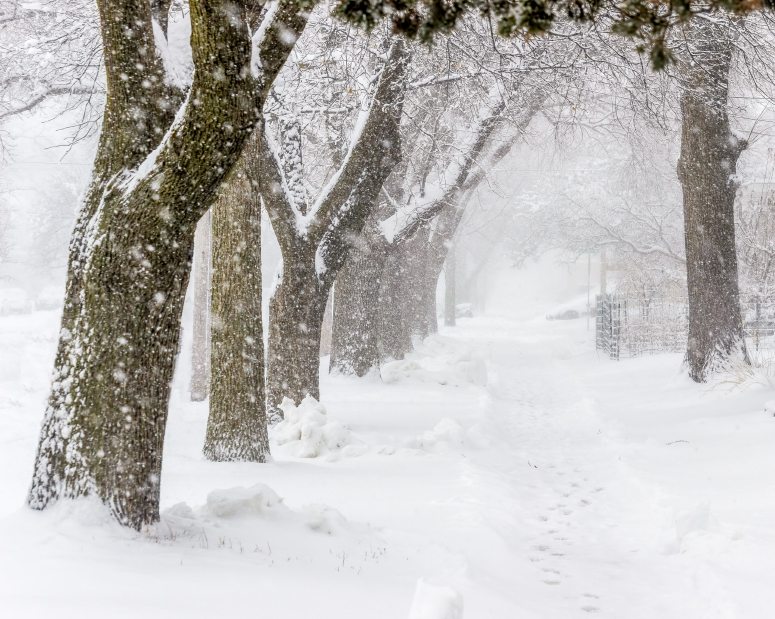
Trees go through a process similar to hibernation called dormancy, and that's what keeps them alive during the winter. Dormancy is like hibernation in that everything within the plant slows down. Metabolism, energy consumption, growth and so on. The first part of dormancy is when trees lose their leaves.
Dormancy is like hibernation in that everything within the plant slows down. Metabolism, energy consumption, growth and so on. The first part of dormancy is when trees lose their leaves. They don't make food in the winter, so they have no use for masses of leaves that would require energy to maintain.
ICYMI, Thursday's links are here, and include St. Bartholomew's Day, the sisters with 37 feet of hair, women's fashion in every year from 1784-1970, and the anniversary of the eruption of Mount Vesuvius and destruction of Pompeii in A.D. 79.
How to Build an Igloo. Giant Snow 'Mushrooms' Are Winter's Rarest Natural Wonder. ICYMI, Wednesday's links are here, and include identifying wildlife droppings, National Fruitcake Toss Day, the giant concrete arrows across the U.S., and a supercut of people falling and landing on vehicles (set to the finale of the 1812 Overture).
In the video below, RealLifeLore looks at the science behind tsunamis and the question of just how massive they can actually become. And it's way bigger than we ever imagined – in some instances capable of creating waves that tower above the biggest buildings humankind has made.
There are two main causes of tsunamis: underwater explosions (like earthquakes or eruptions) and large volumes of material hitting the water (like meteorites or landslides).
What's happening in a tsunami is a principle called water displacement, where some other force or matter takes up the room the water was peacefully occupying and sends it racing off in different directions. The strength of the blast and the distance the water has to travel affects the overall size of the tsunami.
The Indian Ocean tsunami in 2004 was the deadliest tsunami in history and reached heights of 30 metres (or 98 feet). It was generated by a 9.1-magnitude earthquake that produced a greater force than all the explosives used in World War II combined – including the nuclear bombs.
The tsunami that hit Japan in 2011 was from a similarly sized quake to the one in 2004, but the resulting wave towered 40.5 metres (133 feet) into the air. That's just a few metres shorter than the Statue of Liberty.
But as devastating as those waves were, we're still just getting started in terms of potential tsunami size. There's a whole separate category of them, called megatsunamis, usually created by material sliding or falling into the water rather than an earthquake, which throws the waves up much higher.
One of the most tragic examples was the Vajont Dam disaster in 1963 in Italy, where a massive landslide into a dammed reservoir created a wave that reached 250 metres (820 feet) up into the air. It's estimated as many as 2,500 people were killed, but most of the dam structure stood firm and remains in place today. (more at BasementGeographer.
There was an even larger megatsunami than that though, in Lituya Bay, Alaska, in 1958. Again, a powerful landslide was to blame, and this time the terrifying wave reached a peak of 525 metres (1,722 feet) high. (More at Geology.com)
ICYMI, Monday's links are here, and include the end of prohibition, why, when facing predators, male monkeys do whatever the females tell them to do, who poisoned the Goebbels children in Hitler's bunker, and lots of awkward Christmas photos.
ICYMI, Monday"s links are here, and include a set of excellent newspaper corrections, labyrinths of note, Renaissance-style portraits of auto mechanics, and the reasons to elect a supervillain President, with bonus Homer Simpson proving that both candidates are aliens.
ICYMI, Wednesday's links are here, and include maps showing how the continents would look if you could see gravity, how each of the state capitals got their names, Stalin's body double, and a collection of vintage ads you would never see today.
An interesting tidbit about cat behavior: in this BBC clip from Cats Uncovered, veterinarian Dr. John Bradshaw of Bristol University says that cats use the vocalizations that work on their mothers when they're kittens (and then stop working when the kitten is weaned) with their humans as a way of getting attention:
The meow starts off as a kitten vocalization. Its something they use in order to call their mothers over…the mother is very attentive to those meows. And then as the kitten grows up, it gradually stops meowing, presumably because it just stops working. The mother wants to wean the kittens and stops responding. A pet cat is constantly meowing at its owner. It’s a way of getting the owner’s attention.