Amazon Deals

New at Amazon

Showing posts with label Vonnegut. Show all posts

Thursday, May 26, 2022

Kurt Vonnegut's May 29, 1945 letter home after imprisonment in an underground slaughterhouse during the Dresden bombing

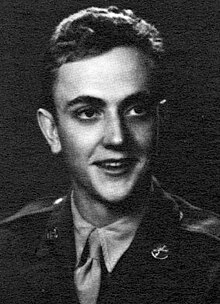
On December 19, 1944, twenty-two year old Kurt Vonnegut (wiki) was captured by Wehrmacht troops. Below is the letter he wrote to his family after the end of the war informing them of his capture and survival. Describing the capture and move to Dresden:
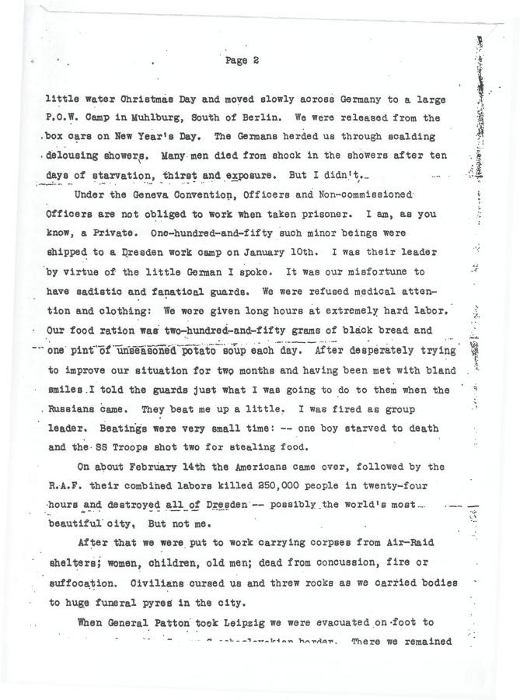
Well, the supermen marched us, without food, water or sleep to Limberg, a distance of about sixty miles, I think, where we were loaded and locked up, sixty men to each small, unventilated, unheated box car. There were no sanitary accommodations -- the floors were covered with fresh cow dung. There wasn't room for all of us to lie down. Half slept while the other half stood. We spent several days, including Christmas, on that Limberg siding. On Christmas eve the Royal Air Force bombed and strafed our unmarked train. They killed about one-hundred-and-fifty of us. We got a little water Christmas Day and moved slowly across Germany to a large P.O.W. Camp in Muhlburg, South of Berlin. We were released from the box cars on New Year's Day. The Germans herded us through scalding delousing showers. Many men died from shock in the showers after ten days of starvation, thirst and exposure. But I didn't.
Under the Geneva Convention, Officers and Non-commissioned Officers are not obliged to work when taken prisoner. I am, as you know, a Private. One-hundred-and-fifty such minor beings were shipped to a Dresden work camp on January 10th.
In Dresden they were imprisoned in an underground slaughterhouse known by German soldiers as "Schlachthof Fünf" (Slaughterhouse Five (wiki)), which, of course, he used 25 years later as the title and organizing principle of his best-known book. During the bombing of Dresden (wiki), which took place in four raids between February 13th and 15th, the subterranean nature of the prison saved their lives: 
On about February 14th the Americans came over, followed by the R.A.F. their combined labors killed 250,000 people* in twenty-four hours and destroyed all of Dresden -- possibly the world's most beautiful city. But not me. 
After that we were put to work carrying corpses from Air-Raid shelters; women, children, old men; dead from concussion, fire or suffocation. Civilians cursed us and threw rocks as we carried bodies to huge funeral pyres in the city. 
Transcript below the scan - read the whole thing.


Transcript

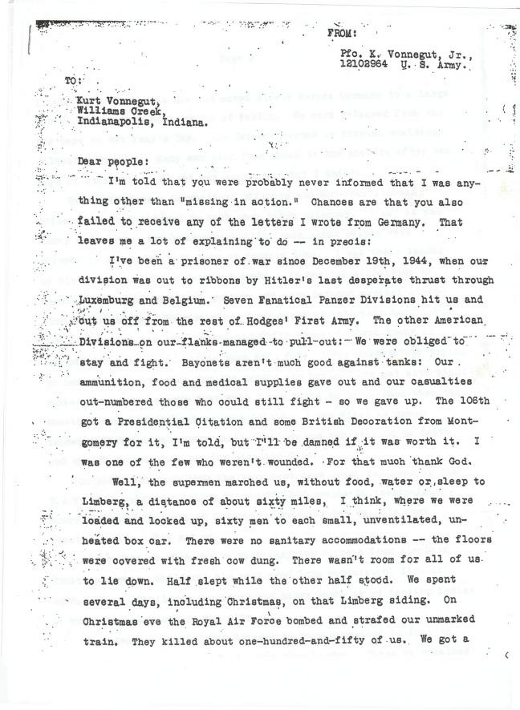
FROM:

Pfc. K. Vonnegut, Jr.,
12102964 U. S. Army.

TO:

Kurt Vonnegut,
Williams Creek,
Indianapolis, Indiana.

Dear people:

I'm told that you were probably never informed that I was anything other than "missing in action." Chances are that you also failed to receive any of the letters I wrote from Germany. That leaves me a lot of explaining to do -- in precis:

The location of the original Slaughterhouse Five
 is now a parking lot in front of an exhibition hall,
 but a stone statue of a cow that once marked
 the entrance to the meatpacking district
somehow survived the bombing. (more here)
I've been a prisoner of war since December 19th, 1944, when our division was cut to ribbons by Hitler's last desperate thrust through Luxemburg and Belgium. Seven Fanatical Panzer Divisions hit us and cut us off from the rest of Hodges' First Army. The other American Divisions on our flanks managed to pull out: We were obliged to stay and fight. Bayonets aren't much good against tanks: Our ammunition, food and medical supplies gave out and our casualties out-numbered those who could still fight - so we gave up. The 106th got a Presidential Citation and some British Decoration from Montgomery for it, I'm told, but I'll be damned if it was worth it. I was one of the few who weren't wounded. For that much thank God.

Well, the supermen marched us, without food, water or sleep to Limberg, a distance of about sixty miles, I think, where we were loaded and locked up, sixty men to each small, unventilated, unheated box car. There were no sanitary accommodations -- the floors were covered with fresh cow dung. There wasn't room for all of us to lie down. Half slept while the other half stood. We spent several days, including Christmas, on that Limberg siding. On Christmas eve the Royal Air Force bombed and strafed our unmarked train. They killed about one-hundred-and-fifty of us. We got a little water Christmas Day and moved slowly across Germany to a large P.O.W. Camp in Muhlburg, South of Berlin. We were released from the box cars on New Year's Day. The Germans herded us through scalding delousing showers. Many men died from shock in the showers after ten days of starvation, thirst and exposure. But I didn't.

Under the Geneva Convention, Officers and Non-commissioned Officers are not obliged to work when taken prisoner. I am, as you know, a Private. One-hundred-and-fifty such minor beings were shipped to a Dresden work camp on January 10th. I was their leader by virtue of the little German I spoke. It was our misfortune to have sadistic and fanatical guards. We were refused medical attention and clothing: We were given long hours at extremely hard labor. Our food ration was two-hundred-and-fifty grams of black bread and one pint of unseasoned potato soup each day. After desperately trying to improve our situation for two months and having been met with bland smiles I told the guards just what I was going to do to them when the Russians came. They beat me up a little. I was fired as group leader. Beatings were very small time: -- one boy starved to death and the SS Troops shot two for stealing food.

Dresden after the bombing raid (wiki)
On about February 14th the Americans came over, followed by the R.A.F. their combined labors killed 250,000 people in twenty-four hours and destroyed all of Dresden -- possibly the world's most beautiful city. But not me.

After that we were put to work carrying corpses from Air-Raid shelters; women, children, old men; dead from concussion, fire or suffocation. Civilians cursed us and threw rocks as we carried bodies to huge funeral pyres in the city.

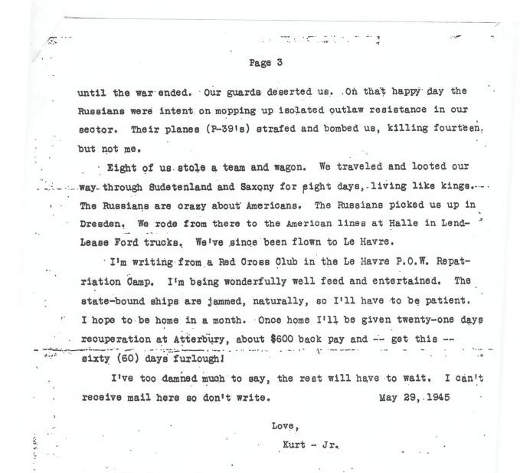
When General Patton took Leipzig we were evacuated on foot to ('the Saxony-Czechoslovakian border'?). There we remained until the war ended. Our guards deserted us. On that happy day the Russians were intent on mopping up isolated outlaw resistance in our sector. Their planes (P-39's) strafed and bombed us, killing fourteen, but not me.

Eight of us stole a team and wagon. We traveled and looted our way through Sudetenland and Saxony for eight days, living like kings. The Russians are crazy about Americans. The Russians picked us up in Dresden. We rode from there to the American lines at Halle in Lend-Lease Ford trucks. We've since been flown to Le Havre.

I'm writing from a Red Cross Club in the Le Havre P.O.W. Repatriation Camp. I'm being wonderfully well feed and entertained. The state-bound ships are jammed, naturally, so I'll have to be patient. I hope to be home in a month. Once home I'll be given twenty-one days recuperation at Atterbury, about $600 back pay and -- get this -- sixty (60) days furlough.

I've too damned much to say, the rest will have to wait, I can't receive mail here so don't write.

May 29, 1945

Love,

Kurt - Jr.

* via a commenter, the book The Bombers and the Bombed: Allied Air War Over Europe, 1940-1945, by Richard Overy (Viking 2013), asserts: "Recent estimates from a historical commission in Dresden have confirmed that the original figure suggested by the city's police president in March 1945 of approximately 25,000 dead is the best available estimate." The 250,000 figure came about via Goebbels' "judicial addition of an additional zero to the provisional casualty estimate."

Via the always interesting but not frequently-enough updated (that was a hint, you guys) blog of Letters of Note.

Previous posts: In 2006, Kurt Vonnegut sent this excellent letter to a high school class, and here's his 1944 letter from a German prison camp.

Wednesday, May 29, 2019

Wednesday links

An earlier battle in the clash of civilizations - May 29, 1453: the fall of Constantinople

A Toilet That Vaporizes Your Poo.

Diet tip of the day: Drinking tequila can lead to weight loss. Among other things.

Kurt Vonnegut's May 29, 1945 letter home after imprisonment in an underground slaughterhouse (Slaughterhouse Five) during the Dresden bombing.

What's the Difference Between Moths and Butterflies?

Do Snails Fart? A Behavioral Ecologist Answers This Burning Question.

ICYMI, Monday's links are here, and include when the worst problem large cities had to deal with was horse manure, advice from 1896 on how to drive an electric car, getting your amputated limbs back from the hospital, and Memorial Day history and links.

Wednesday, May 30, 2018

Wednesday links

Kurt Vonnegut's May 29, 1945 letter home after imprisonment in an underground slaughterhouse (Slaughterhouse Five) during the Dresden bombing.


A Brief History of America’s Appetite for Macaroni and Cheese.

May 29, 1453: the fall of Constantinople to the Ottomans.

18th century tips on managing servants.

Remembering When Only Barbarians Drank Milk: "butter eater” was once a terrible insult.

ICYMI, Monday's links are here, and include Memorial Day links, inside JFK’s door-to-door search for a French call girl (and why she had to look like Jackie), the evolution of the "Beauty and the Beast" story, and the greatest missing art masterpieces.

Monday, May 29, 2017

Monday links

They shall grow not old, as we that are left grow old:
Age shall not weary them, nor the years condemn.
At the going down of the sun and in the morning
We will remember them. 
Death in the Clouds: The Problem of Bodies on Everest

What It's Like to be Struck by Lightning.

An earlier battle in the clash of civilizations - May 29, 1453: the fall of Constantinople. Also on this date, Kurt Vonnegut's May 29, 1945 letter home after being released from being imprisoned in an underground slaughterhouse (Slaughterhouse Five) during the Dresden bombing.

Unbuilt Los Angeles: the city that might have been – in pictures.

This Dog Sits on Seven Editorial Boards.

ICYMI, Friday's links are here, and include a new hottest chili pepper, if meat eaters acted like vegans, early performances of future stars, and T-rex dietary requirements.

Thursday, July 14, 2016

Thursday links

Happy Bastille Day: Here's the classic Jonah Goldberg article on the subject.


Man Spends $51,000 On Supercomputer That Only Plays Tetris.

From Kurt Vonnegut in 1988, a letter to the Ladies & Gentlemen of A.D. 2088.


A Brief History of Trial by Combat.

ICYMI, Friday's links are here, and include Nikola Tesla's birthday, an archive of 3,000 vintage cookbooks. why the Star Trek and Star Wars universes turned out so differently, ancient Minoan culture illustrated with scantily-clad Barbies dolls.

Monday, May 30, 2016

Monday links


Here's Kurt Vonnegut's May 29, 1945 letter home after imprisonment in an underground slaughterhouse (Slaughterhouse Five, specifically) during the Dresden bombing.


ICYMI, Friday's links are here, and include the tactical order of dressing (so you'll always be battle-ready), a history of tug-of-war fatalities, an Australian town on sale for $750,000, and the giant radioactive frog steaks 1913 newspapers predicted we'd be eating.

Friday, May 29, 2015

Friday links

Here's Kurt Vonnegut's May 29, 1945 letter home after imprisonment in an underground slaughterhouse during the Dresden bombing.

The Real “No-Go Zone” of France: A Forbidden No Man’s Land Poisoned by World War 1.

How to Ship a Beluga Whale via UPS.

Pre-Sliced Bread was Once Banned in the United States.

This Is a Wheelchair for a Goldfish.

New Evidence May Solve Mystery Of America's Huge St. Louis Area Ancient City.

Japanese Farmer Finds an Enormous, Mutated Strawberry That Is Now Officially the Heaviest Ever Found.

Tuesday, December 9, 2014

Harrison Bergeron

Unless you've read it, you probably don't realize how short this story is. I've pasted the whole thing below for ease of access, since I refer to it fairly often. Per Wikipedia:
The story satirizes the policy of equality of outcome as an agent for achieving societal equality, and dramatizes the dystopian effects of such a policy if implemented to its logical extreme via government social engineering.


THE YEAR WAS 2081, and everybody was finally equal. They weren't only equal before God and the law. They were equal every which way. Nobody was smarter than anybody else. Nobody was better looking than anybody else. Nobody was stronger or quicker than anybody else. All this equality was due to the 211th, 212th, and 213th Amendments to the Constitution, and to the unceasing vigilance of agents of the United States Handicapper General.

Some things about living still weren't quite right, though. April for instance, still drove people crazy by not being springtime. And it was in that clammy month that the H-G men took George and Hazel Bergeron's fourteen-year-old son, Harrison, away.

It was tragic, all right, but George and Hazel couldn't think about it very hard. Hazel had a perfectly average intelligence, which meant she couldn't think about anything except in short bursts. And George, while his intelligence was way above normal, had a little mental handicap radio in his ear. He was required by law to wear it at all times. It was tuned to a government transmitter. Every twenty seconds or so, the transmitter would send out some sharp noise to keep people like George from taking unfair advantage of their brains.

George and Hazel were watching television. There were tears on Hazel's cheeks, but she'd forgotten for the moment what they were about.

On the television screen were ballerinas.

A buzzer sounded in George's head. His thoughts fled in panic, like bandits from a burglar alarm.

"That was a real pretty dance, that dance they just did," said Hazel.

"Huh" said George.

"That dance-it was nice," said Hazel.

"Yup," said George. He tried to think a little about the ballerinas. They weren't really very good-no better than anybody else would have been, anyway. They were burdened with sashweights and bags of birdshot, and their faces were masked, so that no one, seeing a free and graceful gesture or a pretty face, would feel like something the cat drug in. George was toying with the vague notion that maybe dancers shouldn't be handicapped. But he didn't get very far with it before another noise in his ear radio scattered his thoughts.

George winced. So did two out of the eight ballerinas.

Hazel saw him wince. Having no mental handicap herself, she had to ask George what the latest sound had been.

"Sounded like somebody hitting a milk bottle with a ball peen hammer," said George.

"I'd think it would be real interesting, hearing all the different sounds," said Hazel a little envious. "All the things they think up."

"Um," said George.

"Only, if I was Handicapper General, you know what I would do?" said Hazel. Hazel, as a matter of fact, bore a strong resemblance to the Handicapper General, a woman named Diana Moon Glampers. "If I was Diana Moon Glampers," said Hazel, "I'd have chimes on Sunday-just chimes. Kind of in honor of religion."

"I could think, if it was just chimes," said George.

"Well-maybe make 'em real loud," said Hazel. "I think I'd make a good Handicapper General."

"Good as anybody else," said George.

"Who knows better than I do what normal is?" said Hazel.

"Right," said George. He began to think glimmeringly about his abnormal son who was now in jail, about Harrison, but a twenty-one-gun salute in his head stopped that.

"Boy!" said Hazel, "that was a doozy, wasn't it?"

It was such a doozy that George was white and trembling, and tears stood on the rims of his red eyes. Two of of the eight ballerinas had collapsed to the studio floor, were holding their temples.

"All of a sudden you look so tired," said Hazel. "Why don't you stretch out on the sofa, so's you can rest your handicap bag on the pillows, honeybunch." She was referring to the forty-seven pounds of birdshot in a canvas bag, which was padlocked around George's neck. "Go on and rest the bag for a little while," she said. "I don't care if you're not equal to me for a while."

George weighed the bag with his hands. "I don't mind it," he said. "I don't notice it any more. It's just a part of me."

"You been so tired lately-kind of wore out," said Hazel. "If there was just some way we could make a little hole in the bottom of the bag, and just take out a few of them lead balls. Just a few."

"Two years in prison and two thousand dollars fine for every ball I took out," said George. "I don't call that a bargain."

"If you could just take a few out when you came home from work," said Hazel. "I mean-you don't compete with anybody around here. You just sit around."

"If I tried to get away with it," said George, "then other people'd get away with it-and pretty soon we'd be right back to the dark ages again, with everybody competing against everybody else. You wouldn't like that, would you?"

"I'd hate it," said Hazel.

"There you are," said George. The minute people start cheating on laws, what do you think happens to society?"

If Hazel hadn't been able to come up with an answer to this question, George couldn't have supplied one. A siren was going off in his head.

"Reckon it'd fall all apart," said Hazel.

"What would?" said George blankly.

"Society," said Hazel uncertainly. "Wasn't that what you just said?

"Who knows?" said George.

The television program was suddenly interrupted for a news bulletin. It wasn't clear at first as to what the bulletin was about, since the announcer, like all announcers, had a serious speech impediment. For about half a minute, and in a state of high excitement, the announcer tried to say, "Ladies and Gentlemen."

He finally gave up, handed the bulletin to a ballerina to read.

"That's all right-" Hazel said of the announcer, "he tried. That's the big thing. He tried to do the best he could with what God gave him. He should get a nice raise for trying so hard."

"Ladies and Gentlemen," said the ballerina, reading the bulletin. She must have been extraordinarily beautiful, because the mask she wore was hideous. And it was easy to see that she was the strongest and most graceful of all the dancers, for her handicap bags were as big as those worn by two-hundred pound men.

And she had to apologize at once for her voice, which was a very unfair voice for a woman to use. Her voice was a warm, luminous, timeless melody. "Excuse me-" she said, and she began again, making her voice absolutely uncompetitive.

"Harrison Bergeron, age fourteen," she said in a grackle squawk, "has just escaped from jail, where he was held on suspicion of plotting to overthrow the government. He is a genius and an athlete, is under-handicapped, and should be regarded as extremely dangerous."

A police photograph of Harrison Bergeron was flashed on the screen-upside down, then sideways, upside down again, then right side up. The picture showed the full length of Harrison against a background calibrated in feet and inches. He was exactly seven feet tall.

The rest of Harrison's appearance was Halloween and hardware. Nobody had ever born heavier handicaps. He had outgrown hindrances faster than the H-G men could think them up. Instead of a little ear radio for a mental handicap, he wore a tremendous pair of earphones, and spectacles with thick wavy lenses. The spectacles were intended to make him not only half blind, but to give him whanging headaches besides.

Scrap metal was hung all over him. Ordinarily, there was a certain symmetry, a military neatness to the handicaps issued to strong people, but Harrison looked like a walking junkyard. In the race of life, Harrison carried three hundred pounds.

And to offset his good looks, the H-G men required that he wear at all times a red rubber ball for a nose, keep his eyebrows shaved off, and cover his even white teeth with black caps at snaggle-tooth random.

"If you see this boy," said the ballerina, "do not - I repeat, do not - try to reason with him."

There was the shriek of a door being torn from its hinges.

Screams and barking cries of consternation came from the television set. The photograph of Harrison Bergeron on the screen jumped again and again, as though dancing to the tune of an earthquake.

George Bergeron correctly identified the earthquake, and well he might have - for many was the time his own home had danced to the same crashing tune. "My God-" said George, "that must be Harrison!"

The realization was blasted from his mind instantly by the sound of an automobile collision in his head.

When George could open his eyes again, the photograph of Harrison was gone. A living, breathing Harrison filled the screen.

Clanking, clownish, and huge, Harrison stood - in the center of the studio. The knob of the uprooted studio door was still in his hand. Ballerinas, technicians, musicians, and announcers cowered on their knees before him, expecting to die.

"I am the Emperor!" cried Harrison. "Do you hear? I am the Emperor! Everybody must do what I say at once!" He stamped his foot and the studio shook.

"Even as I stand here" he bellowed, "crippled, hobbled, sickened - I am a greater ruler than any man who ever lived! Now watch me become what I can become!"

Harrison tore the straps of his handicap harness like wet tissue paper, tore straps guaranteed to support five thousand pounds.

Harrison's scrap-iron handicaps crashed to the floor.

Harrison thrust his thumbs under the bar of the padlock that secured his head harness. The bar snapped like celery. Harrison smashed his headphones and spectacles against the wall.

He flung away his rubber-ball nose, revealed a man that would have awed Thor, the god of thunder.

"I shall now select my Empress!" he said, looking down on the cowering people. "Let the first woman who dares rise to her feet claim her mate and her throne!"

A moment passed, and then a ballerina arose, swaying like a willow.

Harrison plucked the mental handicap from her ear, snapped off her physical handicaps with marvelous delicacy. Last of all he removed her mask.

She was blindingly beautiful.

"Now-" said Harrison, taking her hand, "shall we show the people the meaning of the word dance? Music!" he commanded.

The musicians scrambled back into their chairs, and Harrison stripped them of their handicaps, too. "Play your best," he told them, "and I'll make you barons and dukes and earls."

The music began. It was normal at first-cheap, silly, false. But Harrison snatched two musicians from their chairs, waved them like batons as he sang the music as he wanted it played. He slammed them back into their chairs.

The music began again and was much improved.

Harrison and his Empress merely listened to the music for a while-listened gravely, as though synchronizing their heartbeats with it.

They shifted their weights to their toes.

Harrison placed his big hands on the girls tiny waist, letting her sense the weightlessness that would soon be hers.

And then, in an explosion of joy and grace, into the air they sprang!

Not only were the laws of the land abandoned, but the law of gravity and the laws of motion as well.

They reeled, whirled, swiveled, flounced, capered, gamboled, and spun.

They leaped like deer on the moon.

The studio ceiling was thirty feet high, but each leap brought the dancers nearer to it.

It became their obvious intention to kiss the ceiling. They kissed it.

And then, neutraling gravity with love and pure will, they remained suspended in air inches below the ceiling, and they kissed each other for a long, long time.

It was then that Diana Moon Glampers, the Handicapper General, came into the studio with a double-barreled ten-gauge shotgun. She fired twice, and the Emperor and the Empress were dead before they hit the floor.

Diana Moon Glampers loaded the gun again. She aimed it at the musicians and told them they had ten seconds to get their handicaps back on.

It was then that the Bergerons' television tube burned out.

Hazel turned to comment about the blackout to George. But George had gone out into the kitchen for a can of beer.

George came back in with the beer, paused while a handicap signal shook him up. And then he sat down again. "You been crying" he said to Hazel.

"Yup," she said.

"What about?" he said.

"I forget," she said. "Something real sad on television."

"What was it?" he said.

"It's all kind of mixed up in my mind," said Hazel.

"Forget sad things," said George.

"I always do," said Hazel.

"That's my girl," said George. He winced. There was the sound of a rivetting gun in his head.

"Gee - I could tell that one was a doozy," said Hazel.

"You can say that again," said George.

"Gee-" said Hazel, "I could tell that one was a doozy."

"Harrison Bergeron" is copyrighted by Kurt Vonnegut, Jr., 1961.

Monday, June 23, 2014

From Kurt Vonnegut in 1988, a letter to the Ladies & Gentlemen of A.D. 2088

The always interesting but not frequently-enough updated (that was a hint) blog of Letters of Note has this interesting bit of history (it's a bit too man-is-a-plague-upon-the-earth for my tastes, but interesting anyway):
Back in 1988, as part of an ad campaign to be printed in Time magazine, Volkswagen approached a number of notable thinkers and asked them to write a letter to the future—some words of advice to those living in 2088, to be precise. Many agreed, including novelist Kurt Vonnegut; his letter can be read below.
Ladies & Gentlemen of A.D. 2088:

It has been suggested that you might welcome words of wisdom from the past, and that several of us in the twentieth century should send you some. Do you know this advice from Polonius in Shakespeare's Hamlet: 'This above all: to thine own self be true'? Or what about these instructions from St. John the Divine: 'Fear God, and give glory to Him; for the hour of His judgment has come'? The best advice from my own era for you or for just about anybody anytime, I guess, is a prayer first used by alcoholics who hoped to never take a drink again: 'God grant me the serenity to accept the things I cannot change, courage to change the things I can, and wisdom to know the difference.'

Our century hasn't been as free with words of wisdom as some others, I think, because we were the first to get reliable information about the human situation: how many of us there were, how much food we could raise or gather, how fast we were reproducing, what made us sick, what made us die, how much damage we were doing to the air and water and topsoil on which most life forms depended, how violent and heartless nature can be, and on and on. Who could wax wise with so much bad news pouring in?

For me, the most paralyzing news was that Nature was no conservationist. It needed no help from us in taking the planet apart and putting it back together some different way, not necessarily improving it from the viewpoint of living things. It set fire to forests with lightning bolts. It paved vast tracts of arable land with lava, which could no more support life than big-city parking lots. It had in the past sent glaciers down from the North Pole to grind up major portions of Asia, Europe, and North America. Nor was there any reason to think that it wouldn't do that again someday. At this very moment it is turning African farms to deserts, and can be expected to heave up tidal waves or shower down white-hot boulders from outer space at any time. It has not only exterminated exquisitely evolved species in a twinkling, but drained oceans and drowned continents as well. If people think Nature is their friend, then they sure don't need an enemy.

Yes, and as you people a hundred years from now must know full well, and as your grandchildren will know even better: Nature is ruthless when it comes to matching the quantity of life in any given place at any given time to the quantity of nourishment available. So what have you and Nature done about overpopulation? Back here in 1988, we were seeing ourselves as a new sort of glacier, warm-blooded and clever, unstoppable, about to gobble up everything and then make love—and then double in size again.

On second thought, I am not sure I could bear to hear what you and Nature may have done about too many people for too small a food supply.

And here is a crazy idea I would like to try on you: Is it possible that we aimed rockets with hydrogen bomb warheads at each other, all set to go, in order to take our minds off the deeper problem—how cruelly Nature can be expected to treat us, Nature being Nature, in the by-and-by?

Now that we can discuss the mess we are in with some precision, I hope you have stopped choosing abysmally ignorant optimists for positions of leadership. They were useful only so long as nobody had a clue as to what was really going on—during the past seven million years or so. In my time they have been catastrophic as heads of sophisticated institutions with real work to do.

The sort of leaders we need now are not those who promise ultimate victory over Nature through perseverance in living as we do right now, but those with the courage and intelligence to present to the world what appears to be Nature's stern but reasonable surrender terms:
  1. Reduce and stabilize your population.
  2. Stop poisoning the air, the water, and the topsoil.
  3. Stop preparing for war and start dealing with your real problems.
  4. Teach your kids, and yourselves, too, while you're at it, how to inhabit a small planet without helping to kill it.
  5. Stop thinking science can fix anything if you give it a trillion dollars.
  6. Stop thinking your grandchildren will be OK no matter how wasteful or destructive you may be, since they can go to a nice new planet on a spaceship. That is really mean, and stupid.
  7. And so on. Or else. 
Am I too pessimistic about life a hundred years from now? Maybe I have spent too much time with scientists and not enough time with speechwriters for politicians. For all I know, even bag ladies and bag gentlemen will have their own personal helicopters or rocket belts in A.D. 2088. Nobody will have to leave home to go to work or school, or even stop watching television. Everybody will sit around all day punching the keys of computer terminals connected to everything there is, and sip orange drink through straws like the astronauts.

Cheers,

Kurt Vonnegut


Isaac Asimov's 1964 essay predicting life in 2014.