Amazon Deals

New at Amazon

Wednesday, September 6, 2023

September 7 is the anniversary of the battle of Borodino, on which War and Peace and the 1812 Overture are based

French (blue) and Russian (red) troops
before start of battle. Source.

September 7  is the anniversary of the battle of Borodino (wiki) on 7 September 1812, at which Napoleon's (wiki) Grande Armée grappled bitterly with massed Russian forces defending Moscow under Marshal Mikhail Kutusov (1745-1813)* during Napoleon's invasion of Russia. 

Kutusov suffered significant losses, and the French occupied Moscow a week later, but in a month, Napoleon's disastrous retreat toward the west had begun. As Tolstoy noted in War and Peace,
"The cudgel of the people's war was lifted with all its menacing and majestic might, and caring nothing for good taste and procedure, with dull-witted simplicity but sound judgment, it rose and fell, making no distinctions."
Napoleon's own judgment has become more famous:

"Du sublime au ridicule il n'y a qu'un pas."

(From the sublime to the ridiculous is but a step.)

Here's the rousing cannon-punctuated finale of Tchaikovsky's 1812 Overture:


Tchaikovsky (1840-1893) was commissioned to write that staple of summer pops concerts, the 1812 Overture (actually Ouverture Solennelle 1812, Op. 49), for an exhibition of arts and industries at Moscow in 1881. It was intended to commemorate the battle of Borodino and Napoleon's ultimate defeat.**

* N.B. Earlier, at the battle of Smolensk, Kutusov had noted, "The battle has already been decided. It is like a river that runs downhill. I can only move it slightly to the right or left. But its outcome will not be changed by me."

** During the Soviet era, Russian performances of the 1812 Overture substituted an anonymous chorale-like tune for "God Preserve the Czar," the "Russian hymn" quoted by Tchaikovsky in the original.

A brief documentary:


Related post: the anniversary of the 1815 Battle of Waterloo: history, quotes and video (including a Lego re-enactment)

Parts of the text above are based on the late, great Ed Whitman's Quotation of the Day. Ed was my partner and love for 25 years, and the author of Hunters and Killers: Volume 1: Anti-Submarine Warfare from 1776 to 1943 and Hunters and Killers: Volume 2: Anti-Submarine Warfare from 1943.

Friday, August 18, 2023

August 21 is Dorothy Parker's birthday: quotes, poems, a brief bio, and the weird journey of her ashes

A few favorite attributed quotes from Dorothy Parker (wiki):

“Their pooled emotions wouldn’t fill a teaspoon.”

“You can lead a horticulture, but you can't make her think.”

“I’d rather have a bottle in front of me than a frontal lobotomy.”

“I require three things in a man: he must be handsome, ruthless, and stupid.”

August 21 is the anniversary of the birth in 1893 of American humorist, literary critic, and writer Dorothy Parker (wiki, biography.com) (1893-1967), born Dorothy Rothschild in West End, New Jersey. Parker grew up in New York City and in her twenties worked on the magazine Vanity Fair with Robert Benchley and Robert Sherwood. With them, she founded a legendary writer's luncheon group known as Algonquin Hotel's "Round Table" (wiki), (PBS) which ultimately included James Thurber, E.B. White, Ogden Nash (my personal favorite Nash here), and Ring Lardner. 

After 1927, Parker published incisive book reviews in her "Constant Reader" column in the New Yorker and made her literary mark with a series of poignant short stories about the cruelty and absurdity of city living. Later, she collaborated on several screen plays, including A Star is Born(1935), and served as a war correspondent in the Spanish Civil War. Her successes, including two Academy Award nominations, were curtailed as her involvement in left-wing politics led to a place on the Hollywood blacklist.

A few more favorite quotes/poems:

“Beauty is only skin deep, but ugly goes clean to the bone.”

“Men seldom make passes at girls who wear glasses.”

“One more drink and I’ll be under the host.”

"That woman speaks eighteen languages and can’t say ‘no’ in any of them."

“It serves me right for putting all my eggs in one bastard.”

Oh, life is a glorious cycle of song,
A medley of extemporanea;
And love is a thing that can never go wrong;
And I am Marie of Roumania.

"If all the girls who attended the Yale prom were laid end to end, I wouldn't be a bit surprised." 

"It's not the tragedies that kill us, it's the messes." 

My land is bare of chattering folk;
the clouds are low along the ridges,
and sweet's the air with curly smoke
from all my burning bridges. 
By the time you swear you’re his,
Shivering and sighing,
And he vows his passion is
Infinite, undying -
Lady, make a note of this:
One of you is lying.

If you have some time, watch this - The Ten-Year Lunch; Wits & Legends of the Algonquin Round Table (Complete):


Dorothy Parker's memorial and the story of her remains - here's the short(ish) version:

Four suicide attempts never succeeded for Dorothy Parker. When she turned 70, she told an interviewer who asked what she was going to do next, "If I had any decency, I'd be dead. All my friends are." But death waited until she was 73, and a fatal coronary came on June 7, 1967.

Her will was plain and simple. With no heirs, she left her literary estate to Dr. Martin Luther King, Jr. She'd never met the civil rights activist, but always felt strongly for social justice. She named the acerbic author Lillian Hellman as her executor. Parker didn't want a funeral, but Hellman held one anyway, and made herself the star attraction.

Within a year of her death, Dr. King was assassinated, and the Parker estate rolled over to the National Association for the Advancement of Colored People. To this day, the NAACP benefits from the royalty of all Parker publications and productions.

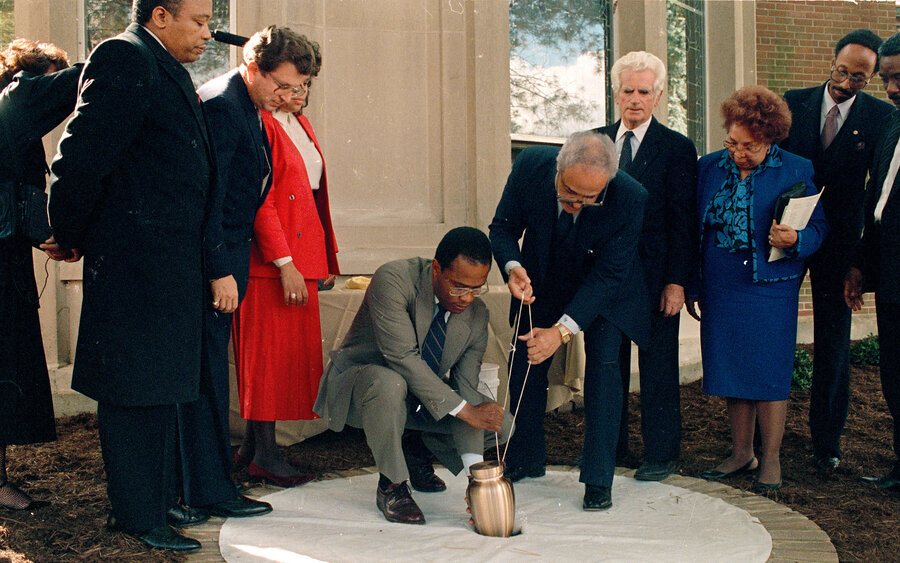
She was cremated, and this is where the story takes a sharp right turn. Parker was cremated on June 9, 1967, at Ferncliff Crematory in Hartsdale, New York. Hellman, who made all the funeral arrangements, never told the crematory what to do with the ashes. So they sat on a shelf in Hartsdale. Six years later, on July 16, 1973, the ashes were mailed to Mrs. Parker's lawyer's offices, O'Dwyer and Bernstein, 99 Wall Street. Paul O'Dwyer, her attorney, didn't know what to do with the little box of ashes. It sat on a shelf, on a desk, and for 15 years, in a filing cabinet.

Hellman went to court to fight the NAACP over Parker's literary estate. Hellman lost in 1972 when a judge ruled that she should be removed from executorship. Hellman was adamant that she get Parker's money, and came out of the mess painted as a racist. She was sure the will was supposed to give her a huge sum. Hellman said, "she must have been drunk when she did it."
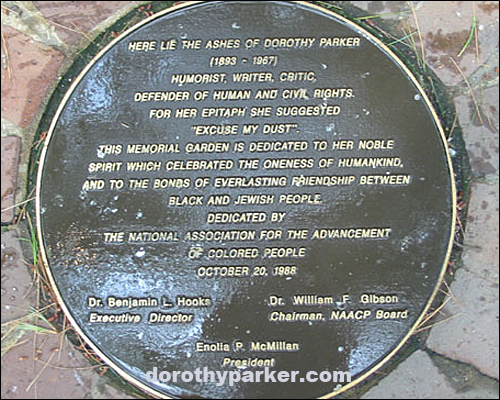
Here lie the ashes of Dorothy Parker (1893-1967)
Humorist, writer, critic, defender of human and
 civil rights. For her epitaph she suggested
 “Excuse My Dust”. This memorial garden is dedicated
 to her noble spirit which celebrated the oneness
 of humankind, and to the bonds of everlas
ting
 friendship between black and Jewish people.

In 1988, someone figured out that Mrs. Parker's ashes were unclaimed, 21 years after her death. New York tabloids ran stories and readers sent in letters about what should be done with the dust. But the NAACP stepped in and took the box from Paul O'Dwyer's drawer. The NAACP built a memorial garden at the national headquarters in Baltimore, and interred the ashes there.

From Christopher Hitchens' 1999 Atlantic article on Parker: Rebel in Evening Clothes:
A small memorial garden was prepared on the grounds of the organization's national headquarters in Baltimore, and a brief ceremony was held at which Mr. Hooks improved somewhat on the terse line about "excuse my dust." It might be better, he said, to recall her lines from "Epitaph for a Darling Lady":
Leave for her a red young rose
Go your way, and save your pity.
She is happy, for she knows
That her dust is very pretty.
In August 2020 the NAACP removed the urn containing Dorothy Parker’s ashes, and returned it to her family members.

More at her website. The Portable Dorothy Parker for a "greatest hits" selection, and, if you'd prefer a biography, What Fresh Hell Is This?.

10 Things You Might Not Know About Dorothy Parker.

Friday, August 11, 2023

Today is Erwin Schrödinger's (he of the famous half-dead cat) birthday: explanation, quotes, jokes, video

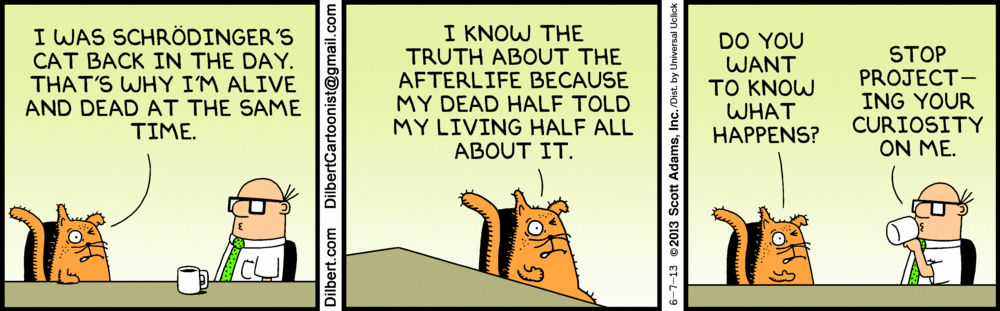
A brief explanation of Schrödinger's cat (wiki): A cat, a flask of poison, and a radioactive source are placed in a sealed box. If an internal monitor detects radioactivity (i.e. a single atom decaying), the flask is shattered, releasing the poison that kills the cat. The Copenhagen interpretation of quantum mechanics implies that after a while, the cat is simultaneously alive and dead. When one looks in the box, however, he sees the cat either alive or dead, not both alive and dead. This poses the question of when exactly quantum superposition ends and reality collapses into one possibility or the other. The Einstein quotation below refers to an earlier version of the experiment that replaced poison with an explosive charge to kill the cat.


If I am to have an interest in something, others must also have one. My word is seldom the first, but often the second, and may be inspired by a desire to contradict or to correct, but the consequent extension may turn out to be more important than the correction, which served only as a connection.

~ Erwin Schrödinger (Nobel Prize address, 1933)

I insist upon the view that "all is waves."

~ Schrödinger (letter to John Lighton Synge, 9 November 1959)

If we were bees, ants, or Lacedaemonian warriors, to whom personal fear does not exist, and cowardice is the most shameful thing in the world, warring would go on forever. But luckily we are only men - and cowards.

~ Schrödinger (Mind and Matter, 1958)

You are the only contemporary physicist, besides Laue,* who sees that one cannot get around the assumption of reality - if only one is honest. Most of them simply do not see what sort of risky game they are playing with reality - reality as something independent of what is experimentally established. Their interpretation is, however, refuted most elegantly by your system of radioactive atom + amplifier + charge of gun powder + cat in a box, in which the psi-function of the system contains both the cat alive and blown to bits. Nobody really doubts that the presence or absence of the cat is something independent of the act of observation.

~ Albert Einstein (1879-1955) (letter to Schrödinger, 1950)

Today is the anniversary of the birth of Austrian physicist Erwin (Rudolf Josef Alexander) Schrödinger (wiki) (1887-1961), one of the most important figures in the development of quantum theory. After early study at the University of Vienna and service in the Austrian fortress artillery during World War I, Schrödinger steadily advanced up the scientific/academic ladder in a series of positions at the universities of Stuttgart, Breslau, and Zurich before becoming a professor at the Friedrich Wilhelm University in Berlin in 1927.

He left Germany with the rise of Nazism in 1933 and taught briefly at Oxford, but then returned to the University of Graz (Austria) in 1936. After Austria was absorbed into the Third Reich, Schrödinger fled to Italy, then to England and Belgium, eventually settling in Ireland for most of the rest of his life. Schrödinger's greatest contribution to quantum theory was in his challenge to the "Copenhagen interpretation" of quantum behavior, which described aspects of fundamental particles only in terms of their probabilities of observation. He dramatized the resulting contradictions with common sense by devising the "thought experiment" known as Schrödinger's cat (wiki) and substituted a quantum interpretation based on the idea of "wave mechanics," in which the position of a particle is described in terms of probability functions, , satisfying the Schrödinger wave equation,


where E is the energy of a particle's state. The philosophical issues raised by Schrödinger's cat are still debated today, and it remains his most enduring legacy in popular science. His wave equation represents his most important finding at a more technical level and has been applied to the understanding of a long series of quantum phenomena and applications.

At an early age, Schrödinger became a student of eastern religions, and in addition to his prolific scientific writings, produced a number of philosophical studies on the relation of science to ethics and religion, as well as theoretical biology. He received the Nobel Prize for physics in 1933 for the derivation of his quantum wave equation. 

* N.B. Max von Laue (1879-1960) was a German physicist who won the Nobel Prize in 1914 for his work on the diffraction of X-rays by crystals.

Anyone remember the Heisenberg joke about being stopped for speeding?

Heisenberg was driving down the Jersey Turnpike when a policeman pulled him over.

The policeman asked Heisenberg, "Do you know how fast you were going?"

And Heisenberg said, "No, but I can tell you exactly where I was."
 
So there's a variation where Schrödinger is the driver, and the cop searches his car: 
 
The cop insists on searching the car (4th amendment doesn't apply in New Jersey) and then asks Schrödinger, "Do you know you have a dead cat in the trunk?",

Schrödinger replies, "Well, now I do."

And my personal favorite:

Schrödinger's cat walks into a bar... and doesn't.

Here's a brief (less than 2 minutes) explanation:


And here's a Big Bang Theory discussion of the concept:


Here are a couple of Dr. Seuss-esque explanations - the first is from Straight Dope, one of my favorite websites:

Schroedinger, Erwin! Professor of physics!
Wrote daring equations! Confounded his critics!
(Not bad, eh? Don't worry. This part of the verse
Starts off pretty good, but it gets a lot worse.)
Win saw that the theory that Newton'd invented
By Einstein's discov'ries had been badly dented.
What now? wailed his colleagues. Said Erwin, "Don't panic,
No grease monkey I, but a quantum mechanic.
Consider electrons. Now, these teeny articles
Are sometimes like waves, and then sometimes like particles.
If that's not confusing, the nuclear dance
Of electrons and suchlike is governed by chance!
No sweat, though — my theory permits us to judge
Where some of 'em is and the rest of 'em was."
Not everyone bought this. It threatened to wreck
The comforting linkage of cause and effect.
E'en Einstein had doubts, and so Schroedinger tried
To tell him what quantum mechanics implied.
Said Win to Al, "Brother, suppose we've a cat,
And inside a tube we have put that cat at —
Along with a solitaire deck and some Fritos,
A bottle of Night Train, a couple mosquitoes
(Or something else rhyming) and, oh, if you got 'em,
One vial prussic acid, one decaying ottom
Or atom — whatever — but when it emits,
A trigger device blasts the vial into bits
Which snuffs our poor kitty. The odds of this crime
Are 50 to 50 per hour each time.
The cylinder's sealed. The hour's passed away. Is
Our pussy still purring — or pushing up daisies?
Now, you'd say the cat either lives or it don't
But quantum mechanics is stubborn and won't.
Statistically speaking, the cat (goes the joke),
Is half a cat breathing and half a cat croaked.
To some this may seem a ridiculous split,
But quantum mechanics must answer, "Tough shit.
We may not know much, but one thing's fo' sho':
There's things in the cosmos that we cannot know.
Shine light on electrons — you'll cause them to swerve.
The act of observing disturbs the observed —
Which ruins your test. But then if there's no testing
To see if a particle's moving or resting
Why try to conjecture? Pure useless endeavor!
We know probability — certainty, never.'
The effect of this notion? I very much fear
'Twill make doubtful all things that were formerly clear.
Till soon the cat doctors will say in reports,
"We've just flipped a coin and we've learned he's a corpse."'
So saith Herr Erwin. Quoth Albert, "You're nuts.
God doesn't play dice with the universe, putz.
I'll prove it!" he said, and the Lord knows he tried —
In vain — until fin'ly he more or less died.
Win spoke at the funeral: "Listen, dear friends,
Sweet Al was my buddy. I must make amends.
Though he doubted my theory, I'll say of this saint:
Ten-to-one he's in heaven — but five bucks says he ain't."

— Cecil Adams


This was sent by a friend, and the description and book cover design are by Nathan W. Pyle

I do not see him here or there.
I do not see him anywhere.
I think he may be in that box,
introducing me to paradox.

I think that cat,
he may be dead,
lying in his cardboard bed.
In the box he would not thrive,
but chances are he’s still alive.

There's lots of Schrödinger's cat merchandise out there - try Amazon and/or Cafepress.

Wednesday, August 2, 2023

Puttanesca Sauce

Linguine alla Puttanesca  (Linguine, “Whore Style”).

4  Tbs olive oil (extra virgin)

2  large garlic cloves, peeled and sliced thinly

1  large fire-roasted red pepper (available bottled), seeded and sliced into thin strips

4  Oz olive-oil packed anchovies, drained and pounded to a paste (This is one small tin; I generally use about 3/4s of it – to taste.)

1  2-pound can of imported Italian peeled tomatoes, drained (but save some of the juice in case you need to thin the sauce later.)  

1  Cup pitted black olives, not from California, which will give the wrong flavor!  (I use pitted Kalamata olives – bottled – from Greece and halve them.)  

2  Tbs small capers (but some extra won’t hurt…)  

1  pound dried pasta

Heat the oil in a heavy skillet, add the garlic and diced red peppers, and fry gently for 6 or 7 minutes until the garlic is softened. Add the pounded anchovies and cook until they dissolve, stirring until thoroughly blended.  

Cut the tomatoes coarsely and add to the pan along with the olives and capers. Cook gently, stirring frequently, until the sauce thickens and begins to take on a slightly brownish hue.  This generally takes about 30 minutes. It must not be watery, but not too thick either…  

Meanwhile, cook the pasta in salted water until al dente – follow package directions – and drain in a colander. Serve in warmed pasta bowls with a generous ladle of sauce on each serving. Alternatively, you can pile all the pasta on a serving plate, spread the sauce on top, and toss it. 

The recipe doubles and triples reasonably well. 

Buon Appetito!

Historical note: Puttanesca sauce has been a Neapolitan classic for more than a century, its name deriving from an impolite Italian word for prostitute – la puttane. One finds several competing theories for the origin of the name, but no one really knows its real derivation. Here are the most popular suggestions:  

(1)  Because the ingredients are readily available, and it cooks quickly, it was easy for a woman of the night to prepare the dish as a pick-me-up between “assignments.”  

(2) Some of the ingredients - notably the olives, anchovies, and capers - are reputed to be aphrodisiacs.  

(3)  It can be made very salty, thus encouraging the puttane’s “clients” to drink more.  

Friday, July 21, 2023

For NatGeo's #SharkWeek: the Batman 1966 Shark Repellent Bat Spray


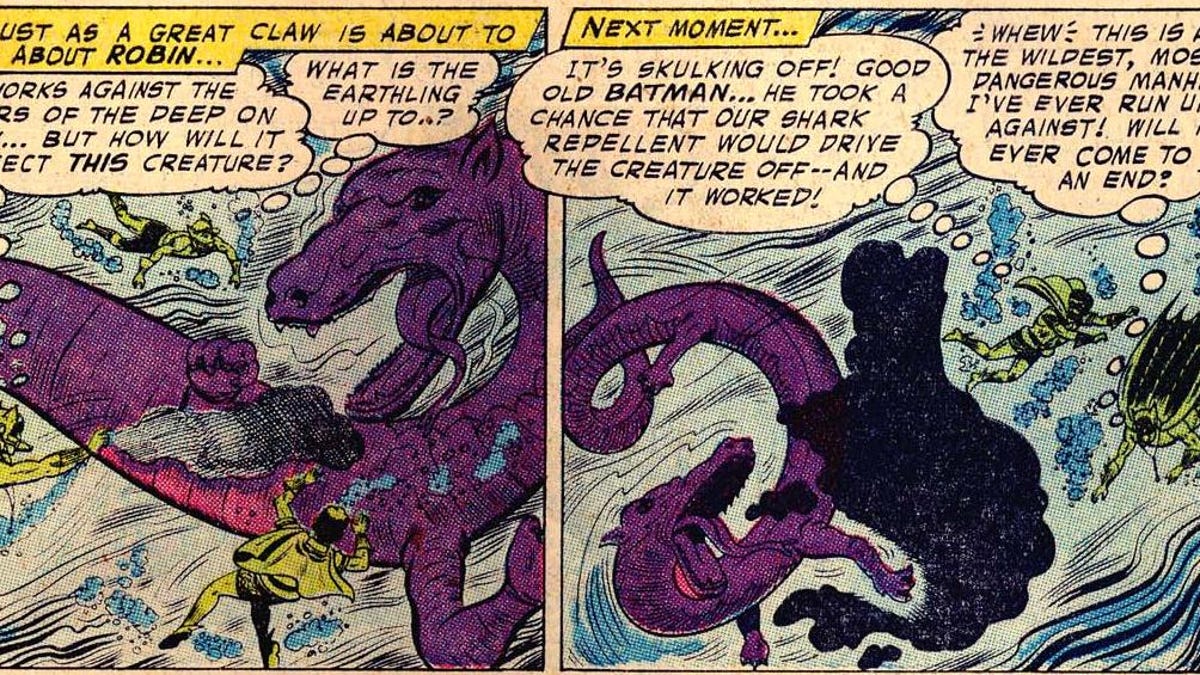
I'm reminded of this every year during Shark Week - in the clip below, Adam West's 1966 Batman fends off an angry about-to-explode shark with a can of shark repellent spray. That scene was actually rather faithful to the early Batman comics, which show that the Dark Knight does, indeed, carry around a can of shark repellent with him at all times. You know, just in case.

So, Batman is hanging from the Bat-copter (on the Bat-ladder) and is attacked by an about-to-explode shark. He wrestles with it for a bit and tries a few ineffectual Bat-punches to the shark’s head and body, then grabs his Bat-radio and asks Robin to throw him down a can of Shark Repellent Bat-Spray. This is stored in the Bat-copter along with three other “Oceanic Repellent Bat Sprays” designed to fend off, in addition to sharks, whales, manta rays and barracudas. Too bad Steve Irwin didn't think to carry those.


There is, of course, a Lego re-enactment:


Kind of related: Mythbusters on Does "Essence of Dead Sharks" Work as Shark Repellent?:


More at Fact Fiend - Batman Really Does Carry Shark Repellent Spray.

Related: 

It was actually first developed during World War II in an effort to help save the lives of seamen and pilots who had to await rescue in open water

Here's the 1983 episode of The Family Feud: the cast of Gilligan's Island vs the cast of Batman.


The Evolution of Batman in Cinema: From 1939 to Present.