May the Great God, whom I worship, grant to my country and for the benefit of Europe in general, a great and glorious Victory; and may no misconduct in any one tarnish it; and may humanity after Victory be the predominant feature of the British Fleet. For myself, individually, I commit my life to Him who made me, and may His blessing light upon my endeavors for serving my Country faithfully. To Him I resign myself and the just cause which is entrusted to me to defend. Amen. Amen. Amen.
~ Horatio, Lord Nelson (wiki) (his prayer, 20 October 1805, on the eve of the Battle of Trafalgar)

~ Nelson (memorandum, written onboard HMS Victory, off Cadiz, 9 October 1805)
ENGAGE THE ENEMY MORE CLOSELY
~ Nelson's favorite signal* (made "general" to the fleet by him for the last time at 1156 on 21 October 1805)
October 21 is Trafalgar Day (wiki), the anniversary of the Battle of Trafalgar and the death of England's greatest naval hero, Admiral Horatio Nelson (wiki) on 21 October 1805. Fought off the southwest coast of Spain, Trafalgar was the greatest naval victory of the Napoleonic wars and essentially destroyed the sea power of France in a single engagement. Nelson and the British fleet had been blockading the French and Spanish fleet under Villeneuve in Cadiz after pursuing it to the Caribbean and back. When Villeneuve finally emerged to give battle, Nelson, depending on the superior seamanship and fighting skill of his "band of brothers" and the British sailor, adopted an unorthodox tactic that split the French/Spanish line into three parts and led to a general melee in which the British took 19 ships without loss.
At the height of the battle however, Nelson was cut down by a French sharpshooter's bullet, and he died a few hours later. In his History of Modern Europe (1883), Charles Alan Fyfe wrote,
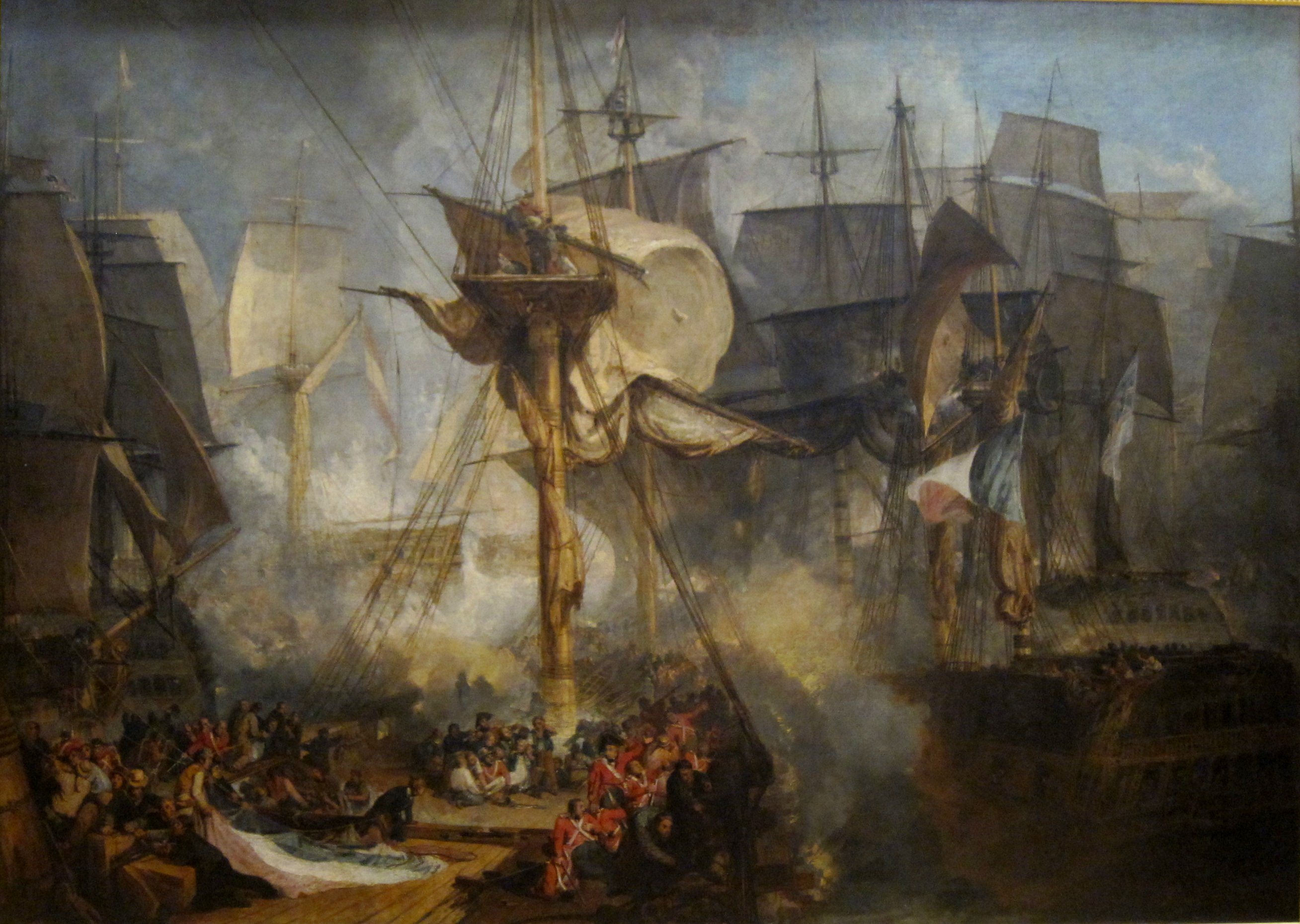 |
| Larger version here. One of several paintings of the battle of Trafalgar by English artist J. M. W. Turner (wiki) (1875-1851) |
"Trafalgar was not only the greatest naval victory, it was the greatest and the most momentous victory either by land or by sea during the whole of the Revolutionary War.** No victory, and no series of victories, of Napoleon produced the same effect upon Europe... Nelson's last triumph left England in such a position that no means remained to injure her."
* N.B. However, much more famous was his signal at the start of the battle:
"ENGLAND EXPECTS THAT EVERY MAN WILL DO HIS DUTY"
Per the online searchable version of Chambers' Book of Days (1869):
There are three accounts of the matter one by Mr. James, in his Naval History; one by Captain Blackwood, who commanded the Euryalus at the battle of Trafalgar; and one by Captain Pasco, who had been Nelson's flag-lieutenant in the Victory. Sir Harris Nicolas accepts Pasco's version, because that officer had himself to signal the words by means of flags. His account runs thus: 'His lordship came to me on the poop, and after ordering certain signals to be made, about a quarter to noon he said: "Mr. Pasco, I wish to say to the fleet, 'England confides that every man will do his duty;' and he added, "you must be quick, for I have one more to make, which is for close action." I replied: "If your lordship will permit me to substitute 'expects,' for confides! the signal will soon be completed, because the word 'expects' is in the vocabulary, whereas the word 'confides' must be spelled?" His lordship replied in haste, and with scenting satisfaction: "That will do, Pasco; make it directly!"In signal flags, this appeared as:

** Meaning here, the conflicts that followed the French revolution in 1789.
BBC's Battlefield Academy: Refight Trafalgar! - Refight Nelson's greatest battle against the remorseless Artificial Intelligence engine of the Academy.
Here's a 1955 newsreel of Queen Elizabeth celebrating Trafalgar day:
A short video re-enactment:
And an excellent 8 minute synopsis of the events leading to and following the battle, as well as of the battle itself:
Since this post is largely is about Trafalgar Day the Lady Hamilton affair is left out. BBC History has more on that, if you're interested.
Also, here's their Animated Map: Battle of Trafalgar - A step-by-step guide to the battle.
 |
| Larger version of this map, which details the names of each ship, is available here. |
Since this post is largely is about Trafalgar Day the Lady Hamilton affair is left out. BBC History has more on that, if you're interested.
History.com's page on the battle.
British Battles Trafalgar page.
The Battle of Trafalgar by Andrew Lambert
Trafalgar: The Long-Term Impact by NAM Rodger
Napoleon, Nelson and the French Threat by Dan Cruickshank
Nelson: The Hero and the Man by Colin White
The Art of War Gallery by Professor Daniel Moran
Life at Sea in the Royal Navy of the 18th Century by Andrew Lambert
Women in Nelson's Navy by Nick Slope
Parts of the text above are adapted from Ed's Quotation of the Day, only available via email - leave your email address in the comments if you'd like to be added to his list. Ed is the author of Hunters and Killers: Volume 1: Anti-Submarine Warfare from 1776 to 1943 and Hunters and Killers: Volume 2: Anti-Submarine Warfare from 1943.
Parts of the text above are adapted from Ed's Quotation of the Day, only available via email - leave your email address in the comments if you'd like to be added to his list. Ed is the author of Hunters and Killers: Volume 1: Anti-Submarine Warfare from 1776 to 1943 and Hunters and Killers: Volume 2: Anti-Submarine Warfare from 1943.