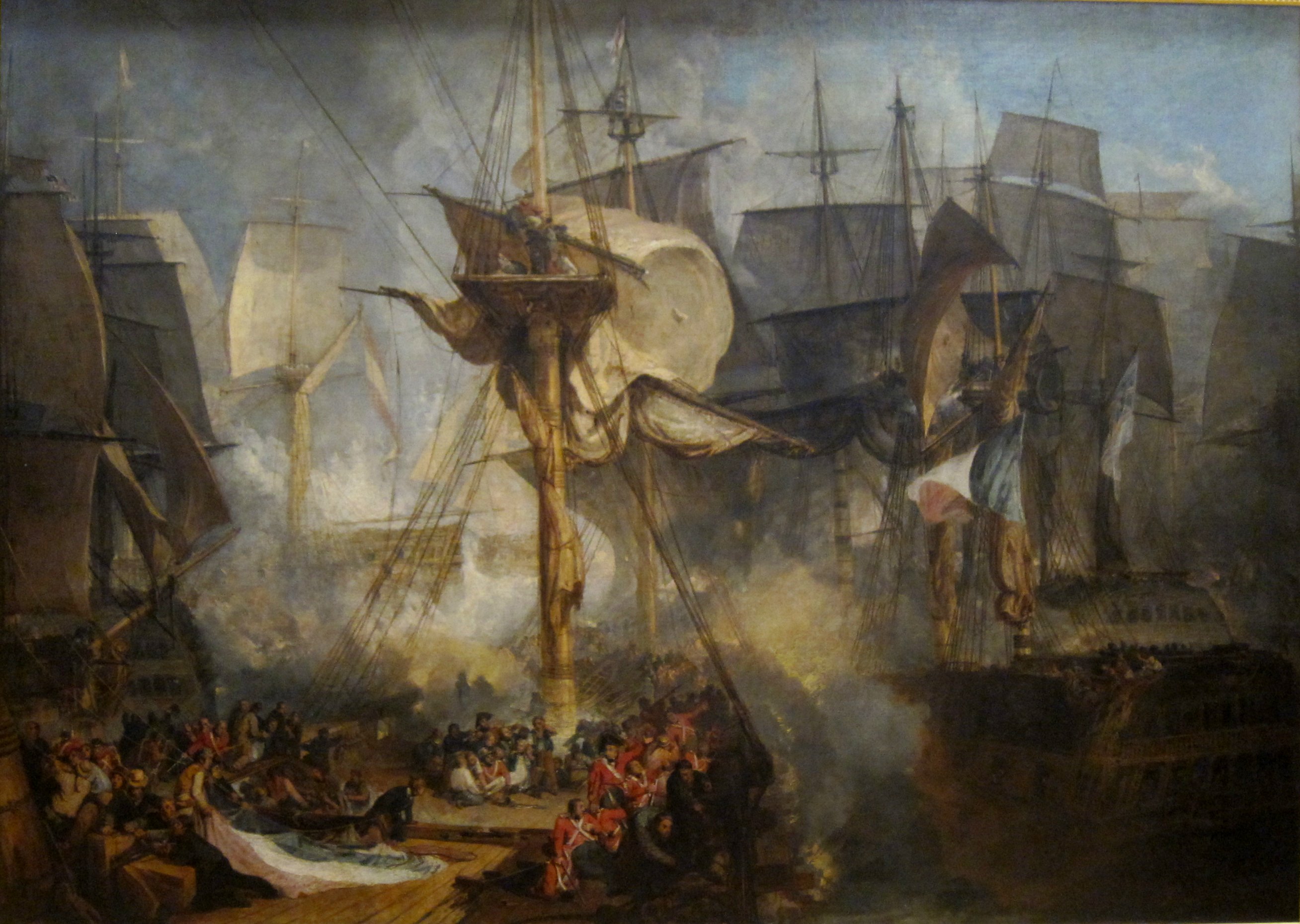
October 21 is Trafalgar Day: history, videos, art and links. Trafalgar was the greatest British naval victory of the Napoleonic wars and essentially destroyed the sea power of France in a single engagement..
ICYMI, most recent links are here, and include the 1814 London Beer Flood that killed 8 people, a detailed account of the Notre Dame restoration process, a map of the entire internet as of 1973 that fit on one sheet of paper, and, from 1865, Mark Twain's proposal for climate control.
A Deep Dive Into Uranus Jokes, because they never get old.
ICYMI, Wednesday's links are here, and include teaching yourself to echolocate, where to poop in King Henry VIII's Hampton Court Palace, jet engines on trucks, Rita Hayworth's birthday (and an excellent compilation of her dancing), and patching crumbling walls with LEGOs.
May the Great God, whom I worship, grant to my country and for the benefit of Europe in general, a great and glorious Victory; and may no misconduct in any one tarnish it; and may humanity after Victory be the predominant feature of the British Fleet. For myself, individually, I commit my life to Him who made me, and may His blessing light upon my endeavors for serving my Country faithfully. To Him I resign myself and the just cause which is entrusted to me to defend. Amen. Amen. Amen.
~ Horatio, Lord Nelson (wiki) (his prayer, 20 October 1805, on the eve of the Battle of Trafalgar)
No captain can do very wrong if he places his ship alongside that of an enemy.
~ Nelson (memorandum, written onboard HMS Victory, off Cadiz, 9 October 1805)
ENGAGE THE ENEMY MORE CLOSELY
~ Nelson's favorite signal* (made "general" to the fleet by him for the last time at 1156 on 21 October 1805)
October 21 is Trafalgar Day (wiki), the anniversary of the Battle of Trafalgar and the death of England's greatest naval hero, Admiral Horatio Nelson (wiki) on 21 October 1805. Fought off the southwest coast of Spain, Trafalgar was the greatest naval victory of the Napoleonic wars and essentially destroyed the sea power of France in a single engagement. Nelson and the British fleet had been blockading the French and Spanish fleet under Villeneuve in Cadiz after pursuing it to the Caribbean and back. When Villeneuve finally emerged to give battle, Nelson, depending on the superior seamanship and fighting skill of his "band of brothers" and the British sailor, adopted an unorthodox tactic that split the French/Spanish line into three parts and led to a general melee in which the British took 19 ships without loss.
At the height of the battle however, Nelson was cut down by a French sharpshooter's bullet, and he died a few hours later. In his History of Modern Europe (1883), Charles Alan Fyfe wrote,
"Trafalgar was not only the greatest naval victory, it was the greatest and the most momentous victory either by land or by sea during the whole of the Revolutionary War.** No victory, and no series of victories, of Napoleon produced the same effect upon Europe... Nelson's last triumph left England in such a position that no means remained to injure her."
* N.B. However, much more famous was his signal at the start of the battle:
There are three accounts of the matter one by Mr. James, in his Naval History; one by Captain Blackwood, who commanded the Euryalus at the battle of Trafalgar; and one by Captain Pasco, who had been Nelson's flag-lieutenant in the Victory. Sir Harris Nicolas accepts Pasco's version, because that officer had himself to signal the words by means of flags. His account runs thus: 'His lordship came to me on the poop, and after ordering certain signals to be made, about a quarter to noon he said: "Mr. Pasco, I wish to say to the fleet, 'England confides that every man will do his duty;' and he added, "you must be quick, for I have one more to make, which is for close action." I replied: "If your lordship will permit me to substitute 'expects,' for confides! the signal will soon be completed, because the word 'expects' is in the vocabulary, whereas the word 'confides' must be spelled?" His lordship replied in haste, and with scenting satisfaction: "That will do, Pasco; make it directly!"
In signal flags, this appeared as:
** Meaning here, the conflicts that followed the French revolution in 1789.
ICYMI, Monday's links are here, and include instructions on tracking humans, Dave Barry's 1996 Halloween column, debunking the 5-second rule, photos and videos of ships vs big waves, and, for Rita Hayworth's birthday, an excellent compilation of her dancing.