Amazon Deals

New at Amazon

Showing posts with label dental. Show all posts

Friday, May 10, 2019

Friday links


The Flying Winnebago: For some reason the heli-camper never really caught on.

How Leonardo da Vinci Drew an Accurate Satellite Map of an Italian City in 1502.

It's Fred Astaire's birthday - here are clips of some of his best dancing.


What Is Going On With UFOs And The Department Of Defense?

ICYMI, Wednesday's links are here, and include the anniversary of V.E. Day (when World War 2 ended in Europe), how the 1969 “Paul McCartney is Dead” hoax came about, a 1911 trans-Saharan ostrich heist, and the 1973 Turkish Captain America movie in which he teams up with a Mexican wrestler to fight evil Spiderman (who murders people with, among other things, shower nozzles and guinea pigs).

Thursday, May 9, 2019

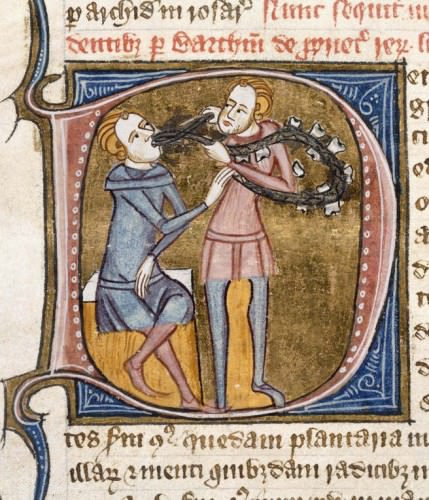
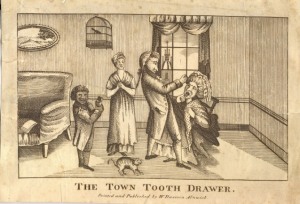
Five medieval toothpaste recipes, plus more medieval dental advice


In general, being a grandma, I tend to think that old ways are always the best. Medicine (including dentistry) is a definite exception. Medieval dentistry is something that most of us probably don't want to think about in any depth, but apparently there are those who do so. Some of the toothpaste recipes below are from a 2004 article in Nature by Trevor Anderson -  the full article (PDF) is here, Here's an excerpt:
John of Gaddesden wrote the Rosa Anglica in Latin around 1314AD... John’s section on toothache includes many prayers and charms. He mentions that anyone who prays to St Apollonia (wiki) on her feast day (February 9th) will be cured of toothache. St Apollonia (d.c.249AD) was an elderly deaconess of Alexandria who was martyred by having all her teeth extracted and was then burnt alive.
One charm involved repeatedly drawing three vertical lines on parchment (to represent running water) while touching the painful tooth with one’s finger. He also mentions that, ‘some say that the beak of a magpie hung from the neck cures pain in the teeth’. Apparently, he is not convinced by this particular charm. He also states that you should prick a ‘many footed worm which rolls up in a ball when you touch it’, with a needle. You then touch the aching tooth with the same needle and, ‘the pain will be eased’. Obviously, a reference to pain transference from tooth worm to the worm-like centipede.
Other recipes are from The Trotula (wiki), a set of medieval texts on women's medicine.

Medievalists.net:

1. According to Gilbertus Anglicus’ Compendium of Medicine, it is important to rub your teeth and gums with a cloth after eating, because it is important to ensure that “no corrupte mater abyde amonge þe teeþ” (“no corrupt matter abides among the teeth,”) Anderson, p.421). 

You can also munch on a paste of pepper and salt for that lovely scratchy feeling, and old-fashioned taste. Gilbertus advises, “chewe þid poudir a good while in [your] mooþ, and then swolle it down” (“chew this powder a good while in [your] mouth and then swallow it down”, Anderson, p.421). As a side benefit, you’re likely to clear your sinuses while you’re at it.

2. From one part of The Trotula, one of the most famous books of medieval remedies and beauty tips for women, comes a recipe “For Black Teeth”:

… take walnut shells well cleaned of the interior rind, which is green, and … rub the teeth three times a day, and when they have been well rubbed … wash the mouth with warm wine, and with salt mixed in if desired. (p.102)

I’m not sure how much anyone would desire mixing salt with the wine, but there you have it: black teeth whitened.

3. This second tooth-whitening recipe from The Trotula may work even better, since it requires wiping the teeth after swishing the wine, preventing unsightly wine stains on the teeth. This recipe requires a bit more effort:
Take burnt white marble and burnt date pits, and white natron, a red tile, salt, and pumice. From all of these make a powder in which damp wool has been wrapped in a fine linen cloth. Rub the teeth inside and out. (p.122)
After that, be sure to do the wine rinse again, “with very good wine” (p.122), then “dry” and “wipe” the teeth “with a new white cloth” (p.122). Perhaps the white cloth helps you find all the wine stains. Finally, finish by chewing on “fennel or lovage or parsley” (p.122) for good oral health and fresh breath.

4. Need to take your toothpaste on the road? No problem. The Physicians of Myddfai have got your back. You can either scrub “briskly” with just one herb – “elecampane” (Anderson, p.420) – or you can make handy powder balls to bring with you:

Take the leaves of sage (Salvia officinalis), powder with as much again of salt, and make it into balls. Bake them till they are burnt and powder. Let your teeth be rubbed frequently therewith. It will render the teeth clean, white, and sweet. (Anderson, p.420)

Who could ask for anything more?

5. This last recipe from The Trotula is for people who are rich and want their teeth to show it. The writer does say this one “works the best”, so, naturally, I’ve saved it for last.

Take some each of cinnamon, clove, spikenard, mastic, frankincense, grain, wormwood, crab foot, date pits, and olives. Grind all of these and reduce them to a powder, then rub the affected places. (p.112)

Your breath, with its mix of frankincense and crab foot, will let everyone know just how wealthy you are. (You’re welcome.)

More on medieval tooth-whitening in particular and medieval dentistry in particular:


Friday, March 4, 2016

Friday links

Video: The Hand-Cranked Wintergatan Marble Machine Uses 2,000 Marbles to Make Music.

March Forth: Today is National Grammar Day.

Army Candidates Take Exam in Their Underpants to Prevent Cheating.

Tomorrow is the anniversary of Winston Churchill's Iron Curtain speech.

The Gruesome And Mysterious Case Of Exploding Teeth.

A Complete History of the Millennium Falcon

ICYMI, Wednesday's links are here, and include Dr. Seuss' book of nudes The Seven Lady Godivas, why we say 'eleven, twelve' instead of 'oneteen, twoteen', bicycles as a moral threat (in the 1890s), and a 1970s-era Air Force rescue beacon disguised as dog poop (plus lipstick guns and shoe transmitters).

Friday, January 29, 2016

Friday links

It's W. C. Fields' birthday: quotes, bio and film clips.

Argue amongst yourselves: The 10 Best Superhero Performances in Movies.

Interesting technology improvements in this year's Super Bowl cameras.

Five medieval toothpaste recipes, plus more medieval dental advice.


Family Wraps an Entire Greenhouse around Their Home to Keep it Warm.

ICYMI, Wednesday's links are here, and include the anniversary of the Soviet Army liberation of Auschwitz, forgotten World War II films, the world's longest war lasted 335 years (and ended in 1986), and proof that children are imbeciles (and babies are stupid).

Monday, October 26, 2015

Monday links

Yesterday, October 25, was the anniversary of three major battles: Agincourt, the charge of the Light Brigade and Leyte Gulf: history, maps, Shakespeare, and documentaries, including one that contains Thomas Edison's 1890 recording of Alfred, Lord Tennyson, reading his own poem Charge of the Light Brigade.


Dead Men’s Teeth: A History of Dentures.

Video: Halloween pumpkin carving tricks.

Instructions for servicemen serving overseas: How The Army Handled Cultural Sensitivity Training in WWII.

Once a book was published and galley proofs were in hand, there was no further use for the original manuscript, so Charles Darwin, father of 10, gave his kids the manuscript of On the Origin of Species to draw on. Here are the surviving pages, complete with drawings.

ICYMI, Friday's links are here, and include lots of Halloween-related links, why more firstborn kids need glasses, a gallery of photos from hot-air balloon festivals, a 400 ft long baguette and a pizza nearly a mile long, and recycling penicillin from patients urine.