Once I moved about like the wind. Now I surrender to you, and that is all.
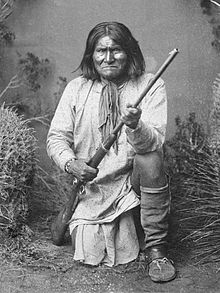
~Geronimo (letter to President McKinley from the reservation at Fort Sill, Oklahoma, 1897)
If you tie a horse to a stake, do you expect he will grow fat? If you pen an Indian up on a small spot of ground, and compel him to stay there, he will not be contented, nor will he grow and prosper. I have asked some of the great white chiefs where they get their authority to say to the Indian that he shall stay in one place, while he sees white men going where they please. They can not tell me.
~ Chief Joseph (wiki) (ca. 1840-1904)* (North American Review, April 1879)
February 17th is the anniversary of the death in 1909 of that legendary Chiricahua Apache chieftain, Geronimo (born ca. 1829), whose actual Indian name was Goyathlay ("One Who Yawns"). The name by which Geronimo is remembered was supposedly bestowed on him by a detachment of Mexican soldiers so stunned by the ferocity of his resistance that they repeatedly invoked the name of St. Jerome against him.

Finally recaptured and imprisoned, first in Florida and then in Alabama, Geronimo and his family were allowed to 1894 to settle on an Indian reservation at Fort Sill, Oklahoma, where he spent the rest of his life as a prosperous farmer and minor celebrity. (He appeared at the 1904 St. Louis World's Fair and rode in Theodore Roosevelt's inaugural parade a year later. In his autobiography, he remarked,
"I cannot think that we are useless or God would not have created us. There is one God looking down on us all. We are all the children of one God. The sun, the darkness, the winds, are all listening to what we have to say.")
* N.B. Chief Joseph (Hinmatóowyalahtq’it) was the greatest latter-day chief of the Nez Perce Indians of northwestern Oregon.

The reason that U.S. airborne troops yell "Geronimo!" when they jump out of airplanes has to do with a 1939 movie entitled Geronimo (a 1993 movie by the same title is also available) which was viewed by a group of early paratroopers (the Parachute Test Platoon in Fort Benning, Georgia) in 1940. The concept of jumping from planes with parachutes was nerve-racking, and in order to demonstrate his bravery one of them planned to yell:
The other soldiers gave him a hard time. They were all scared. Of course he was scared, too. He should just admit it.
"All right, dammit!” Eberhardt finally shouted. “I’ll tell you jokers what I'm gonna do! To prove to you that I'm not scared out of my wits when I jump, I'm gonna yell ‘Geronimo’ loud as hell when I go out that door tomorrow!"
The next day, he made good on his promise. Out the plane he went and everyone heard “Geronimooooooo!” The rest of the platoon wasn’t about to let Eberhardt show them up, so on subsequent jumps the rest of the soldiers took up his battle cry and a tradition was born. The next year, the Army’s first official parachute unit, the 501st Parachute Infantry Battalion, made “Geronimo” the motto on their unit insignia after their commander tracked down descendants of the real Geronimo to ask for their permission to use his name.
A short video biography:
Part of the text above is adapted from Ed's Quotation of the Day, only available via email - leave your email address in the comments if you'd like to be added to his list. Ed is the author of Hunters and Killers: Volume 1: Anti-Submarine Warfare from 1776 to 1943 and Hunters and Killers: Volume 2: Anti-Submarine Warfare from 1943.

