Amazon Deals

New at Amazon

Showing posts with label robots. Show all posts

Tuesday, May 8, 2018

Tuesday links

It's V.E. Day: on May 8, 1945, World War 2 ended in Europe.


Just so you know, there are Poop-Filled Mites On Your Face Right Now.

The Last Stagecoach Tavern of the Wild Wild West.

Not a plot summary for a SyFy movie: Army researchers are developing a self-aware squid-like robot you can 3D print in the field.

ICYMI, Monday's links are here, and include how donuts are made, daggers made from human thigh bones, Neanderthals sea voyages, and illustrated manliness lessons: how to undress in 20 seconds or less (in case you need to rescue someone who's drowning) and the Tactical Order of Dressing (as taught to military and emergency personnel).

Saturday, June 3, 2017

German 'robot priest' helps mark Reformation anniversary

Five hundred years after revolutionary printing presses spread news of Martin Luther’s radical call for church reform across Europe, technology is again challenging religious tradition in the small German town of Wittenberg.

A robot priest that delivers blessings in five languages and beams light from its hands has been unveiled as part of an exhibition to mark the anniversary of the start of the Reformation, a Europe-wide religious, political and cultural upheaval sparked when Luther nailed his 95 theses to a church door in the town.


More here.

Wednesday, July 20, 2016

Wurst robot ever? Watch A German Robot (the Bratwurst Bot) Grill Sausages

Popular Science:
Just like any of us in the summer months, it locates empty spaces on the grill and places bratwursts as needed, eyes them and turns them to ensure even crisping of the skin, and plates them when they're done, with a waggle of its moustachioed tablet face.
More detail at Phys.org:
The BratWurst Bot was developed for the Stallwächter-Party and is made of shelf robotic components such as the light-weight Universal Robots arm UR-10, a standard parallel gripper (Schunk PG-70) and standard grill tongs. A regular tablet with a ROS-based web frontend was used as an interface. The guests could easily order a sausage via this tablet. Then the ordered bratwurst appeared in a queue on the tablet with the name of the guest and the remaining preparation time. In addition to that, a tablet-based chef face behind the robot interacted with the guests.
The robot turned the sausages multiple times until they were ready to be directly served on a guest's plate. 

More at Phys.org, h/t Dyspepsia Generation. 

Friday, February 26, 2016

Friday links


Is Margarine Dead?

Snacks and serendipity: How the microwave was invented by accident.

This is very cool to watch: The Chemistry of Matches, in Super Slow Motion.

13 classic video games you can play right now in your web browser.

The next generation of Boston Dynamics’ Atlas robot is here, and it's approaching Terminator Genisys-like appearance.

ICYMI, Thursday's links are here, and include calculating how long would it take for a single person to fill up an entire swimming pool with their own saliva, real-life technologies inspired by video games, a human-sounding Dorito-eating goat (with bonus goat-related links), and 10 of history's most famous prostitutes.

Tuesday, October 13, 2015

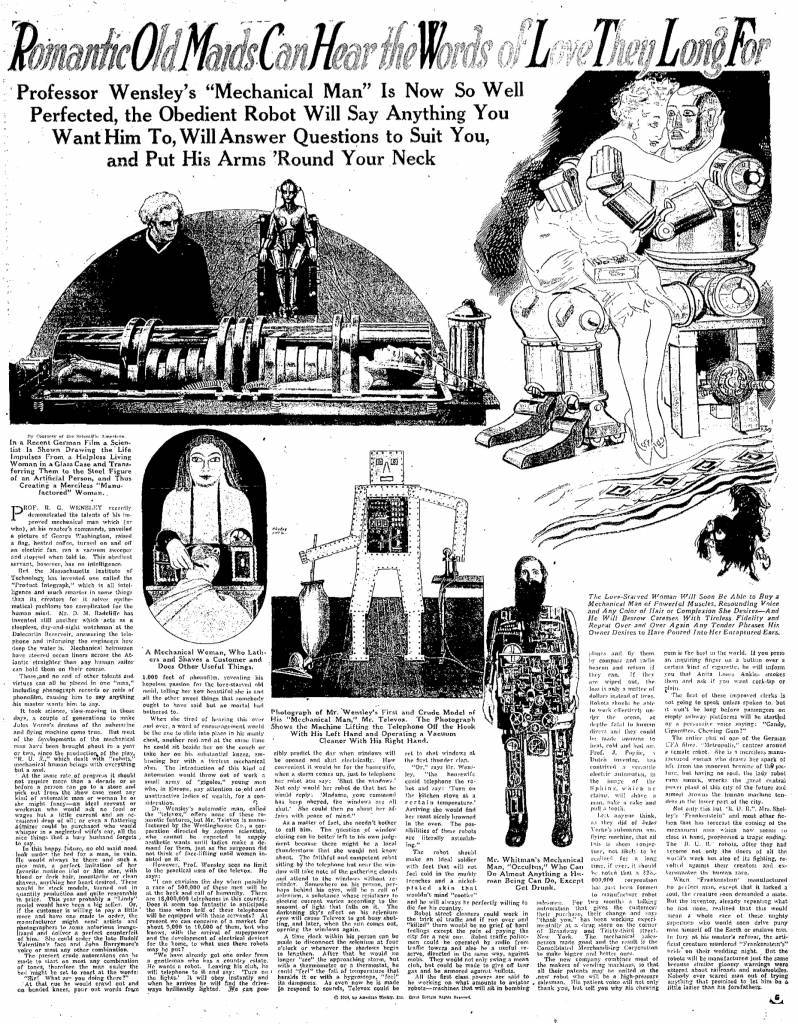
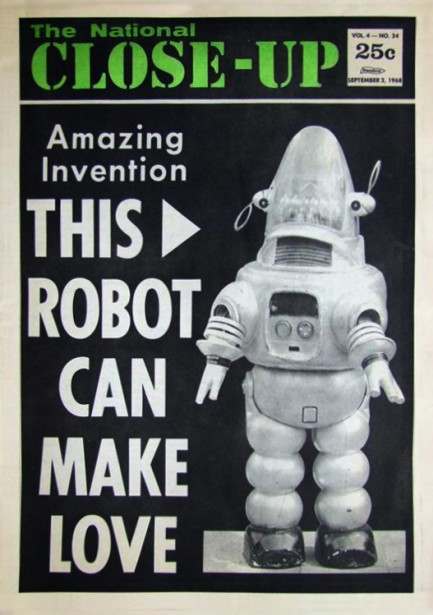
Early- to mid-20th century visions of sex in the future

Robot boyfriends:
Click here to embiggen
From 1933 - 100 years in the future the State may control all mating, with eugenics the chief thought in mind:
Click to embiggen


The Future: Electronic Mating. A look into the more rational marriage choice of the future:


Barbarella:


SPACE: the final, full-frontal frontier… the last hurrah… to go where no man has ever gone before, the forbidden and yet insidiously alluring planet of NYMPHON in the second quadrant of PHI DELTA PUBIS, hard by the tumescent moons of GLUTEON MAXIMUS:


More at Flashback, some of which is NSFW.

Wednesday, January 21, 2015

Wednesday links

It's Stonewall Jackson's birthday - here's the story of his left arm's separate grave (bonus: Lord Uxbridge's leg).

What People Say and What They Really Mean.

The Industrial Revolution: Why Britain Got There First.

French King Louis XVI was guillotined on this day in 1793. Here's Allan Sherman.

The Forgotten History Of How Automakers Invented The Crime Of 'Jaywalking'.

Robot Learns to Cook from YouTube Videos.

ICYMI, Tuesday's links are here, and include Turkey's camel beauty contest and camel wrestling festival, the top 10 design flaws in the U.S.S. Enterprise, anonymously sending envelopes fill of loose glitter to people you hate, and real places that inspired Disney animated movies.

Thursday, May 15, 2014

Mathematics Of Murder, Autonomous Cars and Robotic Soldiers: Should A Robot Sacrifice Your Life To Save Two?

It happens quickly—more quickly than you, being human, can fully process.


A front tire blows, and your autonomous SUV swerves. But rather than veering left, into the opposing lane of traffic, the robotic vehicle steers right. Brakes engage, the system tries to correct itself, but there’s too much momentum. Like a cornball stunt in a bad action movie, you are over the cliff, in free fall.

Your robot, the one you paid good money for, has chosen to kill you. Better that, its collision-response algorithms decided, than a high-speed, head-on collision with a smaller, non-robotic compact. There were two people in that car, to your one. The math couldn’t be simpler.

That's the beginning of a PopSci article discussing a recent opinion piece at Wired on one of the most disturbing questions in robot ethics: If a crash is unavoidable, should an autonomous car choose who it slams into?

Here's a second robotic scenario, in combat:

A group of soldiers has wandered into the kill box. That’s the GPS-designated area within which an autonomous military ground robot has been given clearance to engage any and all targets. The machine’s sensors calculate wind-speed, humidity, and barometric pressure. Then it goes to work.

Boston Dynamics' Atlas robot - video below
The shots land cleanly, for the most part. All of the targets are down.

But only one of them is in immediate mortal danger—instead of suffering a leg wound, like the rest, he took a round to the abdomen. Even a robot’s aim isn’t perfect.

As with the autonomous car crash scenario, everything hinges on that level of technological certainty. A human soldier or police officer isn’t legally or ethically expected to aim for a target’s leg. Accuracy, at any range or skill level, is never a sure thing for mere mortals, much less ones full of adrenaline. 

But if it’s possible to build that level of precision into a machine, expectations would invariably change. A manufacturer may be able to program systems to cripple targets instead of executing them. But if that’s the clear choice—that robots should actively reduce human deaths, even among the enemy—wouldn’t you have to accept that your car has killed you, instead of two strangers?

Per a WhoWhatWhy article on autonomous weapon systems:
The Department of Defense issued a Directive in 2013 titled “Autonomy in Weapons Systems”—another sign of how seriously the military is taking this. Among other things, it “Establishes guidelines designed to minimize[emphasis added] the probability and consequences of failures in autonomous and semi-autonomous weapon systems that could lead to unintended engagements.” But the directive also requires that the robots will “Function as anticipated in realistic operational environments against adaptive adversaries.”
Coping with “adaptive adversaries” implies at least a degree of autonomy—and that is a discomforting notion for some.
Plus this:
DARPA—the Defense Advanced Research Projects Agency—has been actively funding robot research for years and this past summer showcased “one of the most advanced humanoid robots ever built”: a stocky 6’ 2” behemoth of a bot named “Atlas.” Its creators at Boston Dynamics (a company recently acquired by none other than Google, Inc.) say it is designed for disaster response, such as nuclear and chemical incidents. Atlas has no weapons, but it’s not hard not to blink your eyes and imagine a potential military future.

Here's the original Wired article, the one from WhoWhatWhy, and the one from PopSci.