Amazon Deals

New at Amazon

Thursday, March 31, 2022

BBC's 1957 Spaghetti Harvest prank

The Spaghetti Tree prank (wiki) from the April 1, 1957 episode of the BBC Program Panorama:

Here's the explanation:

On April 1, 1957 the British television programme Panorama broadcast a three-minute segment about a bumper spaghetti harvest in southern Switzerland. The success of the crop was attributed both to an unusually mild winter and to the virtual disappearance of the spaghetti weevil. The audience heard Richard Dimbleby, the shows highly respected anchor, discussing the details of the spaghetti crop as they watched video footage of a Swiss family pulling pasta off spaghetti trees and placing it into baskets. The segment concluded with the assurance that, For those who love this dish, theres nothing like real, home-grown spaghetti.

The Swiss Spaghetti Harvest hoax generated an enormous response. Hundreds of people phoned the BBC wanting to know how they could grow their own spaghetti tree. To this query the BBC diplomatically replied, Place a sprig of spaghetti in a tin of tomato sauce and hope for the best. 

To this day the Panorama broadcast remains one of the most famous and popular April Fools Day hoaxes of all time. It is also believed to be the first time the medium of television was used to stage an April Fools Day hoax.

Since 1955 Panorama had been anchored by Richard Dimbleby, whose authoritative, commanding presence had made him one of the most revered public figures in Britain. If Dimbleby said it, people trusted that it was true. Which is one of the reasons why the spaghetti harvest hoax fooled so many viewers. His participation lent the hoax an air of unimpeachable authority.

Almost no one else at the BBC knew about it. The segment was not mentioned at all in the pre-transmission publicity handouts.

The line-up for that days show included a long segment about Archbishop Makarios, leader of the Greek Cypriots, and a clip of the Duke of Edinburgh attending the premiere of the war film The Yangtse Incident.

The second-to-last segment was about a wine-tasting contest, and then it came time for the spaghetti harvest.

Dimbleby, sitting on the set of Panorama, looked into the camera and without a trace of a smile said: And now from wine to food. We end Panorama tonight with a special report from the Swiss Alps.

The screen cut away to the prepared footage. When it was all over, Dimbleby reappeared and said, Now we say goodnight, on this first day of April. He emphasized the final phrase.

Panorama never attempted another April Fools Day spoof, despite numerous calls for a sequel. However, the hoax did inspire a number of similar stunts in its honour.

This film footage is from the Archive Collection held and administered by the Alexandra Palace Television Society. 

Thursday, March 24, 2022

How The World Will End, According To 1939

They seem to have Robert Frost (wiki) (online archive) covered here...

Some say the world will end in fire,
Some say in ice.
From what I've tasted of desire
I hold with those who favor fire.
But if it had to perish twice,
I think I know enough of hate
To say that for destruction ice
Is also great
And would suffice.


But nothing so tame as Eliot envisioned:

This is the way the world ends 
Not with a bang but a whimper.

(Whole poem here)

Popular Science published these apocalyptic illustrations, along with a very upsetting three-page article, in its September 1939 issue (go there for larger images).

A giant meteor running wild through space... may strike the Earth and spread havoc with its impact and scorching breath.

In the image above, thousands of people run from Manhattan as meteors streak down around them. But their flight is futile, because a city-sized asteroid is about one nanosecond away from obliterating the Eastern time zone. "People that it missed would still be threatened, not only by terrible earthquakes, but even more by a searing air blast of hurricane velocity that would mushroom out from the point of impact

Sometimes a star becomes a 'nova,' or mysteriously flares up in brightness. Suppose that suddenly our own star, the sun, should likewise act as if a vast bellows were blowing a draft into its molten interior. In eight brief minutes the resulting blast of radiant heat would reach the earth, and all life on this planet would vanish in clouds of steam and puffs of smoke.

Below: This lonely, icy scene takes place not at one of Earth’s frozen poles, but at its equator. The sun is dying, slowly, and so are the four humans in this painting. The sun will become a dull-red ball in a sullen sky, casting only a feeble, ruddy glow over ice that will cover the earth. For a time, human beings will be able to live near the equator, and then underground, beside perpetually burning fires. But when the solar furnace dwindles to a faint spark, the earth's atmosphere will turn to liquid air and life will become impossible.


Another option: as tidal friction slows down the moon in its orbit, the earth will draw it nearer and nearer.

To anyone still on earth, it will appear as an ominous golden-orange orb, fattening in apparent size until it reaches twenty-four times its present magnitude—no longer a friendly beacon by night, but a terror in the skies. Oceans will wash over all but the highest mountains. Racking strains in the earth's crust will unleash the inferno that lies beneath.

Finally, Popular Science explains, the moon will get so close to Earth that it will experience "land tides," causing our satellite to burst into rocky chunks that then rain down on Earth, "completing the destruction of anything alive." The rest of the moon pieces will orbit around Earth in a ring, and our planet will live out its days like a grotesque version of Saturn.

Further options in other PopSci life-ending articles.

Friday, January 21, 2022

Map of power outages caused by squirrels, with bonus squirrel-related links

"I don't think paralysis [of the electrical grid] is more likely by cyberattack than by natural disaster. And frankly the number-one threat experienced to date by the US electrical grid is squirrels." 

~ John C. Inglis, Former Deputy Director, National Security Agency 2015.07.09

The war with the squirrels continues unabated - from Cyber Squirrel 1 (who is, unfortunately, no longer updating):
This map lists all unclassified Cyber Squirrel Operations that have been released to the public that we have been able to confirm. There are many more executed ops than displayed on this map however, those ops remain classified.
Screenshot from CyberSquirrel1

The data is gathered from Twitter and then listed on a filter-able Google map. You have the option to narrow the data by year and by month, and can even choose to only view the cases related to squirrels, non-squirrels, or all animals, including birds, raccoons, snakes and beavers. The interactive map is available here.

Related posts/links:

Video: The Narcoleptic Squirrel Song.

I'm pretty sure this flesh-eating-squirrels-because-fracking movie never got made, but if it ever happens, I'm in: Squirrels - Pre-production Sales Trailer.


A fire that heavily damaged an apartment complex was started by a resident using a propane torch to remove a squirrel's fur.

Scottish brewery releases $20,000 beer in taxidermy squirrel.

Friday, December 10, 2021

The worlds strongest, explosive powered nut cracker

The worlds strongest, explosive powered nut cracker:

If you’ve ever tried to use a nutcracker, you soon realize they don’t have much in the way of actual force. So, YouTuber Shane Wighton decided to design and fabricate, from scratch, a nutcracker that could bite the hitch off a pick-up truck.

To power it, he used the explosive blank shells that are used in construction to drive nails into concrete. The video animates and explains the physics involved - he creates and machines each component, then has to re-design and re-produce those components to correct his mistakes. 

Pretty cool. Watch full screen.

Thursday, December 9, 2021

Thurber's fable "The Bear Who Let It Alone"

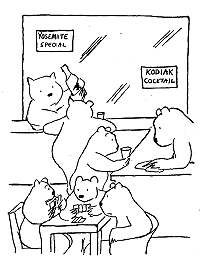
One of my favorite authors is James Thurber, and one of my favorite (very) short stories of his (actually one of his fables) is about a bear who drank too much, then gave it up.

Thurber's fable The Bear Who Let It Alone:

In the woods of the Far West there once lived a brown bear who could take it or let it alone. He would go into a bar where they sold mead, a fermented drink made of honey, and he would have just two drinks. Then he would put some money on the bar and say, "See what the bears in the back room will have," and he would go home. But finally he took to drinking by himself most of the day.

He would reel home at night, kick over the umbrella stand, knock down the bridge lamps, and ram his elbows through the windows. Then he would collapse on the floor and lie there until he went to sleep. His wife was greatly distressed and his children were very frightened.

At length the bear saw the error of his ways and began to reform. In the end he became a famous teetotaler and a persistent temperance lecturer. He would tell everybody that came to his house about the awful effects of drink, and he would boast about how strong and well he had become since he gave up touching the stuff. To demonstrate this, he would stand on his head and on his hands and he would turn cartwheels in the house, kicking over the umbrella stand, knocking down the bridge lamps, and ramming his elbows through the windows.

Then he would lie down on the floor, tired by his healthful exercise, and go to sleep. His wife was greatly distressed and his children were very frightened.

Moral: You might as well fall flat on your face as lean over too far backward.