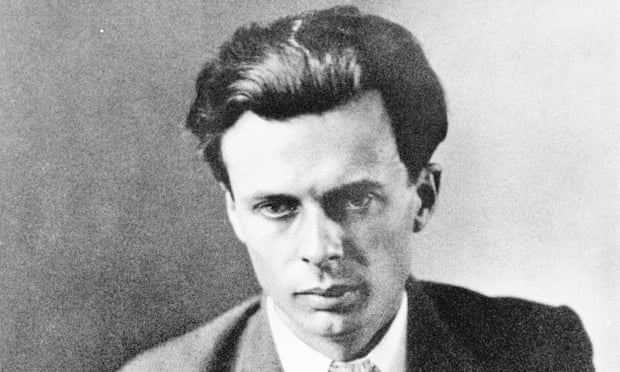
July 26 is Brave New World author Aldous Huxley's birthday: here's a brief bio, audio of him narrating Brave New World, a 1949 letter from Huxley to Orwell and a Huxley vs Orwell infographic.
These Sisters will make your Evil Siblings look like Angels.
Birthdays this weekend include free-market economist Milton Friedman's (July 27): here are some favorite quotes and short videos, and Beatrix Potter's (July 28): in addition to Peter Rabbit et al, she produced some gorgeous botanical drawings.
ICYMI, most recent links are here, and include the Apollo 11 anniversary, early blacklisting in Hollywood, a laser that identifies people from a distance by heartbeat, and the anniversary of the 20th of July plot (the unsuccessful bomb attempt by insiders to kill Hitler in 1944).
For Aldous Huxley's birthday, here's an infographic of Huxley vs Orwell, a letter from Huxley to Orwell explaining why he (Huxley) was right, and audio of Huxley narrating Brave New World.
ICYMI, Wednesday's links are here, and include 17th century infertility remedies, how tech's richest plan to save themselves after the apocalypse, what happens to Sherlock Holmes mail, and, for NatGeo's Shark Week: the Batman 1966 Shark Repellent Bat Spray scene.
For Aldous Huxley's birthday, an infographic of Huxley Vs Orwell, a letter from Huxley to Orwell explaining why he (Huxley) was right, and audio of Huxley narrating Brave New World.
ICYMI, Monday's links are here, and include a cringe-inducing set of fashion ads from the 1970s, a 1923 car that turned into a boat, diagnosing Hitler's flatulence, and a compilation of the 100 greatest action movie punchlines (NSFW language).
A really efficient totalitarian state would be one in which the all-powerful executive of political bosses and their army of managers control a population of slaves who do not have to be coerced, because they love their servitude.
Well, duty's duty. One can't consult one's own preference. I'm interested in truth, I like science. But truth's a menace, science is a public danger. As dangerous as it's been beneficent. It has given us the stablest equilibrium in history. China's was hopelessly insecure by comparison; even the primitive matriarchies weren't steadier than we are. Thanks, I repeat, to science. But we can't allow science to undo its own good work. That's why we so carefully limit the scope of its researches – that's why I almost got sent to an island. We don't allow it to deal with any but the most immediate problems of the moment. All other enquiries are most sedulously discouraged.
So long as men worship the Caesars and Napoleons, Caesars and Napoleons will duly arise and make them miserable.
~ Huxley (Ends and Means, Ch. 8)
Today is the anniversary of the birth of English novelist Aldous Huxley (wiki) (1894-1963*). Although he is now remembered largely for his dystopian novel Brave New World(wiki), I was most impressed when I first ran across him, back in the 60's and 70's, by Islandand by his exploration of mescaline-induced experiences in Doors of Perception**.
The grandson of famed biologist and evolution proponent T. H. Huxley (1825-1895), Aldous attended Eton and Oxford to study English literature. His poor eyesight kept him out of World War I, and he embarked on a writing career while still an undergraduate. Subsequently, he joined the Bloomsbury set and turned out the first of his novels, Crome Yellow (1921) and a long series of essays on wide-ranging topics.
At the Central London Hatchery and Conditioning Centre's Embryo Store
His novels were often inspired by his fear of the dehumanizing potential of scientific progress (as in Brave New World) and his life-long pacifism (as in Eyeless in Gaza, 1935). In 1937, Huxley emigrated to the United States and spent the rest of his life in southern California, where he dabbled unsuccessfully in screen-writing. Late in life, he developed a passionate interest in the Vedic philosophies of India and experimented with psychodelic drugs.
** I re-read Doors of Perception (supposedly, by the way, the inspiration for the name of the band The Doors) several times over the years, for reasons that I will no longer admit to.
Here's Huxley narrating Brave New World (audio from a 1979 LP of a 1956 CBS Radio Workshop broadcast):
Within the next generation I believe that the world's rulers will discover that infant conditioning and narco-hypnosis are more efficient, as instruments of government, than clubs and prisons, and that the lust for power can be just as completely satisfied by suggesting people into loving their servitude as by flogging and kicking them into obedience. In other words, I feel that the nightmare of Nineteen Eighty-Four is destined to modulate into the nightmare of a world having more resemblance to that which I imagined in Brave New World. The change will be brought about as a result of a felt need for increased efficiency. Meanwhile, of course, there may be a large-scale biological and atomic war --- in which case we shall have nightmares of other and scarcely imaginable kinds.
From youtube: The CBS Radio Workshop was an experimental series of productions, subtitled "radio's distinguished series to man's imagination" that ran between 27 January 1956 and 22 September 1957. The premiere production was Brave New World, narrated by Huxley himself, with a complicated sound-effects score that evidently took a long time to construct, and comprised a ticking metronome, tom-tom beats, bubbling water, an air hose, a cow's moo, an oscillator, and three kinds of wine glasses clicking together.There was also a cast of some ten actors.
What was most evident about this two-part adaptation, now available on podcast, was the vocal contrasts: between Huxley the narrator, telling the story in a cut-glass marked RP accent interspersed with occasional Americanisms ("diaper" instead of "nappy," for instance); the Controller, who spoke throughout in jovial tones, appropriate for the Brave New World of perpetual happiness; and the Savage, the representative of feeling, emotional humanity - now consigned to a reserve in darkest Mexico - whose tones became increasingly desperate as he understood how mechanized the universe had become.
The Brave New World was a topsy-turvy environment, which despised institutions such as marriage and parenthood (any mention of such terms was greeted with scornful laughter), and advocated free love without passion. Everyone belonged to everyone else, and no one needed to think any more. Despite the Director's jovial protestations that this was the best of all possible worlds (shades of Voltaire's Candide), the doom-laden consequences of what had happened were suggested by Bernard Herrman's specially composed score, full of doom-laden chords and metronome-like chimes played on the tubular bells.
The adaptation was announced by the actor William Conrad - who subsequently found fame on television as the corpulent detective Cannon: at the end of the first episode he informed listeners in no uncertain terms about the moral purpose of Froug's adaptation. It was intended as a "warning against the destruction of moral standards, family life and the soul of man."
Despite its age, and the quality of the recording - punctuated occasionally by crackles, indicating that it might have been transcribed from a vinyl disc - this was a spellbinding version of Huxley's tale, that made for uncomfortable listening.