Amazon Deals

New at Amazon

Showing posts with label Nazi. Show all posts

Thursday, August 9, 2018

The Herd Reich? Brit farmer turned Nazi super cows into sausage because they were too agressive

Hitler’s drive to produce the perfect Aryan race was not confined to people – it also extended to a specially bred herd of Nazi-engineered cows, which have turned out to be so aggressive that a UK farmer has been forced to turn half of them into sausages.
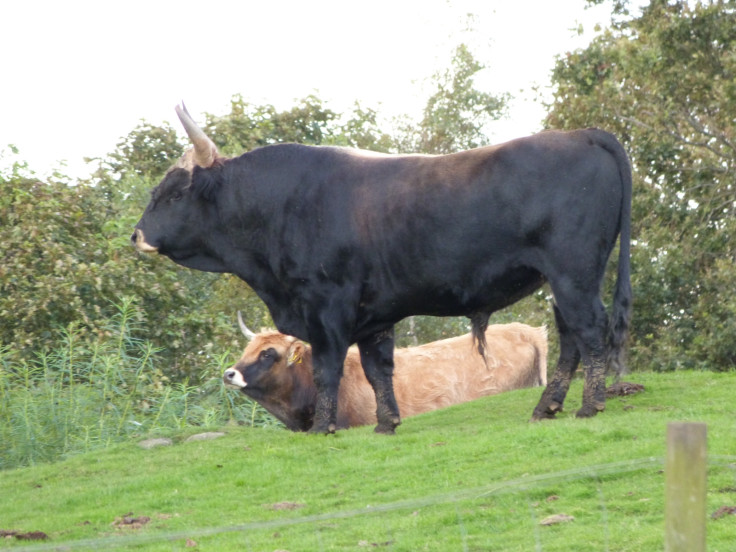
Heck cattle was bred by Nazis as
propaganda tools. MĂ rtainn MacDhòmhnaill
Derek Gow imported more than a dozen Heck super cows to his West Devon farm in 2009, nearly a century after they were first created in the 1920s.

But, Farmer Gow, who is the only British farmer to own the breed, has been forced to kill seven of his herd because the cows were so aggressive they repeatedly tried to kill his staff.

“We have had to cut our herd down to six because some of them were incredibly aggressive and we just couldn’t handle them,” said Farmer Gow, who said the meat made “very tasty” sausages that tasted a bit like venison.

“The ones we had to get rid of would just attack you any chance they could. They would try to kill anyone. Dealing with that was not fun at all. They are by far and away the most aggressive animals I have ever worked with,” he said.

Comparison of the reconstructed appearance
 of the aurochs (top) with average Heck cattle (bottom)
The aggressive breed was produced by German zoologists and brothers Heinz and Lutz Heck, whom the Nazi party commissioned to produce a breed of cattle based on aurochs, a species of extinct ancient wild bull.

The resulting cows, made from wild genes extracted from domestic descendants of the aurochs, had such muscular physiques and deadly horns that they were used in propaganda material during World War II as a further illustration of the Third Reich’s strength and purity.

“There was a thinking around at the time that you could selectively breed animals for Aryan characteristics, which were rooted in runes, folklore and legend. What the Germans did with their breeding programme was create something truly primeval,” said Mr Gow.

“The reason the Nazis were so supportive of the project is they wanted them to be fierce and aggressive. When the Germans were selecting them to create this animal they used Spanish fighting cattle to give them the shape and ferocity they wanted.” Fresians and Simmentals were also part of the breeding process.

Aurochs, or Bos primigenius, died out in 1627 in Poland. 
The aurochs were a species of wild bull that had once roamed the forests of Europe but were hunted to extinction in the 17th century. The brothers' imitation was slightly shorter than the original, but retained the muscular body, deep brown complexion and shaggy, coffee-coloured fringe.

The cattle were mostly destroyed after the fall of Nazism in 1945, although some have survived in European nature conservation parks.

Although many of Farmer Gow’s herd were aggressive, others were calm and quiet, he said, adding that he has no regrets.

A painting by Heinrich Harder showing an
aurochs fighting off a Eurasian Wolf pack
“Since they have gone it is all peaceful again. Peace reigns supreme on the farm. Despite these problems, I have no regrets at all. It has been a good thing to do and the history of them is fascinating,” he said.

Friday, July 20, 2018

Friday links

It's the anniversary of the 20th of July plot, the unsuccessful bomb attempt to kill Hitler in 1944.


The Bayeux Tapestry with knobs on: what do the tapestry’s 93 penises tell us?

On July 20, 1969, Neil Armstrong walked on the moon. 

The Scientific Quest For the Perfect S'more.

Ye Oldest Public Library in the English Speaking World.

ICYMI, Monday's links are here, and include the physics of how lawn mower blades cut grass (at 50K frames per second), spiders flying by using electricity, and the anniversary of the beginning of the atomic age (the 1945 Trinity nuclear test).

Friday, January 26, 2018

On January 27, 1945, the Soviet Army liberated Auschwitz

On this date (January 27) in 1945, the Soviet Army liberated Auschwitz (wiki). Below are two documentaries (one short, one full length) and links to a few articles. Do the world a favor and educate your kids and grandkids about this - the schools don't do much with it anymore.

Auschwitz, also known as Auschwitz-Birkenau, opened in 1940 and was the largest of the Nazi concentration and death camps (wiki). Located in southern Poland, Auschwitz initially served as a detention center for political prisoners. However, it evolved into a network of camps where Jewish people and other perceived enemies of the Nazi state were exterminated, often in gas chambers, or used as slave labor. Some prisoners were also subjected to barbaric medical experiments led by Josef Mengele (1911-79). During World War II (1939-45), more than 1 million people, by some accounts, lost their lives at Auschwitz. In January 1945, with the Soviet army approaching, Nazi officials ordered the camp abandoned and sent an estimated 60,000 prisoners on a forced march to other locations. When the Soviets entered Auschwitz, they found thousands of emaciated detainees and piles of corpses left behind.

How do you describe the sorting out on arriving at Auschwitz, the separation of children who see a father or mother going away, never to be seen again? How do you express the dumb grief of a little girl and the endless lines of women, children, and rabbis being driven across the Polish or Ukrainian landscapes to their deaths? No, I can't do it. And because I'm a writer and a teacher, I don't understand how Europe's most cultured nation could have done that. For these men who killed with submachine-guns in the Ukraine were university graduates. Afterwards they would go home and read a poem by Heine. So what happened?

~  Elie Wiesel (wiki) (b. 1928) (quoted in Le Monde, Paris, 4 June 1987)

Further reading:

I highly recommend the 2015 KL: A History of the Nazi Concentration Camps (KL is the Nazi abbreviation of Konzentrationslager, or concentration camp) by Nikolaus Wachsmann.

For an exhaustive and comprehensive account of the Third Reich that explores in depth the questions raised by Elie Wiesel above, read Richard J. Evans' masterful three-volume history, completed in 2009 with The Third Reich at War. 

Disturbing content warning for these videos:

A short documentary about the liberation:


CONTENT WARNING: This longer (21 minute) documentary
"contains all of the film footage of Auschwitz which was filmed by Soviet camermen between January 27 and February 28, 1945, shortly after the camp was liberated.
In the interest of preserving the original character of the material, even the most shocking pictures have been left unedited, and neither sound nor music has been added."


Related posts and links:

Tales from Auschwitz: survivor stories

Powerful Portraits Of Auschwitz Survivors Mark Anniversary Of Their Liberation.

Auschwitz Survivor Gena Turgel Walked Out of Gas Chamber Alive.

Spielberg highlights anniversary of Auschwitz liberation.

Monday, June 12, 2017

June 12: Anne Frank's birthday

Frank in 1940
It is really a wonder that I haven't dropped all my ideals because they seem so absurd and impossible to carry out. Yet, I keep them, because in spite of everything I still believe that people are really good at heart. I simply can't build up my hopes on a foundation consisting of confusion, misery, and death. I see the world gradually being turned into a wilderness. I hear the ever-approaching thunder, which will destroy us too, I can feel the sufferings of millions, and yet, if I look into the heavens, I think that it will all come right, that this cruelty too will end, and that peace and tranquility will return again. 


When I write I can shake off all my cares. My sorrow disappears, my spirits are revived! But, and that's a big question, will I ever be able to write something great, will I ever become a journalist or a writer?

~ Frank (Ibid., 5 April 1944)

And finally, I twist my heart round again, so that the bad is on the outside and the good is on the inside, and keep on trying to find a way of becoming what I would so like to be, and could be, if... there weren't any other people living in tthe world. 

~ Frank (Ibid., 1 August 1944) 

How do you describe the sorting out on arriving at Auschwitz, the separation of children who see a father or mother going away, never to be seen again? How do you express the dumb grief of a little girl and the endless lines of women, children, and rabbis being driven across the Polish or Ukrainian landscapes to their deaths? No, I can't do it. And because I'm a writer and a teacher, I don't understand how Europe's most cultured nation could have done that. For these men who killed with submachine-guns in the Ukraine were university graduates. Afterwards they would go home and read a poem by Heine. So what happened? 

~  Elie Wiesel (wiki) (b. 1928) (quoted in Le Monde, Paris, 4 June 1987)

The apartment block where the Frank family
 lived from 1934 until 1942
June 12 is the anniversary of the birth of German-Jewish refugee and diarist Anne Frank (wiki) (1929-1945) in Frankfurt-am-Main. With the seizure of power by Hitler and the Nazis in January 1933, Anne's businessman father relocated his company to Amsterdam, where he thought his family would be safe. After Germany occupied the Netherlands in 1940, the Franks went into hiding in a secret room in an annex to his former office, where they were sustained with the assistance of their Dutch friends. During this period, Anne Frank began the diary that would be rediscovered and published to world-wide acclaim in 1947. 

In August 1944, however, two months after the Normandy invasion, the Frank's hiding place was revealed to the Germans by a Dutch collaborator, and the family was captured and deported to the Bergen-Belsen concentration camp (wiki). Only her father survived, Anne having succumbed to mistreatment, malnutrition, and disease just a few weeks before the camp was liberated in April 1945. 

Here's a video tour of the annex where the Frank family (along with others) lived from July 6, 1942 until their arrest on August 4, 1944:


N.B. For an exhaustive and comprehensive account of the Third Reich that explores in depth the questions raised by Elie Wiesel above, read Richard J. Evans' masterful three-volume history, completed in 2009 with The Third Reich at War. Be prepared for 2,000-plus pages - and it's a harrowing tale.

The text above is adapted from Ed's Quotation of the Day, only available via email - leave your email address in the comments if you'd like to be added to his list. Ed is the author of Hunters and Killers: Volume 1: Anti-Submarine Warfare from 1776 to 1943 and Hunters and Killers: Volume 2: Anti-Submarine Warfare from 1943.

Thursday, June 1, 2017

Thursday links

It's the 50th anniversary of the release of The Beatles’ Sgt. Pepper’s Lonely Hearts Club Band, Here's an uncropped version of the Sgt. Pepper album cover, with the unused Hitler cutout. 

Why It’s So Hard to Find the Original Owners of Nazi-Looted Art.

If We Want Bionic Limbs That Actually Work, We Might Need Smarter Amputations.

June Is Goat Trauma Awareness Month: here's a map of every goat in the United States, with bonus goat-related links.

Japan is suffering from a ninja shortage.

Who Started the First Fire?

ICYMI, Monday's links are here, and include the problem of bodies on Everest, what it's like to be struck by lightning, the anniversary of the fall of Constantinople, and Kurt Vonnegut's letter home after being released from imprisonment in an underground slaughterhouse (Slaughterhouse Five) during the Dresden bombing.

Friday, May 5, 2017

Friday links

Happy Cinco de Mayo. And here's an illustrated history of Tex-Mex food.

Europe’s Bog Bodies Are Starting to Reveal Their Secrets.

Nazi Board Games of World War II.


McDonald’s introduces fry-fork utensil with new sandwiches

Take Me Out to the Ball Game: The story of Baseball's National Anthem.

ICYMI, Thursday's links are here, and include International Respect for Chickens Day and Star Wars Day, how to develop Jason Bourne-level situational awareness, the legend of Ludgar the War Wolf, King of the Trebuchets. and a 16th century warning about herb-caused brain scorpions: Take heede therefore ye smellers of Basil.

Tuesday, October 25, 2016

Tuesday links

October 25 is the anniversary of 3 major battles: Agincourt, the charge of the Light Brigade and Leyte Gulf.


Secret Nazi military base discovered by Russian scientists in the Arctic. Related, The Gigantic Nazi City that Was Never Built, and the always (or never) appropriate Nazis with cats.


25 Easy DIY Halloween Costumes You Can Make Last Minute.

Just in time for Christmas - the 2017 Vladimir Putin calendar.

ICYMI, Friday's links are here, and include a gallery of photos from the carving of Mount Rushmore (1927-1941), animals who look as if they had a few too many, the history of the pencil, and the anniversary of Trafalgar Day.

Thursday, September 22, 2016

Thursday links


Australia's Biggest Dog Has No Clue How Big He Actually Is.

ICYMI, Monday's links are here, and include vintage mugshots, how a rogue 1950s drone fiasco ended with rockets fired at southern California, Talk Like a Pirate Day, Dr. Samuel Johnson's birthday (and a collection of his excellent insults). and the creative Amazon reviews of Stronger Together, Hillary Clinton's and Tim Kaine's new book.

Wednesday, July 20, 2016

Wednesday links

It's the anniversary of the 20th of July plot, the unsuccessful bomb attempt to kill Hitler in 1944.

These photos are quite extraordinary: c. 1890: Venice in Photochrom.


Male contraceptive news: just wear a polyester sling, and let the heat and the electrostatics do all the work, with bonus Monty Python.

Miracle breakthrough in high-tech armpit cooling. Be sure to translate.

On July 20, 1969, Neil Armstrong walked on the moon. 

ICYMI, Friday's links are here, and include the world’s largest Nerf gun, bad taxidermy, how much of his ear Vincent Van Gogh sliced off, testing mobility in medieval armor, and drawing eyes on cow butts to protect them from lions.

Friday, April 29, 2016

Friday links

Happy Birthday, Duke Ellington: here's some glorious music and a brief biography.


ICYMI, Tuesday's links are here, and include streaming Netflix through a pork loin, a muskrat cooking competition, menus for 1st, 2nd and 3rd class passengers on the Titanic, legendary plant-animal hybrids, and a roundup of funny (but not gross) colonoscopy videos.

Monday, December 7, 2015

Monday links

A day that will live in infamy: today is the anniversary of the attack on Pearl Harbor. Related: Monty Python's reenactment of the battle.

What Christmas Meant to the Nazis.

The Most Popular Dog Names Of 2015.

ICYMI, Friday's links are here, and include the end of prohibition in the US, the world's most expensive cars, an emergency enema kit (the defibrillator of the 18th century) and more dubious medical treatments, DIY candles, and concrete ships.

Monday, April 20, 2015

Remains of Nazi officer discovered inside 100 year old giant catfish (UPDATE - fake)

UPDATE: Unfortunately, this is a (quite well done!) fake, as pointed out by @kjyost. Had me fooled!

A pair of Polish fisherman made an amazing discovery when they opened the belly of the 410 pound catfish they had just caught in the Oder river. The stomach of the monstrous fish contained fragments of human bones, as well as German military artifacts dating back to the Second World War.

Alfons Brzozowski and Marek Zdanowicz were fishing near the Oder’s confluence with the BĂłbr river on April 6, when they made an astonishing catch: a gigantic Wels catfish, measuring 12 feet (3.68 meters) and weighting 413 pounds (187.5 kg).

Their celebration was rapidly transformed into interrogation, and then disgust, when they opened the animal’s belly. Among a large quantity of half-digested fish, they discovered an old metal insignia dating back to Nazi Germany, as well as dozens of human bone fragments.

The two fishermen rapidly contacted the police, who opened an investigation to determine the origin of the remains.

The examination of the bones enabled the authorities to determine that they belonged to a Caucasian man in his early twenties, who died many decades ago. The biologists who examined the fish, for their part, confirmed that the enormous specimen was probably aged between 90 and 110 years old, making it one of the oldest catfish specimen ever found.

Further analysis of the artefacts and the bones have revealed that they had indeed been ingested by the fish during the 1940s, and were very likely the remains of a German SS officer, killed during the occupation of Poland. The team of forensic experts who proceeded to the tests, could not determine, however, if the man was actually killed by the catfish or if he was already dead when he was eaten by the animal.