ICYMI, most recent links are here, and include Pachelbel's Canon In D performed by train horns, National Geographic’s 100 best photos from 2019, the history of robocalls, and a cumulative list of the Darwin Awards.
ICYMI, Monday's links are here, and include the Scientific American guide to cheating in the Olympics, the anniversary of the Wright brothers' first flight, how to have a British Christmas, and it's not just humans - 'High-Ranking Male Primates Keep Wafting Their Sex Stink at Females, Who Hate It".
In the Northern Hemisphere the December solstice (wiki) marks the longest night and shortest day of the year with the latest dawn and the sun at its lowest point in the sky. I seem to remember that when I was a kid, the first day of each new season was always considered to be the 21st (of March for Spring, June for Summer, September for Autumn, and December for Winter). I guess it's more accurate now.
In seed-time learn, in harvest teach, in winter enjoy.
I wonder if the snow loves the trees and fields, that it kisses them so gently? And then it covers them up snug, you know, with a white quilt; and perhaps it says "Go to sleep, darlings, till the summer comes again.
Nature has many scenes to exhibit, and constantly draws a curtain over this part or that. She is constantly repainting the landscape and all surfaces, dressing up some scene for our entertainment. Lately we had a leafy wilderness; now bare twigs begin to prevail, and soon she will surprise us with a mantle of snow. Some green she thinks so good for our eyes that, like blue, she never banishes it entirely from our eyes, but has created evergreens.
The winter solstice (wiki) produces the shortest day of the year in the northern hemisphere, when darkness descends over the land to its greatest extent. For centuries, humankind has greeted the solstice with mixed emotions - with fear that the darkness might not really recede; and with hope that the cycling of the seasons would again reassert itself.
Of the winter season, American poet Ezra Pound (1885-1972) complained,
"Winter is icumen in, Lhude sing Goddamn, Raineth drop and staineth slop, And how the wind doth ramm! Sing: Goddamn."*
* N.B. This is actually a parody of an anonymous 13th-century English song:
"Sumer is icumen in,
Lhude sing cuccu!
Groweth sed and bloweth med,
And springeth the wude nu.
Sing cuccu."
Here's a brief explanation on the mechanics of solstices and equinoxes:
And a two minute NatGeo video:
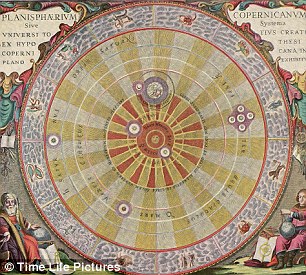
The two revolutions, I mean the annual revolutions of the declination and of the centre of the Earth, are not completely equal; that is the return of the declination to its original value is slightly ahead of the period of the centre. Hence it necessarily follows that the equinoxes and solstices seem to anticipate their timing, not because the sphere of the fixed stars moves to the east, but rather the equatorial circle moves to the west, being at an angle to the plane of the ecliptic in proportion to the declination of the axis of the terrestrial globe.
The winter solstice festival Saturnalia began on December 17 and lasted for seven days in In Ancient Rome. These Saturnalian banquets were held from as far back as around 217 BCE to honor Saturn, the father of the gods.
Saturnalia by Antoine-Francois Callet (1741-1823) Musée du Louvre
The holiday was celebrated with a sacrifice at the Temple of Saturn, in the Roman Forum, and a public banquet, followed by private gift-giving, continual partying, and a carnival atmosphere that overturned Roman social norms.
The festival was characterized as a free-for-all when all discipline and orderly behavior was ignored.
Wars were interrupted or postponed, gambling was permitted, slaves were served by their masters and all grudges and quarrels were forgotten.
The Saturnalia would degenerate into a week-long orgy of debauchery and crime – giving rise to the modern use of the term 'saturnalia', meaning a period of unrestrained license and revelry. A mock 'king' was even chosen from a group of slaves or convicts and was allowed to behave as he pleased for seven days (until his eventual ritual execution).
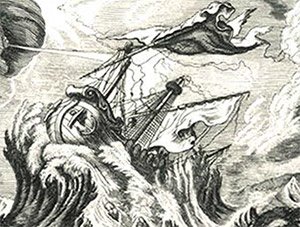
The seven days preceding, and the seven days following the shortest day, or the winter-solstice, were called by the ancients the Halcyon Days. This phrase, so familiar as expressive of a period of tranquility and happiness, is derived from a fable, that during the period just indicated, while the halcyon bird or king-fisher was breeding, the sea was always calm, and might be navigated in perfect security by the mariner. The name halcyon is derived from two Greek words: the sea & to conceive; and, according to the poetic fiction, the bird was represented as hatching her eggs on a floating nest, in the midst of the waters. Dryden thus alludes to the notion:
'Amidst our arms as quiet you shall be,
As halcyons brooding on a winter's sea.'
ICYMI, Wednesday's links are here, and include lots of ugly Christmas sweaters (and DIY instructions for making your own), how animals cope with cold, debunking Kwanzaa, and a 1562 map of America showing the homes of giants, mermaids, dragons and cannibals. Also, T'was the Overnight Before Christmas: the merry tale of how air cargo deregulation led to Amazon.
ICYMI, Monday's links are here, and include Mother Teresa's meeting with then-NYC Mayor Guliani to lobby for a parking permit, the pre-Seinfeld origins of Festivus, Teddy Roosevelt's impact of football, and a new Guinness World Record-setting Rube Goldberg machine that takes 412 steps to light a Christmas tree.
ICYMI, Thursday's links are here, and include Valentine's Day reservations at White Castle, the anniversary of French King Louis XVI's guillotining in 1793. an infographic on the evolution of the Batmobile, and, for Stonewall Jackson's birthday, the story of his left arm's separate grave,
"Winter is damp and cold: we should turn to food. Nourishment should be delicious in the winter. Neither purging nor bloodletting is helpful then, and encounters in bed with your lady friend should be moderate."