Amazon Deals

New at Amazon

Showing posts with label Mencken. Show all posts

Tuesday, September 12, 2017

Tuesday links

"Every election is a sort of advance auction sale of stolen goods." It's the birthday of H.L. Mencken, noted curmudgeon, satirist, and political and cultural critic.

"Jay Walking" and the Fight for the Streets.

The Paradox of the Elephant Brain - with three times as many neurons, why doesn’t the elephant brain outperform ours?


Having a beer might help get your creative juices flowing.

ICYMI, Thursday's links are here, and include drinking cold water and other 19th century causes of death, three simple rules for fire ants when building a tower, and the anniversary of the Battle of Borodino, on which War and Peace and the 1812 Overture are based.

Monday, February 13, 2017

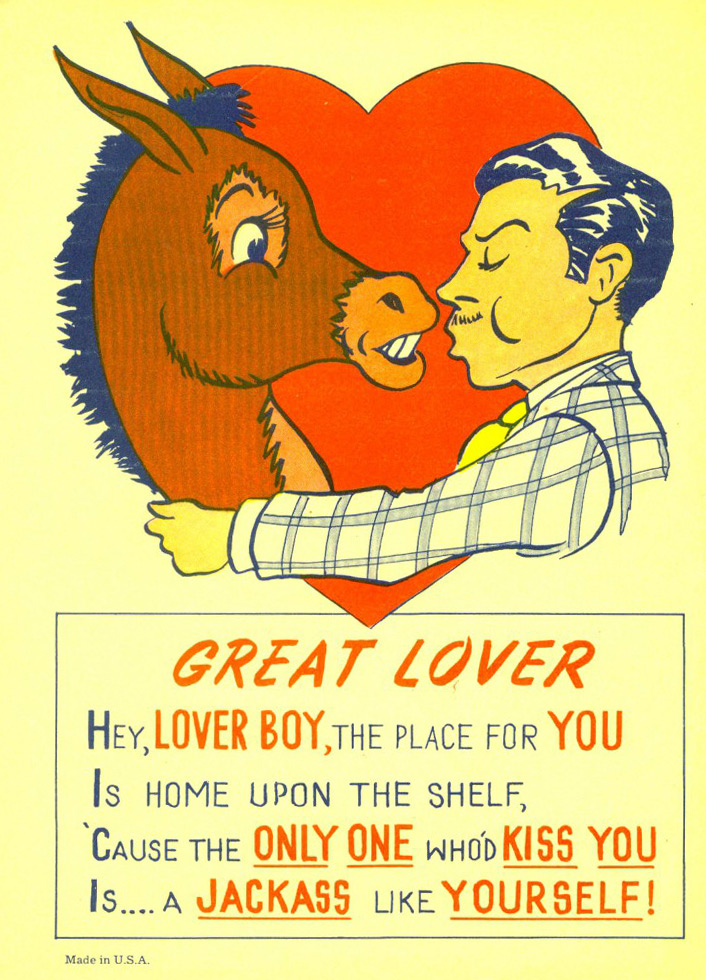
A dose of cynicism for Valentine's Day

Love is the delusion that one woman differs from another.*

~ H. L. Mencken (1880-1956) (Chrestomathy, Ch. 30)

Love. n. A temporary insanity curable by marriage or by removal of the patient from the influences under which he incurred the disorder. This disease, like caries and many other ailments, is prevalent only among civilized races living under artificial conditions; barbarous nations breathing pure air and eating simple food enjoy immunity from its ravages. It is sometimes fatal, but more frequently to the physician than to the patient.

~Ambrose Bierce (1842-1914?) (The Devil's Dictionary)

When love congeals
It soon reveals
The faint aroma of performing seals,
The double-crossing of a pair of heels -
I wish I were in love again!

The broken dates,
The endless waits,
The lovely loving and the hateful hates,
The conversation and the flying plates -
I wish I were in love again!

~ Lorenz Hart (1895-1943) ("I Wish I Were in Love Again," from Babes in Arms)

Love conquers all things - except poverty and toothache.

~ Mae West (1892-1980) (attributed)

Parrots, tortoises, and redwoods
Live a longer life than men do,
Men a longer life than dogs do,
Dogs a longer life than love does.

Edna St. Vincent Millay (1892-1950) ("Pretty Love I Must Outlive You")

February 14 is the feast day of St. Valentine, (wiki) Christian martyr of the 3rd century and the patron saint of lovers. By 100 years later, there were already two martyrs of that name commemorated on Rome's Via Flaminia, one a priest, another a bishop - perhaps the same man - for whom Pope Gelasius established "his" official observance in 496. 
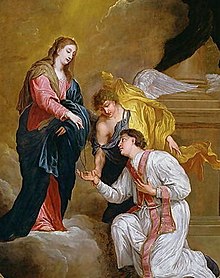
Saint Valentine receives a rosary from the Virgin
More recently, it has been adduced that St. Valentine was executed for conducting weddings of Roman soldiers against the order of the emperor Claudius II (reigned 268-270), but in fact, this prohibition, decreed by Augustus, had already been repealed by Septimus Severus (reigned 193-211). In any event, the saint supposedly cured the blindness of the daughter of the judge that condemned him and sent her a letter signed "your Valentine," thus starting the tradition of Valentine greetings on this date.

It is also attested by Chaucer, among others, that 14 February is the date on which the birds start to sing and choose their mates, lending further significance to the occasion. Be that as it may, one of my favorite observations in this context comes from American poet John Ciardi (1916-1986), who said,
"Love is the word we use to describe the sexual excitement of the young, the habituation of the middle aged, and the mutual dependence of the old."
* N.B. George Bernard Shaw (1856-1950) said something similar in the third act of Major Barbara:
"Like all young men, you greatly exaggerate the difference between one young woman and another."
Lots more Valentine's Day links here.

Monday, September 12, 2016

Monday links

"Every election is a sort of advance auction sale of stolen goods." It's the birthday of H.L. Mencken, noted curmudgeon, satirist, and political and cultural critic.


Fall Foliage Prediction Map

One minute science video lesson of the day: How A Bean Becomes A Fart


ICYMI, Friday's links are here, and include back to school fashion circa 1939, a gallery of unusual cloud formations, Heineken's abandoned plan to build houses out of beer bottles (plus more bottle houses and a DIY bottle brick tutorial), and everything you wanted to know about eyebrow interpretation from the 16th century.

It's the birthday of H.L. Mencken, noted curmudgeon, satirist, and political and cultural critic

I believed then, as I believe now, that it is the prime function of a really first-rate newspaper to serve as a sort of permanent opposition in politics, and I tried to show that the Sun, because of its geographical situation, had a superb opportunity to discharge that function effectively. Baltimore was but forty miles from Washington — and the Washington papers were all third-rate, and seemed doomed to remain so forever, for the overwhelming majority of their readers were petty Federal jobholders, which is to say, half-wits. 

~ H. L. Mencken (wiki) (Thirty-five Years of Newspaper Work: A Memoir by H. L. Mencken)

All of the great patriots now engaged in edging and squirming their way toward the Presidency of the Republic run true to form. This is to say, they are all extremely wary, and all more or less palpable frauds. What they want, primarily, is the job; the necessary equipment of (inescapable) issues, immutable principles, and soaring ideals can wait until it becomes more certain which way the mob will be whooping.

~ Mencken (On Politics: A Carnival of Buncombe

Every election is a sort of advance auction sale of stolen goods. 

~ Mencken (A Mencken Chrestomathy*)

Democracy is the theory that holds that the common people know what they want, and deserve to get it good and hard. 

~ Mencken (A Little Book in C Major)

Variously attributed:

Each party steals so many articles of faith from the other, and the candidates spend so much time making each other's speeches, that by the time election day is past there is nothing much to do save turn the sitting rascals out and let a new gang in. 

On some great and glorious day the plain folks of the land will reach their heart's desire at last, and the White House will be adorned by a downright moron. 

The theory seems to be that as long as a man is a failure he is one of God's children, but that as soon as he succeeds he is taken over by the Devil. 

Mencken is fictionalized in the play Inherit the Wind
(a fictionalized version of the Scopes Monkey Trial of 1925)
as the cynical sarcastic atheist E. K. Hornbeck (right),
seen here as played by Gene Kelly
For every complex problem there is an answer that is clear, simple, and wrong. 

The whole aim of practical politics is to keep the populace alarmed (and hence clamorous to be led to safety) by menacing it with an endless series of hobgoblins, all of them imaginary. 

Love is the triumph of imagination over intelligence.

Love is the delusion that one woman differs from another. 

Democracy is a pathetic belief in the collective wisdom of individual ignorance. 

A politician is an animal which can sit on a fence and yet keep both ears to the ground. 

No one in this world, so far as I know - and I have searched the records for years, and employed agents to help me - has ever lost money by underestimating the intelligence of the great masses of the plain people. 

Puritanism. The haunting fear that someone, somewhere, may be happy. 

The older I grow the more I distrust the familiar doctrine that age brings wisdom. 

Every normal man must be tempted, at times, to spit on his hands, hoist the black flag, and begin slitting throats. 

September 12 is the anniversary of the birth of "the Sage of Baltimore," American journalist, critic, and philologist H(enry) L(ouis) Mencken (wiki) (1880-1956). Perhaps the closest U.S. counterpart to England's Dr. Samuel Johnson, Mencken was a grumpy, hard-drinking, cantankerous curmudgeon, whose political insights, cruel wit, and incisive prose still excite admiration today. 

Born in Baltimore the son of a cigar-maker, Mencken was largely self-educated and started as a reporter for the Baltimore Morning Herald at the age of 19. By 1905, he was the editor of the Evening Herald and then moved on to Baltimore's Sun papers, for which he worked for most of the rest of his life. In 1924, he co-founded and edited the influential literary magazine, The American Mercury, while turning out a series of books based on his political columns and supplementing his monumental treatise, The American Language, whose first volume had appeared in 1919. Mencken continued working in journalism as late as World War II; he died of heart-failure in 1956. 

* N.B. A chrestomathy (mid 19th century: from Greek khrÄ“stomatheia, from khrÄ“stos ‘useful’ + -matheia ‘learning.’ is a collection of selected literary passages, usually by the same author. 

On June 30th, 1948, the Library of Congress made a recorded interview of H.L. Mencken. It is one of the only recordings of his voice in existence: