ICYMI, most recent links are here, and include the physics of juggling, scientists investigating the secrets of smelly cat butts, a 1918 prostate warmer to restore your manly vigor (or radium suppositories if that doesn't work), and the history of toilet paper.
When Napoleon recovered his throne at Paris, in March 1815 (ed - after his escape from Elba)... his first business was to sustain the attack of the united British and Prussians, posted in the Netherlands, and it was his obvious policy to make an attack on these himself before any others could come up to their assistance.
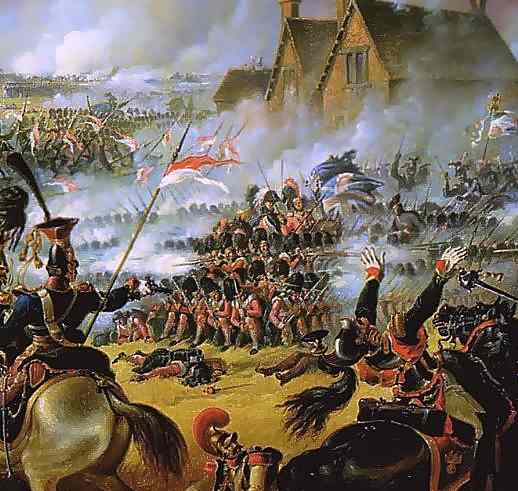
His rapid advance at the beginning of June, before the English and Prussian commanders were aware of his having left Paris; his quick and brilliant assaults on the separate bodies of Prussians and British at Ligny and Quatre Bras on the 16th, were movements marked by all his brilliant military genius. And even when, on the 18th, he commenced the greater battle of Waterloo (wiki) with both, the advantage still remained to him in the divided positions of his double enemy, giving him the power of bringing his whole host concentratedly upon one of theirs; thus neutralizing to some extent their largely superior forces. And, beyond a doubt, through the superior skill and daring which he thus shewed, as well as the wonderful gallantry of his soldiery, the victory at Waterloo ought to have been his.
There was just one obstacle, and it was decisive - the British infantry stood in their squares immovable upon the plain till the afternoon, when the arrival of the Prussians gave their side the superiority.
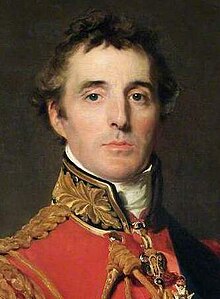
Thrown on that occasion into the central position among the opponents of Bonaparte, he was naturally and justly hailed as the saviour of Europe... Thenceforth the name of Wellington was venerated above that of any living Englishman.
You will have heard of our battle of the 18th. Never did I see such a pounding match... Napoleon did not maneuver at all. He just moved forward in the old style, and was driven off in the old style.
~Arthur Wellesley, Duke of Wellington (wiki) (letter to Sir William Beresford, 2 July 1815)
Meeting an acquaintance of another regiment, a very little fellow, I asked him what had happened to him yesterday. "I'll be hanged," says he, "if I know anything at all about the matter, for I was all day trodden in the mud and galloped over by every scoundrel who had a horse, and, in short, I only owe my existence to my insignificance.
Thou fateful Waterloo,
Millions of tongues record thee, and anew
Their children's lips shall echo them, and say --
"Here, where the sword the united nations drew,
Our countrymen were warring on that day!"
And this is much, and all which will not pass away.**
June 18 is the anniversary of the battle of Waterloo (wiki) in 1815, in which British forces under the Duke of Wellington (wiki) and the Prussians under Field Marshal Blücher decisively defeated the French under Napoleon to end the "Hundred Days Campaign." After the allies took Paris in March 1814, Napoleon was initially exiled to Elba. A year later, however, he returned to France amid great acclaim, re-entered Paris, declared himself emperor again, and retook command of the French armies to renew the struggle.
Four days after the debacle at Waterloo - which Wellington described as "the nearest-run thing you ever saw in your life" - Napoleon abdicated again and was sent into final exile on St. Helena in the South Atlantic, where he died in 1821. On more than one occasion, Wellington is also said to have remarked:
"Next to a battle lost, the greatest misery is a battle gained."
** This passage was quoted by Winston Churchill to President Franklin Roosevelt in choosing the phrase, United Nations, to designate the victorious powers in World War II.
Here's the battle scene from the 1970 movie Waterloo with Rod Steiger as Napoleon and Christopher Plummer as Wellington (and Orson Wells as Louis XVIII):
October 25 is the anniversary of 3 major battles: Agincourt, the charge of the Light Brigade and Leyte Gulf - including a documentary on the Charge of the Light Brigade with graphic quotes from survivors and the original 1890 recording (made by Thomas Edison) of Alfred Tennyson reading part of his famous poem.
ICYMI, Wednesday's links are here, and include an explanation of the chemicals that give Autumn leaves their colors, a self-cleaning house, an excellent site for DIY intelligent women's costumes, and lessons from the Sioux in how to turn a boy into a man.
May the Great God, whom I worship, grant to my country and for the benefit of Europe in general, a great and glorious Victory; and may no misconduct in any one tarnish it; and may humanity after Victory be the predominant feature of the British Fleet. For myself, individually, I commit my life to Him who made me, and may His blessing light upon my endeavors for serving my Country faithfully. To Him I resign myself and the just cause which is entrusted to me to defend. Amen. Amen. Amen.
~ Horatio, Lord Nelson (wiki) (his prayer, 20 October 1805, on the eve of the Battle of Trafalgar)
No captain can do very wrong if he places his ship alongside that of an enemy.
~ Nelson (memorandum, written onboard HMS Victory, off Cadiz, 9 October 1805)
ENGAGE THE ENEMY MORE CLOSELY
~ Nelson's favorite signal* (made "general" to the fleet by him for the last time at 1156 on 21 October 1805)
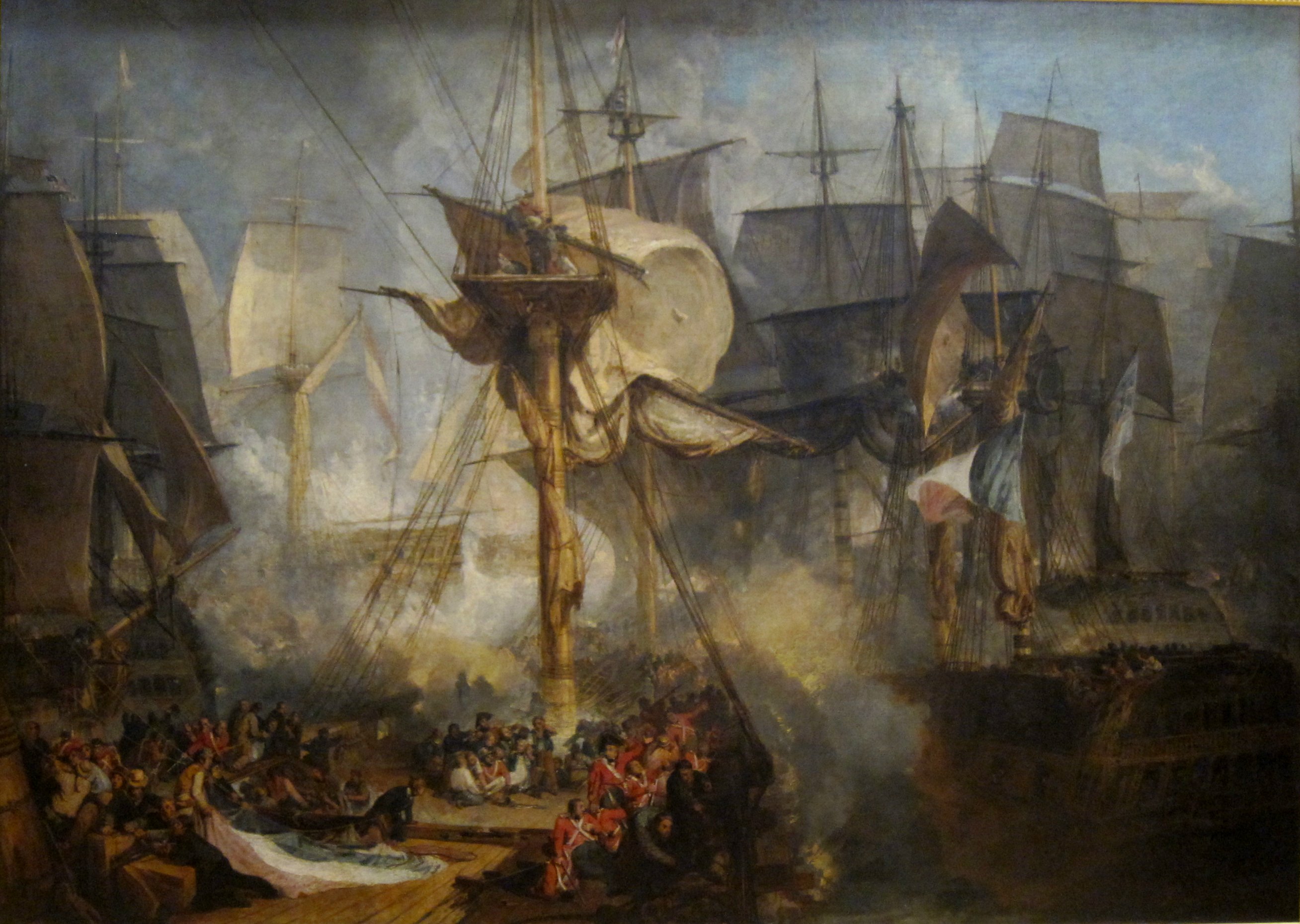
October 21 is Trafalgar Day (wiki), the anniversary of the Battle of Trafalgar and the death of England's greatest naval hero, Admiral Horatio Nelson (wiki) on 21 October 1805. Fought off the southwest coast of Spain, Trafalgar was the greatest naval victory of the Napoleonic wars and essentially destroyed the sea power of France in a single engagement. Nelson and the British fleet had been blockading the French and Spanish fleet under Villeneuve in Cadiz after pursuing it to the Caribbean and back. When Villeneuve finally emerged to give battle, Nelson, depending on the superior seamanship and fighting skill of his "band of brothers" and the British sailor, adopted an unorthodox tactic that split the French/Spanish line into three parts and led to a general melee in which the British took 19 ships without loss.
At the height of the battle however, Nelson was cut down by a French sharpshooter's bullet, and he died a few hours later. In his History of Modern Europe (1883), Charles Alan Fyfe wrote,
"Trafalgar was not only the greatest naval victory, it was the greatest and the most momentous victory either by land or by sea during the whole of the Revolutionary War.** No victory, and no series of victories, of Napoleon produced the same effect upon Europe... Nelson's last triumph left England in such a position that no means remained to injure her."
* N.B. However, much more famous was his signal at the start of the battle:
There are three accounts of the matter one by Mr. James, in his Naval History; one by Captain Blackwood, who commanded the Euryalus at the battle of Trafalgar; and one by Captain Pasco, who had been Nelson's flag-lieutenant in the Victory. Sir Harris Nicolas accepts Pasco's version, because that officer had himself to signal the words by means of flags. His account runs thus: 'His lordship came to me on the poop, and after ordering certain signals to be made, about a quarter to noon he said: "Mr. Pasco, I wish to say to the fleet, 'England confides that every man will do his duty;' and he added, "you must be quick, for I have one more to make, which is for close action." I replied: "If your lordship will permit me to substitute 'expects,' for confides! the signal will soon be completed, because the word 'expects' is in the vocabulary, whereas the word 'confides' must be spelled?" His lordship replied in haste, and with scenting satisfaction: "That will do, Pasco; make it directly!"
In signal flags, this appeared as:
** Meaning here, the conflicts that followed the French revolution in 1789.
ICYMI, Friday's links are here, and include a short 1901 film with some rather impressive special effects, fashion tips from the Middle Ages, the Krakatoa volcanic eruption in 1883 (it was so loud it ruptured eardrums of people 40 miles away), and how The Princess Bride built that sword-fighting scene.
ICYMI, Friday's links are here, and include a compilation of dancing in ‘80s movies, the habits of highly mathematical people, the opening ceremony of the 1936 Nazi Olympic Games, and, from 1944, head shots of all of the ways US intelligence thought Hitler might try to disguise himself.


 (1869)*