Amazon Deals

New at Amazon

Thursday, March 24, 2022

How The World Will End, According To 1939

They seem to have Robert Frost (wiki) (online archive) covered here...

Some say the world will end in fire,
Some say in ice.
From what I've tasted of desire
I hold with those who favor fire.
But if it had to perish twice,
I think I know enough of hate
To say that for destruction ice
Is also great
And would suffice.


But nothing so tame as Eliot envisioned:

This is the way the world ends 
Not with a bang but a whimper.

(Whole poem here)

Popular Science published these apocalyptic illustrations, along with a very upsetting three-page article, in its September 1939 issue (go there for larger images).

A giant meteor running wild through space... may strike the Earth and spread havoc with its impact and scorching breath.

In the image above, thousands of people run from Manhattan as meteors streak down around them. But their flight is futile, because a city-sized asteroid is about one nanosecond away from obliterating the Eastern time zone. "People that it missed would still be threatened, not only by terrible earthquakes, but even more by a searing air blast of hurricane velocity that would mushroom out from the point of impact

Sometimes a star becomes a 'nova,' or mysteriously flares up in brightness. Suppose that suddenly our own star, the sun, should likewise act as if a vast bellows were blowing a draft into its molten interior. In eight brief minutes the resulting blast of radiant heat would reach the earth, and all life on this planet would vanish in clouds of steam and puffs of smoke.

Below: This lonely, icy scene takes place not at one of Earth’s frozen poles, but at its equator. The sun is dying, slowly, and so are the four humans in this painting. The sun will become a dull-red ball in a sullen sky, casting only a feeble, ruddy glow over ice that will cover the earth. For a time, human beings will be able to live near the equator, and then underground, beside perpetually burning fires. But when the solar furnace dwindles to a faint spark, the earth's atmosphere will turn to liquid air and life will become impossible.


Another option: as tidal friction slows down the moon in its orbit, the earth will draw it nearer and nearer.

To anyone still on earth, it will appear as an ominous golden-orange orb, fattening in apparent size until it reaches twenty-four times its present magnitude—no longer a friendly beacon by night, but a terror in the skies. Oceans will wash over all but the highest mountains. Racking strains in the earth's crust will unleash the inferno that lies beneath.

Finally, Popular Science explains, the moon will get so close to Earth that it will experience "land tides," causing our satellite to burst into rocky chunks that then rain down on Earth, "completing the destruction of anything alive." The rest of the moon pieces will orbit around Earth in a ring, and our planet will live out its days like a grotesque version of Saturn.

Further options in other PopSci life-ending articles.

Friday, January 21, 2022

Map of power outages caused by squirrels, with bonus squirrel-related links

"I don't think paralysis [of the electrical grid] is more likely by cyberattack than by natural disaster. And frankly the number-one threat experienced to date by the US electrical grid is squirrels." 

~ John C. Inglis, Former Deputy Director, National Security Agency 2015.07.09

The war with the squirrels continues unabated - from Cyber Squirrel 1 (who is, unfortunately, no longer updating):
This map lists all unclassified Cyber Squirrel Operations that have been released to the public that we have been able to confirm. There are many more executed ops than displayed on this map however, those ops remain classified.
Screenshot from CyberSquirrel1

The data is gathered from Twitter and then listed on a filter-able Google map. You have the option to narrow the data by year and by month, and can even choose to only view the cases related to squirrels, non-squirrels, or all animals, including birds, raccoons, snakes and beavers. The interactive map is available here.

Related posts/links:

Video: The Narcoleptic Squirrel Song.

I'm pretty sure this flesh-eating-squirrels-because-fracking movie never got made, but if it ever happens, I'm in: Squirrels - Pre-production Sales Trailer.


A fire that heavily damaged an apartment complex was started by a resident using a propane torch to remove a squirrel's fur.

Scottish brewery releases $20,000 beer in taxidermy squirrel.

Friday, December 10, 2021

The worlds strongest, explosive powered nut cracker

The worlds strongest, explosive powered nut cracker:

If you’ve ever tried to use a nutcracker, you soon realize they don’t have much in the way of actual force. So, YouTuber Shane Wighton decided to design and fabricate, from scratch, a nutcracker that could bite the hitch off a pick-up truck.

To power it, he used the explosive blank shells that are used in construction to drive nails into concrete. The video animates and explains the physics involved - he creates and machines each component, then has to re-design and re-produce those components to correct his mistakes. 

Pretty cool. Watch full screen.

Thursday, December 9, 2021

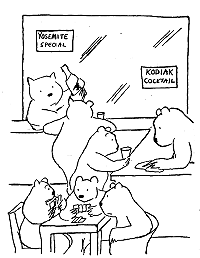
Thurber's fable "The Bear Who Let It Alone"

One of my favorite authors is James Thurber, and one of my favorite (very) short stories of his (actually one of his fables) is about a bear who drank too much, then gave it up.

Thurber's fable The Bear Who Let It Alone:

In the woods of the Far West there once lived a brown bear who could take it or let it alone. He would go into a bar where they sold mead, a fermented drink made of honey, and he would have just two drinks. Then he would put some money on the bar and say, "See what the bears in the back room will have," and he would go home. But finally he took to drinking by himself most of the day.

He would reel home at night, kick over the umbrella stand, knock down the bridge lamps, and ram his elbows through the windows. Then he would collapse on the floor and lie there until he went to sleep. His wife was greatly distressed and his children were very frightened.

At length the bear saw the error of his ways and began to reform. In the end he became a famous teetotaler and a persistent temperance lecturer. He would tell everybody that came to his house about the awful effects of drink, and he would boast about how strong and well he had become since he gave up touching the stuff. To demonstrate this, he would stand on his head and on his hands and he would turn cartwheels in the house, kicking over the umbrella stand, knocking down the bridge lamps, and ramming his elbows through the windows.

Then he would lie down on the floor, tired by his healthful exercise, and go to sleep. His wife was greatly distressed and his children were very frightened.

Moral: You might as well fall flat on your face as lean over too far backward.

Wednesday, November 3, 2021

Drones

drones
Getty Images, Mehmet Kaman

Imagine a few years from now, U.S. supply troops have just wrapped up a field exercise in Poland, showing solidarity with the country in the face of saber-rattling from nearby Russia. As the sun sets, GIs rest next to their trucks, knowing the Russian 18th Guards Motor Rifle Division is encamped just a few miles away.

The soldiers hear a faint buzzing in the distance and see a dark cloud crossing the horizon. Suddenly, a solitary scout drone swoops low over the Americans—it’s seen them. Like a predator catching the scent of prey, the cloud stops dead in its tracks, then rushes toward the soldiers with astonishing speed. Following programming orders, each of the 60 drones scans the ground below and picks its target, while AI ensures no two drones aim for the same vehicle. The drones arm their explosive payloads just as the first bursts of gunfire begin lancing out from the American position.

“The first use of autonomous weapons in war won’t be heralded with a giant fireball in the sky. It may just look like an ordinary drone.”

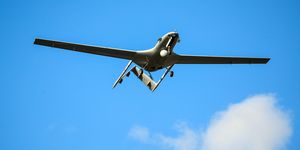
Sometime around March 2020, this longstanding trope of science fiction—autonomous attack drones eliminating human beings on the futuristic battlefield—crossed over into science fact. That’s when, during the Second Libyan Civil War, the interim Libyan government attacked forces from the rival Haftar Affiliated Forces (HAF) with Turkish-made Kargu-2 (“Hawk 2”) drones, marking the first reported time autonomous hunter killer drones targeted human beings in a conflict, according to a United Nations report.

Unmanned combat aerial vehicles, loitering munitions, and the Kargu-2 “hunted down and remotely engaged” HAF logistics convoys and retreating fighters, the UN report found. The autonomous drones were programmed to attack targets “without requiring data connectivity between the operator and munition,” meaning they located and attacked HAF forces independent of any kind of pilot or control scheme.

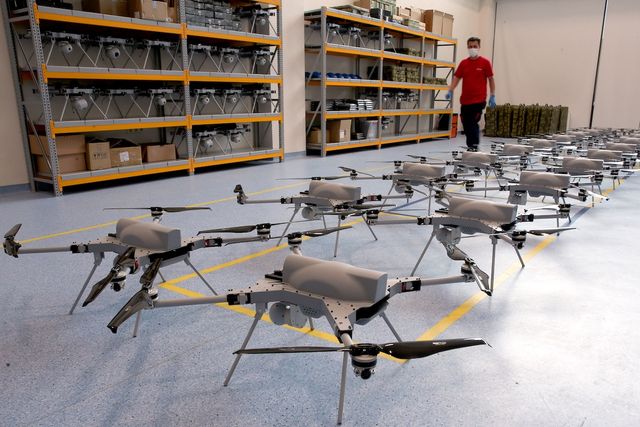
The Kargu-2 is a quadcopter drone developed by STM, a Turkish defense contractor. The drone features sensors and an electronic brain, and is designed to carry a weapons payload. In marketing materials, STM explicitly says Kargu-2 is capable of carrying out an autonomous attack.

Here’s how it works: The drone operator loads a set of target coordinates into the Kargu-2’s software. The drone then takes off and travels to the coordinates, searching for objects on the ground that fit the profile of preferred targets. Once the drone identifies a target, it swoops down on the target at high speed and detonates an onboard explosive package, with an effect similar to that of a shotgun blast.

“The first use of autonomous weapons in war won’t be heralded with a giant fireball in the sky,” says Zachary Kallenborn, an official U.S. Army “Mad Scientist” and national security consultant. “It may just look like an ordinary drone. The event illustrates a key challenge in any attempt to regulate or ban autonomous weapons: How can we be sure they were even used?”


The Evolution of Military Drones


One major difference between a remotely controlled attack drone and an autonomous drone is the software, which might be difficult to obtain from scattered bits of plastic for forensic analysis.

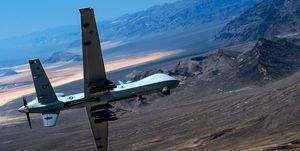
The U.S. Army is working on autonomous drones, including the Bell Textron M5 medium robotic combat vehicle. The M5 is an uncrewed, 10-ton tracked armored vehicle that looks like a miniature tank and has a top speed of 40 miles per hour. It features a 30-millimeter XM813 chain gun and is designed to operate alone or as a wingman to M1A2 Abrams tanks and M2 Bradley infantry fighting vehicles.

The key difference between the Army’s drones and the Kargu-2, however, is that the Army insists on a “human in the loop.” The drone might search for targets autonomously, but it can only open fire once a human operator gives permission. This allows the operator to call off an attack if the drone has mistaken a civilian for a soldier.

Some events in the history of mankind, like the 1945 atomic bomb test at the Alamogordo Bombing Range in New Mexico, are so profound, they serve as a divider between one social, economic, or military era and another. The events in Libya may similarly divide the time when humans had full control of weapons and a time when machines make their own decisions to kill.