Amazon Deals

New at Amazon

Thursday, May 26, 2022

Kurt Vonnegut's May 29, 1945 letter home after imprisonment in an underground slaughterhouse during the Dresden bombing

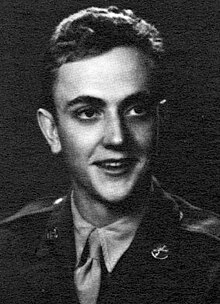
On December 19, 1944, twenty-two year old Kurt Vonnegut (wiki) was captured by Wehrmacht troops. Below is the letter he wrote to his family after the end of the war informing them of his capture and survival. Describing the capture and move to Dresden:
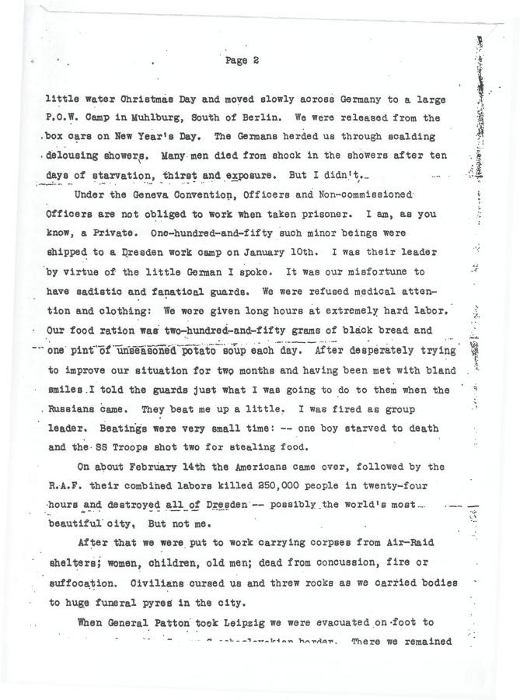
Well, the supermen marched us, without food, water or sleep to Limberg, a distance of about sixty miles, I think, where we were loaded and locked up, sixty men to each small, unventilated, unheated box car. There were no sanitary accommodations -- the floors were covered with fresh cow dung. There wasn't room for all of us to lie down. Half slept while the other half stood. We spent several days, including Christmas, on that Limberg siding. On Christmas eve the Royal Air Force bombed and strafed our unmarked train. They killed about one-hundred-and-fifty of us. We got a little water Christmas Day and moved slowly across Germany to a large P.O.W. Camp in Muhlburg, South of Berlin. We were released from the box cars on New Year's Day. The Germans herded us through scalding delousing showers. Many men died from shock in the showers after ten days of starvation, thirst and exposure. But I didn't.
Under the Geneva Convention, Officers and Non-commissioned Officers are not obliged to work when taken prisoner. I am, as you know, a Private. One-hundred-and-fifty such minor beings were shipped to a Dresden work camp on January 10th.
In Dresden they were imprisoned in an underground slaughterhouse known by German soldiers as "Schlachthof Fünf" (Slaughterhouse Five (wiki)), which, of course, he used 25 years later as the title and organizing principle of his best-known book. During the bombing of Dresden (wiki), which took place in four raids between February 13th and 15th, the subterranean nature of the prison saved their lives: 
On about February 14th the Americans came over, followed by the R.A.F. their combined labors killed 250,000 people* in twenty-four hours and destroyed all of Dresden -- possibly the world's most beautiful city. But not me. 
After that we were put to work carrying corpses from Air-Raid shelters; women, children, old men; dead from concussion, fire or suffocation. Civilians cursed us and threw rocks as we carried bodies to huge funeral pyres in the city. 
Transcript below the scan - read the whole thing.


Transcript

FROM:

Pfc. K. Vonnegut, Jr.,
12102964 U. S. Army.

TO:

Kurt Vonnegut,
Williams Creek,
Indianapolis, Indiana.

Dear people:

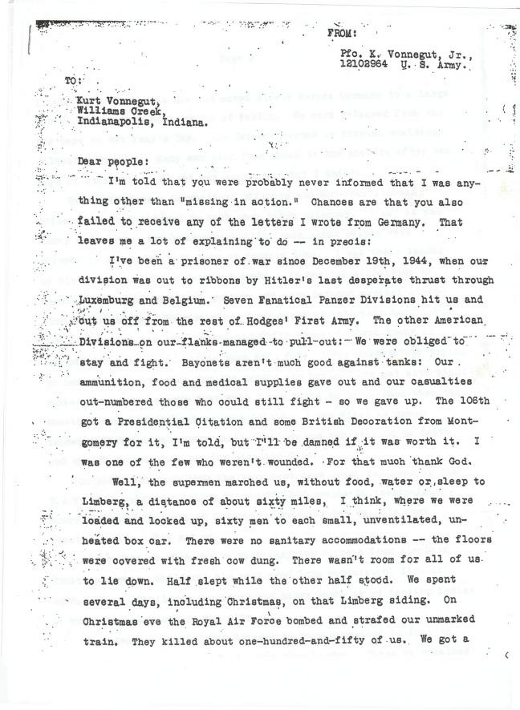
I'm told that you were probably never informed that I was anything other than "missing in action." Chances are that you also failed to receive any of the letters I wrote from Germany. That leaves me a lot of explaining to do -- in precis:

The location of the original Slaughterhouse Five
 is now a parking lot in front of an exhibition hall,
 but a stone statue of a cow that once marked
 the entrance to the meatpacking district
somehow survived the bombing. (more here)
I've been a prisoner of war since December 19th, 1944, when our division was cut to ribbons by Hitler's last desperate thrust through Luxemburg and Belgium. Seven Fanatical Panzer Divisions hit us and cut us off from the rest of Hodges' First Army. The other American Divisions on our flanks managed to pull out: We were obliged to stay and fight. Bayonets aren't much good against tanks: Our ammunition, food and medical supplies gave out and our casualties out-numbered those who could still fight - so we gave up. The 106th got a Presidential Citation and some British Decoration from Montgomery for it, I'm told, but I'll be damned if it was worth it. I was one of the few who weren't wounded. For that much thank God.

Well, the supermen marched us, without food, water or sleep to Limberg, a distance of about sixty miles, I think, where we were loaded and locked up, sixty men to each small, unventilated, unheated box car. There were no sanitary accommodations -- the floors were covered with fresh cow dung. There wasn't room for all of us to lie down. Half slept while the other half stood. We spent several days, including Christmas, on that Limberg siding. On Christmas eve the Royal Air Force bombed and strafed our unmarked train. They killed about one-hundred-and-fifty of us. We got a little water Christmas Day and moved slowly across Germany to a large P.O.W. Camp in Muhlburg, South of Berlin. We were released from the box cars on New Year's Day. The Germans herded us through scalding delousing showers. Many men died from shock in the showers after ten days of starvation, thirst and exposure. But I didn't.

Under the Geneva Convention, Officers and Non-commissioned Officers are not obliged to work when taken prisoner. I am, as you know, a Private. One-hundred-and-fifty such minor beings were shipped to a Dresden work camp on January 10th. I was their leader by virtue of the little German I spoke. It was our misfortune to have sadistic and fanatical guards. We were refused medical attention and clothing: We were given long hours at extremely hard labor. Our food ration was two-hundred-and-fifty grams of black bread and one pint of unseasoned potato soup each day. After desperately trying to improve our situation for two months and having been met with bland smiles I told the guards just what I was going to do to them when the Russians came. They beat me up a little. I was fired as group leader. Beatings were very small time: -- one boy starved to death and the SS Troops shot two for stealing food.
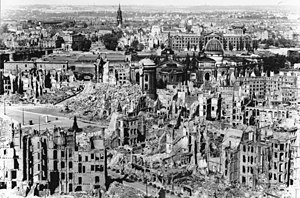
Dresden after the bombing raid (wiki)
On about February 14th the Americans came over, followed by the R.A.F. their combined labors killed 250,000 people in twenty-four hours and destroyed all of Dresden -- possibly the world's most beautiful city. But not me.

After that we were put to work carrying corpses from Air-Raid shelters; women, children, old men; dead from concussion, fire or suffocation. Civilians cursed us and threw rocks as we carried bodies to huge funeral pyres in the city.

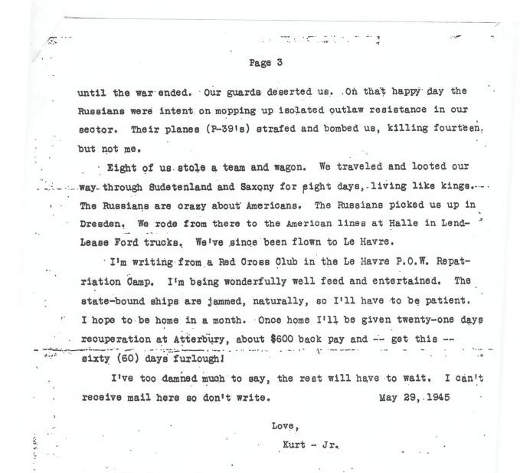
When General Patton took Leipzig we were evacuated on foot to ('the Saxony-Czechoslovakian border'?). There we remained until the war ended. Our guards deserted us. On that happy day the Russians were intent on mopping up isolated outlaw resistance in our sector. Their planes (P-39's) strafed and bombed us, killing fourteen, but not me.

Eight of us stole a team and wagon. We traveled and looted our way through Sudetenland and Saxony for eight days, living like kings. The Russians are crazy about Americans. The Russians picked us up in Dresden. We rode from there to the American lines at Halle in Lend-Lease Ford trucks. We've since been flown to Le Havre.

I'm writing from a Red Cross Club in the Le Havre P.O.W. Repatriation Camp. I'm being wonderfully well feed and entertained. The state-bound ships are jammed, naturally, so I'll have to be patient. I hope to be home in a month. Once home I'll be given twenty-one days recuperation at Atterbury, about $600 back pay and -- get this -- sixty (60) days furlough.

I've too damned much to say, the rest will have to wait, I can't receive mail here so don't write.

May 29, 1945

Love,

Kurt - Jr.

* via a commenter, the book The Bombers and the Bombed: Allied Air War Over Europe, 1940-1945, by Richard Overy (Viking 2013), asserts: "Recent estimates from a historical commission in Dresden have confirmed that the original figure suggested by the city's police president in March 1945 of approximately 25,000 dead is the best available estimate." The 250,000 figure came about via Goebbels' "judicial addition of an additional zero to the provisional casualty estimate."

Via the always interesting but not frequently-enough updated (that was a hint, you guys) blog of Letters of Note.

Previous posts: In 2006, Kurt Vonnegut sent this excellent letter to a high school class, and here's his 1944 letter from a German prison camp.

Monday, May 9, 2022

Cory Doctorow on right-to-repair, VIN-locking and kill-switching: John Deere (and many others)

Read the whole thing - Right-to-repair, VIN-locking and kill-switching: 

John Deere makes this claim: in its battles against the right to repair, Deere styles itself as the guardian of the world’s food supply, whose information security is all that stands between us and a Russian (or Chinese, or supervillain) shutdown of the world’s ag-tech.

They’re not wrong: John Deere’s decision to build ag-tech that can be remotely controlled, disabled and updated, along with its monopolization of the world’s ag-tech market, means that anyone who compromises its system puts the world’s food-supply at risk.

Which is a terrifying proposition, because John Deere has extraordinarily terrible information security. When Sick Codes probed Deere’s security, they found glaring, serious errors that put the entire food supply chain at risk.

Worse, John Deere seems to have no clue as to how bad it is at security. In the company’s entire history it has never once submitted a single bug to the US government’s Common Vulnerabilities and Exposures (CVE) database. As far as Deere knows, its security is literally perfect.

Saturday, May 7, 2022

V.E. Day: on May 8, 1945, World War 2 ended in Europe

May 8th is the anniversary of V.E. Day (for "Victory in Europe") (wikiBBC) in 1945, which saw the German surrender and the end of World War II in the European theater
The beaten foe emerged.
Winston Churchill waves to crowds London on V-E Day.
All over the broad Atlantic, wherever they had been working or lying hid, the U-boats surfaced, confessing the war's end. A few of them, prompted by determination or struck by guilt, scuttled or destroyed themselves, or ran for shelter, not knowing that there was none; but mostly they did what they had been told to do, mostly they hoisted their black surrender flags, and stayed where they were, and waited for orders. 
They rose, dripping and silent, in the Irish Sea, and at the mouth of the Clyde, and off the Lizard in the English Channel, at the top of the Minches where the tides raced; they rose near Iceland, where Compass Rose was sunk and off the north-west tip of Ireland, and close to the Faeroes, and on the Gibraltar run where the sunk ships lay so thick, and near St. Johns and Halifax and in the deep of the Atlantic, with three thousand fathoms of water beneath their keel. 
They surfaced in secret places, betraying themselves and their frustrated plans: they rose within sight of land, they rose far away in mortal waters, where on the map of the battle, the crosses that were the sunken ships were etched so many and so close that the ink ran together. They surfaced above their handiwork, in hatred or in fear, sometimes snarling their continued rage, sometimes accepting thankfully a truce they had never offered to other ships, other sailors.
They rose, and lay wherever they were on the battlefield, waiting for the victors to claim their victory. 
~ Nicolas Monsarrat ("V.E. Day," from The Cruel Sea)

May 8th is the anniversary of V.E. Day (for "Victory in Europe") (wiki, BBC) in 1945, and commemorates the unconditional surrender of Nazi Germany to the Allied forces, ending World War II in Europe.*

With Adolf Hitler dead by his own hand, German military leaders signed surrender documents at several locations in Europe on May 7, capitulating to each of their victorious foes. Germany’s partner in fascism, Italy, had switched sides in 1943, though many Italians continued to fight alongside their German comrades in Italy.

Upon entering the war in December 1941, the United States had agreed on a “Europe first” strategy: concentrate on defeating Germany, Italy and their satellites rather than focusing the bulk of men and resources on the war in the Pacific. V-E Day, therefore, marked a major milestone for the Allies but did not end the war, as Allied governments pointedly reminded their citizens. Attention turned to finishing the war against Imperial Japan. More on that here:
It's V-J Day, the anniversary of the date of Japan's surrender in 1945 and the end of WWII.
* N.B. It's referred to as "Victory Day" in Russia and is celebrated on May 9th.

People dance in the streets of London on
VE Day, 8 May 1945
English novelist Nicolas Monsarrat (1910-1979) was born in Liverpool and earned a law degree at Cambridge. With the outbreak of World War II, he joined the Royal Naval Volunteer Reserve and served on the North Atlantic convoys for several years. This experience led to his crafting perhaps the most highly regarded novel about modern naval warfare yet written - The Cruel Sea - which appeared in 1951 while its author was serving as a British diplomat in South Africa. An equally esteemed motion picture, starring Jack Hawkins, was made of the book two years later, and it remains a classic today. Several other Monsarrat novels followed, but none ever gained the stature of The Cruel Sea.

Below is a generous theatrical trailer for The Cruel Sea, which actually shows some of the best bits.

Here's the Youtube description:
The novel The Cruel Sea by Nicholas Monserrat was an unflinching portrayal of life at sea during WWII on a boat tasked with protecting convoys and seeking and destroying U-boats. A runaway success, the novel had already sold over 4 million copies in just 2 years when Ealing decided to make the film version. Filmed aboard an actual Royal Navy corvette, The Cruel Sea tells the story of the sailors aboard the HMS Compass Rose: the bonds that form between them, the daily pressures they face and their epic struggle to overcome the enemy. Nominated for a BAFTA for Best British Film, The Cruel Sea stars Jack Hawkins, Sir Donald Sinden and Stanley Clarke, and is a gripping insight into the lives of unsung heroes at sea during the war, and the agonizing decisions and incredible peril they faced on a daily basis.


And a brief documentary:


Related posts:

It's V-J Day, the anniversary of the date of Japan's surrender in 1945 and the end of WWII.

Churchill's "We shall fight on the beaches...we shall never surrender" speech: the evacuation of Dunkirk by a flotilla of small boats.

June 6 is D-Day: quotes, videos (footage, FDR's and Reagan's speeches), lots of links.

March 5 is the anniversary of Winston Churchill's Iron Curtain speech.


Before there was Laffer: Churchill on the fiscal cliff.

Parts of the text above are based on Ed's Quotation of the Day, only available via email - leave your email address in the comments if you'd like to be added to his list. Ed is the author of Hunters and Killers: Volume 1: Anti-Submarine Warfare from 1776 to 1943 and Hunters and Killers: Volume 2: Anti-Submarine Warfare from 1943.

Thursday, March 31, 2022

BBC's 1957 Spaghetti Harvest prank

The Spaghetti Tree prank (wiki) from the April 1, 1957 episode of the BBC Program Panorama:

Here's the explanation:

On April 1, 1957 the British television programme Panorama broadcast a three-minute segment about a bumper spaghetti harvest in southern Switzerland. The success of the crop was attributed both to an unusually mild winter and to the virtual disappearance of the spaghetti weevil. The audience heard Richard Dimbleby, the shows highly respected anchor, discussing the details of the spaghetti crop as they watched video footage of a Swiss family pulling pasta off spaghetti trees and placing it into baskets. The segment concluded with the assurance that, For those who love this dish, theres nothing like real, home-grown spaghetti.

The Swiss Spaghetti Harvest hoax generated an enormous response. Hundreds of people phoned the BBC wanting to know how they could grow their own spaghetti tree. To this query the BBC diplomatically replied, Place a sprig of spaghetti in a tin of tomato sauce and hope for the best. 

To this day the Panorama broadcast remains one of the most famous and popular April Fools Day hoaxes of all time. It is also believed to be the first time the medium of television was used to stage an April Fools Day hoax.

Since 1955 Panorama had been anchored by Richard Dimbleby, whose authoritative, commanding presence had made him one of the most revered public figures in Britain. If Dimbleby said it, people trusted that it was true. Which is one of the reasons why the spaghetti harvest hoax fooled so many viewers. His participation lent the hoax an air of unimpeachable authority.

Almost no one else at the BBC knew about it. The segment was not mentioned at all in the pre-transmission publicity handouts.

The line-up for that days show included a long segment about Archbishop Makarios, leader of the Greek Cypriots, and a clip of the Duke of Edinburgh attending the premiere of the war film The Yangtse Incident.

The second-to-last segment was about a wine-tasting contest, and then it came time for the spaghetti harvest.

Dimbleby, sitting on the set of Panorama, looked into the camera and without a trace of a smile said: And now from wine to food. We end Panorama tonight with a special report from the Swiss Alps.

The screen cut away to the prepared footage. When it was all over, Dimbleby reappeared and said, Now we say goodnight, on this first day of April. He emphasized the final phrase.

Panorama never attempted another April Fools Day spoof, despite numerous calls for a sequel. However, the hoax did inspire a number of similar stunts in its honour.

This film footage is from the Archive Collection held and administered by the Alexandra Palace Television Society. 

Thursday, March 24, 2022

How The World Will End, According To 1939

They seem to have Robert Frost (wiki) (online archive) covered here...

Some say the world will end in fire,
Some say in ice.
From what I've tasted of desire
I hold with those who favor fire.
But if it had to perish twice,
I think I know enough of hate
To say that for destruction ice
Is also great
And would suffice.


But nothing so tame as Eliot envisioned:

This is the way the world ends 
Not with a bang but a whimper.

(Whole poem here)

Popular Science published these apocalyptic illustrations, along with a very upsetting three-page article, in its September 1939 issue (go there for larger images).

A giant meteor running wild through space... may strike the Earth and spread havoc with its impact and scorching breath.

In the image above, thousands of people run from Manhattan as meteors streak down around them. But their flight is futile, because a city-sized asteroid is about one nanosecond away from obliterating the Eastern time zone. "People that it missed would still be threatened, not only by terrible earthquakes, but even more by a searing air blast of hurricane velocity that would mushroom out from the point of impact

Sometimes a star becomes a 'nova,' or mysteriously flares up in brightness. Suppose that suddenly our own star, the sun, should likewise act as if a vast bellows were blowing a draft into its molten interior. In eight brief minutes the resulting blast of radiant heat would reach the earth, and all life on this planet would vanish in clouds of steam and puffs of smoke.

Below: This lonely, icy scene takes place not at one of Earth’s frozen poles, but at its equator. The sun is dying, slowly, and so are the four humans in this painting. The sun will become a dull-red ball in a sullen sky, casting only a feeble, ruddy glow over ice that will cover the earth. For a time, human beings will be able to live near the equator, and then underground, beside perpetually burning fires. But when the solar furnace dwindles to a faint spark, the earth's atmosphere will turn to liquid air and life will become impossible.


Another option: as tidal friction slows down the moon in its orbit, the earth will draw it nearer and nearer.

To anyone still on earth, it will appear as an ominous golden-orange orb, fattening in apparent size until it reaches twenty-four times its present magnitude—no longer a friendly beacon by night, but a terror in the skies. Oceans will wash over all but the highest mountains. Racking strains in the earth's crust will unleash the inferno that lies beneath.

Finally, Popular Science explains, the moon will get so close to Earth that it will experience "land tides," causing our satellite to burst into rocky chunks that then rain down on Earth, "completing the destruction of anything alive." The rest of the moon pieces will orbit around Earth in a ring, and our planet will live out its days like a grotesque version of Saturn.

Further options in other PopSci life-ending articles.