Amazon Deals

New at Amazon

Showing posts with label war. Show all posts

Saturday, August 8, 2026

August 9th is the anniversary of the battle of Thermopylae

If you want a quick and dirty understanding of the battle of Thermopylae (wiki), the movie The 300 (or the comic version on which the movie was based) will do in a pinch, and the History Channel videos posted below do a pretty good job.

Dulce et decorum est pro patria mori,
mors et fugacem persequitur virum.
nec parcit imbellis iuventae
poplitibus timidove tergo.

~ Quintus Horatius Flaccus (Horace, 65-27 B.C.) (Carmina, III, ii, 13)

(To die for the fatherland is a sweet and admirable thing.*
Death is at the heels even of the runaway, nor spares the haunches and back of the coward and malingerer.)

Go tell the Spartans, thou, that passeth by, that here, according to their laws, we lie.

~ Simonides of Ceos (556-458 B.C.) (epitaph for the Spartan dead at Thermopylae)

Leonidas at Thermopylae, by Jacques-Louis David, 1814.
Today is the anniversary of the battle of Thermopylae in 480 B.C. Thermopylae is a pass in east central Greece between the cliffs of Mount Oeta and the Malic Gulf, and in ancient times, it was a principal entrance into southern Greece from the north.

It was there that the Greeks confronted the third Persian expedition of the Persian Wars - an army of as many as a half-million men under Xerxes. When they found that their position had been turned, however, the Greeks retreated precipitously - all except for a 300-strong Spartan contingent under their king, Leonidas, and 700 Theban allies. (The latter are often overlooked in references to the battle.)

The pass of Thermopylae today - the road to 
the far right is built on land reclaimed from the sea
Leonidas and his men fought a delaying action in the narrowest part of the pass until they were overcome by the Persians and slaughtered to a man. In book VII of his The Persian Wars, the Greek historian Herodotus (484? - 425? B.C.) wrote,
"...they defended themselves to the last, such as still had swords using them, and the others resisting with their hands and teeth; until the barbarians, who had in part pulled down the wall and attacked them in front, also had gone round and now encircled them on every side, overwhelmed and buried the remnant left beneath showers of missile weapons."
Thermopylae has ever since been celebrated in song and story as one of the legendary battles of western history, although George William Curtis (1824-1892) places it in a larger context:
"Every great crisis of human history is a pass of Thermopylae, and there is always a Leonidas and his three hundred to die in it, if they cannot conquer."
Here's a rather well-done documentary.

* N.B. Two contrary views:

Bent double, like old beggars under sacks,
Knock-kneed, coughing like hags, we cursed through sludge,
Till on the haunting flares we turned our backs
And towards our distant rest began to trudge.
Men marched asleep. Many had lost their boots
But limped on, blood-shod. All went lame; all blind;
Drunk with fatigue; deaf even to the hoots
Of tired, outstripped Five-Nines that dropped behind.

Gas! Gas! Quick, boys!—An ecstasy of fumbling,
Fitting the clumsy helmets just in time;
But someone still was yelling out and stumbling
And flound'ring like a man in fire or lime...
Dim, through the misty panes and thick green light,
As under a green sea, I saw him drowning.

In all my dreams, before my helpless sight,
He plunges at me, guttering, choking, drowning.

If in some smothering dreams you too could pace
Behind the wagon that we flung him in,
And watch the white eyes writhing in his face,
His hanging face, like a devil's sick of sin;
If you could hear, at every jolt, the blood
Come gargling from the froth-corrupted lungs,
Obscene as cancer, bitter as the cud
Of vile, incurable sores on innocent tongues,—
My friend, you would not tell with such high zest
To children ardent for some desperate glory,
The old Lie: Dulce et decorum est
Pro patria mori.

Wilfred Owen (1893-1918) ("Dulce et Decorum Est")

I was the first fruits of the battle of Missionary Ridge.
When I felt the bullet enter my heart
I wished I'd stayed home and gone to jail
For stealing the hogs of Curl Trenary,
Instead of running away and joining the army.
Rather a thousand times the county jail
Than to lie under this marble figure with wings,
And this granite pedestal
Bearing the words, "Pro Patria."
What do they mean, anyway?

~ Edgar Lee Masters (1868-1950) (Spoon River Anthology, "Knowlt Hoheimer")

This whole discussion reminds me of the Patton quote, “The object of war is not to die for your country but to make the other bastard die for his.”

Sunday, November 10, 2024

Before it was Veterans Day it was Armistice Day, for the fallen of the First World War: here's some history

They shall grow not old, as we that are left grow old:
Age shall not weary them, nor the years condemn.
At the going down of the sun and in the morning
We will remember them.

~ Lawrence Binyon (wiki), For The Fallen

On the 11th hour of the 11th day of the 11th month of 1918, an armistice, or temporary cessation of hostilities, was declared between the Allied nations and Germany in the First World War, then known as “the Great War.” Commemorated as Armistice Day beginning the following year, November 11th became a legal federal holiday in the United States in 1938. 

In the aftermath of World War II and the Korean War, Armistice Day became Veterans Day in the U.S. (and Remembrance Day in British Commonwealth nations), a holiday dedicated to veterans of all wars. 

So, the First World War was what Veteran's Day was once really about... 

When every autumn people said it could not last through the winter, and when every spring there was still no end in sight, only the hope that out of it all some good would accrue to mankind kept men and nations fighting. When at last it was over, the war had many diverse results and one dominant one transcending all others: disillusion. 

~  Barbara Tuchman (1912-1989) (of World War I, The Guns of August, "Afterward") 

Are these weeks... months... years going by? No, really only days. We see time passing us by in the colorless faces of the dead; we shovel in our food, we run, we throw, we shoot, we kill, we lie around. We are weak and apathetic, and we only endure because there are those who are weaker, more apathetic, and even more helpless, who look wide-eyed on us as Gods, because we have outrun death so many times.

~ Erich Maria Remarque (1898-1970) (All's Quiet On The Western Front, Ch. 6)

Here dead we lie
Because we did not choose
To live and shame the land
From which we sprung.

Life, to be sure,
Is nothing much to lose,
But young men think it is,
And we were young.

~ A.E. Housman (1859-1936) ("Here Dead We Lie")

As a lover of truth, the national propaganda of all the belligerent nations sickened me. As a lover of civilization, the return to barbarism appalled me.

~ Bertrand Russell (wiki) (1872-1970) (of World War I, Autobiography, Vol. 2, Ch. 1)

Today is the anniversary of Armistice Day, 11 November 1918, when at the 11th hour, of the 11th day, of the 11th month, the First World War came to an end after more than four years of carnage. (Armistice Day became Veterans' Day in 1954.) Described by British historian Corelli Barnett as a war that had "causes but no objectives, "the "Great War" left a legacy of disillusionment in its wake and made a shambles of the rest of the 20th century. All told, there were ten million military dead and seven million civilians killed. 

The resulting economic collapse, the draconian terms of the Treaty of Versailles (wiki), and the conviction of many Germans that they had been "stabbed in the back" led to an even more destructive rematch only two decades later. One could argue - and I do - that World War I was the greatest misfortune that ever befell Western civilization.

It destroyed the West's belief in inevitable human progress. It brought down the Austro-Hungarian, German, Russian, and Ottoman empires, bankrupted France and England, and put the British Empire on the skids. It was the proximate cause of the triumph of Communism in Russia and the formation of the Soviet Union, drove the United States into two decades of international isolation, and instilled in Germany a thirst for revenge that led directly to the rise of the Nazis and World War II.

Moreover, in the Middle East, Britain's and France's cack-handed and self-serving division of the remains of the Ottoman Empire was largely responsible for all the turmoil we suffer there today. On hearing the terms of the Versailles Treaty, Germany's much-maligned Kaiser Wilhelm II noted from exile that, 
"The war to end war has resulted in a peace to end peace." 
Here's a casualty chart for World War 1:
Country/RegionMobilizedKilledWoundedTotal K and WCasualties
Africa 55,00010,000unknownunknown-
Australia330,00059,000152,000211,00064%
Austria-Hungary6,500,0001,200,0003,620,0004,820,00074%
Belgium207,00013,00044,00057,00028%
Bulgaria400,000101,000153,000254,00064%
Canada620,00067,000173,000241,00039%
The Caribbean21,0001,0003,0004,00019%
French Empire7,500,0001,385,0004,266,0005,651,00075%
Germany11,000,0001,718,0004,234,0005,952,00054%
Great Britain5,397,000703,0001,663,0002,367,00044%
Greece230,0005,00021,00026,00011%
India1,500,00043,00065,000108,0007%
Italy5,500,000460,000947,0001,407,00026%
Japan800,0002501,0001,2500.2%
Montenegro50,0003,00010,00013,00026%
New Zealand110,00018,00055,00073,00066%
Portugal100,0007,00015,00022,00022%
Romania750,000200,000120,000320,00043%
Russia12,000,0001,700,0004,950,0006,650,00055%
Serbia707,000128,000133,000261,00037%
South Africa149,0007,00012,00019,00013%
Turkey1,600,000336,000400,000736,00046%
USA4,272,500117,000204,000321,0008%

Here's a 6 minute overview of World War I:


A 3 minute time-lapse video of the changing front lines:


An 8 minute video on The Treaty of Versailles and its consequences:


And, on a broader scale, 1000 years of war in 5 minutes:


Related posts:

April 25th is ANZAC Day - the Battle of Gallipoli was 100 years ago.

100 years ago today Austria declared war on Serbia, the first declaration of World War 1.


Gorgeous set of WW1 posters.

June 6 is D-Day: quotes (Shakespeare, Eisenhower, Churchill), videos (footage, FDR's and Reagan's speeches), lots of links.

It's V.E. Day: 70 years ago today, World War 2 ended in Europe.


The assault on Iwo Jima started 70 years ago today: quotes, history, and a documentary.

If you're interested in further information on the subject on the First World War, there are hundreds of books and films - the best books I know of (although I'm no expert) are Barbara Tuchman's The Guns of August (which won a Pulitzer back when they meant something) and John Keegan's The First World War

Parts of the text above are adapted from my late, great partner's Quotation of the Day, available before his passing only via email. Ed is the author of Hunters and Killers: Volume 1: Anti-Submarine Warfare from 1776 to 1943 and Hunters and Killers: Volume 2: Anti-Submarine Warfare from 1943.

Sunday, May 26, 2024

Memorial Day

Sleep, comrades, sleep and rest
On this Field of the Grounded Arms,
Where foes no more molest,
Nor sentry's shot alarms!

Ye have slept on the ground before,
And started to your feet
At the cannon's sudden roar,
Or the drum's redoubling beat.

But in this camp of Death
No sound your slumber breaks;
Here is no fevered breath,
No wound that bleeds and aches.

All is repose and peace,
Untrampled lies the sod;
The shouts of battle cease,
It is the Truce of God!

Rest, comrades, rest and sleep!
The thoughts of men shall be
As sentinels to keep
Your rest from danger free.

Your silent tents of green
We deck with fragrant flowers;
Yours has the suffering been,
The memory shall be ours. 

~ Henry Wadsworth LongfellowDecoration Day

They went with songs to the battle, they were young,
Straight of limb, true of eye, steady and aglow.
They were staunch to the end against odds uncounted;
They fell with their faces to the foe.

They shall grow not old, as we that are left grow old:
Age shall not weary them, nor the years condemn.
At the going down of the sun and in the morning
We will remember them.**

- Laurence Binyon, For the Fallen 


Until 1967 known as "Decoration Day" and formerly celebrated on 30 May before "long-weekend" national holidays were introduced the next year, various Memorial Days were first observed after the Civil War in both the North and South, when the graves of the fallen were decorated with flowers and bunting. The first widespread use of the 30 May date took place in 1868 as an observance organized by the Union Army veterans' organization, the Grand Army of the Republic, and this custom gradually spread to the rest of the country and was later expanded to honor the dead of all the nation's wars. 

In a speech just six months before his own death, General George S. Patton, Jr. (1885-1945) noted,
"It is foolish and wrong to mourn the men who died. Rather, we should thank God that such men lived." )
* N.B. Longfellow's "Decoration Day" is from his collection, In the Harbor (1882). 

** The fourth verse of (Robert) Laurence Binyon's "For the Fallen" (1914) - generally followed by the phrase, "Lest we forget" - is now part of virtually every war memorial service in Britain and her former colonies. 

Dulce et decorum est pro patria mori,
mors et fugacem persequitur virum.
nec parcit imbellis iuventae
poplitibus timidove tergo.

~ Quintus Horatius Flaccus (Horace), Carmina, III, ii, 13
(To die for the fatherland is a sweet and admirable thing.*
Death is at the heels even of the runaway, nor spares
the haunches and back of the coward and malingerer.)
A brief history of Memorial Day:


Related posts and links:
Here's How To Make An American Flag Out Of Bacon

Sunday, September 10, 2023

September 13 and 14: the anniversary of the battle of Baltimore, inspiration for the Star-Spangled Banner

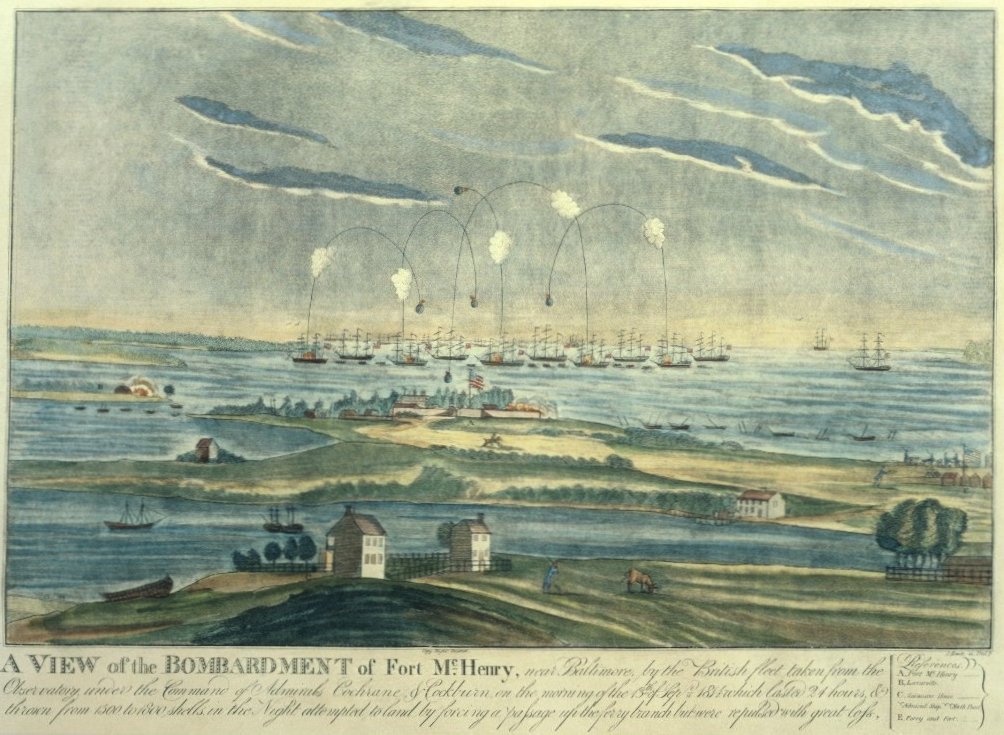
Bombing of Fort McHenry by the British. Engraved by John Bower
It was a galling sight for British seamen to behold. And as the last vessel spread her canvas to the wind, the Americans hoisted a most superb and splendid ensign on their battery and fired at the same time a gun of defiance... When the squadron retreated from Baltimore, sullen discontent was displayed and malevolent aspersions cast upon our veteran chief... 

~ Midshipman Robert Barrett, RN (1799-1828) (on the British withdrawal from Baltimore, "Naval Recollections of the American War") 

Without any clash on the battlefield the young American republic had humbled the might of the British empire. The rebuff of Britain at Baltimore decisively demonstrated America's independence of its former master. And this explosion of national pride was only to be magnified by the events of the remaining months of the war.* 


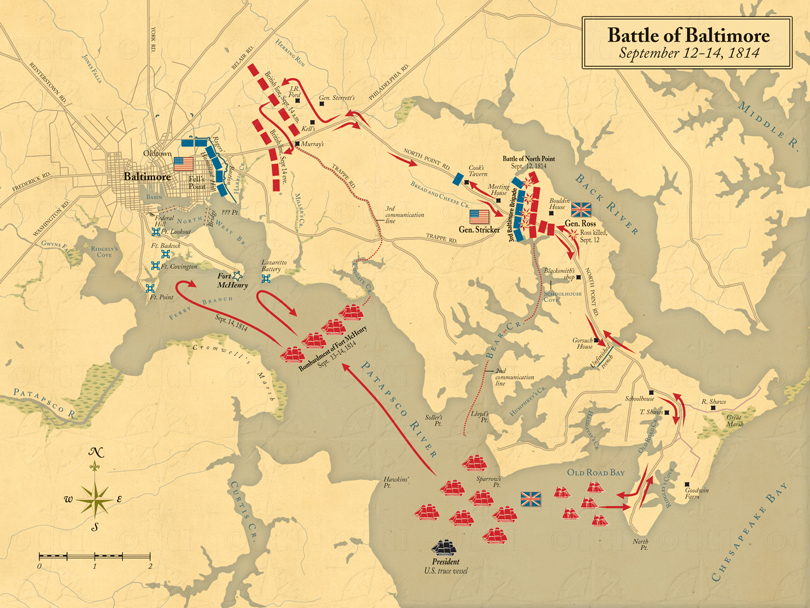
Larger version of map here
September 13th and 14th mark the anniversary of the Battle of Baltimore (wiki) during the War of 1812, remembered primarily for the unsuccessful British bombardment of Fort McHenry and Francis Scott Key's penning the words of "The Star-Spangled Banner" while interned on a British warship. 

President James Madison had declared war on Great Britain in June 1812 in response to interference with American shipping and the impressment of U.S. merchant seamen during the Napoleonic wars, as well as the British stirring up the Indians of the Ohio Valley to resist American settlement. Following an abortive American invasion of southern Canada, the British sent a modest naval and marine force - newly freed up from the Spanish campaign against Napoleon - to the Chesapeake in retaliation. 

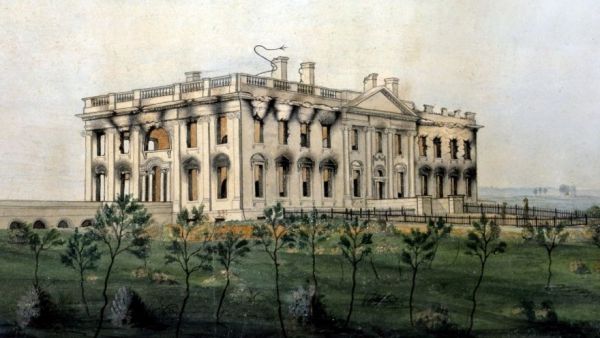
The burned White House by George Munger,
White House Historical Association
In mid-August 1814, an expeditionary force under Admirals Alexander Cochrane and George Cockburn landed on the lower Patuxent River and after routing U.S. militia at the Battle of Bladensburg on the 24th, occupied Washington that night and burned its major government buildings, including the White House and the Capitol, before withdrawing a day later. (Simultaneously, another Royal Navy flotilla maneuvered up the Potomac River to seize Alexandria and held that city for several days before retiring with significant plunder.) After returning to their ships, the British moved up the Chesapeake Bay to attack Baltimore with a naval penetration of the Patapsco River and an amphibious landing southeast of the city on 12 September. 

By then, however, the Americans had rallied their own forces, stopped the (outnumbered) British at the Battle of North Point, and fought off the Royal Navy's attempt to reduce Fort McHenry on the night of September 13th - 14th. In the face of these failures, the badly over-extended British expedition withdrew southward and departed the Chesapeake Bay to prepare for the New Orleans campaign. And as for "The Star-Spangled Banner," here's the verse we never sing:

Oh! thus be it ever, when freemen shall stand
Between their loved home and the war's desolation!
Blest with victory and peace, may the heav'n rescued land
Praise the Power that hath made and preserved us a nation.
Then conquer we must, when our cause it is just,
And this be our motto: "In God is our trust."
And the star-spangled banner in triumph shall wave
O'er the land of the free and the home of the brave!

Here's a rather well-done shortish documentary:


The U.S. Marine Band plays the National Anthem:


* The reference here is to the American victories on Lake Champlain (8-11 September 1814) and in the Battle of New Orleans, 8 January 1815, the second of which was actually fought two weeks after the Treaty of Ghent ended the war. 

** This recent book (St. Martin's Press, New York, 2013) presents a lively and readable account of the British invasion of Washington and the attack on Baltimore during the War of 1812. It should be remembered that all of this happened while Britain was deeply preoccupied with her struggle against Napoleon. He had been exiled to Elba as recently as April 1814 but would return to France on 20 March 1815 to fight the Hundred Days Campaign, which culminated in the Battle of Waterloo on 18 June.

John Farrier at Neatorama has an excellent article on the same subject.

Parts of the text above are adapted from the late, great Ed Whitman's Quotation of the Day. In addition to being my partner, my best friend, and Grandpa to the many kids who call me Grandma, Ed is also the author of Hunters and Killers: Volume 1: Anti-Submarine Warfare from 1776 to 1943 and Hunters and Killers: Volume 2: Anti-Submarine Warfare from 1943.

Wednesday, September 6, 2023

September 7 is the anniversary of the battle of Borodino, on which War and Peace and the 1812 Overture are based

French (blue) and Russian (red) troops
before start of battle. Source.

September 7  is the anniversary of the battle of Borodino (wiki) on 7 September 1812, at which Napoleon's (wiki) Grande Armée grappled bitterly with massed Russian forces defending Moscow under Marshal Mikhail Kutusov (1745-1813)* during Napoleon's invasion of Russia

Kutusov suffered significant losses, and the French occupied Moscow a week later, but in a month, Napoleon's disastrous retreat toward the west had begun. As Tolstoy noted in War and Peace,
"The cudgel of the people's war was lifted with all its menacing and majestic might, and caring nothing for good taste and procedure, with dull-witted simplicity but sound judgment, it rose and fell, making no distinctions."
Napoleon's own judgment has become more famous:

"Du sublime au ridicule il n'y a qu'un pas."

(From the sublime to the ridiculous is but a step.)

Here's the rousing cannon-punctuated finale of Tchaikovsky's 1812 Overture:


Tchaikovsky (1840-1893) was commissioned to write that staple of summer pops concerts, the 1812 Overture (actually Ouverture Solennelle 1812, Op. 49), for an exhibition of arts and industries at Moscow in 1881. It was intended to commemorate the battle of Borodino and Napoleon's ultimate defeat.**

* N.B. Earlier, at the battle of Smolensk, Kutusov had noted, "The battle has already been decided. It is like a river that runs downhill. I can only move it slightly to the right or left. But its outcome will not be changed by me."

** During the Soviet era, Russian performances of the 1812 Overture substituted an anonymous chorale-like tune for "God Preserve the Czar," the "Russian hymn" quoted by Tchaikovsky in the original.

A brief documentary:


Related post: the anniversary of the 1815 Battle of Waterloo: history, quotes and video (including a Lego re-enactment)

Parts of the text above are based on the late, great Ed Whitman's Quotation of the Day. Ed was my partner and love for 25 years, and the author of Hunters and Killers: Volume 1: Anti-Submarine Warfare from 1776 to 1943 and Hunters and Killers: Volume 2: Anti-Submarine Warfare from 1943.

Wednesday, July 27, 2022

On July 28, 1914, Austria declared war on Serbia, the first declaration of World War 1

The lamps are going out all over Europe; we shall not see them lit again in our lifetime. 

~Sir Edward Grey (remark, 3 August 1914, on the eve of Britain's declaration of war) 

The War was decided in the first twenty days of fighting, and all that happened afterwards consisted of battles which, however formidable and devastating, were but desperate and vain appeals against the decision of Fate. 

~Sir Winston Churchill (Preface to Spears, Liaison 1914) 

When every autumn people said it could not last through the winter, and when every spring there was still no end in sight, only the hope that out of it all some good would accrue to mankind kept men and nations fighting. When at last it was over, the war had many diverse results and one dominant one transcending all others: disillusion. 

~Barbara Tuchman (The Guns of August, "Afterward") 

Although many consider the opening act of World War I to be the assassination of Austrian Archduke Franz Ferdinand at Sarajevo - its anniversary was just a month ago (28 June) - the first actual declaration of war took place on 28 July, 1914, when Austria-Hungary initiated hostilities against Serbia, after the latter rejected a draconian Austrian ultimatum intended to give Austria a free hand in bringing Franz Ferdinand's killers to account. As a result, Russia - self-appointed protector of the "South Slavs" - mobilized against Austria, which panicked the Germans (fearful of a two-front war against both France and her Russian ally) and so it went... 

28 July Austria declares war on Serbia
1 August Germany declares war on Russia
3 August Germany declares war on France
4 August Germany invades Belgium (to attack France)
England declares war on Germany in support of Belgium
6 August Austria-Hungary declares war on Russia
Serbia declares war on Germany
11 August France declares war on Austria-Hungary
12 August England declares war on Austria-Hungary*

After Germany's long-intended encirclement of Paris (under the Schlieffen plan) was thwarted by the French and British in the Battle of the Marne, the struggle on the Western Front devolved into a four-year stalemate in which the principal protagonists faced off across a line of trenches that ran from the North Sea to the Swiss border. Despite the unprecedented bloodbath that ensued, virtually no additional ground was gained by either side before the end of the conflict in November 1918.

Despite the "war-guilt" clauses of the Treaty of Versailles, which held Germany largely responsible for the hostilities and imposed extraordinary penalties and reparations, the causes of the war have been debated endlessly for most of the last century. I concluded some years ago after a good deal of reading on the subject that although there was certainly enough blame to go around, it was primarily Austria-Hungary that caused the catastrophe because of her reckless determination to settle long-standing scores with Serbia. Nothing I've learned subsequently has much changed that position. Be that as it may... One could argue - and I do - that World War I was the greatest misfortune that ever befell Western civilization. It destroyed the West's belief in inevitable human progress. It brought down the Austro-Hungarian, German, Russian, and Ottoman empires, bankrupted France and England, and put the British Empire on the skids. It was the proximate cause of the triumph of Communism in Russia and the formation of the Soviet Union, drove the United States into two decades of international isolation, and instilled in Germany a thirst for revenge that led directly to the rise of the Nazis and World War II.

Moreover, in the Middle East, Britain's and France's cack-handed and self-serving division of the remains of the Ottoman Empire was largely responsible for all the turmoil we suffer there today. On hearing the terms of the Versailles Treaty, Germany's much-maligned Kaiser Wilhelm II noted from exile that,

"The war to end war has resulted in a peace to end peace."

*The United States only joined the Allies on 6 April 1917, provoked beyond endurance by Germany's unrestricted submarine warfare campaign and the German "Zimmermann telegram" (wiki) - intercepted by British intelligence - which promised Mexico the return of her "lost territories" in the southwest United States in return for an alliance with a victorious Germany.

(Text above is adapted from Ed's Quotation of the Day, only available via email. Leave your email address in the comments if you'd like to be added to his list.)

If you're interested in further information on the subject there are hundreds of books and films - the best books I know of (and unlike Ed, who's recommendations are above, I'm no expert) are Barbara Tuchman's The Guns of August (which won a Pulitzer back when they meant something) and John Keegan's The First World War

Here's the The BBC’s Horrible Histories explanation of how the Brits got involved:


Here's a 6 minute overview of World War I:


The Atlantic has a series of photoessays entitled World War I in Photos on various WWI topics.

Previous posts: 

June 28 marks the centennial of the start of World War One: a few quotes/videos/links