Amazon Deals

New at Amazon

Showing posts with label napoleon. Show all posts

Wednesday, September 6, 2023

September 7 is the anniversary of the battle of Borodino, on which War and Peace and the 1812 Overture are based

French (blue) and Russian (red) troops
before start of battle. Source.

September 7  is the anniversary of the battle of Borodino (wiki) on 7 September 1812, at which Napoleon's (wiki) Grande Armée grappled bitterly with massed Russian forces defending Moscow under Marshal Mikhail Kutusov (1745-1813)* during Napoleon's invasion of Russia

Kutusov suffered significant losses, and the French occupied Moscow a week later, but in a month, Napoleon's disastrous retreat toward the west had begun. As Tolstoy noted in War and Peace,
"The cudgel of the people's war was lifted with all its menacing and majestic might, and caring nothing for good taste and procedure, with dull-witted simplicity but sound judgment, it rose and fell, making no distinctions."
Napoleon's own judgment has become more famous:

"Du sublime au ridicule il n'y a qu'un pas."

(From the sublime to the ridiculous is but a step.)

Here's the rousing cannon-punctuated finale of Tchaikovsky's 1812 Overture:


Tchaikovsky (1840-1893) was commissioned to write that staple of summer pops concerts, the 1812 Overture (actually Ouverture Solennelle 1812, Op. 49), for an exhibition of arts and industries at Moscow in 1881. It was intended to commemorate the battle of Borodino and Napoleon's ultimate defeat.**

* N.B. Earlier, at the battle of Smolensk, Kutusov had noted, "The battle has already been decided. It is like a river that runs downhill. I can only move it slightly to the right or left. But its outcome will not be changed by me."

** During the Soviet era, Russian performances of the 1812 Overture substituted an anonymous chorale-like tune for "God Preserve the Czar," the "Russian hymn" quoted by Tchaikovsky in the original.

A brief documentary:


Related post: the anniversary of the 1815 Battle of Waterloo: history, quotes and video (including a Lego re-enactment)

Parts of the text above are based on the late, great Ed Whitman's Quotation of the Day. Ed was my partner and love for 25 years, and the author of Hunters and Killers: Volume 1: Anti-Submarine Warfare from 1776 to 1943 and Hunters and Killers: Volume 2: Anti-Submarine Warfare from 1943.

Monday, June 17, 2019

June 18 is the anniversary of the 1815 Battle of Waterloo: history, quotes and video (including a Lego re-enactment)

When Napoleon recovered his throne at Paris, in March 1815 (ed - after his escape from Elba)... his first business was to sustain the attack of the united British and Prussians, posted in the Netherlands, and it was his obvious policy to make an attack on these himself before any others could come up to their assistance. 

Click here to embiggen
His rapid advance at the beginning of June, before the English and Prussian commanders were aware of his having left Paris; his quick and brilliant assaults on the separate bodies of Prussians and British at Ligny and Quatre Bras on the 16th, were movements marked by all his brilliant military genius. And even when, on the 18th, he commenced the greater battle of Waterloo (wiki) with both, the advantage still remained to him in the divided positions of his double enemy, giving him the power of bringing his whole host concentratedly upon one of theirs; thus neutralizing to some extent their largely superior forces. And, beyond a doubt, through the superior skill and daring which he thus shewed, as well as the wonderful gallantry of his soldiery, the victory at Waterloo ought to have been his. 

Napoleon
There was just one obstacle, and it was decisive - the British infantry stood in their squares immovable upon the plain till the afternoon, when the arrival of the Prussians gave their side the superiority.

~ Robert Chambers Book of Days (1869)*

On Wellington (wiki) at Waterloo:

Thrown on that occasion into the central position among the opponents of Bonaparte, he was naturally and justly hailed as the saviour of Europe... Thenceforth the name of Wellington was venerated above that of any living Englishman.

~ibid

The village sleeps, a name unknown till men
With life-blood stain its soil, and pay the due
That lifts it to eternal fame, -- for then
'Tis grown a Gettysburg or Waterloo.

~Mark Antony DeWolfe Howe, Distinction

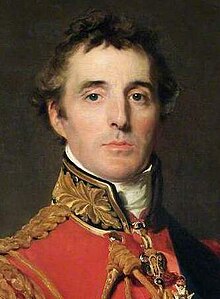
The Duke of Wellington
You will have heard of our battle of the 18th. Never did I see such a pounding match... Napoleon did not maneuver at all. He just moved forward in the old style, and was driven off in the old style. 

~Arthur Wellesley, Duke of Wellington (wiki) (letter to Sir William Beresford, 2 July 1815) 

Meeting an acquaintance of another regiment, a very little fellow, I asked him what had happened to him yesterday. "I'll be hanged," says he, "if I know anything at all about the matter, for I was all day trodden in the mud and galloped over by every scoundrel who had a horse, and, in short, I only owe my existence to my insignificance. 

~Captain John Kincaid (of Waterloo, in Adventures with the Rifle Brigade

Thou fateful Waterloo,
Millions of tongues record thee, and anew
Their children's lips shall echo them, and say --
"Here, where the sword the united nations drew,
Our countrymen were warring on that day!"
And this is much, and all which will not pass away.**

~George Gordon, Lord Byron (wiki), Childe Harold's Pilgrimage, Canto II, 35

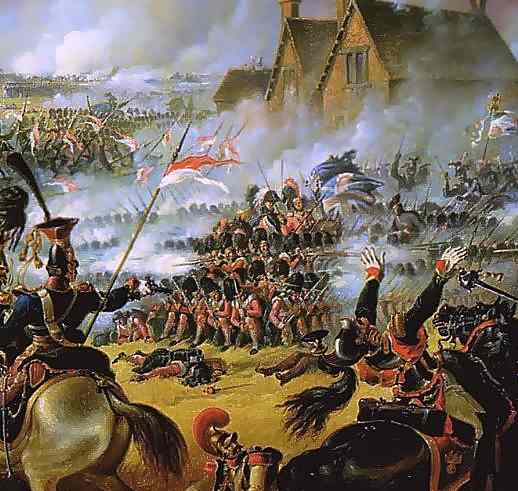
June 18 is the anniversary of the battle of Waterloo (wiki) in 1815, in which British forces under the Duke of Wellington (wiki) and the Prussians under Field Marshal Blücher decisively defeated the French under Napoleon to end the "Hundred Days Campaign." After the allies took Paris in March 1814, Napoleon was initially exiled to Elba. A year later, however, he returned to France amid great acclaim, re-entered Paris, declared himself emperor again, and retook command of the French armies to renew the struggle. 

Four days after the debacle at Waterloo - which Wellington described as "the nearest-run thing you ever saw in your life" - Napoleon abdicated again and was sent into final exile on St. Helena in the South Atlantic, where he died in 1821. On more than one occasion, Wellington is also said to have remarked:

"Next to a battle lost, the greatest misery is a battle gained."

* There's an excellent hyperlinked and searchable version of Chamber's Book of Days here.

** This passage was quoted by Winston Churchill to President Franklin Roosevelt in choosing the phrase, United Nations, to designate the victorious powers in World War II. 

Here's the battle scene from the 1970 movie Waterloo with Rod Steiger as Napoleon and Christopher Plummer as Wellington (and Orson Wells as Louis XVIII):


And, of course, the Lego version:


Parts of the text above are based on the late, great Ed Whitman's (my partner for decades) Quotation of the Day. Ed is the author of Hunters and Killers: Volume 1: Anti-Submarine Warfare from 1776 to 1943 and Hunters and Killers: Volume 2: Anti-Submarine Warfare from 1943.

Friday, May 24, 2019

Friday links

Fans of Hitchhiker's Guide to the Galaxy: don't panic - May 25th is Towel Day!

Napoleon’s Looted Art: he and his troops pillaged art on a vast scale. What did they take and what happened to it?


The Tactical Order of Dressing: An Illustrated Guide (as taught to military and emergency personnel). Related: Because it's important to always be battle-ready: How to Poop Like a Samurai.


ICYMI, most recent links are here, and include turning everyday items into improvised weapons, treating depression by smoking psychedelic toad milk, and why car keys stopped working in one small Ohio town.

Monday, November 19, 2018

Monday links

The Gettysburg Address was seven score and fifteen years ago: here's some history and a brief video with contemporaneous photos and illustrations. Related: Pennsylvania newspaper prints retraction (written in the style of the Gettysburg Address) for 1863 article calling Gettysburg address "silly remarks".

Napoleonic refugees in America.

I'd forgotten all about the USFL: Donald Trump’s Misadventures in Professional Football.

President James Garfield's birthday - when he was shot, Alexander Graham Bell showed up with a metal detector to try to locate the bullet. 

Three Centuries After His Beheading, a Kinder, Gentler Blackbeard Emerges.

There's still time to gather all of the ingredients: The traditional drunken turkey recipe.

ICYMI, most recent links are here, and include Veterans Day links, why pencils are yellow, hair washing advice from the 12th and 17th centuries, and football physics.

Tuesday, March 20, 2018

Tuesday links

Spring is here - The vernal equinox is on March 20th at 12:15 PM EDT. Here's Vivaldi, science, myths, "spring spheres" and more.


100 years later, the question remains: What happened to the USS Cyclops?

A TED video classic from 2005: How To Tie Your Shoes.

"Since sixt week j learn the Englich and j do not any progress": While imprisoned on St Helena, Napoleon started learning English.

These Cows Wrote a Message That Could Be Seen From Space.

ICYMI, Friday's links are here, and include Saint Patrick’s Day, some guys changing tires while driving, the linguistic evolution of "dagnabbit", and the difficulties inherent in coastline measurement.

Wednesday, March 14, 2018

Wednesday links

Albert Einstein was born on March 14, 1879: here's a short bio, video, an explanation of gravitational waves, and the strange post-mortem travels of his brain. Related: Einstein's forgotten inventions.

Why did ancient people drill holes in their heads?


The woman who thought she was married to Napoleon.

Death-Defying 40-ft Vertical Plunges: The High-Diving Horsewomen of Atlantic City.

ICYMI, Friday's links are here, and include solving crimes with knot analysis, Daylight Saving Time history (including Ben Franklin's proposal), a street-legal jet-powered Volkswagen Beetle, and, for Chuck Norris' 78th birthday, his 5 most badass movies, supercut of Norris's best kicks and a bunch of Norris "facts".

Monday, January 15, 2018

Monday links


Napoleon’s Heirs Include a Wall Street Banker, the Founder of the FBI and a Star Trek Actor.


How deep have humans dug into the Earth?

The Neurological Disorders in Alice in Wonderland.

Ten Myths About the 1918 Flu Pandemic.

ICYMI, Friday's links are here, and include Thomas Edison's sci-fi novel, a Victorian dinosaur park, how to celebrate the Feast of the Ass, and why you can't take an orange through customs.

Monday, January 8, 2018

Monday links

Elvis Presley was born on January 8, 1935.

The Business of Fake Hollywood Money.

Fascinatingly Filthy: How Bad Science Saved Lives in Victorian London.

The fennel and garlic diet from 1595, or How to Slim Down in Fourteen Days.

The woman who slept with both Napoleon and Wellington.

Welcome to the National Valet Olympics.

ICYMI, Wednesday's links are here, and include London's oldest house, West Point’s 1826 eggnog riot, and the birthdays of Isaac Asimov and J. R. R. Tolkien (with Middle-Earth history, dancing orcs and a Lego version of the battle of Helm's Deep).

Wednesday, March 15, 2017

Wednesday links

Beware - It's the Ides of March. Related: when Julius Caesar was kidnapped by pirates, he insisted on a higher ransom.

The Evolution of Animation.

Two Irish villages claim that the skeleton of Napoleon’s horse belongs to them. But did the horse ever exist?

How Russians In 1960 Imagined the Year 2017.

After Social Security cards were introduced in 1936, some people had their number tattooed on their skin.


ICYMI, Tuesday's links are here, and include Pi Day, Britain’s ship made of ice, why some car gas tanks are on the right and some on the left, and, for Einstein's birthday, the story of the guy who kept his brain for 43 years,  

Friday, August 12, 2016

Friday links


10 Travel Tips From the Age of Napoleon.

ICYMI, Tuesday's links are here, and include the history of French fries, the anniversary of the battle of Thermopylae, a supercut of "We don’t negotiate with terrorists", and a roundup of wooden skyscrapers.