Amazon Deals

New at Amazon

Showing posts with label history. Show all posts

Sunday, August 23, 2026

August 24: the eruption of Mount Vesuvius and destruction of Pompeii in A.D. 79

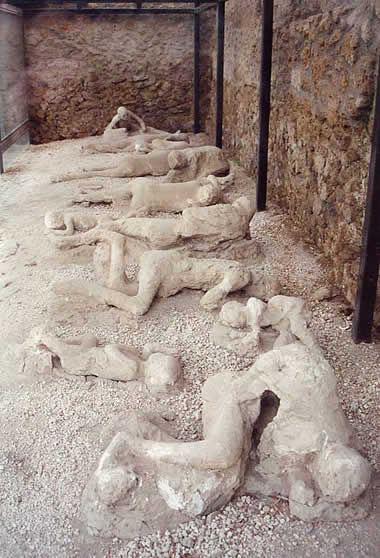
Plaster casts of people who died (buried by ashfall) in
Pompeii during the 79 AD eruption of Mount Vesuvius
He [Pliny the Elder] was at Misenum* in his capacity as commander of the fleet on the 24th of August, when between two or three in the afternoon my mother drew his attention to a cloud of unusual size and appearance. He had had a sunbath, then a cold bath, and was reclining after dinner with his books. He called for his shoes and climbed up to where he could get the best view of the phenomenon. The cloud was rising from a mountain - at such a distance we couldn't tell which - but afterwards learned that it was Vesuvius. I can best describe its shape by likening it to a pine tree. 
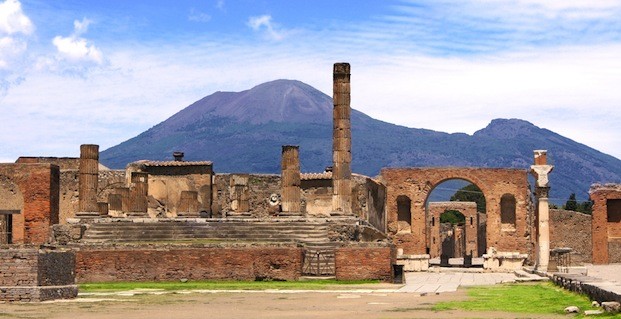
Vesuvius viewed from the ruins of Pompeii
It rose into the sky on a very long "trunk" from which spread some "branches." I imagine it had been raised by a sudden blast, which then weakened, leaving the cloud unsupported so that its own weight caused it to spread sideways. Some of the cloud was white, in other parts there were dark patches of dirt and ash. The sight of it made the scientist in my uncle determined to see it from closer at hand.

~ Gaius Plinius Caecilius Secundus (Pliny the Younger (wiki)) (letter to Tacitus, ca A.D. 95, describing the eruption of Mount Vesuvius and the death of Pliny the Elder (wiki)) 


Natura vero nihil hominibus brevitate vitae preaestitit melius.

~ Gaius Plinius Secundus (Pliny the Elder) (Historia naturalis, VII, 50, 168)  

(Nature has granted man no better gift than the shortness of life.)

Today is the anniversary of the catastrophic eruption of Mount Vesuvius in A.D. 79 and the death of Pliny the Elder (born A.D. 23) in that event. The eruption, which followed several years of precursor ground movements, buried the cities of Pompeii and Herculaneum and is thought to have killed as many as 15,000 people. 
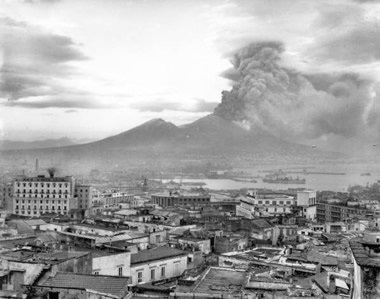
A view of Naples at the height of the eruption of Mount 
Vesuvius in 1944. Photo by Melvin C. Shaffer
Subsequent major eruptions occurred in 1631, 1906, and 1944, the last just after the Allies had taken the city of Naples in World War II. Pliny the Elder is remembered primarily for his "Natural History," a comprehensive compendium of ancient knowledge of the natural world. His scientific curiosity led him to take ship across the Bay of Naples to see the Vesuvius eruption at close quarters, and he was killed there by ash and poisonous fumes from the volcano. The account of his nephew and adopted son, Pliny the Younger (A.D. 61-ca. 114), is the only eyewitness description we have of the eruption of Mount Vesuvius, and it goes on to provide further detail about on-site conditions near the disaster and his own experiences farther afield. 

* N.B. Misenum (near modern-day Bacoli) was on the opposite shore of the Bay of Naples from Mount Vesuvius. During ancient times, it was Rome's principal naval base on the west coast of Italy. 

Here's a brief re-enactment:


And a newsreel about the eruption in 1944:


Recommended reading:

I first read Pliny the Younger's account of  the eruption in the excellent Eyewitness to History, a book that I've also given to several kids and grandkids. 

The thoroughly engaging novel Pompeii by Robert Harris is the story of a Roman engineer trying to repair an aqueduct in the lead-up to the eruption of Mount Vesuvius. Full of interesting technical and historical detail.

Saturday, July 13, 2024

July 14 is Bastille Day

If you're here for Jonah Goldberg's classic article on the subject, here you go: The French are Revolting.
Arise children of the fatherland
The day of glory has arrived
Against us tyranny's
Bloody standard is raised
Listen to the sound in the fields
The howling of these fearsome soldiers
They are coming into our midst
To cut the throats of your sons and consorts

To arms citizens Form your battalions
March, march
Let impure blood
Water our furrows

~ Claude-Joseph Rouget de Lisle (1760-1836) ("La Marseillaise", first verse translated into English. Six more follow, all more or less equally bloodthirsty. *
The Storming of the Bastille by Jean-Pierre Houël
France has neither winter nor summer nor morals - apart from these drawbacks it is a fine country. 

~ Mark Twain (1835-1910) (Anderson, ed., Mark Twain's Notebooks and Journals, Vol. 2, Notebook 18)

Old France , weighed down with history, prostrated by wars and revolutions, endlessly vacillating from greatness to decline, but revived, century after century, by the genius of renewal.

~ Charles de Gaulle (1890-1970) (War Memoirs, Vol. 3, Ch. 7)

The Bastille was later demolished - the Place de la Bastille
 sits where the fortress once stood
July 14th is Bastille Day (wiki), which commemorates the storming of the ancient royal prison of that name in Paris on 14 July 1789, an event which marked the beginning of the French Revolution. That storming was, of course, more symbolic than substantial - as Jonah Goldberg points out in his classic Bastille Day column, it consisted of "the capture of an almost entirely empty prison, the cold-blooded murder of six unarmed soldiers, and the execution of one French governor already captured by the mob". On that day the Bastille held only seven inmates: four forgers, two madmen, and a young rake who had displeased his father. All were freed.

The Marseillais volunteers departing, sculpted on the Arc de Triomphe
Formally known as the Bastille Saint-Antoine, the fortress was built during the Hundred Years’ War to defend the eastern approaches of Paris from English attacks. It Consisted of eight 100-foot high towers, all linked together by equally tall walls, surrounded by 80 foot wide moat. By 1789 the Bastille was actually little used and was scheduled to be demolished, part of the reason why there were so few prisoners there that day.

*La Marseillaise, France's stirring national anthem, was written in Strasbourg on 25 April 1792 by French captain Claude-Joseph Rouget de Lisle and originally titled the "Marching Song of the Army of the Rhine." It gained instant popularity as a rallying song and gained its latter-day name from being first sung in the streets of Paris by newly arrived troops from Marseilles. The remaining verses are available at Wikipedia. 

La Marseillaise was banned in both Vichy and German-occupied France during World War II, and also during the 19th-century French Empire under Napoleon III because of its revolutionary sentiments.  

Has there every been a more stirring rendition than the one at Rick's "Café Americaine" in Casablanca?


Related post: French King Louis XVI was guillotined on January 21, 1793. Here's Allan Sherman (because if you're of a certain age it's inevitable to think of Allan Sherman when you hear La Marseillaise:

Sunday, May 26, 2024

Memorial Day

Sleep, comrades, sleep and rest
On this Field of the Grounded Arms,
Where foes no more molest,
Nor sentry's shot alarms!

Ye have slept on the ground before,
And started to your feet
At the cannon's sudden roar,
Or the drum's redoubling beat.

But in this camp of Death
No sound your slumber breaks;
Here is no fevered breath,
No wound that bleeds and aches.

All is repose and peace,
Untrampled lies the sod;
The shouts of battle cease,
It is the Truce of God!

Rest, comrades, rest and sleep!
The thoughts of men shall be
As sentinels to keep
Your rest from danger free.

Your silent tents of green
We deck with fragrant flowers;
Yours has the suffering been,
The memory shall be ours. 

~ Henry Wadsworth Longfellow, Decoration Day* 

They went with songs to the battle, they were young,
Straight of limb, true of eye, steady and aglow.
They were staunch to the end against odds uncounted;
They fell with their faces to the foe.

They shall grow not old, as we that are left grow old:
Age shall not weary them, nor the years condemn.
At the going down of the sun and in the morning
We will remember them.**

- Laurence Binyon, For the Fallen 


Until 1967 known as "Decoration Day" and formerly celebrated on 30 May before "long-weekend" national holidays were introduced the next year, various Memorial Days were first observed after the Civil War in both the North and South, when the graves of the fallen were decorated with flowers and bunting. The first widespread use of the 30 May date took place in 1868 as an observance organized by the Union Army veterans' organization, the Grand Army of the Republic, and this custom gradually spread to the rest of the country and was later expanded to honor the dead of all the nation's wars. 

In a speech just six months before his own death, General George S. Patton, Jr. (1885-1945) noted,
"It is foolish and wrong to mourn the men who died. Rather, we should thank God that such men lived." )
* N.B. Longfellow's "Decoration Day" is from his collection, In the Harbor (1882). 

** The fourth verse of (Robert) Laurence Binyon's "For the Fallen" (1914) - generally followed by the phrase, "Lest we forget" - is now part of virtually every war memorial service in Britain and her former colonies. 

Dulce et decorum est pro patria mori,
mors et fugacem persequitur virum.
nec parcit imbellis iuventae
poplitibus timidove tergo.

~ Quintus Horatius Flaccus (Horace), Carmina, III, ii, 13
(To die for the fatherland is a sweet and admirable thing.*
Death is at the heels even of the runaway, nor spares
the haunches and back of the coward and malingerer.)
A brief history of Memorial Day:


Related posts and links:
Here's How To Make An American Flag Out Of Bacon

Monday, May 20, 2024

What phrases commonly used today are derived from obsolete technologies?

I've always found phrase origins fascinating - they can give us a glimpse into an entirely different reality, and, perhaps more importantly, they remind us of how many things we accept without question. We should definitely be questioning more.

Some examples of origins you may not know: 

"Hang up the phone."
 This comes from one specific kind of land-line phone that had a kind of hook you'd hang the handset from when you were done. Doing so would pull down the hook that was connected to a switch inside the phone that would disconnect the line.
Originating from printing houses in the days of moveable type:

Upper Case and Lower Case: 
The individual type blocks used in hand typesetting are stored in shallow wooden or metal drawers known as "type cases". Each is subdivided into a number of compartments ("boxes") for the storage of different individual letters.
The terms upper and lower case originate from this division. By convention, when the two cases were taken out of the storage rack, and placed on a rack on the compositor's desk, the case containing the capitals and small capitals stood at a steeper angle at the back of the desk, with the case for the small letters, punctuation and spaces being more easily reached at a shallower angle below it to the front of the desk, hence upper and lower case.


"Mind your Ps and Qs":
A warning to printers’ apprentices to take care when selecting the little blocks with letters on, to ensure that they didn’t confuse the P block with the Q block, and vice versa.


Cut (or copy) and paste: 
The term "cut and paste" comes from the traditional practice in manuscript-editings whereby people would cut paragraphs from a page with scissors and paste them onto another page. This practice remained standard into the 1980s.


To run through the wringer (or put through the wringer) referred to this laundry device that predated the spin cycle.


There's lots of ship-related stuff (more here):

Above Board - Anything on or above the open deck. If something is open and in plain view, it is above board.

As the Crow Flies - When lost or unsure of their position in coastal waters, ships would release a caged crow. The crow would fly straight towards the nearest land thus giving the vessel some sort of a navigational fix. The tallest lookout platform on a ship came to be know as the crow's nest.

Between the Devil and the Deep Blue Sea - The devil seam was the curved seam in the deck planking closest to the side of the ship and next to the scupper gutters. If a sailor slipped on the deck, he could find himself between the devil and the deep blue sea.

Deck hatch
Booby Hatch - Aboard ship, a booby hatch is a sliding cover or hatch that must be pushed away to allow access or passage.

Buoyed Up - Using a buoy to raise the bight of an anchor cable to prevent it from chafing on a rough bottom.

By and Large - Currently means in all cases or in any case. From the nautical: by meaning into the wind and large meaning with the wind: as in, "By and Large the ship handled very well."

Groggy - In 1740, British Admiral Vernon (whose nickname was "Old Grogram" for the cloak of grogram which he wore) ordered that the sailors' daily ration of rum be diluted with water. The men called the mixture "grog". A sailor who drank too much grog was "groggy".

Leeway - The weather side of a ship is the side from which the wind is blowing. The Lee side is the side of the ship sheltered from the wind. A lee shore is a shore that is downwind of a ship. If a ship does not have enough "leeway" it is in danger of being driven onto the shore.

Pipe Down - Means stop talking and be quiet. The Pipe Down was the last signal from the Bosun's pipe each day which meant "lights out" and "silence".

Pooped - The poop is the stern section of a ship. To be pooped is to be swamped by a high, following sea.

Rummage Sale - From the French "arrimage" meaning ship's cargo. Damaged cargo was sold at a rummage sale.

Scuttlebutt - A butt was a barrel. Scuttle meant to chop a hole in something. The scuttlebutt was a water barrel with a hole cut into it so that sailors could reach in and dip out drinking water. The scuttlebutt was the place where the ship's gossip was exchanged.

Skyscraper - A small triangular sail set above the skysail in order to maximize effect in a light wind.

Bitter end
Slush Fund - A slushy slurry of fat was obtained by boiling or scraping the empty salted meat storage barrels. This stuff called "slush" was often sold ashore by the ship's cook for the benefit of himself or the crew. The money so derived became known as a slush fund.

The Bitter End - The end of an anchor cable is fastened to the bitts at the ship's bow. If all of the anchor cable has been payed out you have come to the bitter end.

The Devil to Pay - To pay the deck seams meant to seal them with tar. The devil seam was the most difficult to pay because it was curved and intersected with the straight deck planking. Some sources define the "devil" as the below-the-waterline-seam between the keel and the the adjoining planking. Paying the Devil was considered to be a most difficult and unpleasant task.

Sails "in the wind"
Three Sheets to the Wind - A sheet is a rope line which controls the tension on the downwind side of a square sail. If, on a three masted fully rigged ship, the sheets of the three lower course sails are loose, the sails will flap and flutter and are said to be "in the wind". A ship in this condition would stagger and wander aimlessly downwind.

To Know the Ropes - There was miles and miles of cordage in the rigging of a square rigged ship. The only way of keeping track of and knowing the function of all of these lines was to know where they were located. It took an experienced seaman to know the ropes.

And, moving beyond the nautical:

Post in the sense of "a blog post": from the act of nailing a sign to a wooden post, or from sending a message via a system of posted riders and horses (i.e., they are assigned to their stations, a.k.a. their posts).

Run of the Mill: Mills have very large and heavy grinding stones, it takes some time to get to normal speed for grinding grains. At the operational speed, they produce a nice, fine and uniform powder or grounded grains (flour etc.), this "steady state" output was called run of the mill. Which has come to mean "ordinary".

Software bugs and debugging: In the context of computers it uses was popularized by Grace Murray Hopper, involving an electromechanical fault in the Mark II computer, due to a moth stuck in one of the relays. 


Know of any others? Leave them in the comments!

Wednesday, April 24, 2024

April 25th is ANZAC Day, the anniversary of the Battle of Gallipoli

Ship after ship, crammed with soldiers, moved slowly out of the harbour, in the lovely day, and felt again the heave of the sea. No such gathering of fine ships has ever been seen upon the earth, and the beauty and the exaltation of the youth upon them made them like sacred things as they moved away... 

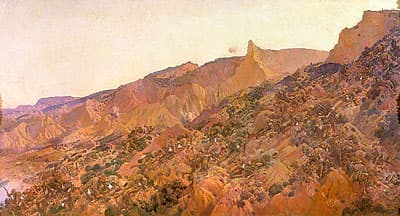
The Making of a Legend, The Landing at Anzac Cove by Lambert
These men had come from all parts of the British world... They had said good-bye to home that they might offer their lives in the cause we stand for. In a few hours at most, as they well knew, perhaps a tenth of them would have looked their last upon the sun, and be a part of the foreign earth or the dumb things that tides push. Many of them would have disappeared forever from the knowledge of man, blotted from the book of life none would ever know how, by a fall, a chance shot in the darkness, or alone, like a hurt beast, in some scrub or gulley, far from comrades and the English speech and the English singing.

~ John Masefield (wiki) (Gallipoli)*

Damn the Dardanelles. They will be our grave.

~ Admiral Sir John Fisher (to the Dardanelles Committee, 1915)

Those heroes that shed their blood and lost their lives... You are now lying in the soil of a friendly country. Therefore rest in peace. There is no difference between the Johnnies and the Mehmets to us where they lie side by side now here in this country of ours... you, the mothers, who sent their sons from faraway countries, wipe away your tears; your sons are now lying in our bosom and are in peace. After having lost their lives on this land, they have become our sons as well.

~Mustafa Kemal - Atatürk (wiki) (tribute to the ANZAC dead, 1934)

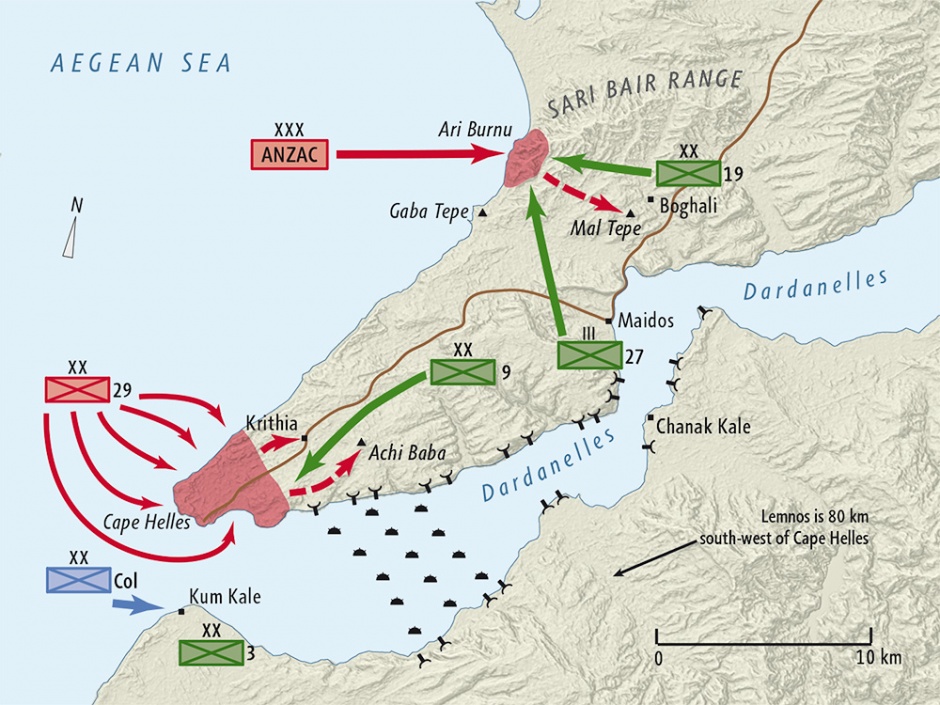
Map of the battle - larger version here
April 25th is celebrated in Australia and New Zealand as ANZAC Day, commemorating the key participation of the Australia-New Zealand Army Corps (ANZAC) in the ill-fated Allied assault on the Turkish-held Gallipoli Peninsula in 1915 during World War I. This was one of the first large-scale amphibious invasion of modern times and the first major military operation in which Australia and New Zealand participated on behalf of the British Empire. As a result, the Gallipoli campaign was perhaps the key  defining event for Australia's nationhood, as it was in a sense for Turkey's also. Turkish Lieutenant-Colonel Mustafa Kemal, the hero of Gallipoli's successful defense, later became the founder of modern Turkey, adopting the name "Atatürk" - father of the Turks.

source
Today much of the Gallipoli Peninsula is a Turkish national park with over 20 cemeteries lovingly tended by the Commonwealth War Graves Commission. We visited there several years ago on ANZAC Day, taking a bus with a dozen or so others, mostly Aussies, from the nearby town of Canakkale to tour the cemeteries and battlefields. The tour guide read the Ataturk quotation above, along with, as is typical, the fourth stanza of Lawrence Binyon's For The Fallen:
They shall grow not old, as we that are left grow old:
Age shall not weary them, nor the years condemn.
At the going down of the sun and in the morning
We will remember them.
Followed, as is also typical, by "Lest we forget..."

The visitor can not help but be struck by the stark, natural beauty of its steep, scrubby, deeply-gullied terrain and sadly moved by the remembrance of the tens of thousands of men on both sides who lost their lives there in a futile clash of empires - only a few miles across the "wine-dark sea" from the ruins of ancient Troy. Of that earlier struggle, Homer wrote in book XIII of the Iliad,

"It is not possible to fight beyond your strength, even if you strive."

* N.B. John Masefield was the Poet Laureate of England from 1930 until his death in 1967. He served as a medical orderly on the Western Front in World War I and later wrote Gallipoli to counter German propaganda seeking to exploit the British defeat there.

The most readable account of the Gallipoli campaign remains Alan Moorehead's venerable history, Gallipoli, from the late 1950s. Also, the 1981 Australian movie of that same name, starring the young Mel Gibson, is an excellent evocation of both the horror and exhilaration of those times. There's a more recent movie, apparently, but I'm not familiar with it, and... Mel Gibson.

Several years ago, Peter Jackson restored and aggregated quite a bit of contemporaneous Gallipoli film:

Here's a 9 minute documentary:


And, as seems inevitable these days, there's a Lego reenactment of the events:


There's a good article on the 2015 centennial at The Guardian, and much more at the Australian government's site.

Parts of the text above are based on the late, great Ed Whitman's Quotation of the Day. Ed was my significant other for decades, and is the author of Hunters and Killers: Volume 1: Anti-Submarine Warfare from 1776 to 1943 and Hunters and Killers: Volume 2: Anti-Submarine Warfare from 1943. I miss him every day.

It's Oliver Cromwell's birthday - here's his speech throwing out the corrupt Parliament, with bonus Monty Python

Today is the anniversary of the birth of Oliver Cromwell (wiki) (1599-1658), Lord Protector of England during the era of the Commonwealth that followed the overthrow and execution of King Charles I in 1649. Cromwell attended Cambridge but never finished his degree. A fervent Puritan, he entered Parliament in 1628 and strongly opposed the king. 


When the English Civil War (wiki) broke out in 1642, Cromwell's evident military genius propelled him into leadership positions with the Parliamentary army, and he defeated the royalist forces at Marston Moor (1644) and Naseby (1645). After the king's capture, Cromwell was a leading advocate for his condemnation, and upon Charles's death and the ensuing dismissal of Parliament, he ruled England until his own death in 1658. 

His son, Richard Cromwell (1626-1712), succeeded him, but within a few years, the Commonwealth lost popular support, and the monarchy was restored in Charles II in 1660. 

His address dismissing the Rump Parliament is one of the best speeches ever. Here's the online version of Chambers' Book of Days setting the scene:
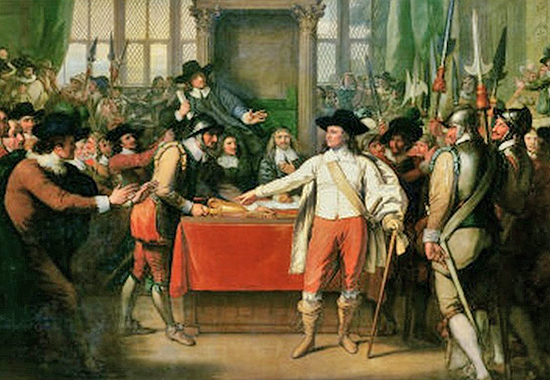
Cromwell, having ordered a company of musketeers to follow him, entered the House 'in plain black clothes and grey worsted stockings,' and, sitting down, listened for a while to their proceedings. Hearing at length the question put, that the bill do pass, he rose, put off his hat, and began to speak. In the course of his address, he told them of their self-seeking and delays of justice, till at length Sir Peter Wentworth interrupted him with a remonstrance against such language. Then blazing up, he said, 'We have had enough of this—I will put an end to your prating.' Stepping into the floor of the House, and clapping on his hat, he commenced a violent harangue, which he occasionally emphasized by stamping with his feet, and which came mainly to this,
And the text of the speech itself:
It is high time for me to put an end to your sitting in this place, which you have dishonored by your contempt of all virtue, and defiled by your practice of every vice; ye are a factious crew, and enemies to all good government; ye are a pack of mercenary wretches, and would like Esau sell your country for a mess of pottage, and like Judas betray your God for a few pieces of money.
Is there a single virtue now remaining amongst you? Is there one vice you do not possess? Ye have no more religion than my horse; gold is your God; which of you have not barter'd your conscience for bribes? Is there a man amongst you that has the least care for the good of the Commonwealth?
Ye sordid prostitutes have you not defil'd this sacred place, and turn'd the Lord's temple into a den of thieves, by your immoral principles and wicked practices? Ye are grown intolerably odious to the whole nation; you were deputed here by the people to get grievances redress'd, are yourselves gone! So! Take away that shining bauble there, and lock up the doors. 
In the name of God, go!
Here's Monty Python's brief history of Cromwell (lyrics below video):


Lyrics - for an explanation of the allusions, see this Wikipedia article:

The most interesting thing about King Charles, the first
Is that he was 5 foot 6 inches tall at the start of his reign
But only 4 foot 8 inches tall at the end of it because of
Oliver Cromwell, Lord Protector of England Puritan
Born in 1599 and died in 1658 September

Was at first only MP for Hunting Don, but then he led the Ironside Cavalry

At Marston Moor in 1644 and won then he founded the New Model Army
And praise be, beat the Cavaliers at Naisby and the King fled up North
Like a bat to the Scots

But under the terms of John Pimm's Solemn League and Covenant
The Scots handed King Charles the first, over to
Oliver Cromwell, Lord Protector of England and his warts
Born in 1599 and died in 1658 September

But alas, oy vay! The disagreement then broke out between
The Presbyterian Parliament and the Military who meant
To have an independent bent and so the 2nd Civil War broke out
And the Roundhead ranks faced the Cavaliers at Preston Banks
And the King lost again, silly thing, stupid Git

And Cromwell sent Colonel Pride to purge the House of Commons
Of the Presbyterian Royalists leaving behind only the rump Parliament
Which appointed a High Court at Westminster Hall to indict
Charles, the first for tyranny, ooh! Charles was sentenced to death
Even though he refused to accept that the court had jurisdiction
Say goodbye to his head


Poor King Charles laid his head on the block
January 1649, down came the axe and in the silence that followed
The only sound that could be heard was a solitary giggle from
Oliver Cromwell, Lord Protector of England, ole
Born in 1599 and died in 1658 September

Then he smashed Ireland, set up the Commonwealth and more
He crushed the Scots at Worcester and beat the Dutch at sea in 1653
And then he dissolved the rump Parliament
And with Lambert's consent wrote the instrument of Government
Under which Oliver was Protector at last

The end

When Cromwell died, the confusions that followed produced the restoration of monarchy, and some time was employed in repairing the ruins of our constitution, and restoring the nation to a state of peace. In every change there will be many that suffer real or imaginary grievances, and therefore many will be disillusioned.

This was, perhaps, the reason why several colonies had their beginning in the reign of Charles the Second. The Quakers willingly sought refuge in Pennsylvania; and it is not unlikely that Carolina owed its inhabitants to the remains of that restless disposition, which had given so much disturbance to our country, and had now no opportunity of acting at home.

~Samuel Johnson (wiki), (An Introduction To The Political State Of Great Britain, 1756) 

My favorite Cromwell quotation:

I beseech you, in the bowels of Christ, think it possible that you may be mistaken. 

~Cromwell (letter to the General Assembly of the Kirk of Scotland, August 1650)

After the Restoration, a vengeful Parliament ordered the exhumation and posthumous execution of Cromwell's corpse, along with those of the prominent regicides, Ireton and Bradshaw. Their bodies were removed from their tombs and dragged to Tyburn gallows, where they were publicly hanged and beheaded on 30 January 1661, the twelfth anniversary of the execution of Charles I.

The headless corpses were thrown into an unmarked pit, but the heads were displayed on spiked poles above Westminster Hall, where they remained for several decades.

During the 18th and 19th centuries, Cromwell's head became a collector's curiosity and was sometimes put on public exhibition. After scientific analysis confirmed that the head was probably genuine, it was finally interred in 1960 in the chapel of Cromwell's old college Sidney Sussex, Cambridge, its precise location undisclosed.

Read more: The incredible journey of Oliver Cromwell's head.

Here's a brief (8 minutes) history by the BBC:


*To the famous English portrait painter, Sir Peter Lely (1618-1680), Cromwell supposedly remarked,
"Mr. Lely, I desire you would use all your skill to paint my picture truly like me, and not flatter me at all; but remark all these roughnesses, pimples, warts, and everything as you see me, otherwise I will not pay a farthing for it." 
Parts of the text above are based on the late, great Ed Whitman's Quotation of the Day. Ed was my significant other for decades, and is the author of Hunters and Killers: Volume 1: Anti-Submarine Warfare from 1776 to 1943 and Hunters and Killers: Volume 2: Anti-Submarine Warfare from 1943. I miss him every day.

Wednesday, February 28, 2024

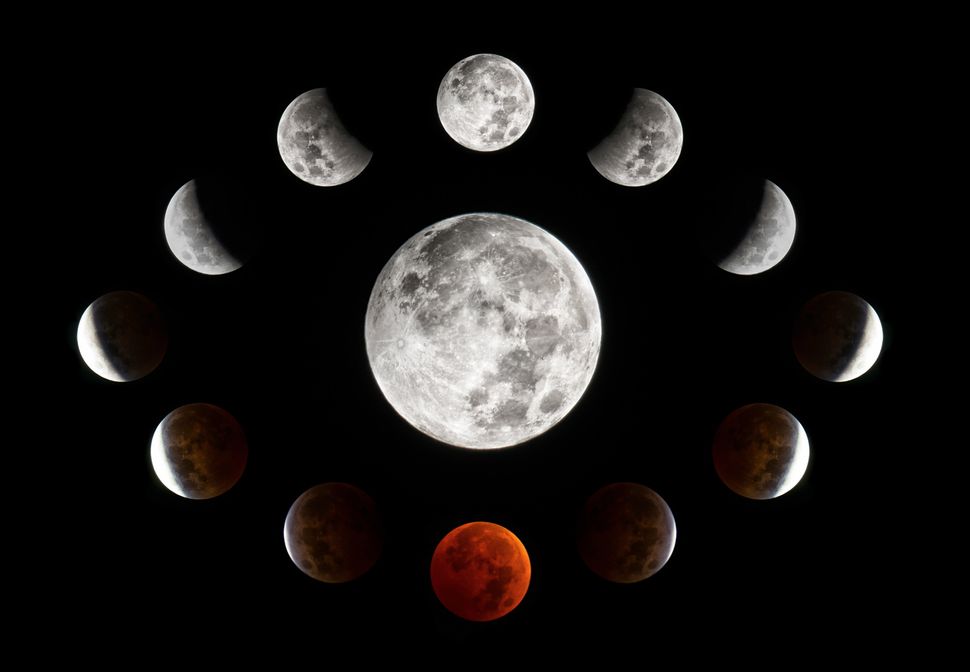
On February 29, 1504: Columbus tricked Jamaicans using knowledge of upcoming lunar eclipse

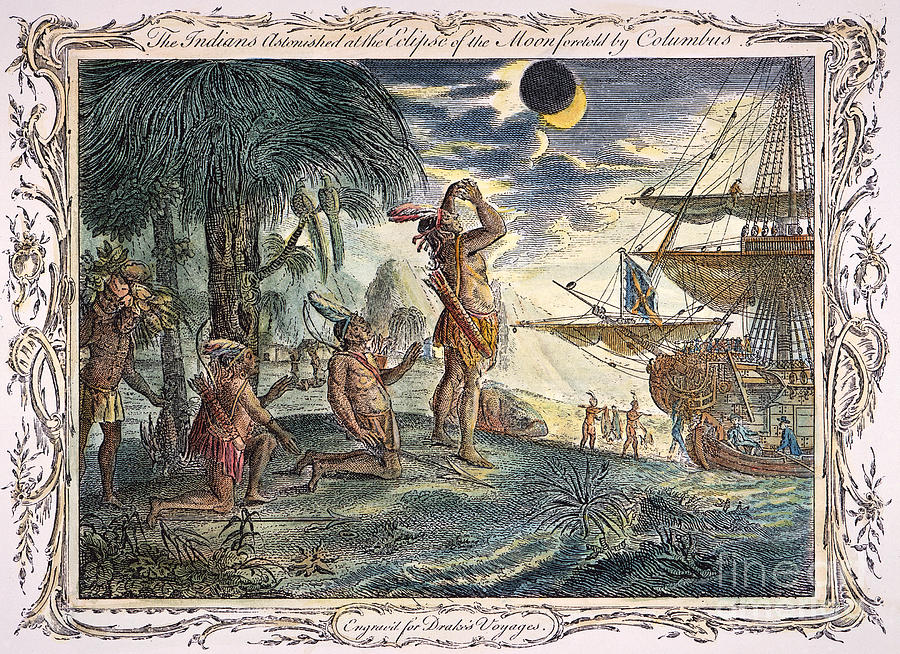
Columbus called a meeting with the chiefs of the nearby tribes shortly before the eclipse was to take place. In this meeting, he told them his god was angry with them for ceasing to give him supplies. As a result, his god would take away the moon as a sign of his anger and subsequently punish them for their actions.
On this day in history, 1504, Christopher Columbus convinced a group of Native Jamaicans that his god was angry with them for ceasing to provide his group with supplies and that god would show his anger with a sign from the heavens. The sign was a lunar eclipse that Columbus knew was imminent.

This event occurred on Columbus’ fourth and final voyage to the Americas, which began in Cadiz in 1502. Columbus landed near the north coast of Jamaica on June 20, 1503 with only two of his original four ships still afloat, but barely sea worthy due to a shipworm infestation. Space.com:
Initially, the native peoples (Arawak Indians) welcomed the castaways, providing them with food and shelter, but as the days dragged into weeks, tensions mounted. Finally, after being stranded for more than six months, half of Columbus' crew mutinied, robbing and murdering some of the Arawaks, who themselves had grown weary of supplying cassava, corn and fish in exchange for little tin whistles, trinkets, hawk's bells and other trashy goods. With famine now threatening, Columbus formulated a desperate, albeit ingenious plan. 
Columbus had an almanac with him, compiled by the German astronomer Johannes Müller von Königsberg, better known today by his Latin name, Regiomontanus (wiki). This almanac contained detailed information about the sun, moon and planets, as well as the more important stars and constellations to navigate by -  with its help, explorers were able to leave their customary routes and venture out into the unknown seas in search of new frontiers. 

The almanac predicted there would be a total lunar eclipse on the evening of February 29, 1504. Columbus also gave an estimation of what time it would occur; this start time was based on Nuremberg, Germany time, so Columbus had to do a bit of estimating. Regiomontanus had even included fairly accurate information as to how long the eclipse would last.

Counting on this accuracy, Columbus called a meeting with the chiefs of the nearby tribes shortly before the eclipse was to take place. In this meeting, he told them his (Columbus's) god was angry with the natives for ceasing to give him supplies. As a result, his god would take away the moon as a sign of his anger and subsequently punish them for their actions.

Amazingly, the prediction proved correct. As the full moon rose in the east on the appointed night, Earth's shadow was already biting into its face. As the moon rose higher, the shadow became larger and more distinct until it completely obscured the moon, leaving nothing but a faint red disk in the sky.
The natives were sufficiently frightened by this unexpected occurrence and by Columbus's uncanny prediction to beg forgiveness and appeal to him to restore their moon to the sky. Columbus responded that he wished to consult with his deity. He retired to his quarters, using a half-hour sandglass to time how long the eclipse would last. Some time later, when the eclipse had reached totality, he emerged to announce that the moon, in answer to his prayers, would gradually return to its normal brightness.
The next day, the natives brought food and did all they could to please Columbus and his crew.
Columbus and his crew were picked up a few months later when a ship from Hispaniola arrived in Jamaica on June 29, 1504. They arrived back in Spain on November 7, 1504.

Pre-knowledge of eclipse timing to fool the natives has been used as a plot device many times, including, most famously, H. Rider Haggard's King Solomon's Mines, and Mark Twain's A Connecticut Yankee in King Arthur's Court.

Friday, January 19, 2024

It's Stonewall Jackson's birthday - here's the story of his left arm's separate grave (bonus: Lord Uxbridge's leg)

From the always interesting Atlas Obscura:

Most of Civil War superstar Thomas Jonathan "Stonewall*" Jackson (wiki) was buried in a Lexington, Virginia, cemetery that now bears his name, but he was so famous at the time of his death that his amputated left arm was spirited away to its own separate grave.

It was just after dark on May 2, 1863. Jackson had just launched a devastating attack against Union forces at Chancellorsville. Returning to his own lines with several staff officers, Jackson, ever the aggressive soldier, decided to conduct reconnaissance in the area. As he and his staff rode through the woods near Confederate lines, a North Carolina regiment, unable to see who was riding up on them, opened fire. Jackson was struck by three bullets, two of them shattering his left arm.** The general was evacuated from the area and given medical treatment, but the arm couldn't be saved and was amputated. Pneumonia set in, and on May 10, 1863, the South lost its most effective tactician. While Jackson's body would travel to Lexington, where he had taught before the war, his severed arm would receive its own burial.

Two-armed Thomas 'Stonewall' Jackson
during the Mexican-American War, 1847
Thinking that the limb of so great a solider was too precious to simply throw on the regular body part trash pile, Jackson's unofficial company chaplain, Reverend Tucker Lacy wrapped the arm in a blanket and took it his family cemetery. The reverend gave the limb a standard Christian burial and placed a marker above the site.

Supposedly Stonewall Jackson's arm was dug up and reburied numerous times in the ensuing years and there is no concrete evidence that it still resides in its original burial space, but the simple gravestone remains to remember one of the oddest instances of hero worship in the history of battle.

* Jackson rose to prominence and earned his most famous nickname at the First Battle of Bull Run (aka First Manassas) on July 21, 1861. As the Confederate lines began to crumble under heavy Union assault, Jackson's brigade provided crucial reinforcements on Henry House Hill, demonstrating the discipline he instilled in his men. Brig. Gen. Barnard Elliott Bee, Jr., exhorted his own troops to re-form by shouting, "There is Jackson standing like a stone wall. Let us determine to die here, and we will conquer!"

The Death of “Stonewall” Jackson
Currier & Ives (1872)
When Jackson died on May 10, 1863, his attending physicians attributed the death to a pneumonia Jackson had developed four days after amputation of his arm. The infection was believed to be secondary to a pulmonary contusion, or bruised lung, that Jackson may have suffered after falling from a stretcher during his removal from the field. For nearly 150 years, that diagnosis was largely unchallenged. 

More recently, however, modern physicians have begun offering alternate possibilities for his cause of death.The most commonly suggested alternative is pyemia, or blood poisoning. Known today as sepsis, pyemia was a well-recognized and deadly condition during the pre-antibiotic days of the Civil War.

** The story of Stonewall Jackson's injury always reminds me of this, from later in the War of Northern Aggression (wiki):

"They couldn't hit an elephant at this distance."

~ Union general John Sedgwick (died 1864) (just before being killed by Confederate fire at the battle of Spotsylvania)

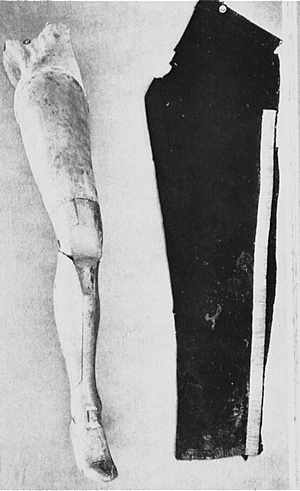
Uxbridge's false leg
Related, via Andrew Stuttaford - read the whole Wikipedia entry: Lord Uxbridge's leg was shattered by a cannon shot at the Battle of Waterloo and removed by a surgeon. The amputated limb went on to lead a somewhat macabre after-life as a tourist attraction in the village of Waterloo in Belgium, where it had been removed and interred.

Per Wikipedia:
Just after the Surgeon had taken off the Marquis of Anglesey's leg, Sir Hussey Vivian came into the cottage where the operation was performed. "Ah, Vivian!" said the wounded noble, "I want you to do me a favour. Some of my friends here seem to think I might have kept that leg on. Just go and cast your eye upon it, and tell me what you think." "I went, accordingly", said Sir Hussey, "and, taking up the lacerated limb, carefully examined it, and so far as I could tell, it was completely spoiled for work. A rusty grape-shot had gone through and shattered the bones all to pieces. I therefore returned to the Marquis and told him he could set his mind quite at rest, as his leg, in my opinion, was better off than on."
I love this bit: 
According to anecdote, he was close to the Duke of Wellington (at Waterloo) when his leg was hit, and exclaimed, "By God, sir, I've lost my leg!", to which Wellington replied "By God, sir, so you have!"
Further reading: Rebel Yell: The Violence, Passion, and Redemption of Stonewall Jackson

Saturday, January 13, 2024

The Story Behind the 1998 Pizza Hut Commercial That Featured Former Russian President Mikhail Gorbachev

 From Vintage Everyday:


In the commercial, Gorbachev and his then-10-year-old granddaughter, Anastasia, are shown walking through Moscow’s Red Square and stopping at a Pizza Hut. Spoken in Russian with English subtitles, the commercial focuses on Pizza Hut’s new Edge Pizza. A family of diners spots Gorbachev a few tables away and starts arguing about whether he took them to “the edge of economic ruin, the edge of chaos.”

“Because of him, we have freedom,” a young man tells Gorbachev’s critic. An older female sympathizer gets in the last word: “Because of him we have many things, like Pizza Hut!” This prompts others to raise a slice to chants of “Hail to Gorbachev!” The commercial hawked pizza, but it also had political overtones of Gorbachev’s policies of glasnost (openness) and perestroika (restructuring).

Better known in the US, here's Ronald Reagan at History.com - "Mr. Gorbachev, tear down this wall!"

Sunday, September 17, 2023

Dr. Samuel Johnson was born on September 18, 1709: here's a selection of his insults and Scotland-bashing quotes.

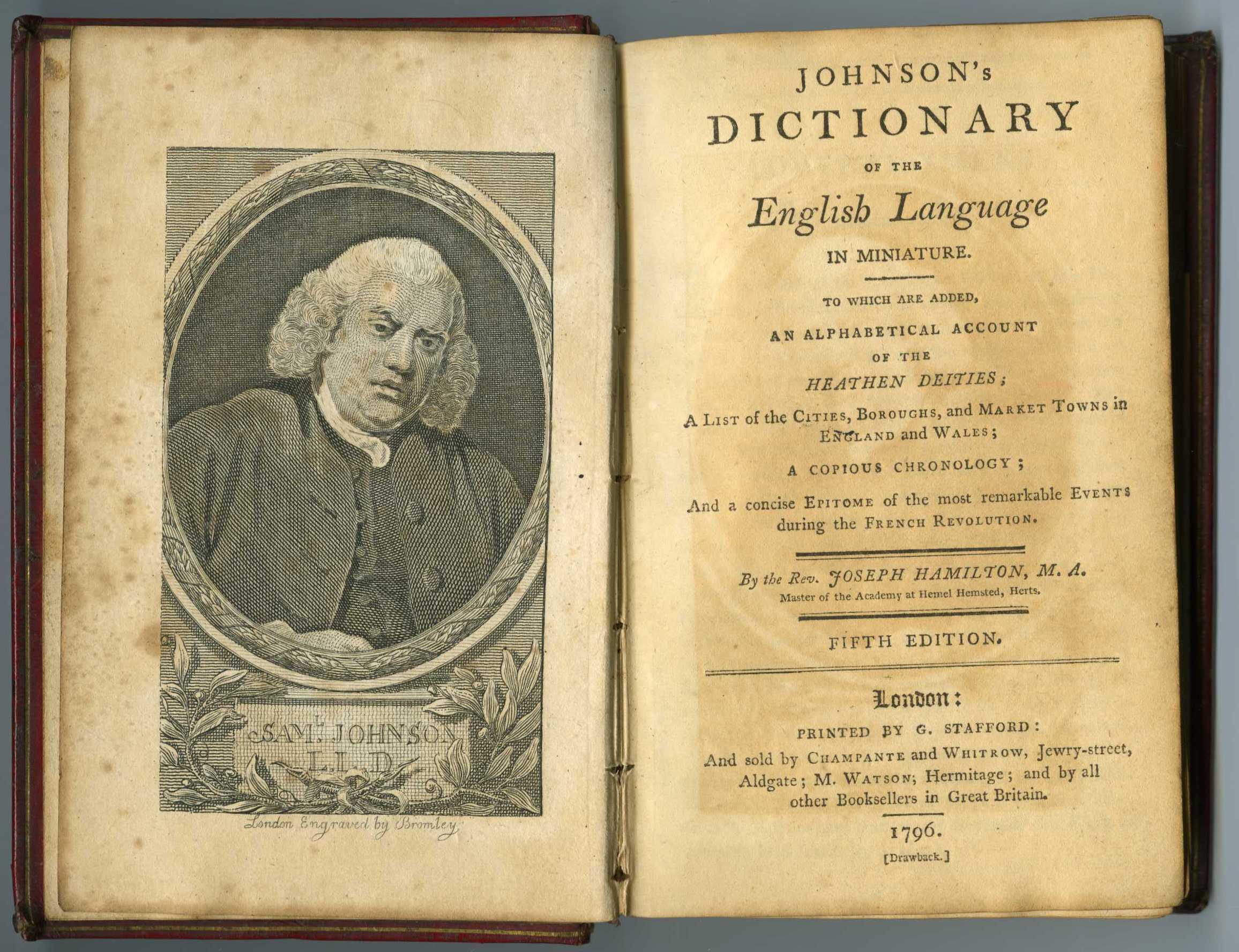
September 18 is the anniversary of the birth in 1709 of that quintessential 18th-century curmudgeon Dr. Samuel Johnson (wiki), the literary lion of Georgian London for much of his lifetime (1709-1784). A poet, critic, lexicographer, and wit, Johnson compiled the first respectable English dictionary between 1747 and 1755, following several years of writing critical articles for London magazines such as The Idler.

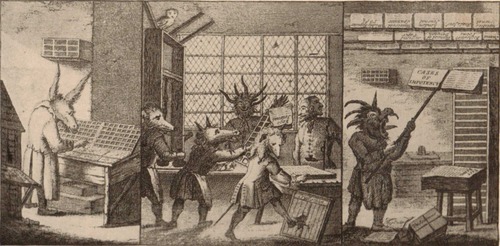
From The Grub Street Journal (Oct 30, 1732), this cartoon depicts the “literatory,” a sort of publishing factory driven by beasts without artistic inspiration. Such was the perception of Grub Street writers like Johnson and Savage, who did indeed scrape together a living from commissioned writing.
Born in Lichfield the son of a book dealer, Johnson studied at Oxford and ran his own private school - where the actor David Garrick was a student - before removing to London and its literary milieu in 1737. There, in 1763, he met his companion and biographer, the Scot, James Boswell (1740-1795), to whom we owe the recording of most of Johnson's voluminous observations. 

He was no fan of Scotland:

"The noblest prospect which a Scotchman ever sees, is the high road that leads him to England!"

I having said that England was obliged to us for gardeners, almost all their gardeners being Scotchmen; Johnson: "Why, Sir, that is because gardening is much more necessary amongst you than with us, which makes so many of your people learn it. It is all gardening with you. Things which grow wild here, must be cultivated with great care in Scotland. Pray now," throwing himself back in his chair, and laughing, "are you ever able to bring the sloe to perfection?"

He would not allow Scotland to derive any credit from Lord Mansfield; for he was educated in England. "Much may be made of a Scotchman, if he be caught young."

"There is in Scotland a diffusion of learning, a certain portion of it widely and thinly spread. A merchant has as much learning as one of their clergy."

"What enemy would invade Scotland, where there is nothing to be got?"

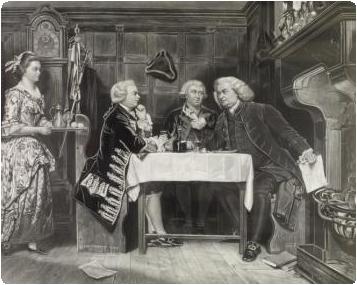
In “The Mitre Tavern” (1880), Samuel Johnson (far right) converses with James Boswell (center) and author Goldsmith. (source)


Asked by a Scot what Johnson thought of Scotland: "That it is a very vile country, to be sure, Sir" "Well, Sir! (replies the Scot, somewhat mortified), God made it." Johnson: "Certainly he did; but we must always remember that he made it for Scotchmen, and comparisons are odious, Mr. S------; but God made hell."

Mr. Arthur Lee mentioned some Scotch who had taken possession of a barren part of America, and wondered why they would choose it. Johnson: "Why, Sir, all barrenness is comparative. The Scotch would not know it to be barren." Boswell: "Come, come, he is flattering the English. you have now been in Scotland, Sir, and say if you did not see meat and drink enough there." Johnson:"Why yes, Sir; meat and drink enough to give the inhabitants sufficient strength to run away from home."

Johnson and Boswell in Edinburgh
"Your country consists of two things, stone and water. There is, indeed, a little earth above the stone in some places, but a very little; and the stone is always appearing. It is like a man in rags; the naked skin is still peeping out."

"A tree might be a show in Scotland as a horse in Venice. At St. Andrews Mr. Boswell found only one, and recommended it to my notice; I told him it was rough and low, or looked as if I thought so. This, said he, is nothing to another a few miles off. I was still less delighted to hear that another tree was not to be seen nearer. Nay, said a gentleman that stood by, I know but of this and that tree in the county."

[Of an inn in Scotland, SJ wrote...] "Of the provisions the negative catalogue was very copious. Here was no meat, no milk, no bread, no eggs, no wine. We did not express much satisfaction."

"He that travels in the Highlands may easily saturate his soul with intelligence, if he will acquiesce in the first account. The highlander gives to every question an answer so prompt and peremptory, that skepticism itself is dared into silence, and the mind sinks before the bold reporter in unresisting credulity; but, if a second question be ventured, it breaks the enchantment; for it is immediately discovered, that what was told so confidently was told at hazard, and that such fearlessness of assertion was either the sport of negligence, or the refuge of ignorance."

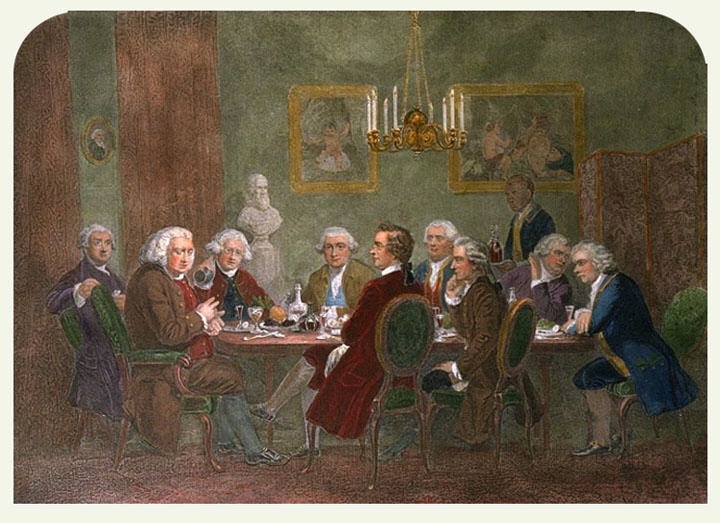
1781: Johnson (second from left), other members of "The Club".
(Written by an Irishman) The author of these memoirs will remember, that Johnson one day asked him, 'Have you observed the difference between your own country impudence and Scottish impudence?' The answer being in the negative: 'Then I will tell you,' said Johnson. 'The impudence of an Irishman is the impudence of a fly, that buzzes about you, and you put it away, but it returns again, and flutters and teazes you. The impudence of a Scotsman is the impudence of a leech, that fixes and sucks your blood.' 

Johnson also, of course, had little use for America or Americans:

"Sir, they are a race of convicts, and ought to be thankful for anything we allow them short of hanging."

"To a man of mere animal life, you can urge no argument against going to America, but that it will be some time before he will get the earth to produce. But a man of any intellectual enjoyment will not easily go and immerse himself and his posterity for ages in barbarism."

"I am willing to love all mankind, except an American"

A Blackadder clip on Johnson's Dictionary:


Here's a very well done bio of Johnson by the BBC:


A selection of his legendary insults:

Dr. Johnson in the ante-room of Lord Chesterfield. 
Of Lord Chesterfield:

"This man I thought had been a Lord among wits; but I find, he is only a wit among Lords."

And of Lord Chesterfield's Letters to His Son*:

"They teach the morals of a whore; and the manners of a dancing-master."

Of Thomas Sheridan:

"Why, Sir, Sherry is dull, naturally dull; but it must have taken him a great deal of pains to become what we now see him. Such an excess of stupidity, Sir, is not in nature."

Of the respective merits of the poets Derrick and Smart:

"Sir, there is no settling the point of precedence between a louse and a flea."

Of the criticism of one critic (Edwards) of another (Warburton):

"A fly, Sir, may sting a stately horse and make him wince; but the one is but an insect and the other is a horse still."

Of Lady Macdonald of Sleat:

"...she was as bad as negative badness could be, and stood in the way of what was good; that insipid beauty would not go a great way... and such a woman might be cut out of a cabbage, if there was a skilful artificer."

Of two disputants:

"One has ball without powder; the other powder without ball."

Of a man hired to sit with him during a convalescence:

"The fellow's an idiot; he is as awkward as a turn-spit when first put to the wheel, and as sleepy as a dormouse."

Of James Macpherson:

"He wants to make himself conspicuous. He would tumble in a hogstye, as long as you looked at him and called him to come out."

Of the new rich:

"Sir, they have lost the civility of tradesmen, without acquiring the manners of gentlemen."

Despite his legendary bile, Johnson did remark later in life,

"As I know more of mankind I expect less of them, and am ready to call a man a good man upon easier terms than I was formerly."

* My favorite quote from Lord Chesterfield's Letters to His Son (to his illegitimate son, that is; he (Chesterfield) was trying to raise him (the son) above his (the son's) lowly origins and inferior blood):
"I knew a gentleman, who was so good a manager of his time, that he would not even lose that small portion of it, which the calls of nature obliged him to pass in the necessary-house; but gradually went through all the Latin poets, in those moments. He bought, for example, a common edition of Horace, of which he tore off gradually a couple of pages, carried them with him to that necessary place, read them first, and then sent them down as a sacrifice to Cloacina*: this was so much time fairly gained; and I recommend you to follow his example.

It is better than only doing what you cannot help doing at those moments; and it will made any book, which you shall read in that manner, very present in your mind. Books of science, and of a grave sort, must be read with continuity; but there are very many, and even very useful ones, which may be read with advantage by snatches, and unconnectedly; such are all the good Latin poets, except Virgil in his "Aeneid": and such are most of the modern poets, in which you will find many pieces worth reading, that will not take up above seven or eight minutes."
Attribution for many of the quotes above can be found at the Samuel Johnson Sound Bite Page. More on Johnson here and here.

Further reading: 

The definitive source for all things Johnson is, of course Boswell's book The Life of Samuel Johnson. 


Parts of the text above are adapted from the late, great Ed Whitman's Quotation of the Day. In addition to being my partner, my best friend, and Grandpa to the many kids who call me Grandma, Ed is also the author of Hunters and Killers: Volume 1: Anti-Submarine Warfare from 1776 to 1943 and Hunters and Killers: Volume 2: Anti-Submarine Warfare from 1943. Fair winds and following seas, Sailor.