Amazon Deals

New at Amazon

Showing posts with label past. Show all posts

Wednesday, June 10, 2020

Wednesday links


Ancient methods for storing food.

How to Kill Snakes and Fleas: advice from 1688.

Father's Day suggestion for the man who has everything - Rhinestone jockstrap belonging to Elvis Presley on sale for almost £30,000.

Gallery of construction photos from 1881-1895: Building London's Tower Bridge.

ICYMI, most recent links are here, and include nature’s best toilet paper substitutes, the dark side of Peter Pan, quarantines in the 19th century, and bronze-age fighting techniques.

Sunday, December 15, 2019

How to Cure Your Cough, 1558


A most beautiful and pleasant secret for curing a cough by greasing the soles of the feet. An extremely true thing, and very easy.

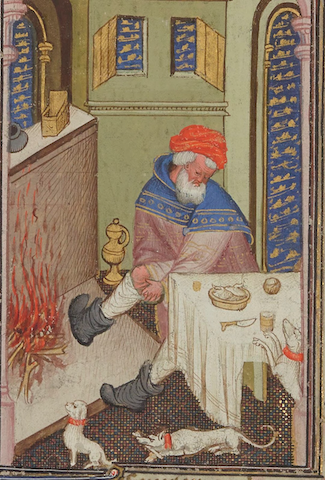
BnF, MS Lat. 9471 (15th c.)
Take two or three heads of garlic and peel them, and crush them very well, and then add pork fat, and crush it together well again. Then, in the evening when you want to go to bed, take your socks off and put the soles of your feet toward the fire, and grease the soles with the mixture of garlic and fat. And keeping the feet always to the fire so that it almost burns you, or as hot as you can endure, let the ointment stay on for a while. Then put on warm socks and go to bed, and in bed have your back massaged a little with the ointment. And after three evenings you will be miraculously cured from any cough.

~ De’ segreti del reverendo donno Alessio Piemontese

Previous, semi-related posts:

Advice from c. 530: How To Use Bacon, including for medicinal purposes such as "thick bacon, placed for a long time on all wounds, be they external or internal or caused by a blow, both cleanses any putrefaction and aids healing".


How to Stop Bleeding, 1664:
“To Stench a Bleeding Wound: Lay hogs Dung, hot from the Hog, to the Bleeding Wound.”
~Samuel Strangehopes, A Book of Knowledge in Three Parts (166[4])
Dubious medical device du jour - the prostate warmer.

Advice from 1380: How to Tell if Someone Is or Is Not Dead, with bonus Monty Python.

Friday, October 18, 2019

How to Prevent Pregnancy, c. 1260 (the weasel/scorpion method), plus other dubious medical advice

So, are the old ways always the best? I tend to think so, since I'm old, but I have my doubts about this one:

"A weasel placed on a scorpion bite helps greatly... if its heel is taken from it while it still lives and is placed on a woman, she will not get pregnant as long as it is there." 
~ Albertus Magnus, De animalibus

via the excellent blog Ask the Past, which adds: 
As if you needed another reason to keep a live weasel in your bedroom.
Not sure if it worked? Here's advice from 1684 on How To Know If You're Pregnant:
"The women are troubled with nauseating and loathing of their meat, and oftentimes covet and greedily long for things contrary to Nutriment, as Coals, Rubish, Chalk, Lime, Starch, Oat-meal, raw Flesh and Fish or the like, which desire proceeds from a former contraction of evil humours... some Women as it has been noted by divers Authors of Credit, have been so extravegant in their longings, that they have coveted Hob-Nails, Leather, Horse Flesh, Mans Flesh, and the Flesh of divers ravenous Beasts..."
~Aristoteles Master-piece (1684)
Then there's advice for caring for your newborn:
“After the woman has delivered the child, you should know how to take care of the child. Know that as soon as the child is born, it should be wrapped in crushed roses mixed with fine salt… And when one wishes to swaddle [the baby], the members should be gently couched and arranged so as to give them a good shape, and this is easy for a wise nurse; for just as wax when it is soft takes whatever form one wishes to give to it, so also the child takes the form which its nurses give to it. And for this reason, you should know that beauty and ugliness are due in large measure to nurses. And when its arms are swaddled, and the hands over the knees, and the head lightly swaddled and covered, let it sleep in the cradle.”
~Aldobrandino of Siena, Regimen for the Body (1254), tr. Faith Wallis
And this: Anoint the gums with the brains of a hare: advice from c. 1450 on soothing a teething baby:
Andrea Mantegna, The Circumcision of Jesus 
(detail, c. 1461)
"Sometimes babies have trouble with teething. In that case you should squeeze the gums with your fingers, and gently massage them, and the palate as well. And you should anoint the gums with the brains of a hare (which are very suitable for this purpose), or with fat or butter or good-quality olive oil; and you should do this twice a day. The milk of a dog is suitable, too. It is also very helpful to use hen's fat for both anointing and massaging the gums."

~Michele Savonarola, Ad mulieres ferrarienses (c. 1450)
If you like this sort of thing, I recommend the book How to Cure the Plague, and Other Curious Remedies.

Previous, semi-related posts:

Advice from c. 530: How To Use Bacon, including for medicinal purposes such as "thick bacon, placed for a long time on all wounds, be they external or internal or caused by a blow, both cleanses any putrefaction and aids healing".


How to Stop Bleeding, 1664:
“To Stench a Bleeding Wound: Lay hogs Dung, hot from the Hog, to the Bleeding Wound.”
~Samuel Strangehopes, A Book of Knowledge in Three Parts (166[4])
Dubious medical device du jour - the prostate warmer.

Advice from 1380: How to Tell if Someone Is or Is Not Dead, with bonus Monty Python.


Urine-drinking Hindu cult believes a warm cup before sunrise straight from virgin cow cures cancer, baldness.

Friday, October 11, 2019

Physiognomy of eyebrows: lots of eyebrow interpretation information from the 16th century

phys·i·og·no·my 
1: the art of discovering temperament and character from outward appearance
2: the facial features held to show qualities of mind or character by their configuration or expression
Physiognomy (wiki) has its roots in antiquity. As early as 500 B.C., Pythagoras was accepting or rejecting students based on how gifted they looked. Aristotle wrote that large-headed people were mean, those with small faces were steadfast, broad faces reflected stupidity, and round faces signaled courage.

Physiognomy—from the ancient Greek, gnomos (character) and physis (nature), hence “the character of one’s nature”—really became popular again in 16th-century Europe, as physicians, philosophers, and scientists searched for tangible, external clues to internal temperaments.

John Varley: Sketch for ‘Treatise on Zodiacal Physiognomy’ 1828
Via the Folger: from a treatise circa 1570 devoted to physiognomy and to specific characteristics comes this analysis of eyebrow shape:

Straight brows

It is generally a good thing to hang around with people with straight eyebrows. 

The first entry describes someone with “strayghte browes”:
“he ys good and wyse trewe in harte worde and deed kepe thow in his companye,” or with modern spelling, “he is good and wise, true in heart, word, and deed. Keep thou in his company.” 
Beetle brows 

Beetle brows = goggle-eyed, shrew-like, deceivable, lime-fingered = not good.

“Byttell browes,” or beetle brows, are another story: 
“that man that ys byttell browed be ware of hyme for he ys lyke vnto the gogell yed man he ys a shrowe in in all manner of companye he ys deseuable and lyme handed be ware of hym.”
Modernized, this reads: “That man that is beetle-browed, beware of him, for he is like unto the goggle-eyed man. He is a shrew in all manner of company. He is deceivable and lime-handed. Beware of him.” Beetle-browed refers to very prominent and shaggy eyebrows; goggle-eyed refers to prominent eyes; and lime-handed refers to someone prone to pilfering.

Unibrows

Thomas Hill’s The contemplation of mankinde, 
contayning a singuler discourse after the art of phisiognomie 
(London, 1571) [STC 13482] includes a 
helpful image of a unibrow (Folger STC 13482, copy 1)
Unibrowed people are unsteadfast and want to eat all of your meat and drink.

Next we have a description of “the here betwine the browes and the nose,” or what we would think of as the unibrow. The unibrowed person has 
“the sygne of the graye yes he ys vnstedfaste and hontethe far and [comtethe?] good meates and drinkes nor he will not depart yf he maye.”
The passage connected to this illustration explains:
The Phisiognomer Cocles reporteth, that when the ouerbrowes appeare thicke of heares, and so plentifull or aboundaunt, that these (as the Philosopher writeth) doe discende to the beginning of the nose, and appear through the same whole formed togither: doe then signifie great adustion: and such hauing like ouerbrowes, are melancholicke, and of an euill nature: yea wicked persons, and sometimes theeues, rauishers of maydens, Murderers, but deceyuers allwayes: and to bee briefe, all vices, and wickednesse, are comprehended and knowne in those persons.
Red brows, hanging brows, and more

The whole leaf, including entries for red brows, brown hair (with straight brows), and a straight forehead.
Further down this same leaf, red brows indicate someone who is lime-handed and deceivable. Brown hair and straight brows, “not hangen but mesurable”—that is, not drooping but of moderate thickness—indicate someone of good of manners and true of heart, word, and deed. The reader is advised to remain in the fellowship of such men.
And the final eyebrow description: “hangen browes with yellow yes blacke here on his browes with white here;” that is, “hanging brows with yellow eyes, black hair on his brows, with white hair”:
That man is a stronge theff and shall be hanged
or elce slayne other eles he shall dye some
shamfull dethe for hathe of all planattes a signe
as saynte Austen sayethe, and godwyne the abbote
for the men that be borne in suche a tyme that
he shall have hys desceuynge but that clerkes
sayethe that over all thynges all mysdedes and
good prayers destroyethe wyked desceuynges.
Other entries refer to forehead types, head size, ear and nose features, hair color and length, and lack of hair altogether (“balled” men). 
It might be easy to laugh at the idea that eyebrows and other facial features could be indicative of one’s character, but physiognomy, in combination with astrology and humoral theory, was a popular pseudo-science in the early modern period, leading people to evaluate past actions and predict future behavior based on one’s visage. It remained popular at least into Victorian times. This is from The Physiognomist's Own Book: an introduction to physiognomy drawn from the writings of Lavater, from 1841:

"CUNNING, DECEIT, AVARICE.
In such a face we may search in vain, for a single expression of frankness; for the slightly projecting chin, when accompanied with small penetrating eyes, denotes the absence of sincerity. There is no display of benevolence in the oblique mouth ; and avarice reveals itself in the close-locked lips. Combine all these features, and they result in a cunning, deceitful, avaricious, and not merely firm, but stubborn old fellow. Such a man moves quick, and speaks slowly and circumspectly; for suspicion is the mainspring of his character."
Ask the Past has a passage from a similar work, dated 1562:
John Bulwer, Anthropometamorphosis
"The eyebrowes that be very heary declare folyshnes of maners and mischiefe... The eyebrowes whyche descende downe warde on the syde of the nose, and raysed vpward on the syde of the temples, and hangyng downeward on bothe sydes declare the man to be wythout shame enuious, folyshe insatiable, and lyke vnto hogges. The eyebrowes which descend crooked on the side of the nose declare the man to be witty in naughty thinges, and whan they be crooked on the out side of the eye, they signifie the man to be recreatife & merry... When the eyebrowes comme togyther, they shewe the man to be verye pensyfe and not very wyse." 
~Richard Roussat, Arcandam

Monday, May 27, 2019

Monday links

They shall grow not old, as we that are left grow old:
Age shall not weary them, nor the years condemn.
At the going down of the sun and in the morning
We will remember them.
Historical images of Arlington National Cemetery.

When the worst problem large cities had to deal with was horse manure. Slightly related: When San Francisco’s Chinatown Was Quarantined for Plague.


Advice from 1896: how to Drive an Electric Car.

Because I've been watching a lot of old Gunsmoke episodes recently: How Dodge City Became The Ultimate Wild West.

Will Hospitals Give Back an Amputated Limb if You Ask For It?

ICYMI, Friday's links are here, and include what happened to Napoleon's looted art, why some countries drive on the left and others on the right, the pistachios that need police protection, composting dead family members, and illustrated guides to always being battle-ready - the tactical order of dressing and how to poop like a Samurai.

Monday, January 14, 2019

Monday links


Like a moth to the flame: why moths are attracted to light.

They wouldn't need any tricks in the D.C. area right now - The Crazy Tricks Early Filmmakers Used To Fake Snow.

Advice from 1595 - How to Slim Down in Fourteen Days. There's lots of garlic bread and fennel tea involved. 


ICYMI, most recent links are here, and are all New Year-related.

Tuesday, December 11, 2018

Wednesday links

Lots of ugly Christmas sweaters, instructions for making your own, plus ugly Christmas sweater suits. Related, here's how to make Ugly Sweater Ornaments.

Your Apps Know Where You Were Last Night, and They’re Not Keeping It Secret.


Advice from c. 1200: How to Survive the Winter. Don't forget to lay off the purging and blood-letting, and keep your hands and feet covered in wolf grease.

The lost art of flower-making.


ICYMI, Friday's links are here, and include using fake "master" fingerprints to unlock smartphones,  the anniversary of Pearl Harbor, an interactive map shows all the ways medieval London could kill you, and T'was the Overnight Before Christmas: The Merry Tale of How Air Cargo Deregulation Led To Amazon. 

Friday, November 9, 2018

Friday links

"The War to End All Wars" ended 100 years ago on the 11th Hour of the 11th Day of the 11th Month in 1918. Before it was Veterans Day it was Armistice Day, for the fallen of the First World War: here's some history. 


The Little-Known Reason Pencils Are Yellow.

Advice on hair washing from the 12th and 17th centuries.

Football Physics: Newton, Einstein and The Forces Behind Those Big Hits.

NASA has plans to probe Uranus in search of gas.

ICYMI, Monday's links are here, and include how telegraph operators were the first to know news of the Civil War (which arrived in code), political maps of the United States from 1850 and 1880, Nazi werewolves, making whiskey and wine in a lab, and Guy Fawkes Day.

Wednesday, July 25, 2018

Advice from 1380: How to Tell if Someone Is or Is Not Dead, with bonus Monty Python

BL Harley 3140, f. 39r (14th c.)
We all know that the old ways are frequently the best; that may turn out to be the case here, but I think we need further testing.  I would personally rather not be declared dead based on the onion test.   
"Moreover, if there is any doubt as to whether a person is or is not dead, apply lightly roasted onion to his nostrils, and if he be alive, he will immediately scratch his nose." 
Johannes de Mirfield, Breviarium Bartholomei (c. 1380-95)


Of course, it's impossible to think about being not quite dead without thinking of the Monty Python (wiki) "Not Dead Yet" scene from Holy Grail:

Wednesday, June 27, 2018

Wednesday links

June 27 is Helen Keller's birthday: here are quotes, links, some history, and a selection of (non-PC) jokes.

The taxpayer funding behind Domino's Extra Cheesy Pizza. Kind of related: How Domino's Pizza Lost Its Mascot.

Synthetic Street USA was a fake, part of the camouflage that covered the B17 Bomber factory in Seattle during WWII.

Anoint the gums with the brains of a hare: advice from c. 1450 on soothing a teething baby. Apparently dog milk works, too.

Science: Why Are Monkey Butts So Colorful? Includes a gallery of colorful monkey butts.


ICYMI, Tuesday's links are here, and include the survival uses for tampons and condoms, that time the U.S. Navy built a battleship in New York City's Union Square, a supercut of movie characters getting angry and flipping over tables, and an interactive map showing where your house would have been 750 million years ago.

Thursday, June 21, 2018

Thursday links

Whatever is dreamed on this night, will come to pass; the summer solstice is this morning (June 21) at 6:07 AM Eastern Time. Related, Fridgehenge: to celebrate the solstice, British guy recreated Stonehenge using old refrigerators

During the Great Depression, ‘Penny Restaurants’ Fed the Unemployed.

How to Have a Healthy Summer: Advice from 1656: you'll need to drink feebl green Wine and eschue the company of women.

Operation Acoustic Kitty: (Unsuccessful) Cold War attempt to eavesdrop via transmitters implanted into cats. 
"CIA staffers drove Acoustic Kitty to the park and tasked it with capturing the conversation of two men sitting on a bench. Instead, the cat wandered into the street, where it was promptly squashed by a taxi."
Alcohol - is there anything it can't do? Drunk People Are Better at Creative Problem Solving.

ICYMI, Monday's links are here, and include the anniversary of the 1815 Battle of Waterloo (including, of course, a Lego re-enactment), the sport of motor-ball (AKA soccer on motorcycles), prayers to stop a dog from barking, and where to hit someone to do the most damage.

Friday, April 27, 2018

Friday links

April 28th is Duke Ellington's birthday.

The Literal Meaning of Every Country's Name on a Map (zoomable).

Inside the Strange World of Dried Hummingbird Love Charm Trafficking.

Because it's time to get the herb gardens planted, here's some advice from the 16th century on avoiding brain scorpions: Take heede therefore ye smellers of Basil.

Here's a clickable map of every street tree in New York City.


ICYMI, Wednesday's links are here, and include how to download a copy of everything Google knows about you, ANZAC Day (the anniversary of the Battle of Gallipoli), the 19th century art of measuring criminals, and, for Oliver Cromwell's birthday, his excellent (and evergreen) speech throwing out the corrupt Parliament (plus the posthumous adventures of his head). 

Friday, February 16, 2018

Friday links

Geronimo died on February 17 in 1909 - some history, quotes, a brief biography, and why we yell his name when we jump out of planes.

Bird Feeders Are Changing the Course of Evolution

The strange tale of triplets separated at birth.

How to survive cold and flu season: advice from 1761 (the orange rind in the nostrils method).

Pushing the Limits of Extreme Breath-Holding.


ICYMI, Tuesday's links are here, and are all Valentine's Day-related: science of chocolate, St. Valentine history, vintage cards, and aphrodisiacs.

Monday, January 29, 2018

Monday links

"A woman drove me to drink, and I never even had the courtesy to thank her": It's W.C. Fields' birthday: quotes, a brief biography and film clips.

Goldman Sachs president's personal assistant stole $1.2 million worth of his boss's wine, then embarked on a world tour while the FBI tracked him. But who was he before?

The crimes that changed history.

Advice from ancient Greece: Need Your Livestock to Breed? Reach for the Spice Cabinet.


Is music universal? The Norwegian group Messaging Extraterrestrial Intelligence (METI) is beaming binary-coded music at one potentially life-friendly exoplanet 12 light-years away. 

ICYMI, Friday's links are here, and include Australia Day, the science of why swearing reduces pain, that time the Soviet Union paid Pepsi in warships, and the anniversary of the Soviet Army liberation of Auschwitz.

Monday, January 8, 2018

Monday links

Elvis Presley was born on January 8, 1935.

The Business of Fake Hollywood Money.

Fascinatingly Filthy: How Bad Science Saved Lives in Victorian London.

The fennel and garlic diet from 1595, or How to Slim Down in Fourteen Days.

The woman who slept with both Napoleon and Wellington.

Welcome to the National Valet Olympics.

ICYMI, Wednesday's links are here, and include London's oldest house, West Point’s 1826 eggnog riot, and the birthdays of Isaac Asimov and J. R. R. Tolkien (with Middle-Earth history, dancing orcs and a Lego version of the battle of Helm's Deep).

Tuesday, November 21, 2017

Tuesday links


A Thanksgiving miscellany: Mark Twain, science, WKRP, Cicero, the best turkey fryer PSA ever, more.


For those of us born between the 22nd and 28th and have always wondered, here's how it works: The Thanksgiving Birthday Pattern.

Advice from c. 1200: How to Survive the Winter.

This Celebrity Perv Apology Generator is my new favorite thing.

Recreating the diet of a 17th century sailor.

ICYMI, Monday's links are here, and include color photos of the 1939 NY World's Fair, the traditional drunken turkey recipe, enginneering the world's largest telescope, and President James Garfield's birthday (when he was shot, Alexander Graham Bell showed up with a metal detector to try to locate the bullet).

Monday, September 18, 2017

Monday links

Dr. Samuel Johnson (wiki) was born on this date in 1709: here's a selection of his insults and Scotland-bashing comments.

The now-abandoned Russian town that was aiming nuclear missiles at America from just 125 miles away.

How to Get Breasts like Apples: Beauty Tips for the Early Modern Woman.

How the Frozen Lake Battle in Game of Thrones Was Filmed.

This Family Has Had Blue Skin For Centuries — Here’s Why.

The Mysterious Illinois Pre-Columbian Settlement of Cahokia.

ICYMI, Friday's links are here, and include 19th century money saving tips, IBM’s 1937 corporate songbook, the definitive sandwich family tree, and how honey is harvested.

Thursday, April 6, 2017

Thursday links


These 10 companies control everything (edible) that you buy

In 1650, here's how you could dye your hair blond.

Map: watch as the world’s cities appear one-by-one over 6,000 years.

Victorian ‘Coffin Torpedoes’ Blasted Would-Be Grave Robbers.

ICYMI, Friday's links are here, and are all April Fool's Day related: history, pranks, and hoaxes.

Tuesday, April 4, 2017

In 1650, here's how you could dye your hair blond

So, are the old ways always the best? I tend to think so, being a grandma. In this particular case, however, I'd recommend more modern methods, although the advice on removing all of the filth before you start is still relevant.
  
Nicolas Arnoult, Recueil des modes de la cour de France (1687), LACMA
"How to make ones haire to become of a yellow Golden Colour. Take the rinde, or outward parings of Rhubarbe, and put them to steep in Whitewine, or clear Lye; wet a spunge or linnen cloth therein, and anoint your haire therewith, and let them dry before the fire or sunne; the oftener you do this the sooner they will become yellow: note that before you use this, it is good to clear your head and hair from sweat, and all other filth whatsoever."
~ A Brief Collection of Many Rare Secrets, La Fountaine, Edward (1650) (text of the entire book is available here).

Friday, December 30, 2016

New Year's links

Advice from 1862: How to Tell Your Fortune for the New Year.

List of lists: the lists of top 2016 science stories from 24 different sources.

Dave Barry's 2016 Year In Review. Previous such columns are available here.

How (Not) to Celebrate the New Year: Advice from 700 AD (or thereabouts).

Strange New Year traditions around the world.

Some links to avoid becoming philogrobolized:
Your Complete Guide to the Science of Hangovers.
Infographic on the Anatomy of a Hangover.
Hangover Cures From Famous Heavy Drinkers.
5 Really Strange Ways to Cure a Hangover.
Scientists Find a Way to Cut Wine Hangovers.
Dark Liquor Makes For Worse Hangovers.
How to Cure a Hangover.
According to a study in the Journal of Food Science, the amino acids and minerals found in asparagus extract may alleviate alcohol hangover and protect liver cells against toxins.

Why We Sing Auld Lang Syne on New Year’s Eve, and here's Mark Steyn singing and explaining What Are You Doing New Year's Eve?

Eat your heart out, New York: Boise, Idaho drops a giant potato downtown on New Year's Eve.