Amazon Deals

New at Amazon

Showing posts with label medieval. Show all posts

Saturday, March 27, 2021

That Time a Woman Named Phyllis Rode Aristotle Around Like a Horse

You learn something new every day, if you aren't careful. I was not aware of the Medieval trend of depicting Aristotle being ridden and whipped by a dominatrix named Phyllis. From JSTOR - go there to read the whole thing. More links below.

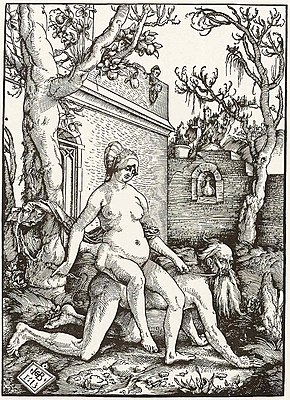
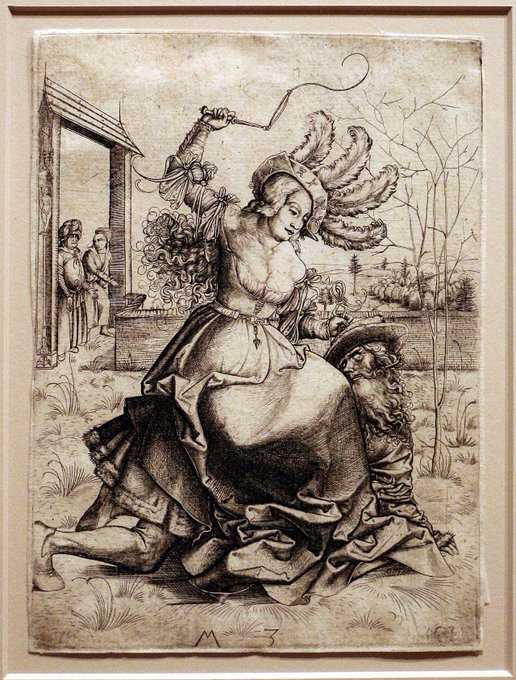
Alexander the Great (wiki), Aristotle’s (wiki) pupil, fell in love with a young woman named Phyllis. Aristotle, concerned that Phyllis was distracting Alexander from his kingly duties, cautioned him and advised him to spend less time with his love. Hurt, Phyllis decided to take her revenge. The next morning, she told Alexander to look out for her from the palace roof. She let down her hair, hiked up her skirts, and ran barefoot through the morning dew in the garden outside the window of Aristotle’s study. The philosopher looked up from his books to see a vision of beauty. Enchanted, he called her to him and begged her to be his.
“Certainly—on one condition,” Phyllis told the philosopher, and demanded that he put on saddle and bridle and give her a ride through the garden. Alexander, up on the battlements, was shocked to see his dignified old tutor with a bit in his mouth, while Phyllis brandished a whip over his back.

So, apparently there's a whole slew of art from over the last few hundred years depicting this story - I've picked a few favorites, but you can find more here. The first image below is not the clearest, but it's Leonardo DaVinci, for goodness sake.


Many more images at Google images.

More about this legend at the JSTOR article, and

http://dhayton.haverford.edu/blog/2016/02/19 (including a thorough retelling, changes through history, and a partial Latin translation of the story)


Friday, January 17, 2020

Friday links

100 years ago - Prohibition in the United States began in January 1920 and ended in December 1933. Related: here's Winston Churchill's doctor's note allowing him to drink "unlimited" alcohol in prohibition-era America.

For Al Capone's birthday, here's the story of that time he bought large blocks of stock in miniature golf construction companies.


January 17 is Ben Franklin's birthday - bio, quotes, videos, his 200+ synonyms for drunk, the bodies found in his basement, and more.

What could go wrong? Living ‘Franken-concrete’ which can heal its own cracks and even ‘give birth’ to new bricks, has been developed by scientists.

The Ten Most Important Weapons of the Middle Ages.

ICYMI, most recent links are here, and celebrating the Feast of the Ass, the science behind why dark winter days bum people out, learning any subject with Richard Feynman's notebook technique, the folklore of gin, and a 1918 publication on remedial politics for newly-enfranchised women in the UK.

Monday, June 10, 2019

Monday links


This article on impotence trials of the 14th through 17th centuries contains an awe-inspiring collection of cheesy sexually-themed metaphors.

18 Urban and Wilderness Survival Hacks That Would Make MacGyver Proud.

Classic Pin-Up Girls Before and After Editing: The Real Women Behind Gil Elvgren's Paintings.


What it was like to eat out in Victorian England.

ICYMI, most recent links are here, and include how regulations make all cars look so much alike, why almost all city trees are male and produce so much pollen, and the anniversaries of D-Day and Dunkirk.

Monday, May 13, 2019

Monday links

May 12 was the birthday of Victorian poet and artist Dante Gabriel Rossetti - here's a brief bio, some art and poetry, and a bit on his obsession with wombats.

Ancient Chinese Buildings Are Held Together With Sticky Rice.

This Plane Accidentally Flew Around the World - After Pearl Harbor, the crew of Pan Am flight 18602 was forced to do the impossible.

Five medieval toothpaste recipes, plus more medieval dental advice.

Why Do Cats—and So Many Other Animals—Look Like They’re Wearing Socks?


ICYMI, Friday's links are here, and include a roundup of Mother's Day links, the 1970s flying Winnebago, an explanation of why we forget what we're doing when we enter a room, and, for Fred Astaire's birthday, clips of some of his best dancing.

Thursday, May 9, 2019

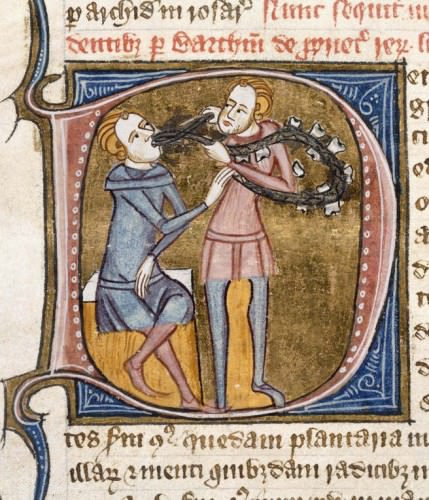
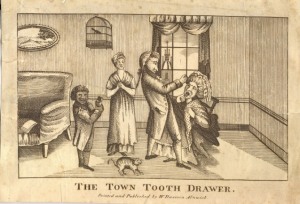
Five medieval toothpaste recipes, plus more medieval dental advice


In general, being a grandma, I tend to think that old ways are always the best. Medicine (including dentistry) is a definite exception. Medieval dentistry is something that most of us probably don't want to think about in any depth, but apparently there are those who do so. Some of the toothpaste recipes below are from a 2004 article in Nature by Trevor Anderson -  the full article (PDF) is here, Here's an excerpt:
John of Gaddesden wrote the Rosa Anglica in Latin around 1314AD... John’s section on toothache includes many prayers and charms. He mentions that anyone who prays to St Apollonia (wiki) on her feast day (February 9th) will be cured of toothache. St Apollonia (d.c.249AD) was an elderly deaconess of Alexandria who was martyred by having all her teeth extracted and was then burnt alive.
One charm involved repeatedly drawing three vertical lines on parchment (to represent running water) while touching the painful tooth with one’s finger. He also mentions that, ‘some say that the beak of a magpie hung from the neck cures pain in the teeth’. Apparently, he is not convinced by this particular charm. He also states that you should prick a ‘many footed worm which rolls up in a ball when you touch it’, with a needle. You then touch the aching tooth with the same needle and, ‘the pain will be eased’. Obviously, a reference to pain transference from tooth worm to the worm-like centipede.
Other recipes are from The Trotula (wiki), a set of medieval texts on women's medicine.

Medievalists.net:

1. According to Gilbertus Anglicus’ Compendium of Medicine, it is important to rub your teeth and gums with a cloth after eating, because it is important to ensure that “no corrupte mater abyde amonge þe teeþ” (“no corrupt matter abides among the teeth,”) Anderson, p.421). 

You can also munch on a paste of pepper and salt for that lovely scratchy feeling, and old-fashioned taste. Gilbertus advises, “chewe þid poudir a good while in [your] mooþ, and then swolle it down” (“chew this powder a good while in [your] mouth and then swallow it down”, Anderson, p.421). As a side benefit, you’re likely to clear your sinuses while you’re at it.

2. From one part of The Trotula, one of the most famous books of medieval remedies and beauty tips for women, comes a recipe “For Black Teeth”:

… take walnut shells well cleaned of the interior rind, which is green, and … rub the teeth three times a day, and when they have been well rubbed … wash the mouth with warm wine, and with salt mixed in if desired. (p.102)

I’m not sure how much anyone would desire mixing salt with the wine, but there you have it: black teeth whitened.

3. This second tooth-whitening recipe from The Trotula may work even better, since it requires wiping the teeth after swishing the wine, preventing unsightly wine stains on the teeth. This recipe requires a bit more effort:
Take burnt white marble and burnt date pits, and white natron, a red tile, salt, and pumice. From all of these make a powder in which damp wool has been wrapped in a fine linen cloth. Rub the teeth inside and out. (p.122)
After that, be sure to do the wine rinse again, “with very good wine” (p.122), then “dry” and “wipe” the teeth “with a new white cloth” (p.122). Perhaps the white cloth helps you find all the wine stains. Finally, finish by chewing on “fennel or lovage or parsley” (p.122) for good oral health and fresh breath.

4. Need to take your toothpaste on the road? No problem. The Physicians of Myddfai have got your back. You can either scrub “briskly” with just one herb – “elecampane” (Anderson, p.420) – or you can make handy powder balls to bring with you:

Take the leaves of sage (Salvia officinalis), powder with as much again of salt, and make it into balls. Bake them till they are burnt and powder. Let your teeth be rubbed frequently therewith. It will render the teeth clean, white, and sweet. (Anderson, p.420)

Who could ask for anything more?

5. This last recipe from The Trotula is for people who are rich and want their teeth to show it. The writer does say this one “works the best”, so, naturally, I’ve saved it for last.

Take some each of cinnamon, clove, spikenard, mastic, frankincense, grain, wormwood, crab foot, date pits, and olives. Grind all of these and reduce them to a powder, then rub the affected places. (p.112)

Your breath, with its mix of frankincense and crab foot, will let everyone know just how wealthy you are. (You’re welcome.)

More on medieval tooth-whitening in particular and medieval dentistry in particular:


Friday, November 2, 2018

Friday links


In Medieval Europe, No Outfit Was Complete Without a Personal Eating Knife.


The physiognomy of eyebrows: everything you wanted to know about eyebrow interpretation from the 16th century.

O'Connor, Rehnquist And A Supreme Marriage Proposal: one future Supreme Court Justice proposed to another, and they kept the secret for almost 70 years. 

From Elizabeth Taylor to Adolph Hitler, Presenting History’s Greatest Decoys.

ICYMI, most recent links are here, and include Halloween stuff, the partisan makeup of different occupations, a gallery of 1930s-era British open-air schools, and the anniversary of 3 major battles: Agincourt, the charge of the Light Brigade and Leyte Gulf.

Thursday, October 18, 2018

Nine Drawn and Quartered at Renaissance Fair

This is from The Onion, written in 1995. Since it's getting difficult to find, I thought I'd copy it here:

RICHMOND, VA—Nine people were torn limb-from-limb and skewered through the anus with wooden stakes this weekend at the city’s annual Renaissance Fair. Organizers boast that the “Drawn and Quartered” show made this year’s fair one of the most authentic ever.


The early-Renaissance torture demonstration was one of many improvisations that peppered the fair ground, performed by actors from the local theatre community dressed in period costumes. These performances have been a fixture of past years’ fairs.

“The skits where we publicly tortured and humiliated ‘condemned heretics’ gave us by far the most response we’ve ever gotten,” actor Paul Mealen said. “Who would have thought that violence would appeal to people?”

In the skit, victims were randomly selected from the crowd, strung up on posts, and read official “charges.” A dirt-encrusted dagger was then used to saw off vital parts of the condemned. One man’s scrotum was cut off, causing his testicles to fall to the ground. According to witnesses, children at the festival then tossed the testicles back and forth as the victim watched.

Source
Vital organs such as the liver were cut out of further victims, then cooked and force-fed to them. The pale and barely conscious victims were then taken down from the posts and prepared for the next stage of their torture amid taunts and bellows from the crowd.

“We loved it,” said Both University of Virginia student Steve Limeneg, who, along with his friend Alicia Ponfret, was attending the fair for the first time. “It was like we were transported back to the real Renaissance. We got turkey drumsticks at the Ye Olde Grille, threw stones at the Drench a Wench booth—I won a stuffed jester doll—then we got to see this heretic forced to eat his own kidney.”

Added Richmond middle-school teacher Linda Rougfas: “It was a lot of fun. They picked my husband out of the crowd and he thought it was a kick. When they eviscerated him and he started screaming and begging for his life and crying out to me, the kids and I did our part, yelling ‘heretic!’ and so on.”

Next, four horses were tied to the arms and legs of each victim, and each horse was made to pull in opposing directions, summarily causing limbs to tear off and go skipping in every direction. Finally, the disembodied and helpless torsos were fed to packs of ravenous dogs. The victims’ horrific, wheezing screams caught the attention of the entire fair.

“I thought it was very impressive,” said Her-man Kline-mest, an executive at a nearby bank who partook of the fair with his wife and three children. “I en-joyed taunting the condemned, and my children enjoyed playing with the testicles.”

One volunteer was tied up and laid on his back spread-eagled, his legs held apart by a short beam roped to a horse. A long wooden stake was braced against a rock and inserted just a few inches into the participant’s anus. When the horse was given a snap from the whip, it bolted, causing the participant to be driven onto the stake until it thrust out of his mouth.

Festival organizer Liz Fendamn has been under pressure to compete with nearby Colonial Williamsburg for tourist dollars, and she said the event was popular enough to guarantee a return next year.

“We try to give people a merry ol’ time, m’Lord,” she said with a smile. “Ye can bet yer knickers we’ll be doing it again.”

She hinted they may even have the performing troupe dress like Spanish soldiers and wantonly slaughter masses of heretical fair visitors.

Though most everyone thought the fair was the most successful ever, several family members of the killed were not so enthusiastic.

Friday, May 18, 2018

Friday links

The Great Sperm Race: The Most Extreme Race on Earth, Scaled To Human Size (plus bonus Monty Python). 
"Meet Glenn. Like most average men Glenn has no idea about the miracle of engineering tucked away in his pants." 


An Interactive Map Shows Just How Many Roads Actually Lead to Rome.

25 Lost Survival Tips from 100 Years Ago – with Illustrations.


ICYMI, Monday's links are here, and include the practice of execution by cannon, ancient Rome's urine tax, more human feet washing up in British Columbia, and pigeons with cameras.

Friday, April 6, 2018

Infographic: The Flowchart of Medieval Penitent Sex

For those of you trying to follow the rules that medieval penitents (wiki) used to follow, this is the "sexual decision-making process according to the penitentials" from Law, Sex, and Christian Society in Medieval Europe by James Brundage:
Click here to embiggen. More information on the background of the chart is available at the History Blog, via Metafilter.

Friday, February 16, 2018

Friday links

Geronimo died on February 17 in 1909 - some history, quotes, a brief biography, and why we yell his name when we jump out of planes.

Bird Feeders Are Changing the Course of Evolution

The strange tale of triplets separated at birth.

How to survive cold and flu season: advice from 1761 (the orange rind in the nostrils method).

Pushing the Limits of Extreme Breath-Holding.


ICYMI, Tuesday's links are here, and are all Valentine's Day-related: science of chocolate, St. Valentine history, vintage cards, and aphrodisiacs.

Friday, October 20, 2017

Friday links

This short 1901 film has some rather impressive special effects: The Fat and the Lean Wrestling Match.

The Mathematics Of Measuring Cups.

The Krakatoa volcanic eruption in 1883 was so loud it ruptured eardrums of people 40 miles away, traveled around the world four times, and was clearly heard 3,000 miles away.

Flowers Have Secret Blue Halos That Bumblebees Can See.

10 Fun Fashion Facts from the Middle Ages.

How The Princess Bride Built Film’s Most Beloved Sword Fight. Here's the fight scene.

ICYMI, Tuesday's links are here, and include how Martian laws will differ from Earth laws, a set of 1860s photos of the five stages of inebriation, eating the world's spiciest chip, and, for Rita Hayworth's birthday, a compilation of her dancing.

Tuesday, August 1, 2017

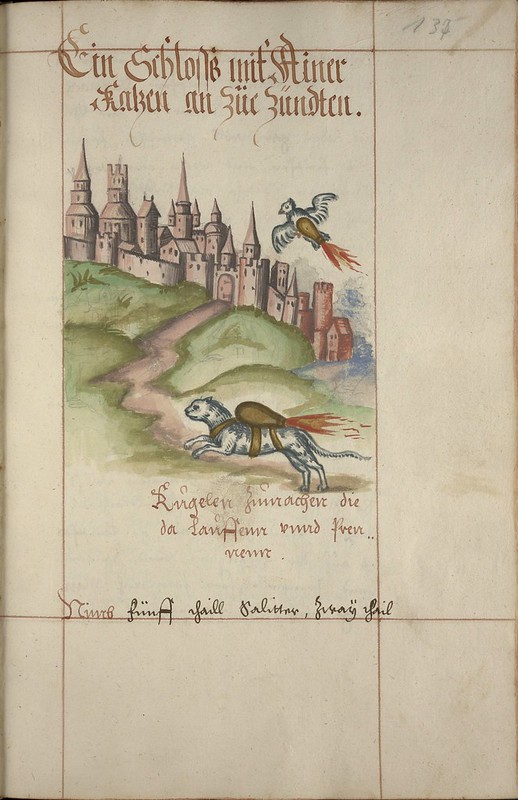
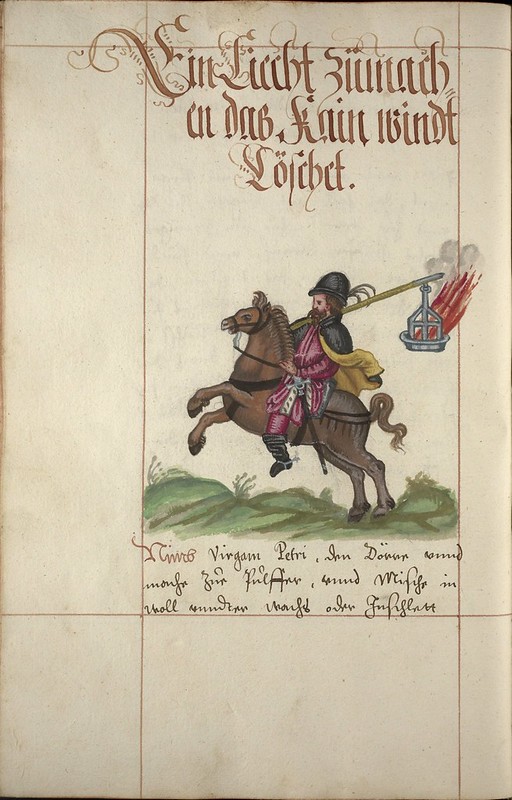
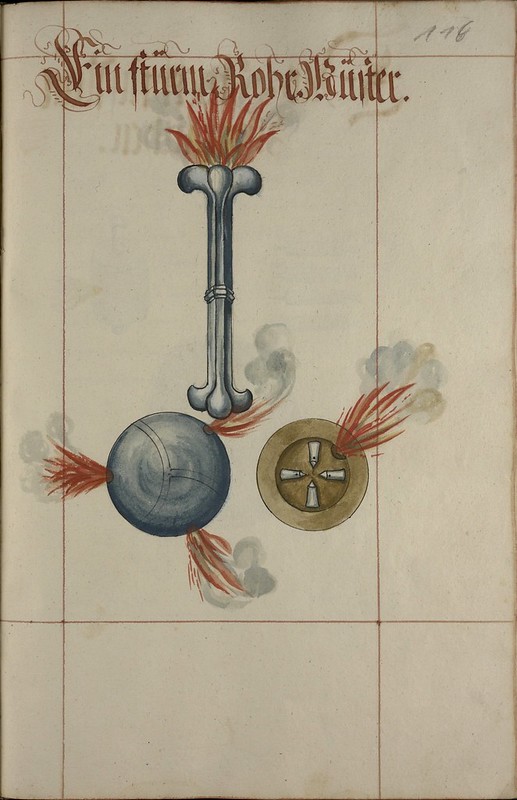
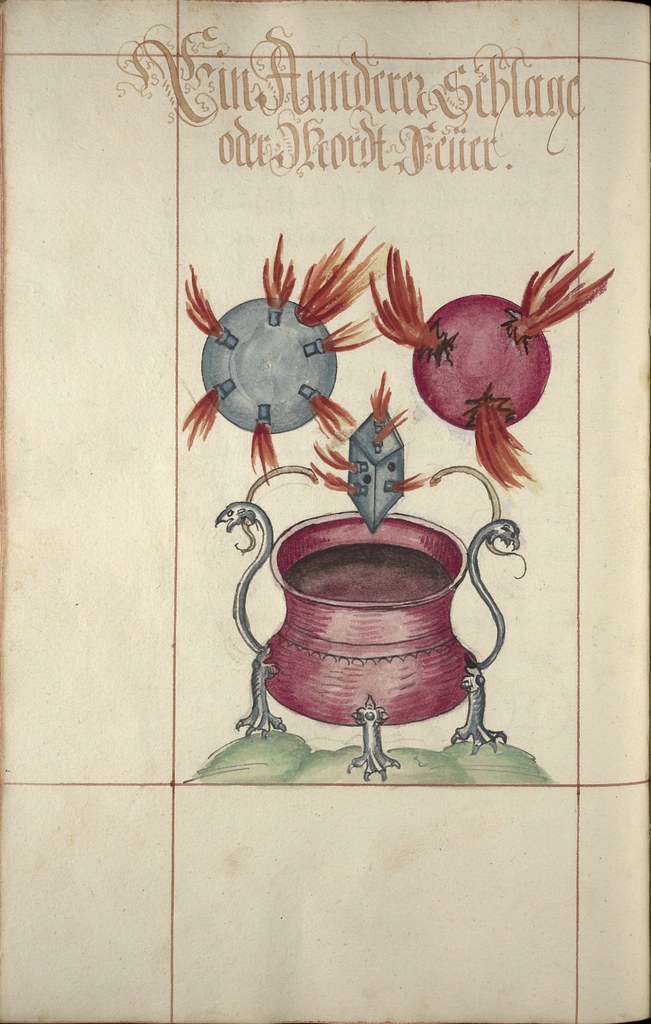
Early Explosives, including cat and bird bombs, from 16th century illustrated manuscripts

Illustrations from Unique at Penn and BibliOdyssey (and Google images, of course):

All of the illustrations here come from early explosives and warfare manuals copied and re-copied with alterations between the 16th and 17th centuries. The immediate originator of the idea behind these cat and bird bombs was Franz Helm of Cologne, an artillery master in the service of various German princes who likely served in campaigns against Turkish forces during the mid-16th century. He wrote a treatise on siege warfare (Buch von den probierten Künsten) and artillery that circulated widely in manuscript, but was not published in print until 1625.
In the text accompanying the images is a section entitled “To set fire to a castle or city which you can’t get at otherwise” [4]. This section details how to use doves and cats loaded with flammable devices to set fire to enemy positions. On cats the text paints a grisly picture of attaching lit sacks of incendiaries onto the animals to have them return to their homes and set fire to them. In my awkward translation:
“Create a small sack like a fire-arrow … if you would like to get at a town or castle, seek to obtain a cat from that place. And bind the sack to the back of the cat, ignite it, let it glow well and thereafter let the cat go, so it runs to the nearest castle or town, and out of fear it thinks to hide itself where it ends up in barn hay or straw it will be ignited.” 


From BibliOdyssey, some general (animal-free) illustrations of explosives:


Friday, July 28, 2017

Friday links

It's Beatrix Potter's birthday: in addition to Peter Rabbit et al, she produced some gorgeous botanical drawings.


The Proper Names of 17 Bodily Functions.

Some examples of bad taxidermy.

Medieval Fashion Trends.

Meet the Woman Behind New York’s 1800s School For Crooks.

ICYMI, Wednesday's links are here, and include a history of prosthetic limbs,  Aldous Huxley's birthday, why monks have strange haircuts, and what happens when you leave a tetherball hanging in the forest.

Friday, November 18, 2016

Friday links

The Gettysburg Address was seven score and thirteen years ago. Related: President James Garfield's birthday - when he was shot, Alexander Graham Bell showed up with a metal detector to try to locate the bullet. 

The Japanese Museum of Rocks That Look Like Faces.


28 Delicious Ways To Use Leftover Bacon Fat.

Protect Your Library the Medieval Way, With Horrifying Book Curses.

ICYMI, last Friday's links are here, and include why we have animals living in our houses, Heineken's campaign to convince consumers that Corona was actually urine, early- to mid-20th century visions of sex in the future, and ranking the most popular canceled TV shows (Firefly, of course, is number 1).

Tuesday, August 23, 2016

Tuesday links

St. Bartholomew's Day - some history (including the massacre), a brief documentary, and Monty Python.

We finally know how sunflowers track the sun across the sky.

Which bathroom stall you should choose if you want the cleanest one?

How to Undress in 20 Seconds or Less, and the tactical order of re-dressing.

How People Call Cats In Different Countries.

Bread in the Middle Ages.

ICYMI, Monday's links are here, and include Dorothy Parker's birthday and the long, weird journey of her ashes, the United States' first trip to the Olympics, the world's only surviving tattoo shop for medieval pilgrims, and a supercut of technology breaking down, then being beaten until it works again.

Friday, July 15, 2016

Friday links

Scary-Ass Cow Science: Scientist Draws Eyes on Cow Butts to Protect Them from Lions.

How far would you go for science? Would you shove jellyfish tentacles under your arms?

These Guys Just Built the World’s Largest Nerf Gun.

Bad taxidermy.

Exactly How Much Of His Ear Did Vincent Van Gogh Slice Off?

Testing Mobility in Medieval Armor. Related: a gallery of Medieval Suits of Armor.

ICYMI, Thursday's links are here, and include a history of trial by combat, a letter from Kurt Vonnegut in 1988 to the Ladies & Gentlemen of A.D. 2088, Bastille Day, the library that the U.S.-Canada border runs through, and how to cook a pig in the ground.

Wednesday, May 18, 2016

Wednesday links


ICYMI, Monday's links are here, and include inventions predicted by The Simpsons, weird epidemics that are still a mystery, the 100 year anniversary of Sykes-Picot, father builds robotic pancreas for his son, and what happens when you build a cube out of one way mirrors.

Thursday, May 5, 2016

Thursday links

Happy Cinco do Mayo!


Medieval Pet Names.


ICYMI, Wednesday's links are here, and include the physics of peacock feathers, Star Wars Day, a video compilation of small dogs trying to get onto or off of big couches, how your devices are spying on you, and the American who placed a $1 million bounty on Hitler the year before we entered WWII. 

Friday, January 29, 2016

Friday links

It's W. C. Fields' birthday: quotes, bio and film clips.

Argue amongst yourselves: The 10 Best Superhero Performances in Movies.

Interesting technology improvements in this year's Super Bowl cameras.

Five medieval toothpaste recipes, plus more medieval dental advice.


Family Wraps an Entire Greenhouse around Their Home to Keep it Warm.

ICYMI, Wednesday's links are here, and include the anniversary of the Soviet Army liberation of Auschwitz, forgotten World War II films, the world's longest war lasted 335 years (and ended in 1986), and proof that children are imbeciles (and babies are stupid).

Monday, January 4, 2016

Monday links

This will get your first Monday morning of the year off to a rousing start: a supercut of people falling and landing on vehicles, set to the cannon-punctuated finale of the 1812 Overture.

What Do the Buttons on Darth Vader's Suit Actually Do and What Really Caused the Emperor's Deformed Appearance?

The History of Farting for Money.

Yesterday was National Fruitcake Toss Day.

How Do You Train a Dog to Sniff Bombs?

A Medieval Guide to Predicting the Year - here's the appropriate bit for 2016: 
If the first of January comes on a Friday, the winter will be temperate, and the summer and autumn, dry. Grain will be cheap. There will be eye diseases, and many infants will die, and there will be movement of knights, and there will be much oil in some places.
ICYMI, Thursday's links are here, including lots of hangover cures, the top 50 photos of 2015, and Dave Barry's Year in Review.