Amazon Deals

New at Amazon

Showing posts with label world war 1. Show all posts

Sunday, November 10, 2024

Before it was Veterans Day it was Armistice Day, for the fallen of the First World War: here's some history

They shall grow not old, as we that are left grow old:
Age shall not weary them, nor the years condemn.
At the going down of the sun and in the morning
We will remember them.

~ Lawrence Binyon (wiki), For The Fallen

On the 11th hour of the 11th day of the 11th month of 1918, an armistice, or temporary cessation of hostilities, was declared between the Allied nations and Germany in the First World War, then known as “the Great War.” Commemorated as Armistice Day beginning the following year, November 11th became a legal federal holiday in the United States in 1938. 

In the aftermath of World War II and the Korean War, Armistice Day became Veterans Day in the U.S. (and Remembrance Day in British Commonwealth nations), a holiday dedicated to veterans of all wars. 

So, the First World War was what Veteran's Day was once really about... 

When every autumn people said it could not last through the winter, and when every spring there was still no end in sight, only the hope that out of it all some good would accrue to mankind kept men and nations fighting. When at last it was over, the war had many diverse results and one dominant one transcending all others: disillusion. 

~  Barbara Tuchman (1912-1989) (of World War I, The Guns of August, "Afterward") 

Are these weeks... months... years going by? No, really only days. We see time passing us by in the colorless faces of the dead; we shovel in our food, we run, we throw, we shoot, we kill, we lie around. We are weak and apathetic, and we only endure because there are those who are weaker, more apathetic, and even more helpless, who look wide-eyed on us as Gods, because we have outrun death so many times.

~ Erich Maria Remarque (1898-1970) (All's Quiet On The Western Front, Ch. 6)

Here dead we lie
Because we did not choose
To live and shame the land
From which we sprung.

Life, to be sure,
Is nothing much to lose,
But young men think it is,
And we were young.

~ A.E. Housman (1859-1936) ("Here Dead We Lie")

As a lover of truth, the national propaganda of all the belligerent nations sickened me. As a lover of civilization, the return to barbarism appalled me.

~ Bertrand Russell (wiki) (1872-1970) (of World War I, Autobiography, Vol. 2, Ch. 1)

Today is the anniversary of Armistice Day, 11 November 1918, when at the 11th hour, of the 11th day, of the 11th month, the First World War came to an end after more than four years of carnage. (Armistice Day became Veterans' Day in 1954.) Described by British historian Corelli Barnett as a war that had "causes but no objectives, "the "Great War" left a legacy of disillusionment in its wake and made a shambles of the rest of the 20th century. All told, there were ten million military dead and seven million civilians killed. 

The resulting economic collapse, the draconian terms of the Treaty of Versailles (wiki), and the conviction of many Germans that they had been "stabbed in the back" led to an even more destructive rematch only two decades later. One could argue - and I do - that World War I was the greatest misfortune that ever befell Western civilization.

It destroyed the West's belief in inevitable human progress. It brought down the Austro-Hungarian, German, Russian, and Ottoman empires, bankrupted France and England, and put the British Empire on the skids. It was the proximate cause of the triumph of Communism in Russia and the formation of the Soviet Union, drove the United States into two decades of international isolation, and instilled in Germany a thirst for revenge that led directly to the rise of the Nazis and World War II.

Moreover, in the Middle East, Britain's and France's cack-handed and self-serving division of the remains of the Ottoman Empire was largely responsible for all the turmoil we suffer there today. On hearing the terms of the Versailles Treaty, Germany's much-maligned Kaiser Wilhelm II noted from exile that, 
"The war to end war has resulted in a peace to end peace." 
Here's a casualty chart for World War 1:
Country/RegionMobilizedKilledWoundedTotal K and WCasualties
Africa 55,00010,000unknownunknown-
Australia330,00059,000152,000211,00064%
Austria-Hungary6,500,0001,200,0003,620,0004,820,00074%
Belgium207,00013,00044,00057,00028%
Bulgaria400,000101,000153,000254,00064%
Canada620,00067,000173,000241,00039%
The Caribbean21,0001,0003,0004,00019%
French Empire7,500,0001,385,0004,266,0005,651,00075%
Germany11,000,0001,718,0004,234,0005,952,00054%
Great Britain5,397,000703,0001,663,0002,367,00044%
Greece230,0005,00021,00026,00011%
India1,500,00043,00065,000108,0007%
Italy5,500,000460,000947,0001,407,00026%
Japan800,0002501,0001,2500.2%
Montenegro50,0003,00010,00013,00026%
New Zealand110,00018,00055,00073,00066%
Portugal100,0007,00015,00022,00022%
Romania750,000200,000120,000320,00043%
Russia12,000,0001,700,0004,950,0006,650,00055%
Serbia707,000128,000133,000261,00037%
South Africa149,0007,00012,00019,00013%
Turkey1,600,000336,000400,000736,00046%
USA4,272,500117,000204,000321,0008%

Here's a 6 minute overview of World War I:


A 3 minute time-lapse video of the changing front lines:


An 8 minute video on The Treaty of Versailles and its consequences:


And, on a broader scale, 1000 years of war in 5 minutes:


Related posts:

April 25th is ANZAC Day - the Battle of Gallipoli was 100 years ago.

100 years ago today Austria declared war on Serbia, the first declaration of World War 1.


Gorgeous set of WW1 posters.

June 6 is D-Day: quotes (Shakespeare, Eisenhower, Churchill), videos (footage, FDR's and Reagan's speeches), lots of links.

It's V.E. Day: 70 years ago today, World War 2 ended in Europe.


The assault on Iwo Jima started 70 years ago today: quotes, history, and a documentary.

If you're interested in further information on the subject on the First World War, there are hundreds of books and films - the best books I know of (although I'm no expert) are Barbara Tuchman's The Guns of August (which won a Pulitzer back when they meant something) and John Keegan's The First World War. 

Parts of the text above are adapted from my late, great partner's Quotation of the Day, available before his passing only via email. Ed is the author of Hunters and Killers: Volume 1: Anti-Submarine Warfare from 1776 to 1943 and Hunters and Killers: Volume 2: Anti-Submarine Warfare from 1943.

Wednesday, July 27, 2022

On July 28, 1914, Austria declared war on Serbia, the first declaration of World War 1

The lamps are going out all over Europe; we shall not see them lit again in our lifetime. 

~Sir Edward Grey (remark, 3 August 1914, on the eve of Britain's declaration of war) 

The War was decided in the first twenty days of fighting, and all that happened afterwards consisted of battles which, however formidable and devastating, were but desperate and vain appeals against the decision of Fate. 

~Sir Winston Churchill (Preface to Spears, Liaison 1914) 

When every autumn people said it could not last through the winter, and when every spring there was still no end in sight, only the hope that out of it all some good would accrue to mankind kept men and nations fighting. When at last it was over, the war had many diverse results and one dominant one transcending all others: disillusion. 

~Barbara Tuchman (The Guns of August, "Afterward") 

Although many consider the opening act of World War I to be the assassination of Austrian Archduke Franz Ferdinand at Sarajevo - its anniversary was just a month ago (28 June) - the first actual declaration of war took place on 28 July, 1914, when Austria-Hungary initiated hostilities against Serbia, after the latter rejected a draconian Austrian ultimatum intended to give Austria a free hand in bringing Franz Ferdinand's killers to account. As a result, Russia - self-appointed protector of the "South Slavs" - mobilized against Austria, which panicked the Germans (fearful of a two-front war against both France and her Russian ally) and so it went... 

28 July Austria declares war on Serbia
1 August Germany declares war on Russia
3 August Germany declares war on France
4 August Germany invades Belgium (to attack France)
England declares war on Germany in support of Belgium
6 August Austria-Hungary declares war on Russia
Serbia declares war on Germany
11 August France declares war on Austria-Hungary
12 August England declares war on Austria-Hungary*

After Germany's long-intended encirclement of Paris (under the Schlieffen plan) was thwarted by the French and British in the Battle of the Marne, the struggle on the Western Front devolved into a four-year stalemate in which the principal protagonists faced off across a line of trenches that ran from the North Sea to the Swiss border. Despite the unprecedented bloodbath that ensued, virtually no additional ground was gained by either side before the end of the conflict in November 1918.

Despite the "war-guilt" clauses of the Treaty of Versailles, which held Germany largely responsible for the hostilities and imposed extraordinary penalties and reparations, the causes of the war have been debated endlessly for most of the last century. I concluded some years ago after a good deal of reading on the subject that although there was certainly enough blame to go around, it was primarily Austria-Hungary that caused the catastrophe because of her reckless determination to settle long-standing scores with Serbia. Nothing I've learned subsequently has much changed that position. Be that as it may... One could argue - and I do - that World War I was the greatest misfortune that ever befell Western civilization. It destroyed the West's belief in inevitable human progress. It brought down the Austro-Hungarian, German, Russian, and Ottoman empires, bankrupted France and England, and put the British Empire on the skids. It was the proximate cause of the triumph of Communism in Russia and the formation of the Soviet Union, drove the United States into two decades of international isolation, and instilled in Germany a thirst for revenge that led directly to the rise of the Nazis and World War II.

Moreover, in the Middle East, Britain's and France's cack-handed and self-serving division of the remains of the Ottoman Empire was largely responsible for all the turmoil we suffer there today. On hearing the terms of the Versailles Treaty, Germany's much-maligned Kaiser Wilhelm II noted from exile that,

"The war to end war has resulted in a peace to end peace."

*The United States only joined the Allies on 6 April 1917, provoked beyond endurance by Germany's unrestricted submarine warfare campaign and the German "Zimmermann telegram" (wiki) - intercepted by British intelligence - which promised Mexico the return of her "lost territories" in the southwest United States in return for an alliance with a victorious Germany.

(Text above is adapted from Ed's Quotation of the Day, only available via email. Leave your email address in the comments if you'd like to be added to his list.)

If you're interested in further information on the subject there are hundreds of books and films - the best books I know of (and unlike Ed, who's recommendations are above, I'm no expert) are Barbara Tuchman's The Guns of August (which won a Pulitzer back when they meant something) and John Keegan's The First World War. 

Here's the The BBC’s Horrible Histories explanation of how the Brits got involved:


Here's a 6 minute overview of World War I:


The Atlantic has a series of photoessays entitled World War I in Photos on various WWI topics.

Previous posts: 

June 28 marks the centennial of the start of World War One: a few quotes/videos/links

Thursday, June 28, 2018

Thursday links

June 28 is the anniversary of both the event that started (the assassination of Archduke Franz Ferdinand of Austria and his wife - heirs to the Austrian throne) and the treaty that ended World War One


DARPA Literally Reinvented the Wheel.

Want your vagina steam-cleaned but don't have a spa nearby? Here are the do-it-yourself instructions.

WHO (World Health Organization) warns you not to drink camel urine.

Bake the Best Chocolate Chip Cookies by Knowing What to Tweak.

ICYMI, Wednesday's links are here, and include Helen Keller's birthday, the science of colorful monkey butts (and a gallery), the new supervolcano is brewing under New England. and the taxpayer funding behind Domino's Extra Cheesy Pizza. 

Wednesday, June 27, 2018

June 28 is the anniversary of both the event that started and the treaty that ended World War One

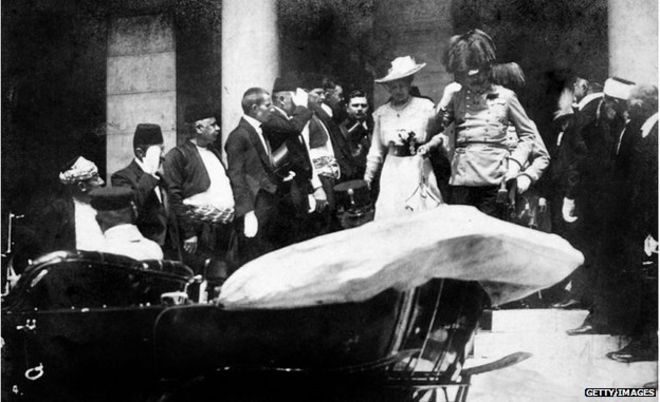
June 28 is the anniversary of two days that might be said to mark the beginning and end of the First World War. It's the anniversary of the assassination of Archduke Franz Ferdinand (wiki) of Austria and his wife - heirs to the Austrian throne - by Serbian radical Gavrilo Princip on June 28, 1914, the proximate cause of the beginning of the war. If you're interested in further information on the subject there are hundreds of books and films - the best books I know of (and I'm no expert) are Barbara Tuchman's The Guns of August (this won a Pulitzer back when they meant something) and John Keegan's The First World War.

Franz Ferdinand and his wife Sophie at Sarajevo - The German caption
 says, "Leaving the town hall, 5 minutes before the assassination":
On the same date in 1919, five years later, the peace treaty that ended the war was signed in the Hall of Mirrors at Versailles. In the interim, ten million died, twice that number were wounded, and Europe's late-19th-century faith in the inevitability of progress and human betterment was destroyed. On hearing the terms of the Versailles Treaty (wiki), Germany's much-maligned Kaiser Wilhelm II noted from exile that, 

"The war to end war has resulted in a peace to end peace,"

and France's Marshall Ferdinand Foch observed,

"This is not peace; it is an armistice for twenty years." 

They were right.

God grant we may not have a European war thrust upon us, and for such a stupid reason too, no I don't mean stupid, but to have to go to war on account of tiresome Servia beggars belief. 

~ Mary, Queen-Consort of England's George V (letter to her aunt, Princess Augusta of Mecklenburg-Strelitz, 28 July 1914) 

The lamps are going out all over Europe; we shall not see them lit again in our lifetime. 

~ Sir Edward Grey (remark, 3 August 1914, on the eve of Britain's declaration of war) 

The War was decided in the first twenty days of fighting, and all that happened afterwards consisted of battles which, however formidable and devastating, were but desperate and vain appeals against the decision of Fate. 

~ Sir Winston Churchill (Preface to Spears, Liaison 1914) 

When every autumn people said it could not last through the winter, and when every spring there was still no end in sight, only the hope that out of it all some good would accrue to mankind kept men and nations fighting. When at last it was over, the war had many diverse results and one dominant one transcending all others: disillusion. 

~Barbara Tuchman (The Guns of August, "Afterward") 

This animated map reflects the daily changes over the course of the war:


Here's a 6 minute overview of World War I:


And the BBC’s Horrible Histories explanation of how the Brits got involved:

The Atlantic has a series of photoessays entitled World War I in Photos on various WWI topics.


An 8 minute video on The Treaty of Versailles and its consequences:


Previous posts: Wilfred Owen, the best of the WWI "War Poets", was born 121 years ago today

Thursday, April 6, 2017

Thursday links


These 10 companies control everything (edible) that you buy

In 1650, here's how you could dye your hair blond.

Map: watch as the world’s cities appear one-by-one over 6,000 years.

Victorian ‘Coffin Torpedoes’ Blasted Would-Be Grave Robbers.

ICYMI, Friday's links are here, and are all April Fool's Day related: history, pranks, and hoaxes.

Wednesday, April 5, 2017

The United States entered World War I on April 6, 1917.

The War was decided in the first twenty days of fighting, and all that happened afterwards consisted of battles which, however formidable and devastating, were but desperate and vain appeals against the decision of Fate. 

~ Sir Winston S. Churchill (wiki) (1874-1965) (Preface to Spears, Liaison 1914)

Napoleon had said it was rare to find generals willing to fight battles. The curse [of World War I] was that so few could do anything else. 


When every autumn people said it could not last through the winter, and when every spring there was still no end in sight, only the hope that out of it all some good would accrue to mankind kept men and nations fighting. When at last it was over, the war had many diverse results and one dominant one transcending all others: disillusion. 

~ Barbara Tuchman (1912-1989) (The Guns of August, "Afterward") 

Today is the 100th anniversary - the centennial - of the entry of the United States into World War I on April 6, 1917, when the House of Representatives passed the declaration of war proposed four days earlier by President Woodrow Wilson (1856-1924) (wiki) and adopted by the Senate on the 4th. The United States only joined the Allies after nearly three years of war, provoked beyond endurance by Germany's unrestricted submarine warfare campaign and the German "Zimmermann telegram" (wiki) - intercepted by British intelligence - which promised Mexico the return of her "lost territories" in the southwest United States in return for an alliance with a victorious Germany. 

Ultimately nearly two million American troops joined French and British counterparts on the Western Front and provided the final impetus for breaking the stalemate that had lasted there since late 1914. The United States lost over 53,000 men killed or missing in action, plus 204,000 wounded.* In his call for a war declaration, President Wilson noted,
Zimmerman Telegram
"It is a fearful thing to lead this great peaceful people into war ... We shall fight for the things we have always carried nearest our hearts - for democracy, for the right of those who submit to authority to have a voice in their own Governments, for the rights and liberties of small nations, for a universal dominion of right by such a concert of free peoples as shall bring peace and safety to all nations and make the world itself at last free."
Alas, these noble aspirations were largely unrealized, and the primary legacy of World War I - the worst calamity to afflict Western Civilization in our times - was World War II.

* N.B. The U.S. dead were only a small percentage of the total number of those killed on both sides - 5-1/2 million. It's also notable that the United States military suffered even more deaths to other causes, mostly the influenza pandemic that struck in 1918. 

A brief documentary on the entry:


From the BBC: 
In this collection of archive footage and interviews, the introduction and training of United States soldiers to the Allied cause in the First World War is discussed.


The text above is adapted from Ed's Quotation of the Day, only available via email - leave your email address in the comments if you'd like to be added to his list. Ed is the author of Hunters and Killers: Volume 1: Anti-Submarine Warfare from 1776 to 1943 and Hunters and Killers: Volume 2: Anti-Submarine Warfare from 1943.

If you're interested in further information on the subject there are hundreds of books and films - the best books I know of (and unlike Ed, I'm no expert) are Barbara Tuchman's The Guns of August (which won a Pulitzer back when they meant something) and John Keegan's The First World War.

Monday, November 28, 2016

Monday links

Six ways to modify your baseball bat into a zombie-killing weapon: real versions and an infographic.


Back When Your Thanksgiving Dinner Walked Hundreds of Miles to Market: The forgotten history of turkey drives.

What not to watch just before flying: this airplane crash supercut.


ICYMI, Friday's links are here, and include the history of mirrors, a video compilation of every gadget from every James Bond film, in chronological order, why eating boogers may be good for your health, and kids re-enacting the first Black Friday.

Friday, November 11, 2016

Friday links


In 1987, Heineken Tried to Convince Beer Drinkers That Corona Was Actually Urine.


Early- to mid-20th century visions of sex in the future.

Why The Heck Do Animals Live In Our Houses?

This Siberian beach is covered with thousands of giant snowballs made by nature. A similar phenomenon occurred on Lake Michigan in 2014.

ICYMI, Monday"s links are here, and include a set of excellent newspaper corrections, labyrinths of note, Renaissance-style portraits of auto mechanics, and the reasons to elect a supervillain President, with bonus Homer Simpson proving that both candidates are aliens.

Tuesday, July 26, 2016

Tuesday links

For Aldous Huxley's birthday, an infographic of Huxley Vs Orwell, a letter from Huxley to Orwell explaining why he (Huxley) was right, and audio of Huxley narrating Brave New World.


Sir David Attenborough narrating Pokémon Go is a hoot. Related: the fatwa against Pokémon Go: it spreads Darwinism.


ICYMI, Monday's links are here, and include a cringe-inducing set of fashion ads from the 1970s, a 1923 car that turned into a boat, diagnosing Hitler's flatulence, and a compilation of the 100 greatest action movie punchlines (NSFW language).