Amazon Deals

New at Amazon

Wednesday, May 24, 2023

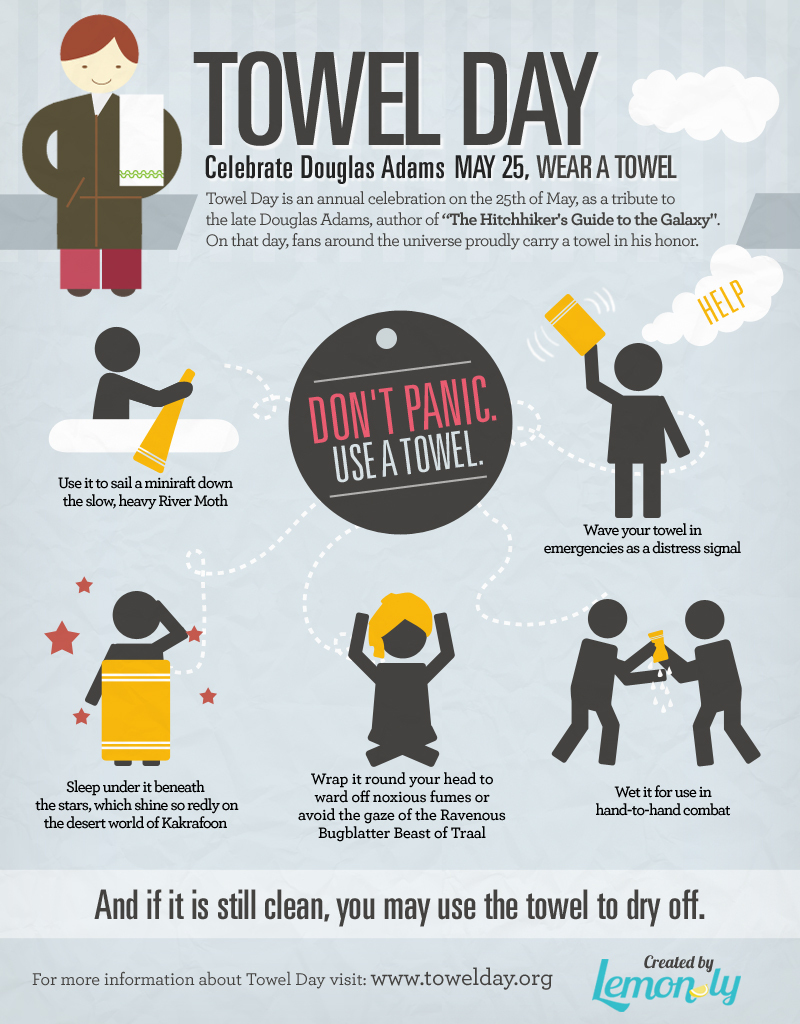
For fans of Hitchhiker's Guide to the Galaxy: don't panic - today is Towel Day!

It's Towel Day, a day to honor the late Douglas Adams (wiki) and the first book of his 5-book "trilogy", The Hitchhiker's Guide to the Galaxy (trailer for the movie version is below). The quote regarding the importance of always carrying a towel (I keep one in the trunk of my car):

A towel, is about the most massively useful thing an interstellar hitchhiker can have. Partly it has great practical value. You can wrap it around you for warmth as you bound across the cold moons o Jaglan Beta; you can lie on it on the brilliant marble-sanded beaches of Santraginus V, inhaling the heady sea vapors; you can sleep under it beneath the stars which shine so redly on the desert world of Kakrafoon; use it to sail a miniraft down the slow heavy River Moth; wet it for use in hand-to-hand-combat; wrap it round your head to ward off noxious fumes or avoid the gaze of the Ravenous Bugblatter Beast of Traal (such a mind-boggingly stupid animal, it assumes that if you can't see it, it can't see you)*; you can wave your towel in emergencies as a distress signal, and of course dry yourself off with it if it still seems to be clean enough.

More importantly, a towel has immense psychological value. For some reason, if a strag (strag: nonhitchhiker) discovers that a hitchhiker has his towel with him, he will automatically assume that he is also in possession of a toothbrush, washcloth, soap, tin of biscuits, flask, compass, map, ball of string, gnat spray, wet-weather gear, space suit etc., etc. Furthermore, the strag will then happily lend the hitchhiker any of these or a dozen other items that the hitchhiker might have accidentally "lost.". What the strag will think is that any man that can hitch the length and breadth of the Galaxy, rough it, slum it, struggle against terrible odds, win through and still know where his towel is, is clearly a man to be reckoned with.
Hence a phrase that has passed into hitchhiking slang, as in "Hey, you sass that hoopy Ford Prefect? There's a frood who really knows where his towel is." (Sass: know, be aware of, meet, have sex with; hoopy: really together guy; frood: really amazingly together guy.)
*Here's an animated version of "wrap it round your head to ward off noxious fumes or avoid the gaze of the Ravenous Bugblatter Beast of Traal (such a mind-boggingly stupid animal, it assumes that if you can't see it, it can't see you)":


Here's the trailer for the 2005 movie:


BT.com has a a non-hitchhiker’s guide to Towel Day.

Via Lemonly.com:


If you're a real Adams fan, check out this Kinja post on adaptations of some of his other works.

Wednesday, May 10, 2023

May 10, 2023: My significant other, Dr. Edward C. Whitman, aged 82, passed away this morning.

My long-time (25 years) significant other passed away early this morning. Many of you know him or know of him, but the obituary below, put together by his daughter and sons, gives more detail. 

I'll add to this post as I feel able.


Dr. Edward C. Whitman, aged 82, passed away in Potomac, Maryland at 12:10 AM May 10, 2023.

Born June 12, 1940, in Newark, New Jersey and raised in nearby Lyndhurst with his late brother Robert (Bob) Whitman, sons of the late Edward Whitman and Dorothy (Maillot) Whitman.  A proud product of public high school, Edward attended MIT on an Alfred P. Sloan National Scholarship.   Participating in a co-op program throughout college with the Naval Ordnance Laboratory (NOL) in White Oak, Maryland, he left MIT with S.B., S.M. and E.E. degrees and remained a devoted U.S. Navy civilian employee for 40 years.  After a decade of development engineering at NOL, largely in underwater sensors and weapons – while also earning a Ph.D. at the University of Maryland – Edward moved (he would say he was kicked upstairs) into Navy management and a long series of senior-executive positions.  Moving with his family to Naples, Italy, he served as the Science Advisor to the Admiral of the 6th Fleet.  Later he worked at the Defense Advanced Research Projects Agency, the Offices of the Chief of Naval Operations, as Deputy Assistant Secretary of the Navy for C4I and Space Programs, and as Technical Director to the Oceanographer of the Navy.   Edward followed his retirement from the Navy in 1998 by joining the Center for Security Strategies and Operations (CSSO), a national security studies and analysis organization in Arlington, VA, as a naval science advisor. For five years, he also served as senior editor—and frequent contributor—to Undersea Warfare, the official magazine of the U.S. submarine force. He later co-authored the comprehensive history of anti-submarine warfare, Hunters and Killers, Volumes I & II.  In his spare time, he studied Italian and joined the American Balalaika Symphony, a Russian folk-instrument orchestra, after teaching himself to play the domra-bass. 

Edward raised his three children, twin sons Robert and Michael Whitman, and daughter Leslie Ann (Whitman) Dahring with his late wife Katherine Mary (Gaffney) Whitman in Laurel, Maryland.  Widowed in 1988, he enjoyed his next stage of life in Potomac, Maryland devoted to his partner Debby Witt (the Viper of VA – if you know, you know) and a large extended family of children, 20 grandchildren, and 4 great grandchildren. 

Ed’s passion for classical and organ music was enormous, as was his zeal for reading. His well-read book and music library was becoming one of the great collections of the world.  His love of history was shared for decades in an infamous QOTD (quotation of the day) distributed to hundreds of recipients.  A true polymath, and a Renaissance Man by any measure, he loved to travel, attend theater, cook fabulous meals, and entertain guests. However, his proudest role was that of father and grandfather to the next generations in his family.

This sounds like a lot, but it barely scratches the surface of the extraordinary life he led.

If you wish to honor Ed, in lieu of flowers, please donate to the Baltimore Symphony Orchestra, to which he was devoted; pick up a copy of his oft-quoted Spoon River Anthology, play some grand organ music loudly, cook a fabulous Italian meal, read a weighty book, try something new, travel, feed the birds, hug your loved ones close, and raise a glass of good red wine to Ed.  He will be forever missed.  What a man.  What a life.  We love you, Ed.  Fair winds and following seas.

Last year, on his 81st birthday:


Epitaph
By Merrit Malloy

When I die
give what’s left of me away
to children
and old men that wait to die.

And if you need to cry,
cry for your brother
walking the street beside you.
And when you need me,
put your arms
around anyone
and give them
what you need to give to me.

I want to leave you something,
something better
than words
or sounds.

Look for me
in the people I’ve known
or loved,
and if you cannot give me away,
at least let me live on your eyes
and not on your mind.

You can love me most
by letting
hands touch hands,
by letting
bodies touch bodies,
and by letting go
of children
that need to be free.

Love doesn’t die,
people do.
So, when all that’s left of me
is love,
give me away.

I’ll see you at home
in the earth.

Saturday, May 6, 2023

Grandmothers gave humans longer lifespans

I've seen things along these lines before; they always warm the cockles of my grandmotherly heart*. Aside from the (invaluable, really) babysitting services, and the love, there's all that wisdom.  


Grandmother's Story by Hugues Merle
Help with childcare from grandmothers at an early stage of human history could have resulted in an evolutionary change which caused women to live long past the menopause, researchers said.

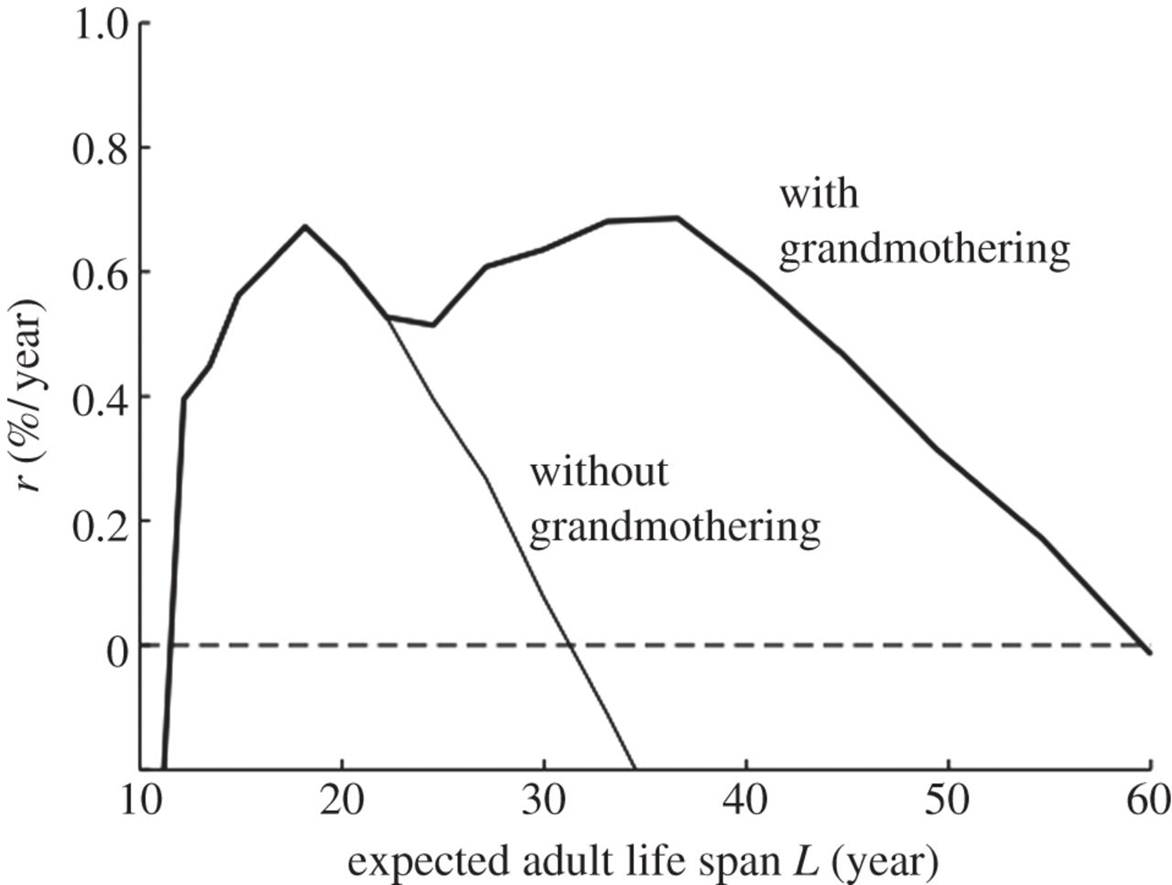
Female chimpanzees rarely live beyond their 30s or early 40s, when their fertility typically ends, but a computer simulation showed that the influence of grandmothers could extend their lifespan to human levels within 24,000 to 60,000 years.

A popular theory known as the "Grandmother Hypothesis" (wiki) suggests that older women had an evolutionary benefit by caring for their grandchildren after their childbearing years were over.

The new study, published in the Proceedings of the Royal Society B journal, backs up the theory by demonstrating that grandmothers alone, and not other factors like the development of larger brains, could result in women having longer lifespans.

Researchers suggested grandmothers may even have been responsible for increasing humans' brain size by allowing mothers to have larger families, which increased the pressure of natural selection on their children.

Most primates and mammals collect their own food after they have been weaned, but when African forests began to be replaced by dry savannah two million years ago, children were no longer able to forage for themselves.

The Grandmother Theory suggests that older women began performing childcare tasks such as cracking hard nuts or digging up tubers from the dry ground, which allowed their daughters to keep producing and caring for new babies.

This meant long-lived and healthy grandmothers could pass on their genes to more descendants, increasing the number of women who would survive beyond childbearing age.


Mathematicians simulated the impact of childcare from grandmothers on a society of animals which only lived for 25 years after reaching adulthood, similar to chimpanzees in the wild.

They found that thanks to "grandmothering" female chimps would evolve to live for 49 years as adults – a level similar to human hunter-gatherers – within the space of 24,000 to 60,000 years.

Prof Kristen Hawkes of the University of Utah, senior author of the study, said: "Grandmothering was the initial step towards making us who we are."

It resulted in "a whole array of social capacities that are the foundation for the evolution of other distinctly human traits, including pair bonding, bigger brains, learning new skills and our tendency for co-operation," she said.


Thursday, May 4, 2023

Happy Cinco de Mayo

Badges? We ain't got no badges. We don't need no badges! I don't have to show you any stinkin' badges!

~Treasure of the Sierra Madre (Alfonso Bedoya bandit character)*

Mexico: where life is cheap, death is rich, and the buzzards are never unhappy. 

~ Edward Abbey (attributed) 

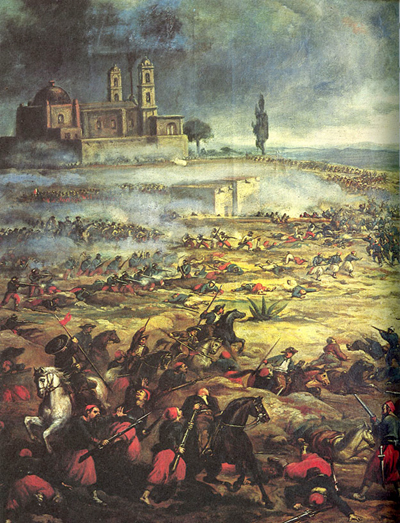
Today is Cinco de Mayo, Mexico's great national holiday and the anniversary of the defeat of 6,000 French soldiers by 2,000 Mexicans at the battle of Puebla in 1862. After Mexico had defaulted on its bonds, Britain, France, and Spain made a joint naval demonstration to compel payment. (Embroiled in its own Civil War, the United States was too preoccupied to object.) When negotiations opened, the British and Spanish departed, but France decided to seize on the opportunity to conquer the country and impose Napoleon III's brother-in-law, Maximilian, as emperor.

Édouard Manet's The Execution of the Emperor Maximilian (1867)
is one of five versions of his representation
of the execution of the Mexican monarch
Despite the Mexican victory at Puebla, the French eventually prevailed, but by 1867, Maximilian had been overthrown and executed, his demise the subject of a memorable painting (1867-68) by Eduard Manet now in the National Gallery, London.** Some decades later, ruthless Mexican president cum dictator Porfirio Diaz (1830-1915) noted,

"Poor Mexico, so far from God - and so near to the United States."

* N.B. John Huston's classic movie, The Treasure of the Sierra Madre (1948), starred Humphrey Bogart and Tim Holt in a stark tale of greed in the southwestern desert. It won three Academy Awards, and the phrase quoted here has become something of a cult incantation, though most often in the form,

"We ain't got no stinkin' badges..."

** Maximilian's body was later repatriated to Austria, and his sarcophagus can be seen today in the Kapuzinergruft in downtown Vienna, along with those of many other famous Hapsburg monarchs.

Here's a brief History Channel explanation of the holiday:


The text above is adapted from Ed's Quotation of the Day, only available via email - leave your email address in the comments if you'd like to be added to his list. Ed is the author of Hunters and Killers: Volume 1: Anti-Submarine Warfare from 1776 to 1943 and Hunters and Killers: Volume 2: Anti-Submarine Warfare from 1943.

Wednesday, May 3, 2023

May 4th is International Respect for Chickens day: some chicken-related links to help you celebrate

Whether you raise your own or not, you may be interested to know that May 4th is International Respect for Chickens Day.  In celebration, a few chicken related links:

Take a look at this, even if you don't read the whole thing: the famous (and definitive!) Chicken scientific study.

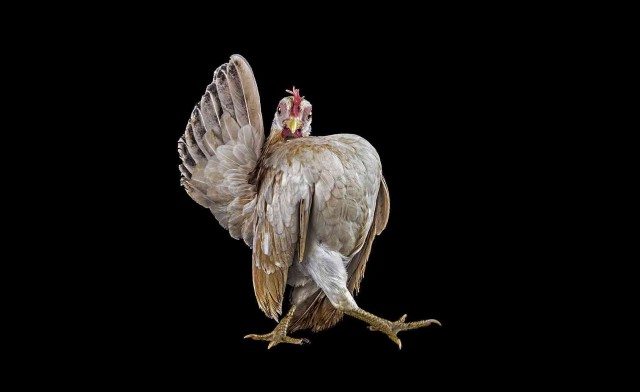
Glamour portraits of chickens from Chickens:


More at the artist's web site, and here's a mini documentary on the poultry portraiture project.

Epic Chick Fight: 2 women reenact Family Guy’s famed chicken fight:


And the original: 


Related posts and links:

Here's an excellent (and cheap!) chicken hat - I have one of these, and it actually quite warm!

This Chinese "Chick Chick" music video is the weirdest thing you'll watch all day.

A 500 lb chicken from hell: large feathered dinosaur species discovered in North America.

Scientists engineer flu-stopping superchicken.

The history of chickens and eggs: When and why did they get domesticated?

Got more? Leave them in the comments, and I'll update later.