Amazon Deals

New at Amazon

Friday, August 11, 2023

Today is Erwin Schrödinger's (he of the famous half-dead cat) birthday: explanation, quotes, jokes, video

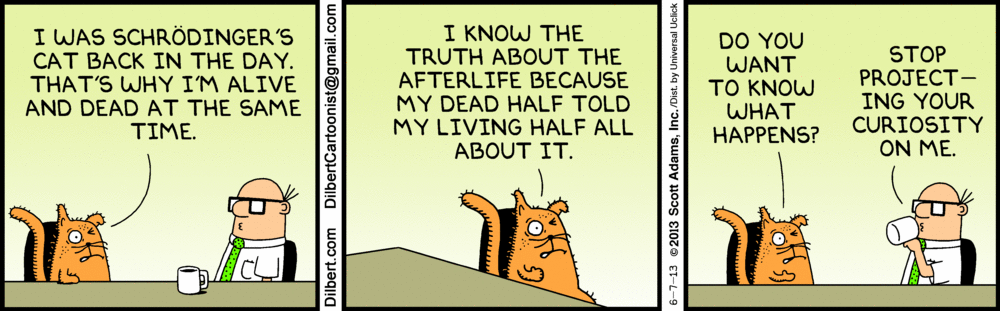
A brief explanation of Schrödinger's cat (wiki): A cat, a flask of poison, and a radioactive source are placed in a sealed box. If an internal monitor detects radioactivity (i.e. a single atom decaying), the flask is shattered, releasing the poison that kills the cat. The Copenhagen interpretation of quantum mechanics implies that after a while, the cat is simultaneously alive and dead. When one looks in the box, however, he sees the cat either alive or dead, not both alive and dead. This poses the question of when exactly quantum superposition ends and reality collapses into one possibility or the other. The Einstein quotation below refers to an earlier version of the experiment that replaced poison with an explosive charge to kill the cat.


If I am to have an interest in something, others must also have one. My word is seldom the first, but often the second, and may be inspired by a desire to contradict or to correct, but the consequent extension may turn out to be more important than the correction, which served only as a connection.

~ Erwin Schrödinger (Nobel Prize address, 1933)

I insist upon the view that "all is waves."

~ Schrödinger (letter to John Lighton Synge, 9 November 1959)

If we were bees, ants, or Lacedaemonian warriors, to whom personal fear does not exist, and cowardice is the most shameful thing in the world, warring would go on forever. But luckily we are only men - and cowards.

~ Schrödinger (Mind and Matter, 1958)

You are the only contemporary physicist, besides Laue,* who sees that one cannot get around the assumption of reality - if only one is honest. Most of them simply do not see what sort of risky game they are playing with reality - reality as something independent of what is experimentally established. Their interpretation is, however, refuted most elegantly by your system of radioactive atom + amplifier + charge of gun powder + cat in a box, in which the psi-function of the system contains both the cat alive and blown to bits. Nobody really doubts that the presence or absence of the cat is something independent of the act of observation.

~ Albert Einstein (1879-1955) (letter to Schrödinger, 1950)

Today is the anniversary of the birth of Austrian physicist Erwin (Rudolf Josef Alexander) Schrödinger (wiki) (1887-1961), one of the most important figures in the development of quantum theory. After early study at the University of Vienna and service in the Austrian fortress artillery during World War I, Schrödinger steadily advanced up the scientific/academic ladder in a series of positions at the universities of Stuttgart, Breslau, and Zurich before becoming a professor at the Friedrich Wilhelm University in Berlin in 1927.

He left Germany with the rise of Nazism in 1933 and taught briefly at Oxford, but then returned to the University of Graz (Austria) in 1936. After Austria was absorbed into the Third Reich, Schrödinger fled to Italy, then to England and Belgium, eventually settling in Ireland for most of the rest of his life. Schrödinger's greatest contribution to quantum theory was in his challenge to the "Copenhagen interpretation" of quantum behavior, which described aspects of fundamental particles only in terms of their probabilities of observation. He dramatized the resulting contradictions with common sense by devising the "thought experiment" known as Schrödinger's cat (wiki) and substituted a quantum interpretation based on the idea of "wave mechanics," in which the position of a particle is described in terms of probability functions, , satisfying the Schrödinger wave equation,


where E is the energy of a particle's state. The philosophical issues raised by Schrödinger's cat are still debated today, and it remains his most enduring legacy in popular science. His wave equation represents his most important finding at a more technical level and has been applied to the understanding of a long series of quantum phenomena and applications.

At an early age, Schrödinger became a student of eastern religions, and in addition to his prolific scientific writings, produced a number of philosophical studies on the relation of science to ethics and religion, as well as theoretical biology. He received the Nobel Prize for physics in 1933 for the derivation of his quantum wave equation. 

* N.B. Max von Laue (1879-1960) was a German physicist who won the Nobel Prize in 1914 for his work on the diffraction of X-rays by crystals.

Anyone remember the Heisenberg joke about being stopped for speeding?

Heisenberg was driving down the Jersey Turnpike when a policeman pulled him over.

The policeman asked Heisenberg, "Do you know how fast you were going?"

And Heisenberg said, "No, but I can tell you exactly where I was."
 
So there's a variation where Schrödinger is the driver, and the cop searches his car: 
 
The cop insists on searching the car (4th amendment doesn't apply in New Jersey) and then asks Schrödinger, "Do you know you have a dead cat in the trunk?",

Schrödinger replies, "Well, now I do."

And my personal favorite:

Schrödinger's cat walks into a bar... and doesn't.

Here's a brief (less than 2 minutes) explanation:


And here's a Big Bang Theory discussion of the concept:


Here are a couple of Dr. Seuss-esque explanations - the first is from Straight Dope, one of my favorite websites:

Schroedinger, Erwin! Professor of physics!
Wrote daring equations! Confounded his critics!
(Not bad, eh? Don't worry. This part of the verse
Starts off pretty good, but it gets a lot worse.)
Win saw that the theory that Newton'd invented
By Einstein's discov'ries had been badly dented.
What now? wailed his colleagues. Said Erwin, "Don't panic,
No grease monkey I, but a quantum mechanic.
Consider electrons. Now, these teeny articles
Are sometimes like waves, and then sometimes like particles.
If that's not confusing, the nuclear dance
Of electrons and suchlike is governed by chance!
No sweat, though — my theory permits us to judge
Where some of 'em is and the rest of 'em was."
Not everyone bought this. It threatened to wreck
The comforting linkage of cause and effect.
E'en Einstein had doubts, and so Schroedinger tried
To tell him what quantum mechanics implied.
Said Win to Al, "Brother, suppose we've a cat,
And inside a tube we have put that cat at —
Along with a solitaire deck and some Fritos,
A bottle of Night Train, a couple mosquitoes
(Or something else rhyming) and, oh, if you got 'em,
One vial prussic acid, one decaying ottom
Or atom — whatever — but when it emits,
A trigger device blasts the vial into bits
Which snuffs our poor kitty. The odds of this crime
Are 50 to 50 per hour each time.
The cylinder's sealed. The hour's passed away. Is
Our pussy still purring — or pushing up daisies?
Now, you'd say the cat either lives or it don't
But quantum mechanics is stubborn and won't.
Statistically speaking, the cat (goes the joke),
Is half a cat breathing and half a cat croaked.
To some this may seem a ridiculous split,
But quantum mechanics must answer, "Tough shit.
We may not know much, but one thing's fo' sho':
There's things in the cosmos that we cannot know.
Shine light on electrons — you'll cause them to swerve.
The act of observing disturbs the observed —
Which ruins your test. But then if there's no testing
To see if a particle's moving or resting
Why try to conjecture? Pure useless endeavor!
We know probability — certainty, never.'
The effect of this notion? I very much fear
'Twill make doubtful all things that were formerly clear.
Till soon the cat doctors will say in reports,
"We've just flipped a coin and we've learned he's a corpse."'
So saith Herr Erwin. Quoth Albert, "You're nuts.
God doesn't play dice with the universe, putz.
I'll prove it!" he said, and the Lord knows he tried —
In vain — until fin'ly he more or less died.
Win spoke at the funeral: "Listen, dear friends,
Sweet Al was my buddy. I must make amends.
Though he doubted my theory, I'll say of this saint:
Ten-to-one he's in heaven — but five bucks says he ain't."

— Cecil Adams


This was sent by a friend, and the description and book cover design are by Nathan W. Pyle

I do not see him here or there.
I do not see him anywhere.
I think he may be in that box,
introducing me to paradox.

I think that cat,
he may be dead,
lying in his cardboard bed.
In the box he would not thrive,
but chances are he’s still alive.

There's lots of Schrödinger's cat merchandise out there - try Amazon and/or Cafepress.

Wednesday, August 2, 2023

Puttanesca Sauce

Linguine alla Puttanesca  (Linguine, “Whore Style”).

4  Tbs olive oil (extra virgin)

2  large garlic cloves, peeled and sliced thinly

1  large fire-roasted red pepper (available bottled), seeded and sliced into thin strips

4  Oz olive-oil packed anchovies, drained and pounded to a paste (This is one small tin; I generally use about 3/4s of it – to taste.)

1  2-pound can of imported Italian peeled tomatoes, drained (but save some of the juice in case you need to thin the sauce later.)  

1  Cup pitted black olives, not from California, which will give the wrong flavor!  (I use pitted Kalamata olives – bottled – from Greece and halve them.)  

2  Tbs small capers (but some extra won’t hurt…)  

1  pound dried pasta

Heat the oil in a heavy skillet, add the garlic and diced red peppers, and fry gently for 6 or 7 minutes until the garlic is softened. Add the pounded anchovies and cook until they dissolve, stirring until thoroughly blended.  

Cut the tomatoes coarsely and add to the pan along with the olives and capers. Cook gently, stirring frequently, until the sauce thickens and begins to take on a slightly brownish hue.  This generally takes about 30 minutes. It must not be watery, but not too thick either…  

Meanwhile, cook the pasta in salted water until al dente – follow package directions – and drain in a colander. Serve in warmed pasta bowls with a generous ladle of sauce on each serving. Alternatively, you can pile all the pasta on a serving plate, spread the sauce on top, and toss it. 

The recipe doubles and triples reasonably well. 

Buon Appetito!

Historical note: Puttanesca sauce has been a Neapolitan classic for more than a century, its name deriving from an impolite Italian word for prostitute – la puttane. One finds several competing theories for the origin of the name, but no one really knows its real derivation. Here are the most popular suggestions:  

(1)  Because the ingredients are readily available, and it cooks quickly, it was easy for a woman of the night to prepare the dish as a pick-me-up between “assignments.”  

(2) Some of the ingredients - notably the olives, anchovies, and capers - are reputed to be aphrodisiacs.  

(3)  It can be made very salty, thus encouraging the puttane’s “clients” to drink more.  

Sunday, July 23, 2023

Roundup of funny colonoscopy videos

For those of us of a certain age, who have to think about these things...

The Colon is a Mighty Big River:


Here's to the Colorectal Surgeon:


Dave Barry on his colonoscopy. Article here.


From The Simpsons, Homer's colonoscopy:


The Colonoscopy Song - Peter Yarrow of Peter, Paul and Mary:


Lou Rawls/Damon Wayans Colonoscopy Exam:


Polyp Man Sings and Dances on Ice (with Lyrics):


Update - Miss Cellania at Neatorama had posted this one a few years ago:
Gastroenterologist Patricia Raymond is also a comedienne known as The Divine Ms. Butt Meddler. Here she sings her way into your ...heart, with a song about what your first colonoscopy will be like. 


The same doctor borrowed the tune from The Street Where You Live from My Fair Lady:
The Hole In Your Rear (from the classic Broadway musical "My Fair Colon")

Friday, July 21, 2023

For NatGeo's #SharkWeek: the Batman 1966 Shark Repellent Bat Spray


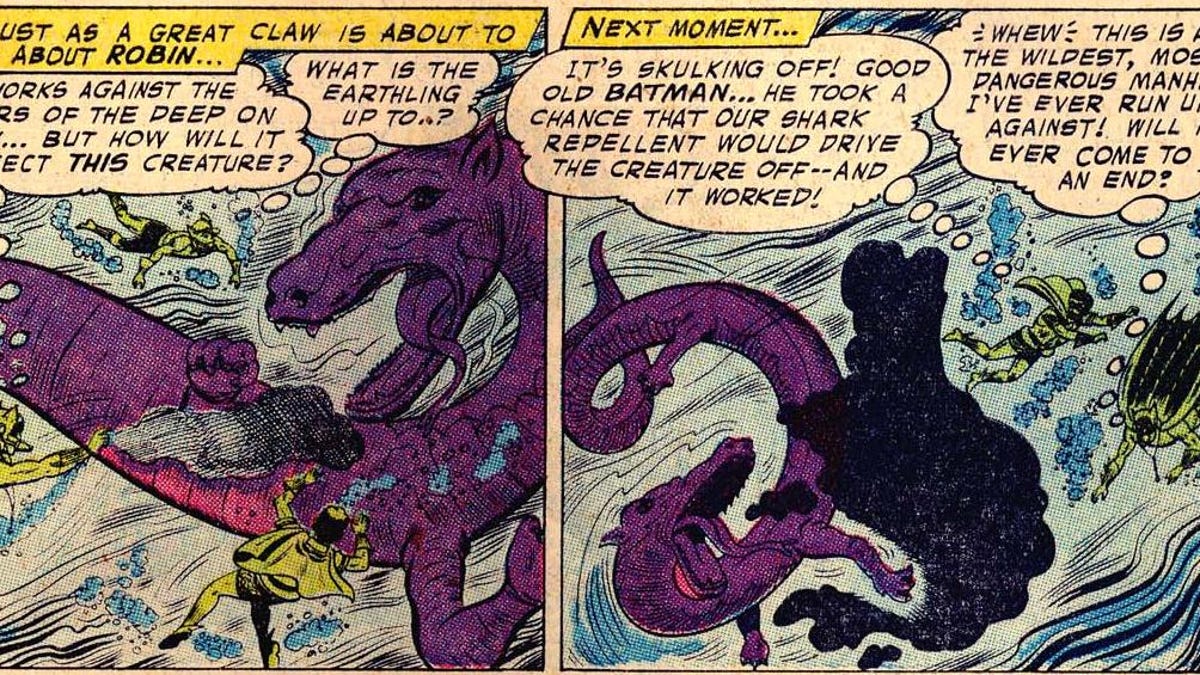
I'm reminded of this every year during Shark Week - in the clip below, Adam West's 1966 Batman fends off an angry about-to-explode shark with a can of shark repellent spray. That scene was actually rather faithful to the early Batman comics, which show that the Dark Knight does, indeed, carry around a can of shark repellent with him at all times. You know, just in case.

So, Batman is hanging from the Bat-copter (on the Bat-ladder) and is attacked by an about-to-explode shark. He wrestles with it for a bit and tries a few ineffectual Bat-punches to the shark’s head and body, then grabs his Bat-radio and asks Robin to throw him down a can of Shark Repellent Bat-Spray. This is stored in the Bat-copter along with three other “Oceanic Repellent Bat Sprays” designed to fend off, in addition to sharks, whales, manta rays and barracudas. Too bad Steve Irwin didn't think to carry those.


There is, of course, a Lego re-enactment:


Kind of related: Mythbusters on Does "Essence of Dead Sharks" Work as Shark Repellent?:


More at Fact Fiend - Batman Really Does Carry Shark Repellent Spray.

Related: 

It was actually first developed during World War II in an effort to help save the lives of seamen and pilots who had to await rescue in open water

Here's the 1983 episode of The Family Feud: the cast of Gilligan's Island vs the cast of Batman.


The Evolution of Batman in Cinema: From 1939 to Present.

Saturday, July 1, 2023

Lincoln's 1858 speech on the meaning of Independence Day: Let us stick to it then. Let us stand firmly by it then.

Lincoln’s speech of July 10, 1858 concludes with an explanation of the meaning of this day to Americans with matchless eloquence and insight in words that remain as relevant now as then. Emphasis is mine: 
Now, it happens that we meet together once every year, sometime about the 4th of July, for some reason or other. These 4th of July gatherings I suppose have their uses. If you will indulge me, I will state what I suppose to be some of them.
We are now a mighty nation, we are thirty—or about thirty millions of people, and we own and inhabit about one-fifteenth part of the dry land of the whole earth. We run our memory back over the pages of history for about eighty-two years and we discover that we were then a very small people in point of numbers, vastly inferior to what we are now, with a vastly less extent of country,—with vastly less of everything we deem desirable among men,—we look upon the change as exceedingly advantageous to us and to our posterity, and we fix upon something that happened away back, as in some way or other being connected with this rise of prosperity.
We find a race of men living in that day whom we claim as our fathers and grandfathers; they were iron men, they fought for the principle that they were contending for; and we understood that by what they then did it has followed that the degree of prosperity that we now enjoy has come to us. We hold this annual celebration to remind ourselves of all the good done in this process of time of how it was done and who did it, and how we are historically connected with it; and we go from these meetings in better humor with ourselves—we feel more attached the one to the other, and more firmly bound to the country we inhabit. In every way we are better men in the age, and race, and country in which we live for these celebrations. But after we have done all this we have not yet reached the whole. There is something else connected with it.
We have besides these men—descended by blood from our ancestors—among us perhaps half our people who are not descendants at all of these men, they are men who have come from Europe—German, Irish, French and Scandinavian—men that have come from Europe themselves, or whose ancestors have come hither and settled here, finding themselves our equals in all things. If they look back through this history to trace their connection with those days by blood, they find they have none, they cannot carry themselves back into that glorious epoch and make themselves feel that they are part of us, but when they look through that old Declaration of Independence they find that those old men say that “We hold these truths to be self-evident, that all men are created equal,” and then they feel that that moral sentiment taught in that day evidences their relation to those men, that it is the father of all moral principle in them, and that they have a right to claim it as though they were blood of the blood, and flesh of the flesh of the men who wrote that Declaration [loud and long continued applause], and so they are. That is the cord in that Declaration that links the hearts of patriotic and liberty-loving men together, that will link those patriotic hearts as long as the love of freedom exists in the minds of men throughout the world. [Applause.]
Now, sirs, for the purpose of squaring things with this idea of “don’t care if slavery is voted up or voted down” [Douglas's "popular sovereignty" position on the extension of slavery to the territories], for sustaining the Dred Scott decision [A voice---"Hit him again"], for holding that the Declaration of Independence did not mean anything at all, we have Judge Douglas giving his exposition of what the Declaration of Independence means, and we have him saying that the people of America are equal to the people of England. According to his construction, you Germans are not connected with it. Now I ask you in all soberness, if all these things, if indulged in, if ratified, if confirmed and endorsed, if taught to our children, and repeated to them, do not tend to rub out the sentiment of liberty in the country, and to transform this Government into a government of some other form.
Those arguments that are made, that the inferior race are to be treated with as much allowance as they are capable of enjoying; that as much is to be done for them as their condition will allow. What are these arguments? They are the arguments that kings have made for enslaving the people in all ages of the world. You will find that all the arguments in favor of king-craft were of this class; they always bestrode the necks of the people, not that they wanted to do it, but because the people were better off for being ridden. That is their argument, and this argument of the Judge is the same old serpent that says you work and I eat, you toil and I will enjoy the fruits of it. Turn in whatever way you will—whether it come from the mouth of a King, an excuse for enslaving the people of his country, or from the mouth of men of one race as a reason for enslaving the men of another race, it is all the same old serpent, and I hold if that course of argumentation that is made for the purpose of convincing the public mind that we should not care about this, should be granted, it does not stop with the negro. I should like to know if taking this old Declaration of Independence, which declares that all men are equal upon principle and making exceptions to it where will it stop. If one man says it does not mean a negro, why not another say it does not mean some other man? If that declaration is not the truth, let us get the Statute book, in which we find it and tear it out! Who is so bold as to do it! [Voices---"me" "no one," & c.] If it is not true let us tear it out! [cries of "no, no,"] let us stick to it then [cheers], let us stand firmly by it then. [Applause.]
via PowerLine, which has more backstory.