Amazon Deals

New at Amazon

Showing posts with label Magna Carta. Show all posts

Friday, June 14, 2024

Mark Steyn on remembering the lessons from Magna Carta: The Field Where Liberty Was Sown

This 2015 post was written on the occasion of the 800th anniversary of the signing of Magna Carta; I no longer see this on Mark's website, so I've copied it here from an archive. Here's the original link - if it starts working again I'll delete this post and point to it.

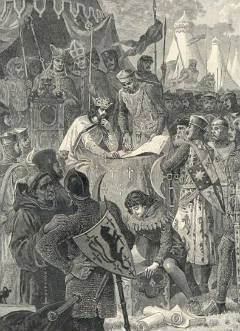
The most important anniversary this year falls on Monday June 15th, marking the day, eight centuries ago, when a king found himself in a muddy field on the River Thames near Windsor Castle with the great foundational document of modern liberty under his nose and awaiting his seal. Here’s what I had to say about it earlier this year:

The world has come a long way since Magna Carta, and not always for the best. A couple of years back, testifying to the House of Commons in Ottawa about Canada’s (now repealed) censorship law, I said the following:
Section 13 is at odds with this country’s entire legal inheritance, stretching back to Magna Carta. Back then, if you recall–in 1215–human rights meant that the King could be restrained by his subjects. Eight hundred years later, Canada’s pseudo-human rights apparatchiks of the commission have entirely inverted that proposition, and human rights now means that the subjects get restrained by the Crown in the cause of so-called collective rights that can be regulated only by the state.
I liked it better the old way. Real rights are like Magna Carta: restraints on state power. Too many people today understand the word “rights” to mean baubles and trinkets a gracious sovereign bestows on his subjects – “free” health care, “free” community college, “safe spaces” from anyone saying anything beastly – all of which require a massive, coercive state regulatory regime to enforce.

But, to give it its full name, Magna Carta Libertatum (my italics – I don’t think they had ’em back then) gets it the right way round. It was in some respects a happy accident. In 1215, a bunch of chippy barons were getting fed up with King John. In those days, in such circumstances, the malcontents would usually replace the sovereign with a pliable prince who’d be more attentive to their grievances. But, having no such prince to hand, the barons were forced to be more inventive, and so they wound up replacing the King with an idea, and the most important idea of all – that even the King is subject to the law.

On this 800th anniversary, that’s a lesson worth re-learning. Restraints on state power are increasingly unfashionable among the heirs to Magna Carta: in America, King Barack decides when he wakes up of a morning what clauses of ObamaCare or US immigration law he’s willing to observe or waive according to royal whim; his heir, Queen Hillary, operates on the principle that laws are for the other 300 million Americans, not her. In the birthplace of Magna Carta, a few miles from that meadow at Runnymede, David Cameron’s constabulary leans on newsagents to cough up the names and addresses of troublesome citizens who’ve committed the crime of purchasing Charlie Hebdo.

The symbolism was almost too perfect when Mr Cameron went on TV with David Letterman, and was obliged to admit that he had no idea what the words “Magna Carta” meant. Magna Carta Libertatum: The Great Charter of Liberties. I’m happy to say Mr Cameron’s Commonwealth cousins across the Atlantic in Ottawa are more on top of things: One of the modestly heartening innovations of Stephen Harper’s ministry is that, when immigrants to Canada take the oath of citizenship, they’re now given among other things a copy of Magna Carta.

Why? Because everything flows therefrom – from England’s Glorious Revolution to the US Constitution and beyond. It’s part of the reason why the English-speaking world, in contrast to Continental Europe, has managed to sustain its freedoms across the generations – at least until now. As John Robson, my old colleague from Conrad Black’s Hollinger group, puts it:
All the rights we cherish, from due process of law to elected representatives, trace back to it. It has been assailed time and again and always defended. It’s why we have rights today. But that story needs to be told again and again or it will be lost and with it our freedom.
Security of the person, property rights, religious freedom, due process… The core animating principles of modern free societies began in that muddy field in Runnymede eight centuries ago. That’s why it’s the most important anniversary of the year: when the pampered, solipsistic beneficiaries of an 800-year inheritance start to lose the habits of liberty, only darkness lies ahead. Better to re-learn the old lessons while we still can.

Friday, June 15, 2018

Friday links

Magna Carta was signed on June 15, 1215: history, quotes, Horrible Histories and Monty Python explanations. Related, Mark Steyn's The Field Where Liberty Was Sown, on re-learning those lessons.

How did nuts and bananas come to mean “crazy”?


For Father's Day, a selection of parenting advice from Homer Simpson: “Kids, you tried your best and you failed miserably. The lesson is, never try". Related: here are some Father's Day lessons from Walter White, Don Draper and Tywin Lannister, and one of my favorite Dad stories (NSFW- language).

How the West Was Wired: before telephone company wiring was ubiquitous, isolated Great Plains farmers used barbed-wire fences to transmit telephone calls. 

Before Camping Got Wimpy: Roughing It With the Victorians.

ICYMI, Tuesday's links are here, and include how to email a cat, Anne Frank's birthday (including a video tour of the annex where her family hid for two years prior to their arrest), weeding fields with flamethrowers, and that time the U.S. Postal Service tried delivering mail by missile.

Thursday, June 14, 2018

Magna Carta was signed on June 15, 1215: history, quotes, and Monty Python's explanation

The Magna Carta (wiki), the basis of the thesis that leaders are not above the law, the beginning of the path from absolute monarchy to the rule of law, and an important foundation of our Anglo-Saxon liberties, was signed on June 15, 1215. 

The British Library has produced two illustrated videos on it, narrated by Monty Python's Terry Jones - see below. First, a couple of quotes:
Nullus ballivus ponat decetero aliquem ad legem simplici loquela sua, sine testibus fidelibus ad hoc inductis.

~Magna Carta, clause 38
(In future, no official shall place a man on trial upon his own unsupported statement, without producing credible witnesses to the truth of it.) 
Nullus liber homo capiatur, vel imprisonetur, aut dissaisiatur, aut utlagetur, aut exulietur, aut aliquo modo destruator, nec super eum ibimus, nec super eum mittermus, nisi per legale judicium parium suorem vel per legem terrae.
~Ibid., clause 39
(No free man shall be taken or imprisoned or dispossessed, or outlawed or exiled, or in any way destroyed, nor will we go upon him, nor will we send against him except by the lawful judgement of his peers or by the law of the land.) 
Nulli vendemus, nulli negabimus aut differemus, rectum aut justitiam.

~Ibid., clause 40
(To no man will we sell, deny, or delay right or justice.) 

The Magna Carta (wiki) (the "Great Charter") was signed by England's King John at Runnymede, south of London. John, the youngest son of Henry II, reigned from 1199 to 1216 and aroused fierce opposition in both the nobility and the church for his high-handed authoritarianism. 

The resulting bloodless rebellion ended when John - under compulsion - signed the Great Charter, drafted in Latin by the British clergy, that guaranteed both baronial and ecclesiastical rights and privileges and the customs of the towns.* Of course, as soon as the barons left London, John renounced the document and then appealed to Pope Innocent II, who technically still ruled England. The Pope declared the Magna Carta null and void. It was modified, re-issued and reaffirmed a handful of times until the final version of 1225**, and is now considered the most important document of English constitutional history. Four contemporaneous copies remain extant in England.*** 

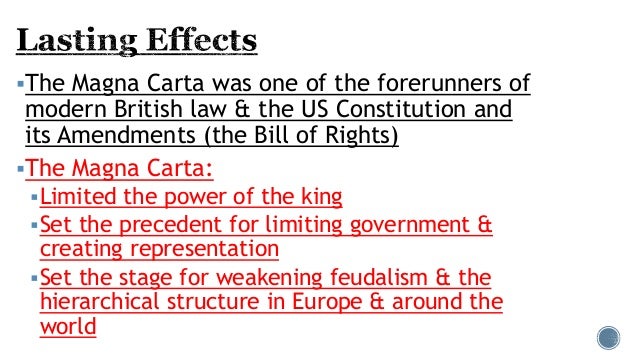
A few clauses of the Magna Carta became part of the American government: Clause 39 (quoted above), or habeas corpus, provides that arrests and trials of citizens must have merit and is found in Article One of the U.S. Constitution. Clause 61, which called for a committee of barons to oversee the king's actions, inspired the "checks and balances" system.

"The underlying idea of the sovereignty of law, long existent in feudal custom, was raised by it into a doctrine for the national State. And when in subsequent ages, the State, swollen with its own authority, has attempted to ride roughshod over the rights and liberties of the subject, it is to this doctrine that appeal has again and again been made, and never, as yet, without success."
* N.B. To get a flavor of some of the other clauses, consider these: 

1. The English Church shall be free, and shall have its rights undiminished, and its liberties unimpaired.

13. The City of London shall enjoy all its ancient liberties and free customs, both by land and by water. We also will and grant that all other cities, boroughs, towns, and ports shall enjoy all their liberties and free customs. 

30. No sheriff, royal official, or other person shall take horses or carts for transport from any free man, without his consent. 

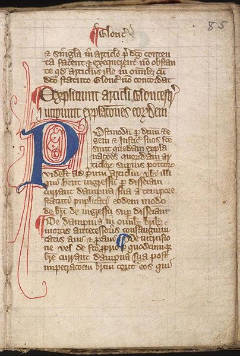
The original - click here to embiggen
54. No one shall be arrested or imprisoned upon the appeal of a woman for the death of anyone except her husband. 

** Cato has an good synopsis of the revision process: Getting King John To Sign Magna Carta Was Only Half The Battle

*** Originally, a large number of copies were made for the barons and for distribution among the English counties. Of these "first editions," four survive. One is on display at the Houses of Parliament, one is in the British Library, and one is in a cathedral in Salisbury, England. The fourth copy is usually housed at Lincoln Cathedral in Lincolnshire, but is occasionally loaned out.

The British Library explanation of Magna Carta, narrated by Monty Python's Terry Jones:


Another in the same series:


Horrible Histories: find out how Magna Carta came to be in the Horrible Histories 800 years Song:


Neatorama has a reprint of a good article from Uncle Johns's Unsinkable Bathroom Reader on the history of Magna Carta.

Related, Mark Steyn's The Field Where Liberty Was Sown, on re-learning those lessons.

Parts of the text above are based on Ed's Quotation of the Day, only available via email - leave your email address in the comments if you'd like to be added to his list. Ed is the author of Hunters and Killers: Volume 1: Anti-Submarine Warfare from 1776 to 1943 and Hunters and Killers: Volume 2: Anti-Submarine Warfare from 1943.

Wednesday, June 15, 2016

Wednesday links

Magna Carta was signed on June 15, 1215: history, quotes, Horrible Histories and Monty Python explanations. Related, Mark Steyn's The Field Where Liberty Was Sown, on re-learning those lessons.

The Incredibly Weird Story Behind Tetris.


Ulysses fan, or just a fan of hanging out in an Irish pub? June 16 is Bloomsday - here's my favorite quote from Joyce's obscenity trial:
“[i]n respect of the recurrent emergence of the theme of sex in the minds of [Joyce's] characters, it must always be remembered that his locale was Celtic and his season Spring.”
What Species Would Become Dominant On Earth If Humans Died Out?

Wedding Night Games Are Awkward All Around the World.

ICYMI, Tuesday's links are here, and include Flag Day and the birthday of the U.S. Army, exoskeletons for the elderly, how donating your body to science works, and macaroni and cheese summer cocktails.