From Screen Junkies - watch full screen. List of movies below the video.
Movies used:
Fight Club, Lethal Weapon 3, Teenage Mutant Ninja Turtles (2014), The Mask, Face/Off, Die Hard with a Vengeance, Independence Day, Star Trek III: The Search for Spock, The Dark Knight, Transformers: Age of Extinction, Tropic Thunder, The Expendables, Guardians of the Galaxy, Star Wars, Return of the Jedi, Die Hard, Django Unchained, Caddyshack, V for Vendetta, Dr. Strangelove, Ghostbusters, The Lord of the Rings: The Two Towers, Robocop (1987), Terminator 2: Judgment Day, Transformers: Revenge of the Fallen, The Terminator, Speed, Oz The Great and Powerful, The Lord of the Rings: The Fellowship of the Ring, Mary Poppins, Rio, Paul, The Theory of Everything, Neighbors, The Croods.
From The Slow Mo Guys. Watch full screen, and if you’re in a hurry, just go to 3:54 and watch the floating fireball for about 10 seconds. Nothing happens after 8:45.
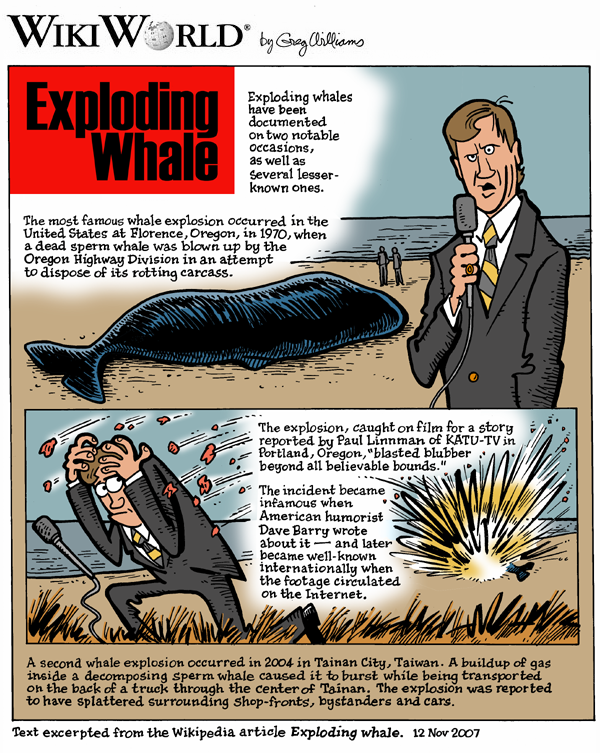
The term exploding whale primarily refers to an event at Florence, Oregon in November 1970, when a dead sperm whale (reported to be a gray whale) was blown up by the Oregon Highway Division in an attempt to dispose of its rotting carcass. The explosion threw whale flesh over 800 feet (240 m) away.
On November 9, 1970, a 45-foot long, 8 ton whale beached itself at Florence on the central Oregon Coast. At the time, Oregon beaches were under the jurisdiction of the state's Highway Division which, after consulting with the United States Navy, decided to remove the whale in the same way as they would a boulder – using dynamite – assuming that the resulting pieces would be small enough for scavengers to clear up.
George Thornton, the engineer in charge of the operation, told an interviewer that he wasn't sure how much dynamite would be needed, explaining that he was chosen to remove the whale because his supervisor had gone hunting. A charge of half a ton of dynamite was selected. A military veteran with explosives training who happened to be in the area warned that the planned twenty cases of dynamite was far too much – 20 sticks would have sufficed – but his advice went unheeded.
The dynamite was detonated on November 12 at 3:45 p.m. The resulting explosion was caught on film by cameraman Doug Brazil for a story reported by news reporter Paul Linnman of KATU-TV in Portland, Oregon. In his voice-over, Linnman joked that "land-lubber newsmen" became "land-blubber newsmen ... for the blast blasted blubber beyond all believable bounds." The explosion caused large pieces of blubber to land near buildings and in parking lots some distance away from the beach. Only some of the whale was disintegrated; most of it remained on the beach for the OHD workers to clear away. In his report, Linnman also noted that scavenger birds, whom it had been hoped would eat the remains of the carcass after the explosion, did not appear as they were possibly scared away by the noise. The explosives-expert veteran's brand-new automobile, purchased during a "Get a Whale of a Deal" promotion in a nearby city, was flattened by a chunk of falling blubber.
I am absolutely not making this incident up; in fact I have it all on videotape. The tape is from a local TV news show in Oregon, which sent a reporter out to cover the removal of a 45-foot, eight-ton dead whale that washed up on the beach. The responsibility for getting rid of the carcass was placed upon the Oregon State Highway Division, apparently on the theory that highways and whales are very similar in the sense of being large objects.
So anyway, the highway engineers hit upon the plan — remember, I am not making this up — of blowing up the whale with dynamite. The thinking here was that the whale would be blown into small pieces, which would be eaten by sea gulls, and that would be that. A textbook whale removal.
So they moved the spectators back up the beach, put a half-ton of dynamite next to the whale and set it off. I am probably not guilty of understatement when I say that what follows, on the videotape, is the most wonderful event in the history of the universe. First you see the whale carcass disappear in a huge blast of smoke and flame. Then you hear the happy spectators shouting “Yayy!” and “Whee!” Then, suddenly, the crowd’s tone changes. You hear a new sound like “splud.” You hear a woman’s voice shouting “Here come pieces of… MY GOD!” Something smears the camera lens.
Later, the reporter explains: “The humor of the entire situation suddenly gave way to a run for survival as huge chunks of whale blubber fell everywhere.” One piece caved in the roof of a car parked more than a quarter of a mile away. Remaining on the beach were several rotting whale sectors the size of condominium units. There was no sign of the sea gulls, who had no doubt permanently relocated in Brazil. This is a very sobering videotape. Here at the institute we watch it often, especially at parties. But this is no time for gaiety. This is a time to get hold of the folks at the Oregon State Highway division and ask them, when they get done cleaning up the beaches, to give us an estimate on the US Capitol.
ICYMI, Friday's links are here, and include a short 1901 film with some rather impressive special effects, fashion tips from the Middle Ages, the Krakatoa volcanic eruption in 1883 (it was so loud it ruptured eardrums of people 40 miles away), and how The Princess Bride built that sword-fighting scene.
ICYMI, Monday's links are here, and include facial reconstructions of famous historical figures, the science of sword-swallowing, sunken Nazi gold, and Milton Friedman's birthday.
ICYMI, Friday's links are here, and include a map of New York’s earliest skyscrapers, dozens of nuclear test videos that have been declassified and uploaded to YouTube, forged art that fooled the Metropolitan Museum for decades, and lots of information on Saint Patrick.
“Contrary to popular belief, grenades are actually very safe if they don’t have a hand throwing them. They require the hand to increase their velocity in order to prime the explosives enough for full combustion.”
After 12 years and almost 300 episodes, the Mythbusters has ended. Here's an excellent supercut that reminds us why the show was awesome. The clips are without context, so they're mostly just explosions. Watch full screen:
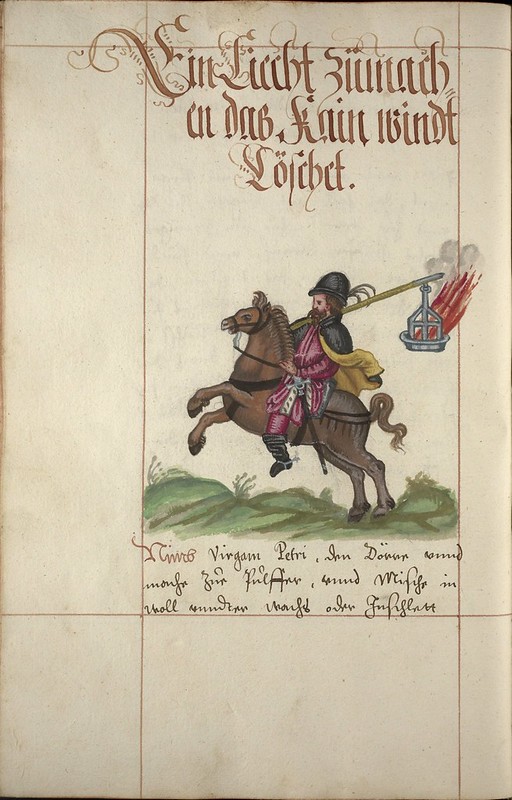
Although the use of animals in warfare is widespread and well-documented, these medieval images have caught the collective imagination. A video (below) has been making the rounds in the last day or so based on a set of images originally posted in November, 2012 on the BibliOdyssey blog: Early Explosives: Grenades, projectiles, fireworks and offensive weaponry illustrations from a 16th century German manuscript. hat post led to the involvement of Mitch Fraas, an historian at the University of Pennsylvania; he did some research into the subject and found similar images elsewhere, and information on what was actually going on.
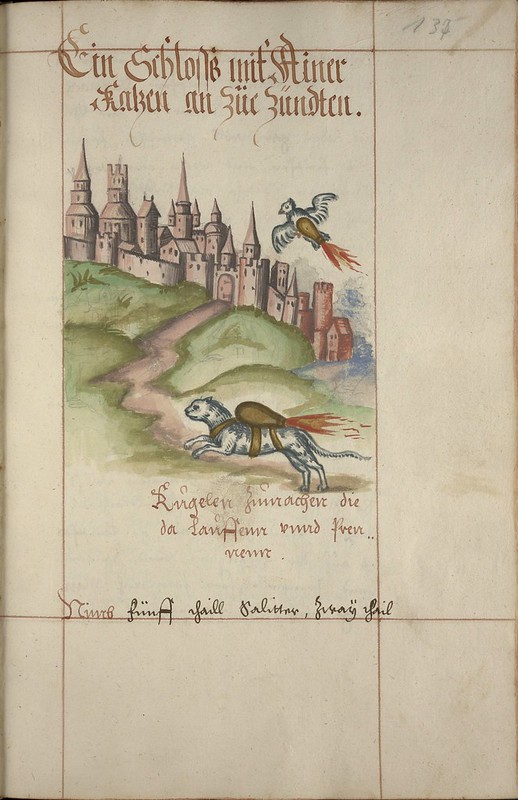
Turns out the manuscript was actually a guide to siege warfare, and those be-backpacked kitties are meant to burn down hard-to-access castles and the like, dying in the process. Considering, for example, the section titled “To set fire to a castle or city which you can’t get at otherwise’:
“This section details how to use doves and cats loaded with flammable devices to set fire to enemy positions.
On cats the text paints a grisly picture of attaching lit sacks of incendiaries onto the animals to have them return to their homes and set fire to them.
'Create a small sack like a fire-arrow … if you would like to get at a town or castle, seek to obtain a cat from that place.
'And bind the sack to the back of the cat, ignite it, let it glow well and thereafter let the cat go, so it runs to the nearest castle or town, and out of fear it thinks to hide itself where it ends up in barn hay or straw it will be ignited.'"
The extract from the Russian Primary Chronicle describing the actions of Olga of Kiev (c.945 CE) is particularly striking:
“Olga requested three pigeons and three sparrows from each household. Upon their receipt, her men attached rags dipped in sulphur to the feet of each bird. When the birds returned to their nests, they lit the city on fire and the Derevlians perished in their homes.Olga’s vengeance was now complete.” The Russian Primary chronicle : Laurentian text, (Mediaeval Academy of America,1953), p.81.
Original set of images from BibliOdyssey, and they have several more.