ICYMI, most recent links are here, and include the physics of the (im)possibility of lightsabers, Flag Day and Father's Day links (with lots of Homer Simpson advice), a map of the literal translation of every country's name, and the time when foster care was synonymous with farm labor.
When Napoleon recovered his throne at Paris, in March 1815 (ed - after his escape from Elba)... his first business was to sustain the attack of the united British and Prussians, posted in the Netherlands, and it was his obvious policy to make an attack on these himself before any others could come up to their assistance.
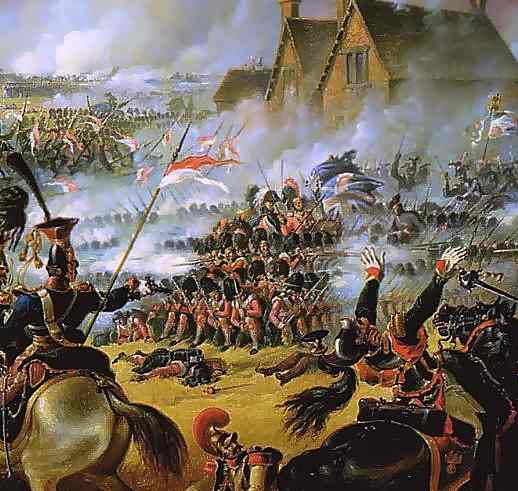
His rapid advance at the beginning of June, before the English and Prussian commanders were aware of his having left Paris; his quick and brilliant assaults on the separate bodies of Prussians and British at Ligny and Quatre Bras on the 16th, were movements marked by all his brilliant military genius. And even when, on the 18th, he commenced the greater battle of Waterloo (wiki) with both, the advantage still remained to him in the divided positions of his double enemy, giving him the power of bringing his whole host concentratedly upon one of theirs; thus neutralizing to some extent their largely superior forces. And, beyond a doubt, through the superior skill and daring which he thus shewed, as well as the wonderful gallantry of his soldiery, the victory at Waterloo ought to have been his.
There was just one obstacle, and it was decisive - the British infantry stood in their squares immovable upon the plain till the afternoon, when the arrival of the Prussians gave their side the superiority.
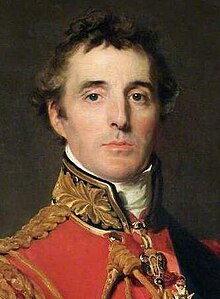
Thrown on that occasion into the central position among the opponents of Bonaparte, he was naturally and justly hailed as the saviour of Europe... Thenceforth the name of Wellington was venerated above that of any living Englishman.
You will have heard of our battle of the 18th. Never did I see such a pounding match... Napoleon did not maneuver at all. He just moved forward in the old style, and was driven off in the old style.
~Arthur Wellesley, Duke of Wellington (wiki) (letter to Sir William Beresford, 2 July 1815)
Meeting an acquaintance of another regiment, a very little fellow, I asked him what had happened to him yesterday. "I'll be hanged," says he, "if I know anything at all about the matter, for I was all day trodden in the mud and galloped over by every scoundrel who had a horse, and, in short, I only owe my existence to my insignificance.
Thou fateful Waterloo,
Millions of tongues record thee, and anew
Their children's lips shall echo them, and say --
"Here, where the sword the united nations drew,
Our countrymen were warring on that day!"
And this is much, and all which will not pass away.**
June 18 is the anniversary of the battle of Waterloo (wiki) in 1815, in which British forces under the Duke of Wellington (wiki) and the Prussians under Field Marshal Blücher decisively defeated the French under Napoleon to end the "Hundred Days Campaign." After the allies took Paris in March 1814, Napoleon was initially exiled to Elba. A year later, however, he returned to France amid great acclaim, re-entered Paris, declared himself emperor again, and retook command of the French armies to renew the struggle.
Four days after the debacle at Waterloo - which Wellington described as "the nearest-run thing you ever saw in your life" - Napoleon abdicated again and was sent into final exile on St. Helena in the South Atlantic, where he died in 1821. On more than one occasion, Wellington is also said to have remarked:
"Next to a battle lost, the greatest misery is a battle gained."
** This passage was quoted by Winston Churchill to President Franklin Roosevelt in choosing the phrase, United Nations, to designate the victorious powers in World War II.
Here's the battle scene from the 1970 movie Waterloo with Rod Steiger as Napoleon and Christopher Plummer as Wellington (and Orson Wells as Louis XVIII):
ICYMI, most recent links are here, and include urban and wilderness survival hacks, eating out in Victorian England, the photos on which classic pin-up girl paintings were based, and how Dr. Seuss changed education in America.
How serious were the problems? Serious enough that a couple countries threatened to pull out of the program, according to U.S. Defense Department documents.
The U.S. Navy and Marine Corps’ F-35s become unpredictable to handle when executing the kind of extreme maneuvers a pilot would use in a dogfight or while avoiding a missile.
ICYMI, most recent links are here, and include how regulations make all cars look so much alike, why almost all city trees are male and produce so much pollen, and the anniversaries of D-Day and Dunkirk.


 (1869)*