Amazon Deals

New at Amazon

Showing posts with label plane. Show all posts

Saturday, December 17, 2022

December 17 is the anniversary of the Wright brothers' first flight


For some years I have been afflicted with the belief that flight is possible to man. My disease has increased in severity and I feel that it will soon cost me an increased amount of money if not my life. I have been trying to arrange my affairs in such a way that I can devote my entire time for a few months to experiment in this field.

~ Wilbur Wright (letter to Octave Chanute, 13 May 1900)
SUCCESS FOUR FLIGHTS THURSDAY MORNING ALL AGAINST TWENTY ONE MILE WIND STARTING FROM LEVEL WITH ENGINE POWER ALONE SPEED THROUGH AIR THIRTY ONE MILES LONGEST 57 SECOND* INFORM PRESS HOME CHRISTMAS

~ Orville Wright (telegram to Milton Wright, 17 December 1903)

There are no signposts in the sky to show a man has passed that way before. There are no channels marked. The flier breaks each second into uncharted seas.

~ Anne Morrow Lindbergh (1906-2001) (North to the Orient, Ch. 1)

Per aspera ad astra.

~ familiar Latin tag, often used as a motto

(Through adversity to the stars.)


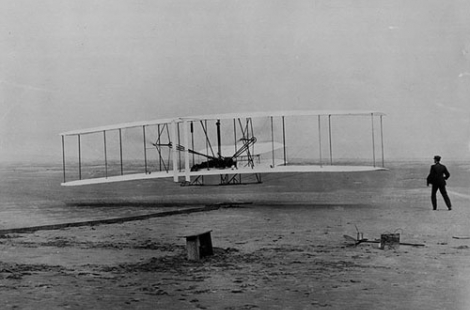
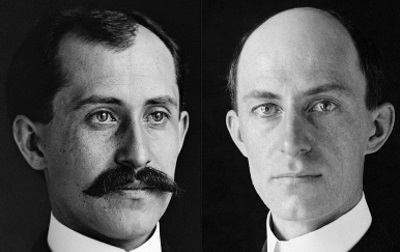
Today is the anniversary of mankind's first powered flight, achieved at Kitty Hawk, North Carolina on 17 December 1903 by pioneer American aviators Wilbur and Orville Wright (wiki) (1867-1912 and 1871-1948, respectively). The Wrights - Dayton, Ohio bicycle mechanics - become interested in aviation as an avocation and embarked on a systematic experimental program that eventually led to their extraordinary success - of which movable wing parts and a lightweight engine were the key elements. 

Via a now-defunct page from BrainFeed:
Prior To the powered flight, the brothers completed over one thousand glides from atop Big Kill Devil Hill. These flying skills were a crucial component of their invention. Through those experiments, they had solved the problem of sustained lift and more importantly they could control an aircraft while in flight. The brothers felt they were ready to truly fly. But first, the Wrights had to power their aircraft.
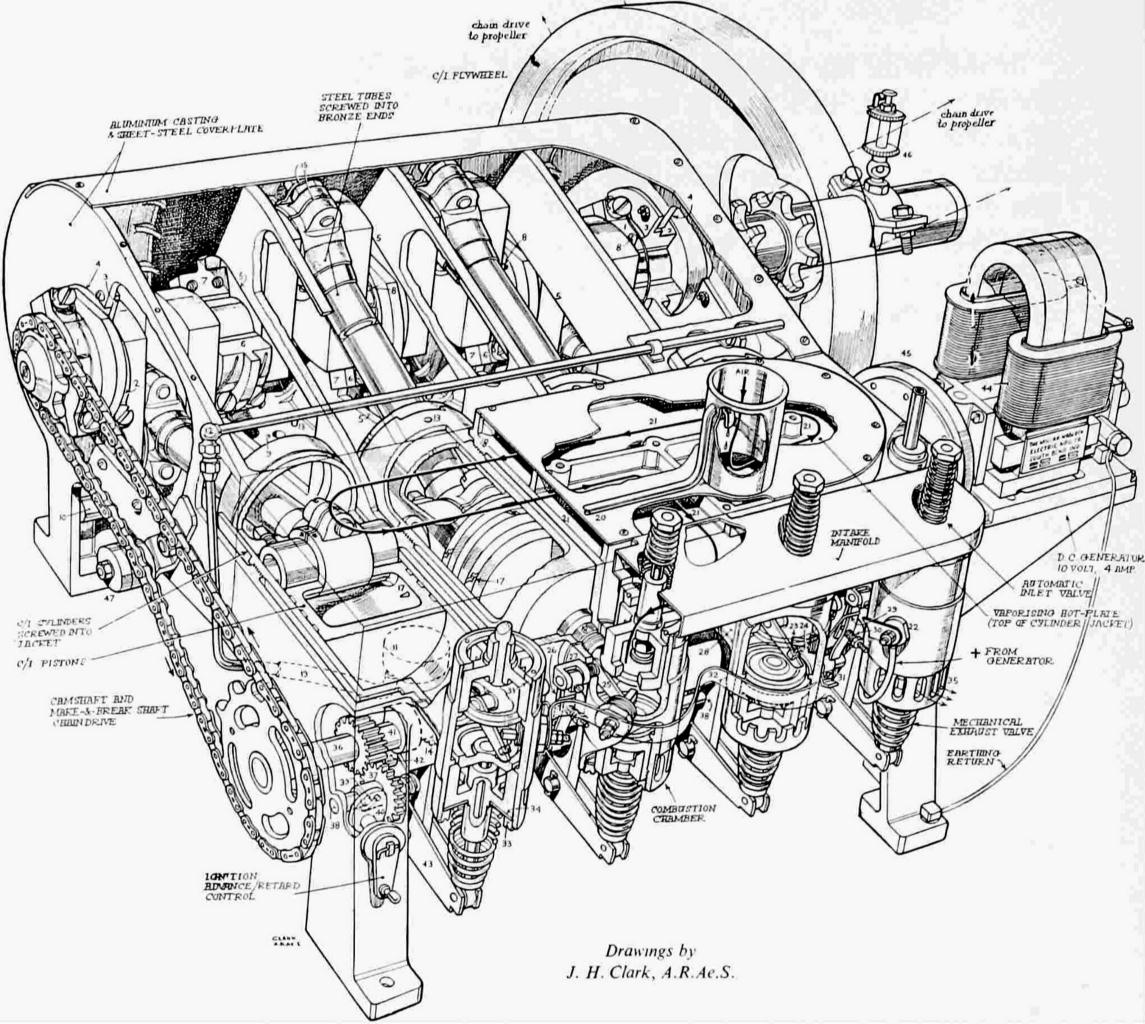
Zoomable version of the cutaway here.
Gasoline engine technology had recently advanced to where its use in airplanes was feasible. Unable to find a suitable lightweight commercial engine, the brothers designed their own. Using their air tunnel data, they designed the first efficient airplane propeller, one of their most original and purely scientific achievements. (Much more on the engine design here)
The Wright brothers were finally ready on December 14th. In order to decide who would fly first, the brother tossed a coin. Wilbur won the coin toss, but lost his chance to be the first to fly when he oversteered with the elevator after leaving the launching rail. The flyer, climbed too steeply, stalled, and dove into the sand. The first flight would have to wait on repairs.
Three days later, on December 17, they were ready for the second attempt. Now it was Orville’s turn. The flyer moved down the rail as Wilbur steadied the wings. The flyer was unruly, pitching up and down as Orville overcompensated with the controls. He kept it aloft until it hit the sand about 120 feet from the rail. Into the 27-mph wind, the groundspeed had been 6.8 mph, for a total airspeed of 34 mph. The brothers took turns flying three more times that day, getting a feel for the controls and increasing their distance with each flight. Wilbur’s second flight – the fourth and last of the day – was an impressive 852 feet in 59 seconds.
The most striking aspect of this anniversary is how quickly the Wright Brothers' invention led to the air and space age.  Man reached the moon only 66 years later - less than a human lifetime - and this remarkable acceleration of mankind's ability to achieve its most daunting goals is both exhilarating and frightening. 

Because satellites now do it so much better, French aviator and writer Antoine de Saint-Exupéry** (1900-1944) seems almost naive for remarking in 1939 that

"The aeroplane has revealed to us the true face of the earth."

Footage of later Wright Brothers' flights and an explanation of the history and mechanics: 


* N.B. Apparently, the actual time duration of that first flight was 59 seconds.

** A renowned flier, who described his experiences in vivid prose, Saint-Exupéry lost his life flying for the Free French in World War II. His most famous book is the children's story, Le Petite Prince ("The Little Prince").

Monday, March 26, 2018

Monday links

In honor of Robert Frost's birthday ("Some say the world will end in fire, Some say in ice..."), here's How The World Will End, According To 1939.


Sounds like a Hitchcock (or maybe SyFy) movie: 20,000 Bees Chased a Car for 24 Hours to Rescue Their Trapped Queen Bee.


10 Dangerous Toys from Decades Past (and the Commercials That Sold Them)

You Can Now Buy Your Very Own F-4 Phantom Fighter Jet for a Total Steal.

ICYMI, Friday's links are here, and include a comprehensive breakdown of how much a person will poo in their lifetime, why UPS trucks (mostly) don't turn left, 17th century London weather, and how to make beer in space.  

Monday, January 15, 2018

The Ultimate Paper Airplane

This isn't of the kind of paper airplane you fold from a sheet of notebook paper and throw across the room. It's a paper sculpture of a Boeing 777 and Luca Iaconi-Stewart has been building it for years, all from paper. He's recreating all the details of the real 777, including the passenger seats, wind struts, retractable landing gear, and hinged doors.


via Wired

Friday, August 11, 2017

Friday links

August 12 is Erwin Schrödinger's (he of the famous half-dead cat) birthday: explanation, quotes, jokes, video.


Browse the British Library’s online copy of Leonardo da Vinci’s 570-page notebook.

Roman roads of Britain.

The Tiny Island in New York That Nobody’s Allowed to Visit.

ICYMI, Wednesday's links are here, and include directly streaming music to your cochlear implant, the anniversary of the battle of Thermopylae, the 1814 beer flood that killed eight people, village sin-eaters, and Glen Campbell's Alzheimer's-related song.

Wednesday, September 14, 2016

Wednesday links


How many fireflies would it take to match the brightness of the Sun?

The designated survivor: while most government officials are at the State of the Union address, one member of the Cabinet is flown to a secure location in the event that the Capitol is attacked and the entire government is wiped out.

Which body part hurts the most when stung by a bee? A scientist put himself through a torturous experiment to find out.

The discovery and reconstruction of a Supermarine Spitfire.

The Illustrated Map of America's Worst Utopias.

ICYMI, Monday's links are here, and include how far above and below your property you own, a fall foliage prediction map, how a bean becomes a fart, and H. L. Mencken's birthday.

Monday, March 14, 2016

Monday Links

Albert Einstein was born on March 14, 1879: bio, videos, gravitational waves explained, and the post-mortem saga of his brain.


3.1416: Happy Pi Day: history, video explanation, and the digits of Pi set to music.


Airlander 10: World's largest aircraft prepares to take to the skies (it's 25 per cent larger than a Boeing 747 and designed to remain airborne for up to five days)

ICYMI, Friday's links are here, and include a "best of" Mythbusters supercut, exploding killer lakes, lots of eyebrow interpretation advice from the 16th century, and the (court-ordered) unmasking of the Lone Ranger.

Tuesday, February 16, 2016

Tuesday links

These awkward glamour photos will make you cringe (and smile).


ICYMI, Friday's links are here, and are all related to Valentine's Day: history, music, a bit of cynicism, geeky, vintage and racist cards, and aphrodisiac cocktails.

Tuesday, February 2, 2016

Tuesday links

Don't like what the groundhog has to say? It's probably wrong - Punxsutawney Phil has been correct just 39% of the time since 1887. And here are way too many Groundhog Day links, including an analysis of how long Bill Murray was stuck (spoiler - at least 34 years).

Psychiatrists studied 400 movies to find the most realistic psychopath.


Docs Removed My Brain For Nothing: Ridiculous Tabloid Headlines That Are Totally 100% True.


New York Public Library menu collection, from the 1850s to the modern day.

ICYMI, Monday's links are here, and are all February and Groundhog Day related.

Monday, October 12, 2015

Watch footage of Teddy Roosevelt's first airplane flight, October 11, 1910

On October 11, 1910 Teddy Roosevelt (wiki) became the first president (well, ex-president at the time) to fly in an airplane. The Library of Congress has footage:


From the following day's New York Tribune:

The aeroplane sped quickly around the field at a height of less than one hundred feet. It made the first lap of a mile and a half before news percolated through the crowd that Mr. Roosevelt was Hoxsey’s passenger. When he swept past the grandstand he leaned forward a bit and waved his hands. The spectators seemed frightened and remained silent, watching the aeroplane intently.
The flying machine sped by and made the turn for the second lap. Hoxsey could be seen to bend over and shout something into Mr. Roosevelt’s ear. The engine cracked regularly, hurling the aeroplane forward at a speed of nearly a mile a minute, but from the ground it looked as though it were travelling much slower because it sailed so evenly and smoothly. There was not a breath of wind, and the engine did not miss fire once.
Via UPI, 
Here's Aviator Hoxsey's story of Roosevelt's daring trip:
"President Lambert of the St. Louis Aero club introduced me to Roosevelt. Lambert said something about my trip from Springfield. Roosevelt said he envied me. 'Here's your chance,' I said to him.
'"All right,' said Roosevelt, 'but let's not make too much fuss about it.'
"Roosevelt was on the machine before I was. He was bareheaded. A newspaperman gave him a cap and he said 'let 'er go.' We started.
"I didn't look at Roosevelt until I felt the machine wiggle. He was waving at the crowd. We were up about 150 feet.
"'Be careful not to pull any of those strings,' I warned him. He was sitting directly underneath the valve cord of the engine and the engine would have stopped had he touched it.
"'Nothing doing,' he shouted back, showing his teeth. The propeller made so much noise we had to shout.
h/t Paleofuture 

Tuesday, September 22, 2015

Watch The World's Largest Airliner Land In A Crosswind 

Dude. An 80 foot tall A380:

Per Jalopnik:
It is also worth noting how much runway the A380 needs to make a safe landing. Assuming it is fully loaded at its Maximum Landing Weight (MLW) of 434 tons (over 868,000 pounds!) and operating at sea level, the big Airbus needs at least 5,000 feet to safely halt. The shorter of the two runways at Düsseldorf is 8,859 feet in length, and the airport is situated just 147 feet above sea level. Given these constraints and the later-than-normal touchdown, this A380 appears to have used close to every foot of runway available to decelerate to a taxiing speed.

More crosswind landing videos: The Ten Scariest Aircraft Landings Caught On Video.