"Every election is a sort of advance auction sale of stolen goods." It's the birthday of H.L. Mencken, noted curmudgeon, satirist, and political and cultural critic.
ICYMI, Friday's links are here, and include back to school fashion circa 1939, a gallery of unusual cloud formations, Heineken's abandoned plan to build houses out of beer bottles (plus more bottle houses and a DIY bottle brick tutorial), and everything you wanted to know about eyebrow interpretation from the 16th century.
We are living now, not in the delicious intoxication induced by the early successes of science, but in a rather grisly morning after when it has become apparent that what triumphant science has done hitherto is to improve the means for achieving unimproved or actually deteriorated ends.
... a point well demonstrated in the checkered career of one man:
Gaseous nitrogen combines with gaseous hydrogen in simple quantitative proportions to produce gaseous ammonia.
~ Fritz Haber (wiki) (attributed; a vast simplification of the Haber process for fixing nitrogen)
The field of scientific abstraction encompasses independent kingdoms of ideas and of experiments, and within these, rulers whose fame outlasts the centuries. But they are not the only kings in science. He also is a king who guides the spirit of his contemporaries by knowledge and creative work, by teaching and research in the field of applied science, and who conquers for science provinces which have only been raided by craftsmen.
~ Haber (memorial remarks on his mentor, Professor Georg Lunge, in January 1923)
The effects of the successful gas attack were horrible. I am not pleased with the idea of poisoning men. Of course the entire world will rage about it first and then imitate us. All the dead lie on their backs with clenched fists; the whole field is yellow.
~ Rudolph Binding (1867-1938) (on the first German gas attack, April 1915, in A Fatalist at War, 1915)
War and its horrors, and yet I sing and whistle...
~ Confederate General George E. Pickett (1825-1875) (letter to his wife, May 1864)
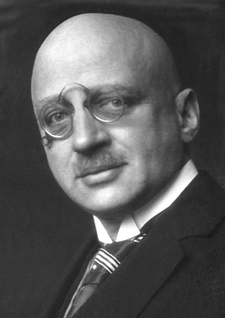
Today is the anniversary of the birth of German physical chemist Fritz Haber (wiki) (1868-1934), who received the Nobel prize for chemistry in 1918 for his role in inventing the Haber-Bosch process for "fixing" nitrogen on an industrial scale, thus permitting mass production of synthetic fertilizers and high explosives.* Born to a well-to-do Jewish family in Breslau, Prussia, Haber studied chemistry at the Friedrich Wilhelm University in Berlin, eventually receiving a doctorate in 1891.
Unable to find a comfortable working relationship with his father in the latter's Breslau chemical plant, Haber accepted successive academic positions in the universities of Jena and Karlsruhe and developed his nitrogen-fixing process at the latter between 1894 and 1911, while also working on electrochemistry, combustion reactions, and the separation of gold from seawater. When World War I broke out, Haber's process was key to Germany's ability to produce both fertilizer and high-explosives despite her inability to import nitrates because of the British blockade. Moreover, as a militant German imperialist who strongly supported the war effort, Haber played a major role in the development of chemical warfare by the Germans in World War I and was primarily responsible - as an army officer - for the weaponization of chlorine gas and its first devastating deployment against Canadian troops in the Second Battle of Ypres in April 1915.**
He was also active in developing gas masks, studying the physiological effects of poison gas, and is still recognized by many as "the father of chemical warfare.*** Between the wars, Haber continued secret work for Germany on poison gas weapons, but with the coming to power of the Nazis in 1933, his Jewish ancestry told against him (despite an earlier conversion to Lutheranism), and he removed himself to Switzerland, where he died in 1934, a strange, enigmatic man... In his The Void of War, 1918, English writer Reginald Farrer (1880-1920) noted,
"Even in theory, the gas mask is a dreadful thing. It stands for one's first flash of insight into man's measureless malignity against man."
* N.B. Although atmospheric nitrogen is plentiful, it is relatively inert and difficult to coax into forming compounds. The Haber-Bosch process converts atmospheric nitrogen to ammonia by a reaction with hydrogen using a metal catalyst and high temperatures and pressures. The ammonia is used in turn for manufacturing synthetic fertilizers or to produce the nitric acid needed for explosives. Thus, the Haber-Bosch process is one of the most important - and beneficial - industrial procedures ever devised.
** A detailed account of Haber's role in the first deployment of poison gas at 2nd Ypres is provided by Diana Preston in her recent book, A Higher Form of Killing, which treats "the six weeks in World War I that forever changed the nature of warfare." (Preston also treats the sinking of the Lusitania and the first Zeppelin bombing raids on London, all in April/May 1915.)
*** Haber's first wife, who was strongly opposed to his work on chemical weapons, committed suicide within two weeks of their first use at 2nd Ypres. His award of the Nobel prize was bitterly opposed by the Allied nations.
What an extraordinarily mixed legacy - more here on the benefits to the world of the ability to fertilize crops with artificially produced ammonia. SciShow has an excellent brief video on Haber's inventions, good and bad:
Unsurprisingly, after a few minutes of this the French soldiers fled their trenches in terror. Harold Peat, a Canadian private in reserve in the eastern part of the salient, witnessed the first moments of this new horror in war:
In the far distance we saw a cloud rise as though from the earth. It was a greeny-red color, and increased in volume as it rolled forward. It was like a mist rising, and yet it hugged the ground, rose five or six feet, and penetrated to every crevice and dip in the ground. We could not tell what it was. Suddenly from out the mist we men in reserves saw movement. Coming towards us, running as though Hell as it really was had been let loose behind them, were the black troops from Northern Africa. Poor devils, I do not blame them. It was enough to make any man run.
Another Canadian soldier in the front line, Reginald Grant, painted a similar picture:
The line trembled from one end to the other, as the Algerian troops immediately on our left, jumped out of their trenches, falling as they ran. The whole thing seemed absolutely incomprehensible until I got a whiff of the gas. They ran like men possessed, gasping, choking, blinded and dropping with suffocation. They could hardly be blamed... The buttons on our uniforms were tinged yellow and green from the gas, so virulent was the poison.
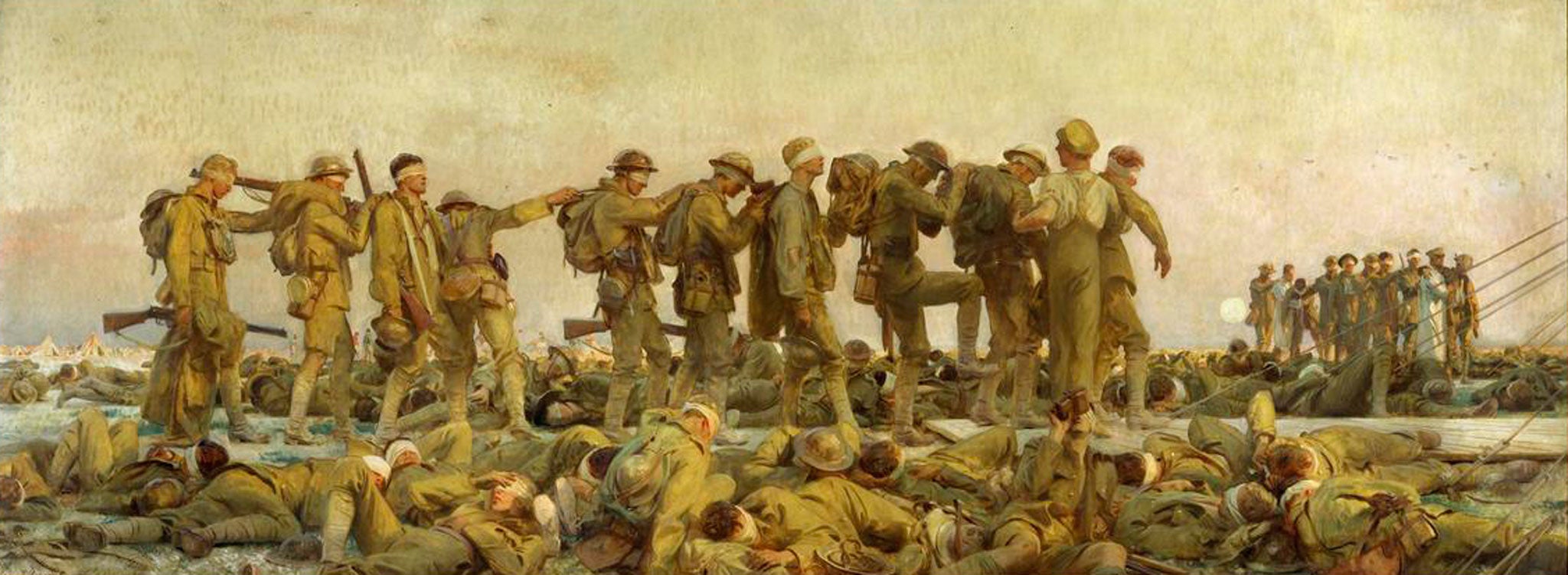
Gassed, a relatively little-known painting by famed American painter John Singer Sargent (1856-1925), better known for his exquisite portraiture. Now in the Imperial War Museum, London, it makes a harrowing impression full size:
Based on Ed's Quotation of the Day, only available via email. Leave your email address in the comments if you'd like to be added to his list.
Per the Telegraph, a damp Italian autumn has produced a bumper crop of wild mushrooms, and a busy time for Italian poison control centers.
A surge in the number of mushrooms growing in the damp woods and fields of Italy this autumn has resulted in an increase in people being poisoned after eating the wrong variety.
More than 220 people have been treated for poisoning in the last few weeks and four people have died since the mushroom-picking season started in late August in northern Italy. Of the 227 poisoning cases, more than 20 were classified as serious, meaning that patients are so badly affected by toxins that they may have to undergo liver transplants.
Enthusiasts take to the woods and hills to scour the damp undergrowth and leaf litter for prized varieties such as porcini and chanterelle mushrooms, but edible and non-edible types often look very much alike. Making the wrong choice can be fatal.
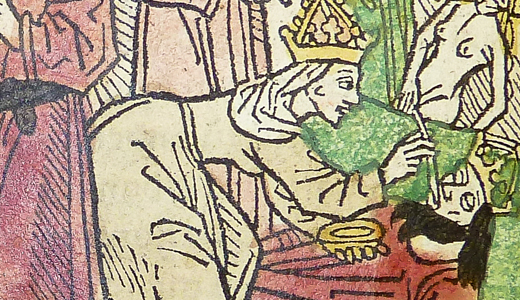
In general, these plants are of a pernicious nature, and the use of them should be altogether rejected; for if by chance they should happen to grow near a hob-nail, a piece of rusty iron, or a bit of rotten cloth, they will immediately imbibe all these foreign emanations and flavors, and transform them into poison. Who, in fact, is able to distinguish them, except those who dwell in the country, or the persons that are in the habit of gathering them? There are other circumstances, too, which render them noxious; if they grow near the hole of a serpent, for instance, or if they should happen to have been breathed upon by one when just beginning to open; being all the more disposed to imbibe the venom from their natural affinity to poisonous substances.
* Natural History consisted of thirty-seven books including all that the Romans knew about the natural world in the fields of cosmology, astronomy, geography, zoology, botany, mineralogy, medicine, metallurgy, and agriculture. (source)