Albert Einstein was born on March 14, 1879: here's a short bio, video, an explanation of gravitational waves, and the strange post-mortem saga of his brain.
ICYMI, Friday's links are here, and include Chuck Norris' 77th birthday, Japanese equipment for clearing a path through 60 feet of snow, Daylight Saving Time history (including Ben Franklin's proposal), how Mickey Mouse evades the public domain, and how to make prescription eyeglasses from scratch.
Today is the Ides of March - notionally, in the Roman lunar calendar, the day of the full moon that marked the midpoint of the month.* It was on this date in 44 B.C. that Julius Caesar (wiki) was assassinated by a conspiracy headed by Marcus Junius Brutus (wiki) and Quintus Cassius Longinus, who feared Caesar's growing power in the Roman Senate.
The most famous portrayal of the events of that infamous day is found in Shakespeare's Julius Caesar, based largely on Sir Thomas North's 1579 English translation of Plutarch's Lives** and likely first presented at the Globe in the summer of 1599.
Julius Caesar:
Soothsayer: Caesar!
Caesar: Ha! who calls?
Casca: Bid every noise be still: peace yet again!
Caesar: Who is it in the press that calls on me?
I hear a tongue, shriller than all the music,
Cry "Caesar." Speak! Caesar is turned to hear.
Soothsayer: Beware the ides of March.
Caesar: What man is that?
Brutus: A soothsayer bids you beware the ides of March.
Caesar: Set him before me; let me see his face.
Casca: Fellow, come from the throng; look upon Caesar.
Caesar: What sayst thou to me now? speak once again.
Soothsayer: Beware the ides of March.
Caesar: He is a dreamer; let us leave him: pass.
~ William Shakespeare (Julius Caesar, Act I, Sc. 2)
Pulling Caesar’s toga was the signal to begin the attack
On the fateful day, Caesar encounters the soothsayer again:
Caesar: The ides of March are come.
Soothsayer: Ay, Caesar, but not gone.
~ Ibid., Act III, Sc. 1
Caesar: Et tu, Brute? Then fall, Caesar!
~ Id.
The corpse was still lying where it had fallen, abased and stained with blood - that of a man who had marched west to the British Isles and the Ocean,and intended to march east to the thrones of Parthia and India, so that they too might be made subject to a single empire and all land and sea be governed from one capital; but no one dared to remain and recover his body. Those of his friends who were present had fled, those who were outside were hiding in their houses; or changed their clothes and departed for the countryside and the nearby towns.
* In the Julian calendar (reformed in 46 B.C.), the ides were the 15th days of March, May, July, and October - and the 13th days of all the other months. From 222 until 154 B.C., the ides of March was the day on which the new consuls of the Roman Republic entered office. The Romans did not number days of a month sequentially from the first through the last day. Instead, they counted back from three fixed points of the month: the Nones (5th or 7th, depending on the length of the month), the Ides (13th or 15th), and the Kalends (1st) of the following month. The Ides occurred near the midpoint, on the 13th for most months, but on the 15th for March, May, July, and October. The Ides were supposed to be determined by the full moon, reflecting the lunar origin of the Roman calendar. On the earliest calendar, the Ides of March would have been the first full moon of the new year.
** According to Plutarch, Caesar was not killed in the Senate itself, but rather in the Theater of Pompey, as the main Senate building was being restored at the time, so the Theater was being used as a substitute. The actual death of Caesar appears to have gone something like this, (from Plutarch's Lives):
Casca gave him the first cut, in the neck, which was not mortal nor dangerous, as coming from one who at the beginning of such a bold action was probably very much disturbed. Caesar immediately turned about, and laid his hand upon the dagger and kept hold of it. And both of them at the same time cried out, he that received the blow, in Latin, “Vile Casca, what does this mean?” and he that gave it, in Greek, to his brother, “Brother, help!” Upon this first onset, those who were not privy to the design were astonished and their horror and amazement at what they saw were so great, that they durst not fly nor assist Caesar, nor so much as speak a word. But those who came prepared for the business enclosed him on every side, with their naked daggers in their hands. Which way soever he turned, he met with blows, and saw their swords leveled at his face and eyes, and was encompassed, like a wild beast in the toils, on every side. For it had been agreed they should each of them make a thrust at him, and flesh themselves with his blood; for which reason Brutus also gave him one stab in the groin. Some say that he fought and resisted all the rest, shifting his body to avoid the blows, and calling out for help, but that when he saw Brutus’s dagger drawn, he covered his face with his robe and submitted, letting himself fall, whether it were by chance, or that he was pushed in that direction by his murderers, at the foot of the pedestal on which Pompey’s statue stood, and which was thus wetted with his blood.
** Nikolaus of Damascus was a Greek historian who befriended Herod the Great and Augustus Caesar, Julius's nephew, heir, and later Roman emperor. This excerpt from his fragmentary Universal History is believed to be the earliest account of Caesar's murder.
*** After the Roman people were aroused against the conspirators by Marc Antony, Brutus and Cassius fled to Syria and in 42 B.C. were defeated by Antony and Octavian at the battle of Phillipi. This left the way open for Octavian to seize power and - as Caesar Augustus - become the first Roman emperor.
Matt Baillie from the Facebook group Soviet Visuals sent me a tip about the retro-futuristic filmstrip... the illustrations were created by L. Smekhov and written by V. Strukova and V. Shevchenko.
I’ve included select images from what appears to be the original source (Sergey Pozdnyakov) below, along with some of the translations from the Moscow Times.
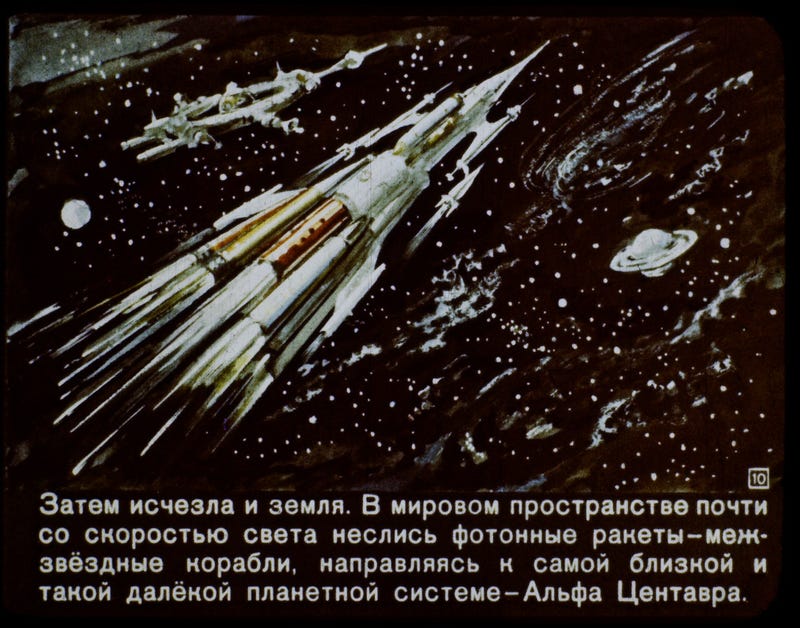
Then in the film, the Earth itself disappears. In outer space, almost at the speed of light, photon interstellar rocketships set off for the nearest and faraway planetary system, Alpha Centauri.
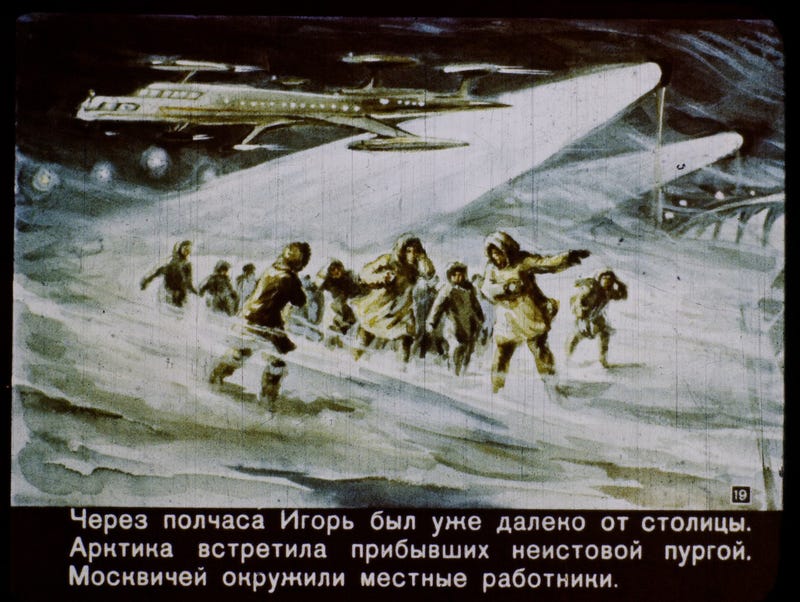
Of course they've envisioned a way to deal with the harsh winters:
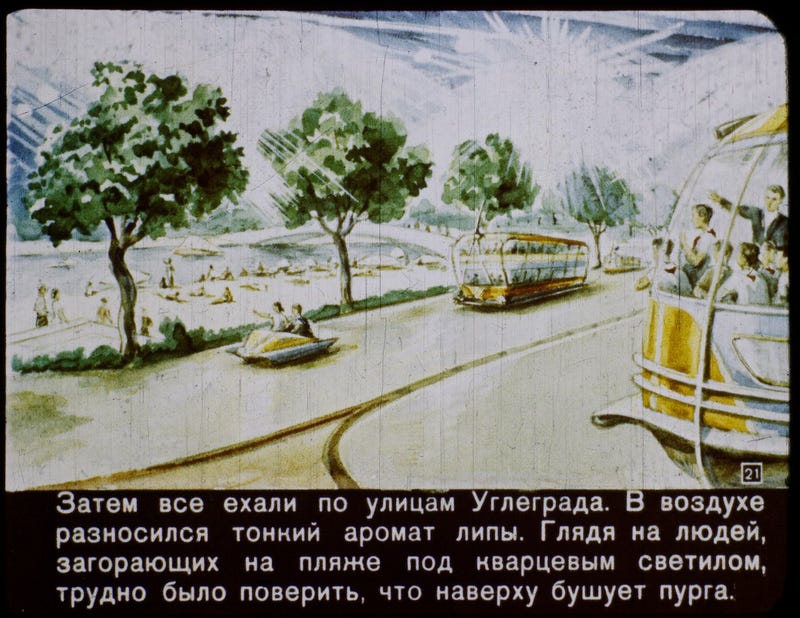
by building an underground paradise:
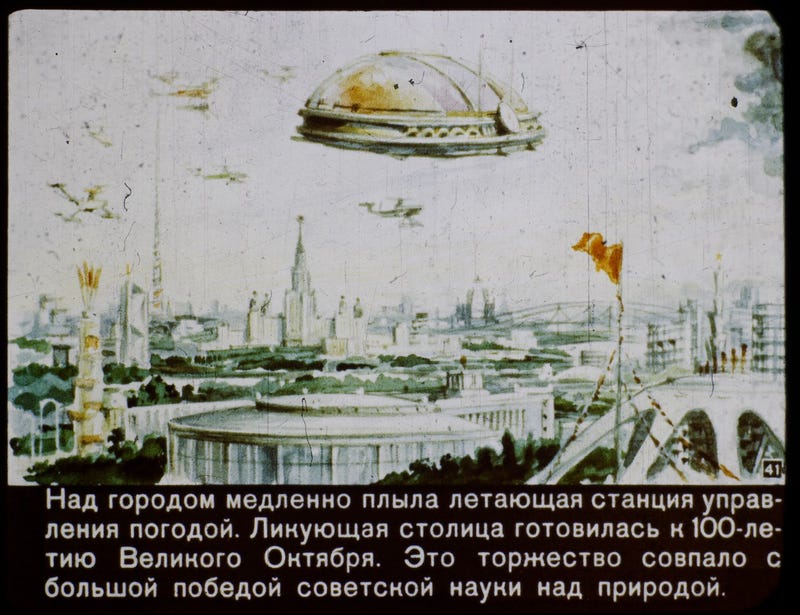
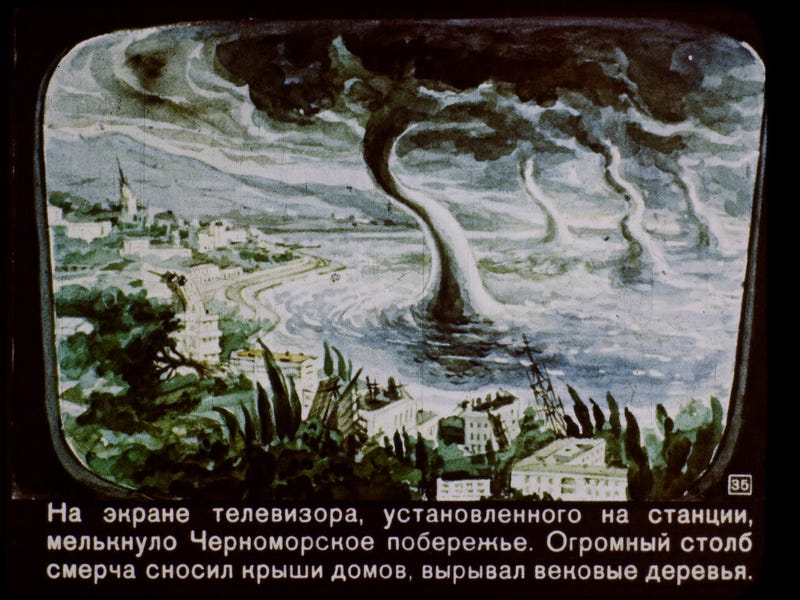
The Soviets have developed sophisticated weather control stations, which they occasionally have to use to save the world from the remnants of the dirty capitalists:
Meanwhile, back at the Central Institute for Weather Control, where Igor’s father works, there’s dire news. “We’ve just been informed,” the head meteorologist says, “that the last remaining imperialists, hiding on a remote island, have tested a banned meson weapon. During the test, there was an explosion of unprecedented strength, which destroyed the entire island and simultaneously created atmospheric disturbances around the planet.”
Someone put together a video version of the slide, with horrendous loud music - if you choose to watch it, I suggest that you turn the sound way down or mute it. There are no translations of the slides, but the Moscow Times has the whole set with translations.
March 11th, 1811 is a black-letter day in the annals of Nottinghamshire. It witnessed the commencement of a series of riots which, extending over a period of five years, have, perhaps, no parallel in the history of a civilized country for the skill and secrecy with which they were managed, and the amount of wanton mischief they inflicted.
Machines were, it may be said, the weapon employed by the capitalists to quell the revolt of specialized labor.
~ Karl Marx (1818-1883) (The Poverty of Philosophy, Ch. 5)
I'm afraid for all those who will have the bread snatched from their mouths by these machines... What business does science and capitalism got, bringing all these new inventions into the works, before society has produced a generation educated up to using them!
~ Henrik Ibsen (1828-1906) (Aune, in Pillars of Society, Act II)
By his very success in inventing labor-saving devices, modern man has manufactured an abyss of boredom that only the privileged classes in earlier civilizations have ever fathomed.*
~ Lewis Mumford (1895-1990) ("The Challenge of Renewal," in The Conduct of Life)
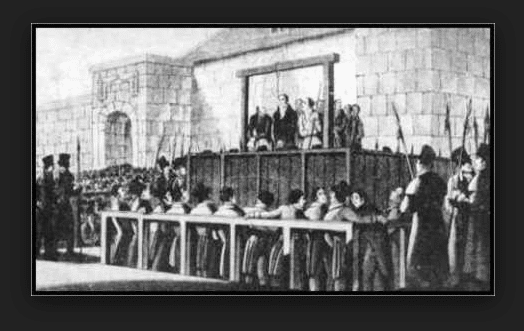
The mass Luddite trial at York
Industrial man - a sentient reciprocating engine having a fluctuating output, coupled to an iron wheel rotating with uniform velocity. And then we wonder why this should be the golden age of revolution and mental derangement.
~ Aldous Huxley (1894-1963) (Time Must Have a Stop, Ch. 30)
March 11 is the anniversary of the first of the Luddite (wiki) riots in 1811, at the village of Arnold near Nottingham, England, where a group of disgruntled hand weavers, concerned with the threat of newly introduced textile machinery to their livelihood, smashed a number of knitting frames. Supposedly led by a young apprentice, Ned Ludd, the movement spread quickly to other textile-producing areas in Yorkshire and Lancashire, and widespread damage was done to textile machinery.
The riots were put down by the British government with the army and with draconian punishments: the troops were sent in to control the Luddites, and the government followed it up with the Frame Breaking Act of 1812 which made the breaking of machines a capital felony. They held a mass trial of those caught in 1813 and executed 17 men - others were sent to penal colonies. The harsh punishments meted out did stop the Luddite protests, but in all between 60 and 70 people were executed.**
Although the Luddites were not opposed to machinery per se - but rather to the devaluing of their specialized skills by its introduction to the industry - the term Luddite has come to be applied pejoratively to anyone opposed to modern technology and its sociological effects. Be that as it may, that same issue arises today with the spread of automation and its inevitable elimination of many jobs. On the other hand, as Czech writer, Karel Cepad (1890-1938) has noted,
"Man will never be enslaved by machinery if the man tending the machine be paid enough."
* N.B. I am reminded of Voltaire's famous observation, "Work banishes those three great evils - poverty, boredom, and vice."
** English historian Eric Hobsbawm (1917-2012) has called the Luddites' wrecking of machinery as "collective bargaining by riot."
ICYMI, Monday's links are here, and include training bomb-sniffing dogs, predatory plants, and Michelangelo's birthday (and his illustrated grocery list).