Amazon Deals

New at Amazon

Showing posts with label soviet. Show all posts

Sunday, September 24, 2023

Composer Dimitri Shostakovich was born September 25, 1906: some quotes, history, and music

I always try to make myself as widely understood as possible; and if I don't succeed, I consider it my own fault.

Dmitri Shostakovich (quoted in Machlis, Introduction to Contemporary Music)

The composer apparently does not set himself the task of listening to the desires and expectations of the Soviet public. He scrambles sounds to make them interesting to formalist elements who have lost all taste... The power of good music to affect the masses has been sacrificed to a petty-bourgeois, "formalist" attempt to create originality through cheap clowning. It is a game of clever ingenuity that may end very badly.*

~ Pravda (on the Shostakovich opera Lady MacBeth of Mtsensk, "Muddle Instead of Music," January 1936)

Shostakovich told me: "I finished the Fifth Symphony in the major and fortissimo... It would be interesting to know what would have been said if I finished it pianissimo and in the minor." Only later did I understand the full significance of these words, when I heard the Fourth Symphony, which does finish in the minor and pianissimo. But in 1937, nobody knew the Fourth Symphony.**

~ Boris Khaikin (1904-1978) (Discourses on Conducting)
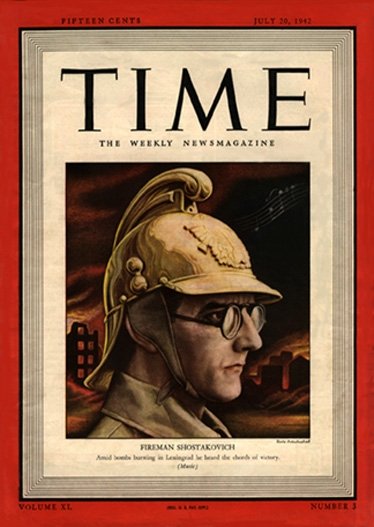
The cover of a 1942 issue of Time Magazine with the
caption "Fireman Shostakovich: 'Amid bombs burning
 in Leningrad, he heard the chords of victory.' Refers to
the Battle of Leningrad in which he served
 as a volunteer in the anti-fire brigades
There may be few notes, but there's lots of music.

~ Shostakovich (on his film music for King Lear; quoted in Wilson, Shostakovich, A Life Remembered)

Particularly during the Cold War, Shostakovich was anathema to many Western critics:

The Fifth Symphony of Shostakovich always has been singularly irritating to this chronicler... Whenever I hear one of his marches, my imagination fastens upon a picture of the parades in Red Square and the banners of Uncle Joe, and my irritation becomes powerful.

~ Cyrus Durgin (? - 1962) (Boston Globe, 25 October 1952)

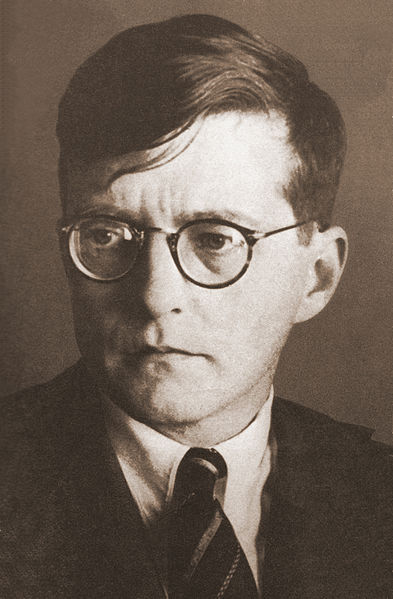
To anyone who knew his music, a first encounter with Dmitri Shostakovich could not fail to be startling. In contrast to the elemental force, bombast, grandeur of his works, he was a chétif*** figure, the perennial student, unassertive and shy, who looked as though all the music could be wrung out of him in a couple of song cycles.

~ Yehudi Menuhin (1916-1999) (Unfinished Journey)

September 25 is the anniversary of the birth of Soviet composer Dmitri Shostakovich (wiki) (1906-1975), considered by some as the greatest symphonist of the 20th century. Born in St. Petersburg, Shostakovich was an early piano prodigy and studied composition at the St. Petersburg Conservatory during the early Soviet era.
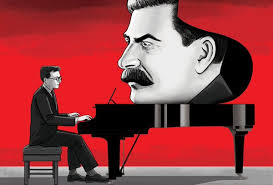
At first recognized internationally as an exemplar of the best of Soviet musicianship, he ran afoul of the regime with his modernistic opera, Lady MacBeth of Mtsensk, which so outraged Stalin that he is said to have had a personal hand in writing the infamous Pravda editorial, "Muddle Instead of Music" that literally put the composer's life in jeopardy during the "Great Purge" of the late 1930s. 

Shostakovich somehow survived, even though he was recurrently criticized by the regime for his “modernist” tendencies. During his subsequent tumultuous career, he produced an enormous oeuvre: 15 symphonies, concertos, a great quantity of chamber music, song cycles, piano music, and several operas. Generally considered a serious - almost tragic - composer, Shostakovich nonetheless wrote a large amount of “light” music, including even a stage work – Moscow Cheryomushki (1959) – that might be described as a Russian musical comedy.

Harry Potter looks exactly like
 a young Shostakovich
For newcomers to the music of Shostakovich, I would recommend his 4th, 5th, and 10th symphonies, the two piano concertos, the "autobiographical" 8th strinq quartet, his several "jazz" and "ballet" suites compiled from light works of the 1930s, and his film score for The Gadfly, whose "Romance" was used to great effect as the principal theme of the TV series, "Riley, Ace of Spies."

During the last two decades, there has been a raging musicological debate about whether the music of Shostakovich reveals him as a loyal Soviet citizen or a closet dissident whose works portray a tormented man. No one really knows. He was clearly a quirky guy. In contradiction to the opening quotation above, he noted late in life,
"I've said what I said. Either you have it in you to understand, or if not, then it would be fruitless to try to explain anyway."
* N.B. In the first year of the Great Purge, this last sentence was a terrifying threat.

** After the uproar caused by Lady MacBeth of Mtsensk, Shostakovich "redeemed" himself with his Fifth Symphony (1937), designated "A Soviet Artist's Response to Just Criticism," still one of his most successful and popular works. However, his iconoclastic Fourth Symphony, which had been in rehearsal at the time of the debacle, was withdrawn and did not emerge again until 1961. It is now considered one of the master's most original works and a fascinating indicator of "the road not taken." By the way, Boris Khaikin was a Soviet-Jewish conductor.

*** Chétif - a French word meaning "puny."

Here is the romance from The Gadfly:


More typical of Shostakovich is the opening of his 4th symphony:


Parts of the text above are adapted from the late, great Ed Whitman's Quotation of the Day. In addition to being my partner, my best friend, and Grandpa to the many kids who call me Grandma, Ed is also the author of Hunters and Killers: Volume 1: Anti-Submarine Warfare from 1776 to 1943 and Hunters and Killers: Volume 2: Anti-Submarine Warfare from 1943. Fair winds and following seas, Sailor. I miss you.

Friday, March 6, 2020

Friday links

Daylight Saving Time: Here's DST history (including Ben Franklin's proposal), stories and video.

The Soviet Census Debacle of 1937 - Stalin didn't like the results.

Syndrome K: The Fake Disease That Fooled the Nazis and Saved Lives - Italian doctors made up the disease to save Jews who had fled to their hospital to get away from the Nazis. Syndrome K "patients" were quarantined and the Nazis were told that it was a deadly, disfiguring, and highly contagious illness. More here.


Do you know what Washington saw as the future of America? Mules.

Thursday, September 14, 2017

Thursday links

It's the anniversary of the battle of Baltimore, inspiration for the Star-Spangled Banner.


An eyewitness look at the 1917 Halifax Explosion.

September 14, 1861 was The Night of the Flaming Ballerinas.

Why There’s A West Virginia.

Getting to Know Whale Vaginas in 7 Steps.

ICYMI, Tuesday's links are here, and include H.L. Mencken's birthday, 1950 information tests to try on your children, jay-walking and the fight for the streets, and why elephant brains, which have three times as neurons as ours, don't perform better than ours.   

Monday, August 21, 2017

Monday links


Latitude/longitude digits explainer: The 5th decimal place is worth up to 1.1 meters: it distinguishes trees from each other.


It's Dorothy Parker's birthday: quotes, poems, a brief bio, and the weird journey of her ashes.

18 Science Fiction Spacesuits, Ranked. They may look cool, but how safe and usable would they be in real life?


ICYMI, Friday's links are here, and include hundred year old fruitcake, all about Genghis Khan, the invention of the Illuminati conspiracy, and gin infused with vintage Harley-Davidson parts.

Friday, June 16, 2017

Friday links

For Father's Day, parenting advice from Homer Simpson: “Kids, you tried your best and you failed miserably. The lesson is, never try". Related: here are some Father's Day lessons from Walter White, Don Draper and Tywin Lannister, and one of my favorite Dad stories (NSFW- language).


A scientific meta-analysis of whiskey flavors and quality.

June 18 is the anniversary of the 1815 Battle of Waterloo: history, quotes and video (including a Lego re-enactment).

The Artful Propaganda of Soviet Children’s Literature.


ICYMI, Wednesday's links are here, and include Flag Day, how lemons gave rise to organized crime in Sicily, embarrassing landmarks by state, the ships buried below San Francisco, and works of art recreated using Marvel action figures.

Friday, March 10, 2017

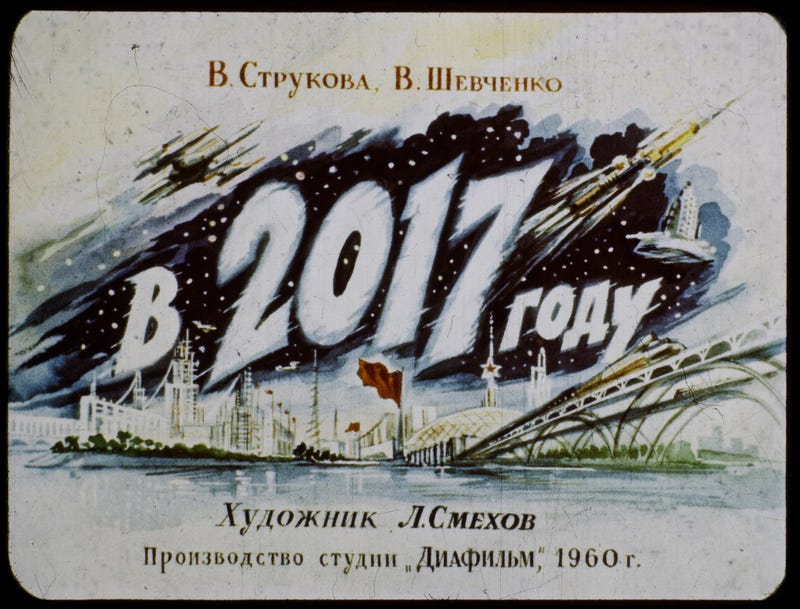
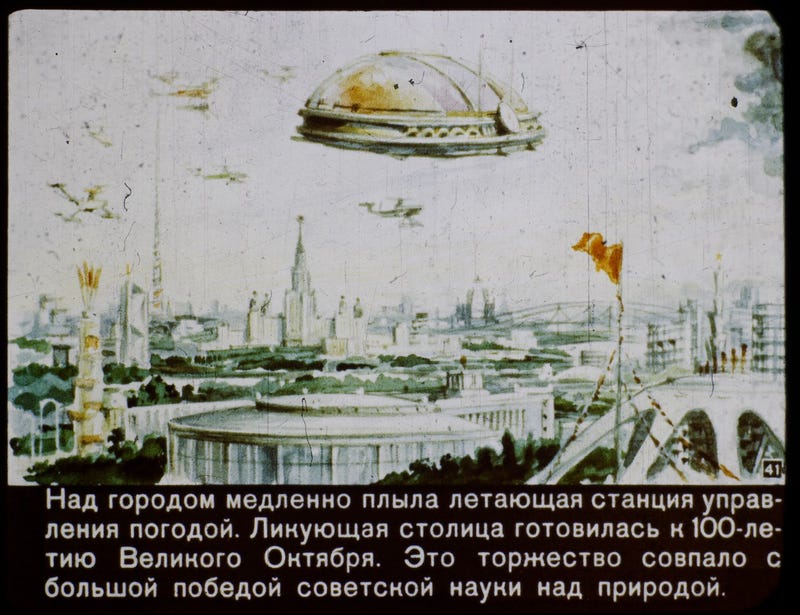
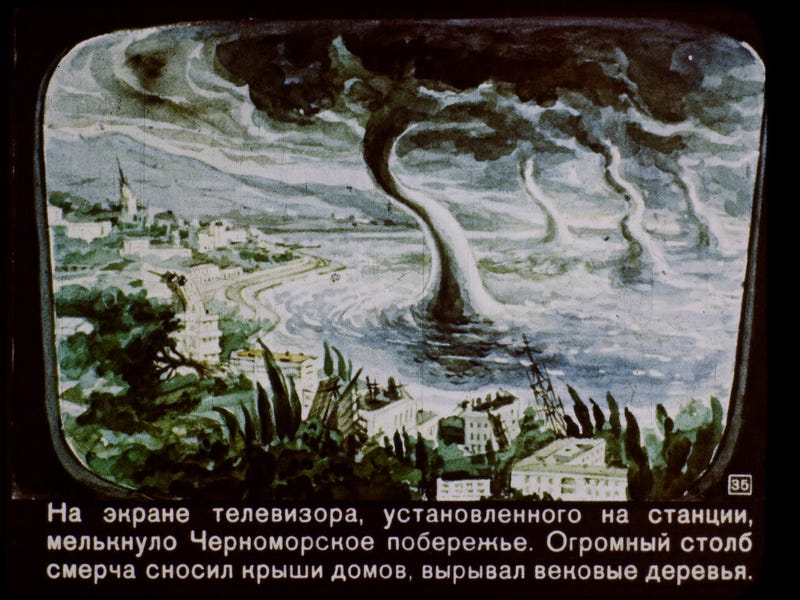
How Russians In 1960 Imagined the Year 2017


Matt Novak from Paleofuture:
Matt Baillie from the Facebook group Soviet Visuals sent me a tip about the retro-futuristic filmstrip... the illustrations were created by L. Smekhov and written by V. Strukova and V. Shevchenko. 
I’ve included select images from what appears to be the original source (Sergey Pozdnyakov) below, along with some of the translations from the Moscow Times

From the Moscow Times:
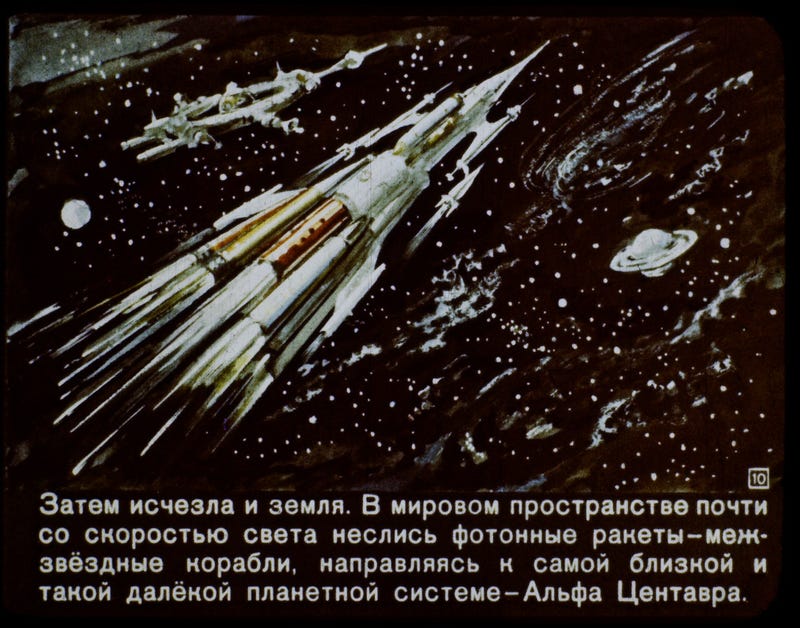
Then in the film, the Earth itself disappears. In outer space, almost at the speed of light, photon interstellar rocketships set off for the nearest and faraway planetary system, Alpha Centauri.
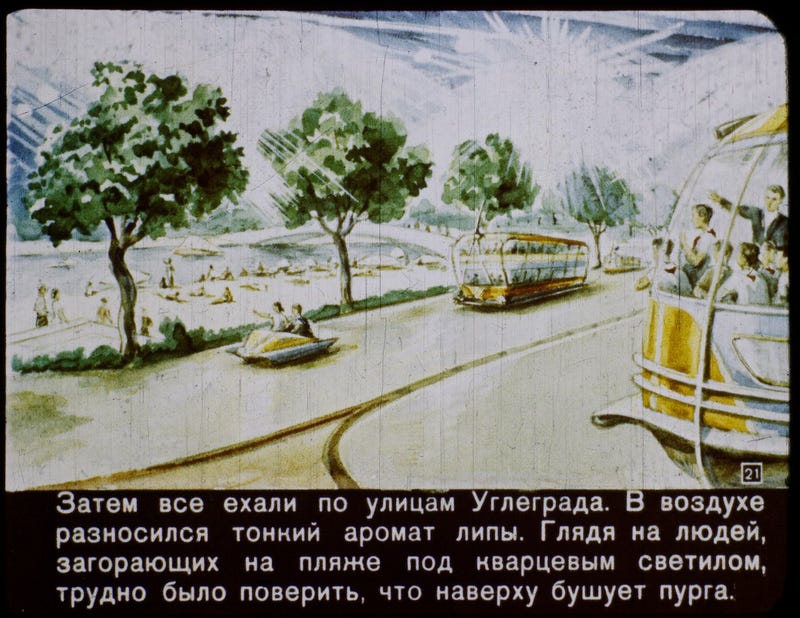
Of course they've envisioned a way to deal with the harsh winters:


by building an underground paradise:


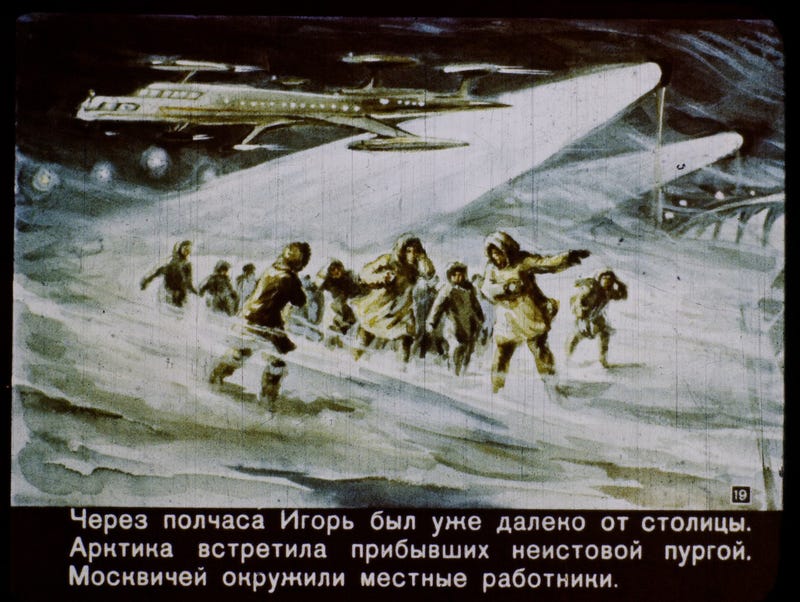
The Soviets have developed sophisticated weather control stations, which they occasionally have to use to save the world from the remnants of the dirty capitalists:


From the Moscow Times:
Meanwhile, back at the Central Institute for Weather Control, where Igor’s father works, there’s dire news. “We’ve just been informed,” the head meteorologist says, “that the last remaining imperialists, hiding on a remote island, have tested a banned meson weapon. During the test, there was an explosion of unprecedented strength, which destroyed the entire island and simultaneously created atmospheric disturbances around the planet.”


Someone put together a video version of the slide, with horrendous loud music - if you choose to watch it, I suggest that you turn the sound way down or mute it. There are no translations of the slides, but the Moscow Times has the whole set with translations.

Thursday, February 25, 2016

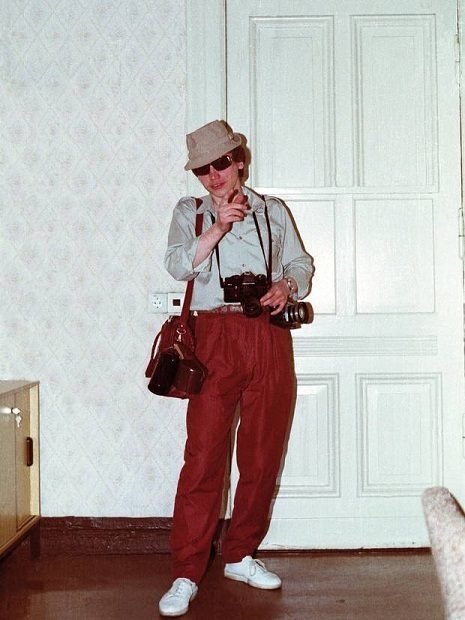
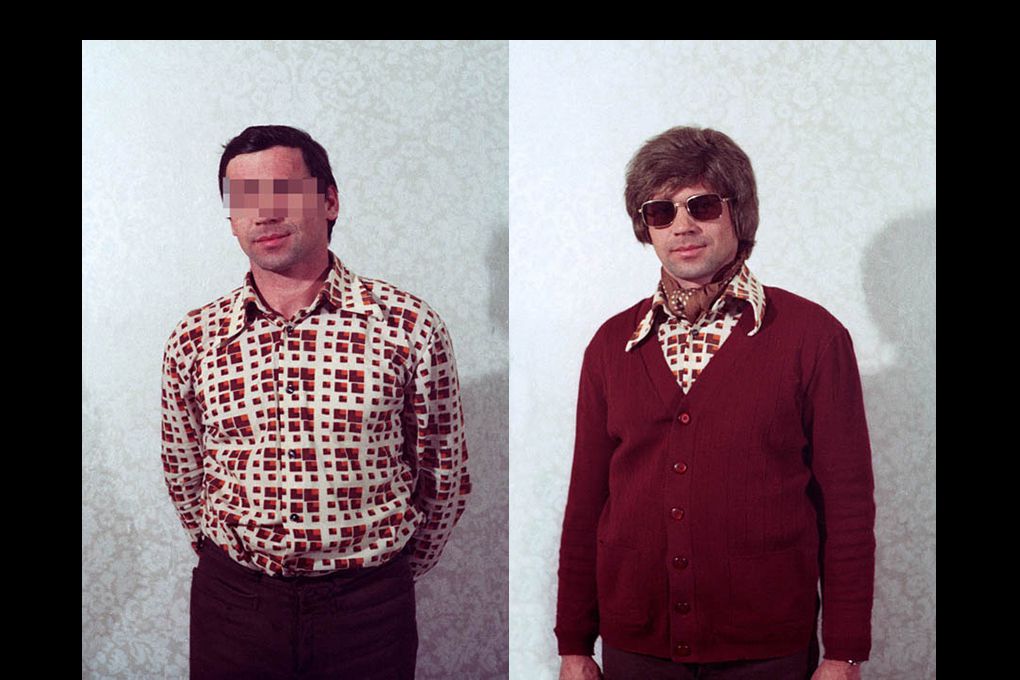
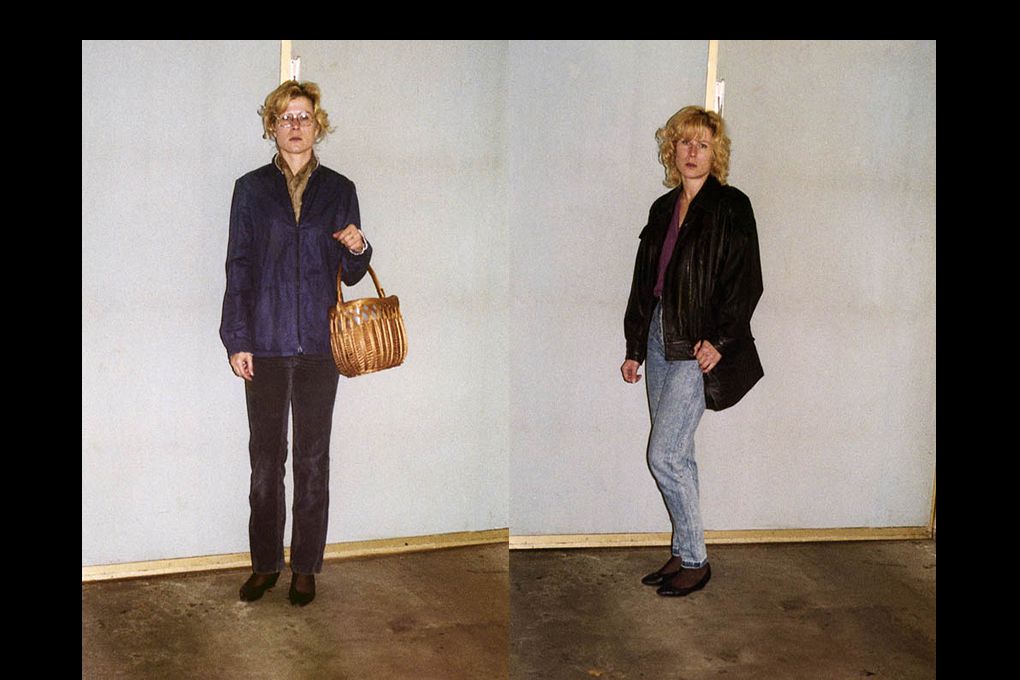
Fashion Advice from a 1980s East German Stasi disguise seminar

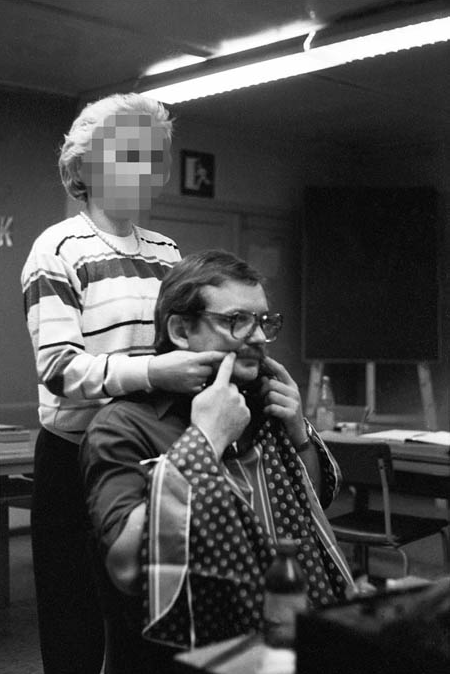
The pictures below are from official papers examined by author Simon Menner in the course of research for his book, Top Secret: Images from the Stasi Archivesand are now housed at the Stasi Archives. Documents included a dress code for undercover agents, since they were supposed to blend in and look like everybody else. From the book's synopsis at Amazon:
Almost 300,000 people worked for the STASI (wiki), the East German secret police--per capita, far more than are or were employed by agencies such as the CIA or the Soviet Union's KGB. Once top secret, and now preposterous, these images are both comical and sinister.
Flashbak has more numbers:
In 1989, 91,015 comrades worked directly for the Stasi (short for Staatssicherheitsdienst, or State Security Service), East Germany’s not-so-secret secret police (1950-1990). That’s from a population – and let’s be precise here – of 16,586,490. To keep the people watched at all times, the Stasi employed a further 173,081 part-time informants. In East Germany it was reasonable to assume you were being watched, your movements held on file.

At its apogee, the Stasi had a staff three times that of the Gestapo. “They offered incentives, made it clear people should cooperate, recruited informal helpers to infiltrate the entire society,” says Konrad Jarausch, of University of North Carolina. “They beat people up less often, sure, but they psychologically trampled people.”

Mustache-application lessons


Thursday, January 14, 2016

Thursday links


Infographic: What's the Most Powerful Weapon in Sci-Fi History?
Map of power outages caused by squirrels, with bonus squirrel-related links.

Stalin's Diminutive Size.

Venison Jello, Mystery Ingredients, and Other Triumphs of Soviet Cuisine.

ICYMI, Friday's links are here, and include Antarctica ownership conflicts, 100 manly skills,  the mysterious dancing epidemic of 1518, and the French power plant that runs on cheese.

Friday, October 16, 2015

Friday links

Early- to mid-20th century visions of sex in the future.

Lessons from the Sioux in How to Turn a Boy Into a Man.

The history of Oktoberfest is much bigger than beer.

For Rita Hayworth's birthday: this compilation of her dancing scenes set to Stayin' Alive will make your day.

Images Of A Young André, Before He Became The Giant.

How Soviets used IBM Selectric keyloggers to spy on US diplomats.

ICYMI, Monday's links are here, and include footage of Teddy Roosevelt's first airplane flight in 1910,  Columbus Day links, every Girl Scout catalog from 1917 to 2015, and a supercut of technology breaking down, then being beaten until it works again.

Tuesday, September 22, 2015

Tuesday links

First day of Fall (well, the middle of the night tonight, anyway): Autumnal equinox science, videos, quotes, poems, Vivaldi and Copernicus.

The Biggest Guns in Human History. Kind of related - Forgotten Weapons: The Burgess Folding Shotgun, a fascinating folding oddity from the 1890s.


"Fiddler On The Roof" opened on this date in 1964. Here's some history, the Chagall painting it was based on, Zero Mostel singing "If I Were A Rich Man" and a Lego version.

Gallery of Soviet cigarettes.

46 Vintage Photos Of Boston After The Great Fire Of 1872

ICYMI, Friday's links are here, and include Samuel Johnson insults, pulling a tooth with a drone, near-extinction events, and unusual travel warnings for visitors to the U.S.

Thursday, July 2, 2015

Thursday links

One for you New Yorkers: extraordinary collection of footage of NYC taken between 1896 and 1905, with maps.

The First Car Accident.


Communist Dollhouses: Stasi Chic in Miniature.

Winner of The 2015 World’s Ugliest Dog Contest, plus some previous winners.

Python Realized (Too Late) That Eating a Whole Porcupine Is Actually a Very, Very Bad Idea.

Discussion of the legal implications of using velociraptors in war.

ICYMI, Tuesday's links are here, and include the anniversary of the Night of the Long Knives, an extremely weird Norwegian potato chip video, funny clothing tags, the winners of NOAA's weather photo contest, and North Korean propaganda videos.

Tuesday, March 18, 2014

Tuesday links

The perfect communist word of tomorrow: Soviet Science Fiction of the Cold War.

The Himalayan Art of Hand-painted “Beware of the Dog” Signs.

A video tour of the (excellent) Museum of Bad Art.

15 Striking Portraits of Ancient Tribes Around the World.

Wilfred Owen, the best of the WWI "War Poets", was born 121 years ago today.


ICYMI, Friday's links are here, and include weird antique medical treatments, pig milk cheese, and a gallery of bizarre car accidents.

Wednesday, March 5, 2014

Wednesday links

It is mandatory to have a smile if you come across a child or pet. Even if they are ugly: 11 French Travel Tips for Visiting America. Geographically related: The Last Peach Orchards of Paris.

Old English Words We Should Still Use Today.

German Pro-Soviet Propaganda Of World War Two: The Crimea, The Jews And The Nazi Good Guys.

Dr. Seuss's Little-Known Book of Nudes: The Seven Lady Godivas (SFW)

Interactive Baby Name Visualizer: Enter a name (you can search over 29,000 names) and watch how its popularity spreads across the United States over the past century. Mouseover a state to its details.

ICYMI, Monday's links, including that crocodile-eating snake and the origins of American accents, are here.