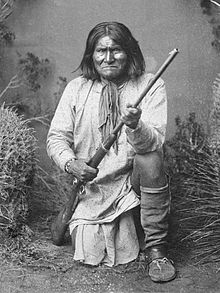
ICYMI, Friday's links are here, and include how bird feeders are changing bird evolution, a strange tale of triplets separated at birth, why we yell Geronimo when we jump out of planes, extreme breath-holding, and advice from 1761 on surviving cold and flu season.
Once I moved about like the wind. Now I surrender to you, and that is all.
~ Geronimo (wiki) (surrendering to General Crook, 25 March 1886)
It [Arizona] is my land, my home, my father's land, to which I now ask to be allowed to return. I want to spend my last days there, and be buried among those mountains. If this could be I might die in peace, feeling that my people, placed in their native homes, would increase in numbers, rather diminish as at present, and that our name would not become extinct.
~Geronimo (letter to President McKinley from the reservation at Fort Sill, Oklahoma, 1897)
If you tie a horse to a stake, do you expect he will grow fat? If you pen an Indian up on a small spot of ground, and compel him to stay there, he will not be contented, nor will he grow and prosper. I have asked some of the great white chiefs where they get their authority to say to the Indian that he shall stay in one place, while he sees white men going where they please. They can not tell me.
~ Chief Joseph (wiki) (ca. 1840-1904)* (North American Review, April 1879)
February 17th is the anniversary of the death in 1909 of that legendary Chiricahua Apache chieftain, Geronimo (born ca. 1829), whose actual Indian name was Goyathlay ("One Who Yawns"). The name by which Geronimo is remembered was supposedly bestowed on him by a detachment of Mexican soldiers so stunned by the ferocity of his resistance that they repeatedly invoked the name of St. Jerome against him.
Born along the Gila River in what is now Arizona during a time when his people were fighting both U.S. and Mexican settlers for their lands, Geronimo became a raider after his own family was killed in 1858. He was captured several times and confined to a reservation, but he escaped repeatedly to continue his campaign of guerilla warfare, most notably during 1885-86, when 5,000 U.S. soldiers were arrayed against his small band.
Finally recaptured and imprisoned, first in Florida and then in Alabama, Geronimo and his family were allowed to 1894 to settle on an Indian reservation at Fort Sill, Oklahoma, where he spent the rest of his life as a prosperous farmer and minor celebrity. (He appeared at the 1904 St. Louis World's Fair and rode in Theodore Roosevelt's inaugural parade a year later. In his autobiography, he remarked,
"I cannot think that we are useless or God would not have created us. There is one God looking down on us all. We are all the children of one God. The sun, the darkness, the winds, are all listening to what we have to say.")
* N.B. Chief Joseph (Hinmatóowyalahtq’it) was the greatest latter-day chief of the Nez Perce Indians of northwestern Oregon.
The reason that U.S. airborne troops yell "Geronimo!" when they jump out of airplanes has to do with a 1939 movie entitled Geronimo (a1993 movie by the same title is also available) which was viewed by a group of early paratroopers (the Parachute Test Platoon in Fort Benning, Georgia) in 1940. The concept of jumping from planes with parachutes was nerve-racking, and in order to demonstrate his bravery one of them planned to yell:
The other soldiers gave him a hard time. They were all scared. Of course he was scared, too. He should just admit it.
"All right, dammit!” Eberhardt finally shouted. “I’ll tell you jokers what I'm gonna do! To prove to you that I'm not scared out of my wits when I jump, I'm gonna yell ‘Geronimo’ loud as hell when I go out that door tomorrow!"
The next day, he made good on his promise. Out the plane he went and everyone heard “Geronimooooooo!” The rest of the platoon wasn’t about to let Eberhardt show them up, so on subsequent jumps the rest of the soldiers took up his battle cry and a tradition was born. The next year, the Army’s first official parachute unit, the 501st Parachute Infantry Battalion, made “Geronimo” the motto on their unit insignia after their commander tracked down descendants of the real Geronimo to ask for their permission to use his name.
This has been my “standard” house marinara sauce for many years and can be used as the basis for other sauces. By the way, despite the name, which means roughly “sailor sauce,” this recipe has nothing particularly nautical about it..
2 Tb olive oil
1 medium yellow onion, chopped
2 small carrots, chopped
2 large garlic cloves, chopped
Freshly ground pepper and salt, to taste
2 28-oz cans of imported peeled Italian tomatoes* (San Marzano variety, if possible)
3 Tb butter
1/2 tsp dried hot pepper, ground fine (optional)
I generally use the Cuisinart to chop the onions and carrots together but mince the garlic separately. Then, sauté the onions, carrots, and garlic in the olive oil until the onions and carrots are soft.
*Add the tomatoes, roughly chopping them or breaking them up with your hands, reserving the juice from the cans. Add the salt and pepper, and simmer uncovered over low heat – stirring occasionally – until most of the liquid boils off and the mixture gets somewhat thick. (Scott says 20 minutes, but I usually take at least 30.) If you go too far and the sauce gets too thick, use the reserved tomato juice to thin it – it’s a matter of judgment and preference.
In order to end up with a smooth sauce, push the sauce through a food mill into a separate sauce pan, where you had the butter melting with the hot pepper. (I use a Foley Mill to puree the sauce, and it should emerge somewhat “velvety.” It takes a lot of reiterated “back and forth” to completely separate out the seeds and solids, so don’t give up early.) Stirring often, cook another 15 minutes or so over low heat – more if the sauce needs further reduction to the right consistency. (Again, that’s a matter of judgment, as is the amount of garlic and hot pepper you include.) Makes about 7 cups and doubles well. It will keep at least a week if refrigerated and freezes well also.