Amazon Deals

New at Amazon

Saturday, June 15, 2024

One of my favorite Father's Day stories (NSFW- language)

This is from Justin Halpern, author of Sh*t My Dad Says, and is funny and weirdly touching. NSFW.

You Take What You Need From Your Father
Father’s Day has never been a big deal at my house. My dad hates celebrations. He goes through the motions for Christmas because it means a lot to my mom. He’ll put up with Easter because it means he gets to eat ham. “You can pretty much get to do whatever you want if you give me ham,” he’s said many times in my life. But Father’s Day is technically his holiday, and therefore he feels he has the right to squash it in our house. 
“Anyone can fucking procreate, and most eventually do. I refuse to celebrate a statistical probability,” he announced on Father’s Day when I was seventeen.
I was about to graduate from high school, and my relationship with my dad during the last year had been rocky. Everything we did seemed to annoy one another. I dealt with the friction by avoiding being in the house while he was there, and he dealt with it by repeating the phrase, “You mind? I’m watching the fucking Nature Channel.” 
So when he told me on the morning of Father’s Day that year that he would not partake in a celebration, frankly, I was fine with it. But my mother was not. That night I sat on my bed reading a brochure from San Diego State University, where I was heading in the fall, when the door to my room opened and my father entered.
“Sorry to interrupt whatever it is you’re doing,” he said.
“I’m just looking at some of the classes they have at State,” I said. 
“Oh yeah? Like what?” 
“You want to know?” 
“Ah, fuck it, not really. Listen, your mother thinks you’re going to go off to college and hate me and then we’re not going to be friends again until I’m dying and I got a wad of shit in my pants. That’s bullshit right?” 
“Ah – “ 
“So, look, I’m not an easy guy to get along with. I know that. But you know I would murder another human being for you if it came down to it. Murder. Fucking homicide. If it came down to it.” 
“Why would you need to do that for me?” I said. 
“I don’t know. Maybe you get mixed up in some gambling shit or you screw some guy’s wife or – don’t matter. Not my point. My point is: I may seem like an asshole, but I mean well. And I want to tell you a story,” he said, taking a seat on the foot of my bed before quickly jumping up.
“Your bed smells like shit. Where can I sit that doesn’t smell like shit?” 
I pointed to my desk chair, which was covered with dirty clothes. He brushed the clothes onto the ground and collapsed in the chair. 
“Just for your information, this chair also smells like shit. This isn’t a non-­‐shit-­‐smelling option. In case a girl comes over or something.” 
“What’s your story, Dad?” I snapped. 
“I ever tell you how I mangled my arm?” he asked, pointing to the large, white crescent-­‐shaped scar that practically circled his entire elbow.
“Yeah, lots of times. You were, like, ten and you were on the farm and you fell off a tobacco wagon, then the wagon rolled over it.” 
“Right. But I ever tell you what happened after the wagon rolled over it?”
“Maybe.” 
He leaned back in the chair. “I was laying on the ground, bones poking through my skin. Your Aunt Debbie is just going ape-­‐shit. They pop me in our car, and we drive forty-­‐five minutes to Lexington to the doctor’s. This is 1946 Kentucky, and my town was a shit stain on a map so we had to drive to the city. So the doc sees me, dresses the wounds best he can, and puts me up in the hospital bed. At this point I’m about to pass out on account of the pain.” 
“I almost had that happen once,” I interrupted. 
No you didn’t. So anyway, I’m lying in my hospital bed when your Grandpa gets there. And your Grandpa was a tough son of a bitch. He wasn’t like how you knew him; he softened up in his nineties. So Grandpa grabs the doc, and your Aunt Debbie and the two of them go outside my room. I can hear them talking, but they don’t know that. The doc tells your Grandpa that they think there’s a good chance that an infection has already taken hold in my arm. And Grandpa, in that scratchy voice he’s got, asks what that means. And the doc tells him it means they have some medicine they can give me that might kill the infection, but it might not, and if it doesn’t, I’ll die.” 
“You heard the doctor say that?” 
“Yep.” 
“What’d you do?”
“What do you mean? I had fucking bones coming out of my elbow. I didn’t do shit. So the doc tells Grandpa that there’s a 50/50 chance the medicine works. But then he says there’s another option. He tells Grandpa if they amputate my arm at the elbow, there’s a 100 percent chance that I’ll live.” 
“What did Grandpa say?” I asked, inching toward the edge of the bed. 
“He said, ‘Give him the medicine.’ And the doc says, ‘But there’s a 50 percent chance he’ll die.’ Then it’s quiet for a bit. Nobody making a fucking peep. Then I hear Grandpa clear his throat and say, ‘Then let him die. There ain’t no room in this world for a one-­‐armed farmer.”
My dad fell silent and leaned back in the chair, stretching his legs out.
My dad hadn’t told me many stories about his father at this point, and I wasn’t quite sure how he felt about the man. This was the first time I had gotten a glimpse.       
“Man, I’m really sorry, Dad.” 
“Sorry for what?” he asked, his face morphing into a look of confusion as he sat up straight in the chair. 
“Well, that’s, I don’t know, that’s really… messed up. I can’t believe Grandpa did that.” 
“What in the fuck are you talking about? The man saved my arm! They were going to cut off my arm and he saved it. That’s my point: Grandpa could be an asshole sometimes but when it came down to it he was there for me.” 
“That’s what you took from that?” 
“Hell yes. I don’t know what else you were expecting me to take. Imagine me with one goddamned arm. Be a fucking disaster. Anyway, just like Grandpa cared about me, I care about you and I don’t want you out there hating me, cause I don’t hate you. I love the shit out of you.” 
He stood up, ironing his pants’ front with his hands. 
“Jesus H. Christ, do something about the fucking smell in this room.” 
Fourteen years later, on this Father’s Day, despite his reluctance to celebrate the holiday, I’d like to thank my dad for everything he’s done for me and advise him: If a wagon ever crushes me, let’s not roll the dice. Cut off my arm, Dad. There’s more than enough room in this world for a one-­‐armed writer. 
~Justin Halpern June 2011

“Kids, you tried your best and you failed miserably. The lesson is, never try.” Parenting advice from Homer Simpson

For fellow Simpsons fans:

“No, no, no, Lisa. If adults don’t like their jobs, they don’t go on strike. They just go in every day and do it really half-assed. That’s the American Way.”

“OK, son. Just remember to have fun out there today, and if you lose, I’LL KILL YOU!”

“You tried your best and you failed miserably. The lesson is, never try.”

“The code of the schoolyard, Marge! The rules that teach a boy to be a man. Let’s see. Don’t tattle. Always make fun of those different from you. Never say anything, unless you’re sure everyone feels exactly the same way you do. What else…”

“Kids, you tried your best and you failed miserably. The lesson is, never try.”

“When I look at the smiles on all the children’s faces, I just know they’re about to jab me with something.”

“I have to work overtime at work instead of spending time with my wife and kids, which is what I want.”

“Kids are great, Apu. You can teach them to hate the things you hate and they practically raise themselves now-a-days, you know, with the internet and all.”

“I think the saddest day of my life was when I realized I could beat my Dad at most things, and Bart experienced that at the age of four.”

“Don’t eat me. I have a wife and kids. Eat them.”

“Marge, don’t discourage the boy! Weaseling out of things is important to learn. It’s what separates us from the animals! Except the weasel.”

“What do we need a psychiatrist for? We know our kid is nuts. “

“It’s not easy to juggle a pregnant wife and a troubled child, but somehow I managed to squeeze in 8 hours of TV a day.”

“Remember as far as anyone knows, we’re a nice normal family.”

“Marriage is like a coffin and each kid is another nail.”

“The key to parenting is don’t overthink it. Because overthinking leads to … what were talking about?”

Related:

Funny signs from The Simpsons (and links to lots more).

An archive of Bart's blackboard writing. The graphic below is from 2012 - click on it to zoom.


Friday, June 14, 2024

Mark Steyn on remembering the lessons from Magna Carta: The Field Where Liberty Was Sown

This 2015 post was written on the occasion of the 800th anniversary of the signing of Magna Carta; I no longer see this on Mark's website, so I've copied it here from an archive. Here's the original link - if it starts working again I'll delete this post and point to it.

The most important anniversary this year falls on Monday June 15th, marking the day, eight centuries ago, when a king found himself in a muddy field on the River Thames near Windsor Castle with the great foundational document of modern liberty under his nose and awaiting his seal. Here’s what I had to say about it earlier this year:

The world has come a long way since Magna Carta, and not always for the best. A couple of years back, testifying to the House of Commons in Ottawa about Canada’s (now repealed) censorship law, I said the following:
Section 13 is at odds with this country’s entire legal inheritance, stretching back to Magna Carta. Back then, if you recall–in 1215–human rights meant that the King could be restrained by his subjects. Eight hundred years later, Canada’s pseudo-human rights apparatchiks of the commission have entirely inverted that proposition, and human rights now means that the subjects get restrained by the Crown in the cause of so-called collective rights that can be regulated only by the state.
I liked it better the old way. Real rights are like Magna Carta: restraints on state power. Too many people today understand the word “rights” to mean baubles and trinkets a gracious sovereign bestows on his subjects – “free” health care, “free” community college, “safe spaces” from anyone saying anything beastly – all of which require a massive, coercive state regulatory regime to enforce.

But, to give it its full name, Magna Carta Libertatum (my italics – I don’t think they had ’em back then) gets it the right way round. It was in some respects a happy accident. In 1215, a bunch of chippy barons were getting fed up with King John. In those days, in such circumstances, the malcontents would usually replace the sovereign with a pliable prince who’d be more attentive to their grievances. But, having no such prince to hand, the barons were forced to be more inventive, and so they wound up replacing the King with an idea, and the most important idea of all – that even the King is subject to the law.

On this 800th anniversary, that’s a lesson worth re-learning. Restraints on state power are increasingly unfashionable among the heirs to Magna Carta: in America, King Barack decides when he wakes up of a morning what clauses of ObamaCare or US immigration law he’s willing to observe or waive according to royal whim; his heir, Queen Hillary, operates on the principle that laws are for the other 300 million Americans, not her. In the birthplace of Magna Carta, a few miles from that meadow at Runnymede, David Cameron’s constabulary leans on newsagents to cough up the names and addresses of troublesome citizens who’ve committed the crime of purchasing Charlie Hebdo.

The symbolism was almost too perfect when Mr Cameron went on TV with David Letterman, and was obliged to admit that he had no idea what the words “Magna Carta” meant. Magna Carta Libertatum: The Great Charter of Liberties. I’m happy to say Mr Cameron’s Commonwealth cousins across the Atlantic in Ottawa are more on top of things: One of the modestly heartening innovations of Stephen Harper’s ministry is that, when immigrants to Canada take the oath of citizenship, they’re now given among other things a copy of Magna Carta.

Why? Because everything flows therefrom – from England’s Glorious Revolution to the US Constitution and beyond. It’s part of the reason why the English-speaking world, in contrast to Continental Europe, has managed to sustain its freedoms across the generations – at least until now. As John Robson, my old colleague from Conrad Black’s Hollinger group, puts it:
All the rights we cherish, from due process of law to elected representatives, trace back to it. It has been assailed time and again and always defended. It’s why we have rights today. But that story needs to be told again and again or it will be lost and with it our freedom.
Security of the person, property rights, religious freedom, due process… The core animating principles of modern free societies began in that muddy field in Runnymede eight centuries ago. That’s why it’s the most important anniversary of the year: when the pampered, solipsistic beneficiaries of an 800-year inheritance start to lose the habits of liberty, only darkness lies ahead. Better to re-learn the old lessons while we still can.

Sunday, May 26, 2024

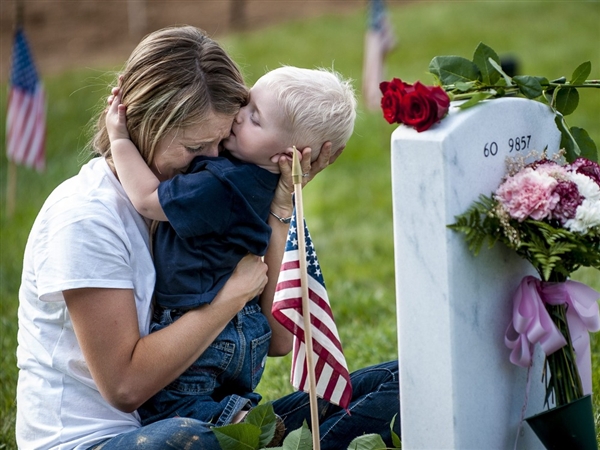
Memorial Day

Sleep, comrades, sleep and rest
On this Field of the Grounded Arms,
Where foes no more molest,
Nor sentry's shot alarms!

Ye have slept on the ground before,
And started to your feet
At the cannon's sudden roar,
Or the drum's redoubling beat.

But in this camp of Death
No sound your slumber breaks;
Here is no fevered breath,
No wound that bleeds and aches.

All is repose and peace,
Untrampled lies the sod;
The shouts of battle cease,
It is the Truce of God!

Rest, comrades, rest and sleep!
The thoughts of men shall be
As sentinels to keep
Your rest from danger free.

Your silent tents of green
We deck with fragrant flowers;
Yours has the suffering been,
The memory shall be ours. 

~ Henry Wadsworth Longfellow, Decoration Day* 

They went with songs to the battle, they were young,
Straight of limb, true of eye, steady and aglow.
They were staunch to the end against odds uncounted;
They fell with their faces to the foe.

They shall grow not old, as we that are left grow old:
Age shall not weary them, nor the years condemn.
At the going down of the sun and in the morning
We will remember them.**

- Laurence Binyon, For the Fallen 


Until 1967 known as "Decoration Day" and formerly celebrated on 30 May before "long-weekend" national holidays were introduced the next year, various Memorial Days were first observed after the Civil War in both the North and South, when the graves of the fallen were decorated with flowers and bunting. The first widespread use of the 30 May date took place in 1868 as an observance organized by the Union Army veterans' organization, the Grand Army of the Republic, and this custom gradually spread to the rest of the country and was later expanded to honor the dead of all the nation's wars. 

In a speech just six months before his own death, General George S. Patton, Jr. (1885-1945) noted,
"It is foolish and wrong to mourn the men who died. Rather, we should thank God that such men lived." )
* N.B. Longfellow's "Decoration Day" is from his collection, In the Harbor (1882). 

** The fourth verse of (Robert) Laurence Binyon's "For the Fallen" (1914) - generally followed by the phrase, "Lest we forget" - is now part of virtually every war memorial service in Britain and her former colonies. 

Dulce et decorum est pro patria mori,
mors et fugacem persequitur virum.
nec parcit imbellis iuventae
poplitibus timidove tergo.

~ Quintus Horatius Flaccus (Horace), Carmina, III, ii, 13
(To die for the fatherland is a sweet and admirable thing.*
Death is at the heels even of the runaway, nor spares
the haunches and back of the coward and malingerer.)
A brief history of Memorial Day:


Related posts and links:
Here's How To Make An American Flag Out Of Bacon

Monday, May 20, 2024

What phrases commonly used today are derived from obsolete technologies?

I've always found phrase origins fascinating - they can give us a glimpse into an entirely different reality, and, perhaps more importantly, they remind us of how many things we accept without question. We should definitely be questioning more.

Some examples of origins you may not know: 

"Hang up the phone."
 This comes from one specific kind of land-line phone that had a kind of hook you'd hang the handset from when you were done. Doing so would pull down the hook that was connected to a switch inside the phone that would disconnect the line.
Originating from printing houses in the days of moveable type:

Upper Case and Lower Case: 
The individual type blocks used in hand typesetting are stored in shallow wooden or metal drawers known as "type cases". Each is subdivided into a number of compartments ("boxes") for the storage of different individual letters.
The terms upper and lower case originate from this division. By convention, when the two cases were taken out of the storage rack, and placed on a rack on the compositor's desk, the case containing the capitals and small capitals stood at a steeper angle at the back of the desk, with the case for the small letters, punctuation and spaces being more easily reached at a shallower angle below it to the front of the desk, hence upper and lower case.


"Mind your Ps and Qs":
A warning to printers’ apprentices to take care when selecting the little blocks with letters on, to ensure that they didn’t confuse the P block with the Q block, and vice versa.


Cut (or copy) and paste: 
The term "cut and paste" comes from the traditional practice in manuscript-editings whereby people would cut paragraphs from a page with scissors and paste them onto another page. This practice remained standard into the 1980s.


To run through the wringer (or put through the wringer) referred to this laundry device that predated the spin cycle.


There's lots of ship-related stuff (more here):

Above Board - Anything on or above the open deck. If something is open and in plain view, it is above board.

As the Crow Flies - When lost or unsure of their position in coastal waters, ships would release a caged crow. The crow would fly straight towards the nearest land thus giving the vessel some sort of a navigational fix. The tallest lookout platform on a ship came to be know as the crow's nest.

Between the Devil and the Deep Blue Sea - The devil seam was the curved seam in the deck planking closest to the side of the ship and next to the scupper gutters. If a sailor slipped on the deck, he could find himself between the devil and the deep blue sea.

Deck hatch
Booby Hatch - Aboard ship, a booby hatch is a sliding cover or hatch that must be pushed away to allow access or passage.

Buoyed Up - Using a buoy to raise the bight of an anchor cable to prevent it from chafing on a rough bottom.

By and Large - Currently means in all cases or in any case. From the nautical: by meaning into the wind and large meaning with the wind: as in, "By and Large the ship handled very well."

Groggy - In 1740, British Admiral Vernon (whose nickname was "Old Grogram" for the cloak of grogram which he wore) ordered that the sailors' daily ration of rum be diluted with water. The men called the mixture "grog". A sailor who drank too much grog was "groggy".

Leeway - The weather side of a ship is the side from which the wind is blowing. The Lee side is the side of the ship sheltered from the wind. A lee shore is a shore that is downwind of a ship. If a ship does not have enough "leeway" it is in danger of being driven onto the shore.

Pipe Down - Means stop talking and be quiet. The Pipe Down was the last signal from the Bosun's pipe each day which meant "lights out" and "silence".

Pooped - The poop is the stern section of a ship. To be pooped is to be swamped by a high, following sea.

Rummage Sale - From the French "arrimage" meaning ship's cargo. Damaged cargo was sold at a rummage sale.

Scuttlebutt - A butt was a barrel. Scuttle meant to chop a hole in something. The scuttlebutt was a water barrel with a hole cut into it so that sailors could reach in and dip out drinking water. The scuttlebutt was the place where the ship's gossip was exchanged.

Skyscraper - A small triangular sail set above the skysail in order to maximize effect in a light wind.

Bitter end
Slush Fund - A slushy slurry of fat was obtained by boiling or scraping the empty salted meat storage barrels. This stuff called "slush" was often sold ashore by the ship's cook for the benefit of himself or the crew. The money so derived became known as a slush fund.

The Bitter End - The end of an anchor cable is fastened to the bitts at the ship's bow. If all of the anchor cable has been payed out you have come to the bitter end.

The Devil to Pay - To pay the deck seams meant to seal them with tar. The devil seam was the most difficult to pay because it was curved and intersected with the straight deck planking. Some sources define the "devil" as the below-the-waterline-seam between the keel and the the adjoining planking. Paying the Devil was considered to be a most difficult and unpleasant task.

Sails "in the wind"
Three Sheets to the Wind - A sheet is a rope line which controls the tension on the downwind side of a square sail. If, on a three masted fully rigged ship, the sheets of the three lower course sails are loose, the sails will flap and flutter and are said to be "in the wind". A ship in this condition would stagger and wander aimlessly downwind.

To Know the Ropes - There was miles and miles of cordage in the rigging of a square rigged ship. The only way of keeping track of and knowing the function of all of these lines was to know where they were located. It took an experienced seaman to know the ropes.

And, moving beyond the nautical:

Post in the sense of "a blog post": from the act of nailing a sign to a wooden post, or from sending a message via a system of posted riders and horses (i.e., they are assigned to their stations, a.k.a. their posts).

Run of the Mill: Mills have very large and heavy grinding stones, it takes some time to get to normal speed for grinding grains. At the operational speed, they produce a nice, fine and uniform powder or grounded grains (flour etc.), this "steady state" output was called run of the mill. Which has come to mean "ordinary".

Software bugs and debugging: In the context of computers it uses was popularized by Grace Murray Hopper, involving an electromechanical fault in the Mark II computer, due to a moth stuck in one of the relays. 


Know of any others? Leave them in the comments!