Amazon Deals

New at Amazon

Showing posts with label dinosaur. Show all posts

Wednesday, October 23, 2019

Wednesday links

Dubious medical device du jour - the prostate warmer.

Scientists are investigating the secrets of smelly cat butts - apparently anal sacs can tell you a lot about an animal.


The peculiar bathroom habits of Westerners. Related: Toilet Paper History: How America Convinced the World to Wipe. My favorite writing on the subject is the toilet paper advice from Lord Chesterfield's Letters to His Son.

The Origin of the Bar Foot Rail.


ICYMI, most recent links are here, and include 1960 instructions for building your own fallout shelter, the anniversary of Trafalgar Day, the 19th century practice of dining and dating in cemeteries, and why sodas in outdoor vending machines don't freeze in the winter.

Tuesday, August 21, 2018

Tuesday links

Dorothy Parker's birthday: quotes, poems, a brief bio, and the weird journey of her ashes.

The etymology of 'orange': Which came first, the color or the fruit?

History of Money Design: How Did American Dollar Bills Change?

These awkward Russian glamour photos are a hoot.


Smartphone screens found to be more than three times dirtier than a toilet seat.

ICYMI, Friday's links are here, and include the histories of 1. macaroni and cheese, and 2. posthumous executions, the anniversary of the death of climate change hero Genghis Khan, Steve Jobs illegitimate daughter, and Davy Crockett's birthday.

Tuesday, June 26, 2018

Tuesday links

The Swiss Army Survival Tampon: 7 Survival Uses. Related, from the same guy: 11 Ways A Condom Can Save Your Life.

Getting angry and flipping over a table: the supercut.

Interactive Map Shows Where Your House Would Have Been 750 Million Years Ago. Type in your address and use the drop-down arrow at the top of the page to chose how far back to go, or just use the up and down arrow keys.

As a recruiting tool, the U.S. Navy built a battleship in New York City's Union Square. It was there from 1917-1920.

The parakeet has a goiter: the best standard publisher rejection letter ever.


ICYMI, Friday's links are here, and include the birthday of Ambrose Bierce (author of The Devil's Dictionary), the history of state liquor laws, awkward pregnancy photos, Japanese spider fighting, and that time the U.S. released a bioweapon in San Francisco.

Friday, January 12, 2018

Friday links

Director John Ford's WWII-era movies made for the pre-CIA OSS How to Operate Behind Enemy Lines and Sex Hygiene.


A Victorian dinosaur park.

Sunday, January 14: Happy Feast of the Ass.

People Walked Differently in Medieval Times.

Thomas Edison's sci-fi novel.

ICYMI, Wednesday's links are here, and include an $800 belt with airbags to protect your hips, the anniversary of Julius Caesar crossing the Rubicon River, how illegal shipping containers reshaped the world economy, and (via video x-ray camera) how hamsters fit so much in their cheeks.

Friday, May 19, 2017

Friday links

Now there's a KFC romance novel: Tender Wings of Desire.

The psychological effects of growing up with an extremely common name.

Victorians Believed That a Train Ride Could Cause Instant Insanity.

What to do if you get caught in an avalanche.

Here's the Justice Department’s guide to using psychics in police investigations.

How Much Force Could a T.Rex Bite Deliver?

ICYMI, Wednesday's links are here, and include second careers of former football players, digitizing a 6 foot tall 17th century book, a few dancing clips for Fred Astaire's birthday, and Thomas Sowell on greed.

Sunday, September 4, 2016

Why would we evolve to poop in the same place as our friends?

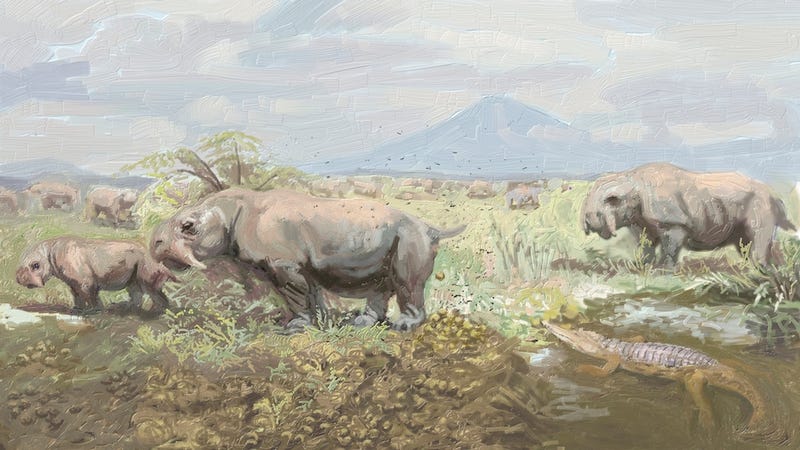
Artistic recreation of the ancient reptiles, dicynodonts, using
their communal latrine. Courtesy of Emilio López Rolandi.
Communal latrines, or defecation spots, are exactly what they sound like: Relatively small areas where multiple individuals relieve themselves, sometimes at the same time. Humans and housecats obviously defecate in communal latrines, but studies show that a number of other mammals do, too, and the behavior is particularly common among large herbivores. 

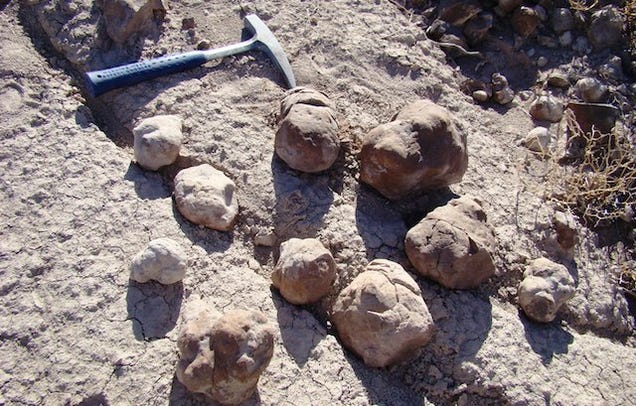
In fact, research shows this behavior was an ancient evolutionary development: scientists have discovered a large, rhino-like reptile defecated in "communal latrines" some 240 million years ago. Turns out, communal latrines have important biological functions. 

The eight communal latrines the researchers discovered were each 400 to 900 square meters and 1.5 kilometers apart. These fields were loaded with fossilized poo called coprolites - within the latrines, there were, on average, 67 coprolites per square meter, but in some areas the poo density reached 94 coprolites per square meter. Given the amount of coprolites and their size variation, the researchers believe the latrines were really communal, and used by many animals of different ages. 

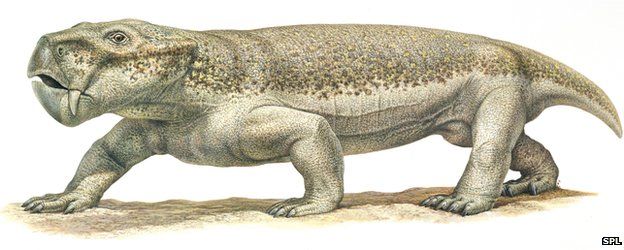
The culprits were dicynodonts - ancient megaherbivores
"There is no doubt who the culprit was," said Dr Lucas Fiorelli, of Crilar-Conicet, who discovered the dung heaps. The perpetrator was Dinodontosaurus, an eight-foot-long megaherbivore similar to modern rhinos. These animals were dicynodonts - large, mammal-like reptiles common in the Triassic period when the first dinosaurs began to emerge. The fact they shared latrines suggests they were gregarious, herd animals, who had good reasons to poo strategically, said Dr Fiorelli:
"Firstly, it was important to avoid parasites - 'you don't poo where you eat', as the saying goes.
"But it's also a warning to predators. If you leave a huge pile, you are saying: 'Hey! We are a big herd. Watch out!"
 The new discovery also indicates that the seemingly mammal-only behavior of defecating in communal latrines developed before mammals first evolved. This new find actually predates the previous fossil record of communal latrines by 220 million years. We may owe our sanitary practices to our reptile ancestors.
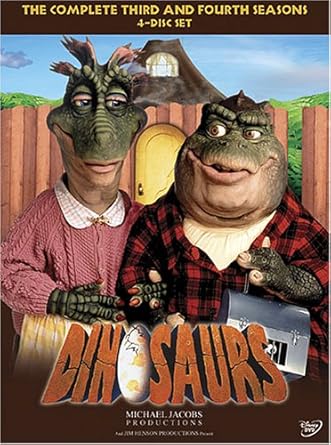
Anyone remember the show Dinosaurs? Here's the episode where the baby runs away to the forest rather than poop in the same place as everyone else, because, as he explains it to the other forest denizens (hereafter FD1 and FD2),..

Baby: They tried to make me go potty.

FD1 explains to the others: When nature calls you've got to go to this one particular room and sit in this special chair...

FD2: You're making this up!

FD1: No, wait, wait wait there's even more conditions than that - everyone uses the same chair!

(loud expressions of disgust)

FD2: But, wait, what if you have to go and someone's already using the chair?

FD1: Then you have to wait.

FD2: But what if you can't wait?

FD1: You have to!

Baby: I wanna go when I wanna go!

FD1: Well, that's how we do it out here. You can go any time you want, anywhere you want.

Baby: Anywhere?

FD2: Well, except over there - that's the volleyball court.

Start watching at 8:50, if the video doesn't automatically start there:


Here's the full scientific article, a report at BBC, and discussion at io9.

Friday, January 15, 2016

Friday links

January 17 is Ben Franklin's birthday - bio, quotes, videos, his 200 synonyms for drunk, the bodies found in his basement, and more.


A brief  history of shaving.


The Delicate Art of Breeding Cheetahs.

Dinosaurs performed dances to woo mates, according to new evidence.

ICYMI, Thursday's links are here, and include the Feast of the Ass, an infographic on the most powerful weapon in sci-fi history, a map of power outages caused by squirrels (with bonus squirrel-related links), and that time President George H. W. Bush escaped cannibals.

Sunday, May 18, 2014

Holy crap - look at the size of this bone: Biggest dinosaur ever discovered (update: more photos of big dino bones)

It's time to revise all of those dinosaur books once again - scientists in Argentina have uncovered the bones of a creature believed to be the world’s biggest dinosaur.

Based on its huge thigh bones, it was 130ft long and 65ft tall. Scientists believe it is a new species of titanosaur - an enormous herbivore dating from the Late Cretaceous period.

Fossilised bones of a dinosaur believed to be the largest creature ever to walk the Earth have been unearthed in Argentina, palaeontologists say.
The bones were initially discovered a year ago by a local farm worker in the desert near La Flecha, about 135 miles west of the Patagonian town of Trelew, and were this week excavated by a team of paleontologists. They unearthed the partial skeletons of seven individuals - about 150 bones in total - all in "remarkable condition".


This giant herbivore lived in the forests of Patagonia between 95 and 100 million years ago, based on the age of the rocks in which its bones were found. 

Argentinosaurus
Weighing in at 77 tons, it was as heavy as 14 African elephants, and 7 tons heavier than the previous record holder, Argentinosaurus, a similar type of sauropod, also discovered in Patagonia.

There have been many previous contenders for the mantle of the world’s largest dinosaur and some scientists say it is difficult to determine with any certainty which is the winner.

The Argentine researchers say the number of bones discovered give them enough material to be confident they have found “the big one”. This video describes how the creature's size and mass are calculated from the existing bones:


But while Dr. Paul Barrett, a dinosaur expert from London’s Natural History Museum, agreed the new species is “a genuinely big critter”, he cautioned that further research was needed before declaring the find the world’s biggest dinosaur.

Standing with its neck up, it was about 65ft high - equal to a 7 story building.

Friday, March 21, 2014

A 500 lb chicken from hell: large feathered dinosaur species discovered in North America

That's a lot of nuggets.


It stood 11.5-feet tall and tipped the scales at perhaps 500 pounds, with the body of a raptor, the head of a chicken and the crest of a cassowary; it sported big sharp claws and, probably, feathers. That’s the picture emerging from three fossil skeletons that paleontologists say represent a dinosaur species new to science: Anzu wyliei, or the “chicken from hell,” as they have nicknamed it. The fossils, which were discovered in North and South Dakota, date to around 66 million years ago–near the end of the dinosaurs’ reign.

The skeletons, described in a paper published today in PLOS ONE, cast new light on a mysterious clade of dinosaurs known as the oviraptorosaurs, which are known mainly from specimens found in China and Mongolia. According to Matthew Lamanna of the Carnegie Museum of Natural History in Pittsburgh and his co-authors, the new species reveals “the first comprehensive picture of the skeletal structure” of the so-called caenagnathid lineage of oviraptorosaurs.

Exactly how these peculiar dinosaurs, with their toothless, beak-covered jaws, long legs and big feet made a living is unclear. Scientists have variously proposed that the caenagnathids were specialized waders, fleet-footed runners and skilled tree climbers. Some contend that the beasts specialized in eating eggs, others suggest that they ate mostly plants and still others argue that the creatures fed on small aquatic invertebrates.

Anzu brings fresh evidence to bear on the matter. The remains came from mudstones in the fossil-rich Hell Creek Formation that suggest these dinosaurs lived in a floodplain habitat, rather than a drier environment. Lamanna and his colleagues note that fossilized trackways in Wyoming that look to have been left by theropod dinosaurs similar to Anzu also hint that caenagnathids hung out by the water’s edge and may have waded. Large-bodied caenagnathids like Anzu seem unlikely to have spent much of their adult life in the trees, they add. As for what these dinosaurs ate, the team observes that their jaw morphology would have allowed them to process a wide range of foods. “In sum, in our view, Anzu and other derived caenagnathids may well have been ecological generalists that fed upon vegetation, small animals, and perhaps even eggs on the humid coastal plains of western North America at the end of the Age of Dinosaurs,” the authors conclude.