Amazon Deals

New at Amazon

Showing posts with label poop. Show all posts

Friday, May 4, 2018

Friday links

In addition to International Respect for Chickens Day, May the Fourth (be with you) is also Star Wars Day. Here's a nice collection of Star Wars propaganda posters.

Strange cases of mass hysteria. The one that's always fascinated me is the mysterious dancing epidemic of 1518.


What Are The Odds Of Getting Bit By Both A Bear And A Shark? It happened to some guy, and a statistician explains how the odds are calculated. Kind of related: Defensive Gun Use and the Difficult Statistics of Rare Events.

Why would we evolve to poop in the same place as our friends?

The Turkish Roots of Swedish Meatballs.

The Longest Route You Can Sail in a Straight Line Without Hitting Land.

ICYMI, Tuesday's links are here, and include the world's oldest crayon, a history of tug-of-war fatalities, the Duke of Wellington's birthday, and a WW1 plan to turn America's trees into telephones. 

Friday, March 23, 2018

Friday links

UPS Trucks (Mostly) Don't Turn Left, Saving Them 10 Million Gallons of Gas Per Year.

Scientists provide comprehensive breakdown of how much people poo in their lifetime.

Famed archaeologist forged murals, inscriptions for decades.

How Do You Make Beer in Space?

Astronauts return to earth with altered DNA.

London Weather in the Late Seventeenth Century.

ICYMI, Thursday's links are here, and include high-tech forgery (a computer-generated 'Rembrandt' painting), Middle School reading lists 100 years ago vs. today (plus a 1912 test for eighth graders in Kentucky), the Florida town where people cut off their appendages for insurance money, and, for William Shatner's birthday a Star Trek/Monty Python mashup.

Tuesday, September 19, 2017

Tuesday links

Happy Talk Like a Pirate Day, me hearties! Instructions, translators, and the Dave Barry column that started it.

Is there a single food that you can survive on forever?


Bacteria from elite athletes’ poop might boost sports performance.

ICYMI, Monday's links are here, and include the blue-skinned family, Dr. Samuel Johnson's birthday, the now-abandoned Russian town that was aiming nuclear missiles at America from just 125 miles away, and the Illinois Pre-Columbian settlement of Cahokia.

Friday, October 14, 2016

Friday links

The Battle of Hastings occurred 950 years ago on October 14, 1066: history, videos, maps, and links.


Heh - I guess it made sense at the time: Why Alcohol Is Not Always Your Best Friend.


The 1970s Monster Cereal That Caused a Pink Poop Panic.

ICYMI, Wednesday's links are here, and include an explanation of the significance of the Economic Nobel Prize winners’ work, the science of why you love cheese, how water towers work, and how you could end up in an insane asylum circa 1890.

Tuesday, September 6, 2016

Tuesday links

It's the anniversary of the birth of the Revolutionary War hero Marquis de Lafayette.


Why would we evolve to poop in the same place as our friends?


The Absurd Rules for College Women That Were Actually Enforced in the 1950s.

ICYMI, Friday's links are here, and include ancient library wars, private detectives on the internet, how to fight multiple assailants, FDR's attempts to keep his polio secret, and V-J Day, the day in 1945 that WWII ended with Japan's surrender.

Sunday, September 4, 2016

Why would we evolve to poop in the same place as our friends?

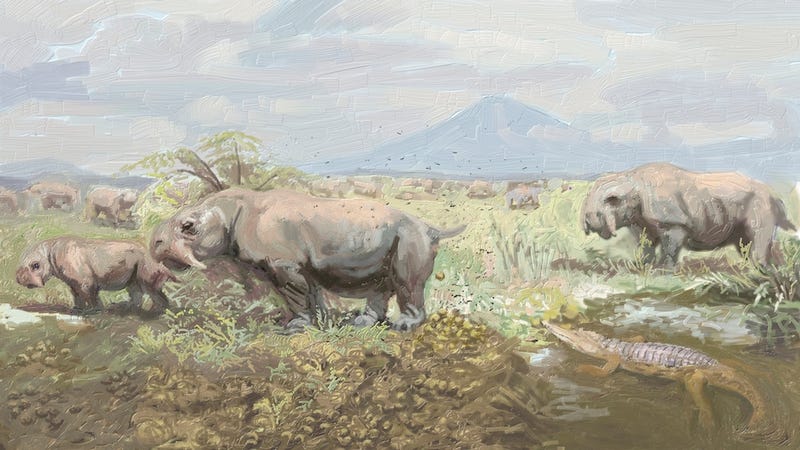
Artistic recreation of the ancient reptiles, dicynodonts, using
their communal latrine. Courtesy of Emilio López Rolandi.
Communal latrines, or defecation spots, are exactly what they sound like: Relatively small areas where multiple individuals relieve themselves, sometimes at the same time. Humans and housecats obviously defecate in communal latrines, but studies show that a number of other mammals do, too, and the behavior is particularly common among large herbivores. 

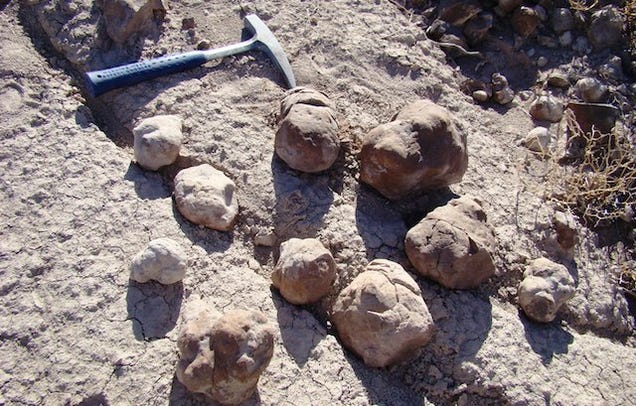
In fact, research shows this behavior was an ancient evolutionary development: scientists have discovered a large, rhino-like reptile defecated in "communal latrines" some 240 million years ago. Turns out, communal latrines have important biological functions

The eight communal latrines the researchers discovered were each 400 to 900 square meters and 1.5 kilometers apart. These fields were loaded with fossilized poo called coprolites - within the latrines, there were, on average, 67 coprolites per square meter, but in some areas the poo density reached 94 coprolites per square meter. Given the amount of coprolites and their size variation, the researchers believe the latrines were really communal, and used by many animals of different ages. 

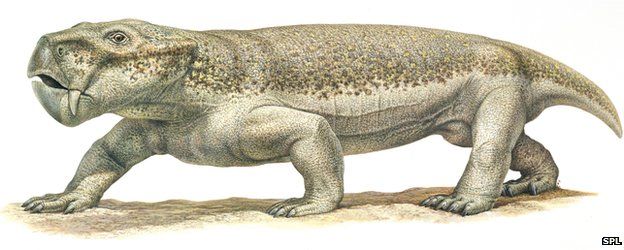
The culprits were dicynodonts - ancient megaherbivores
"There is no doubt who the culprit was," said Dr Lucas Fiorelli, of Crilar-Conicet, who discovered the dung heaps. The perpetrator was Dinodontosaurus, an eight-foot-long megaherbivore similar to modern rhinos. These animals were dicynodonts - large, mammal-like reptiles common in the Triassic period when the first dinosaurs began to emerge. The fact they shared latrines suggests they were gregarious, herd animals, who had good reasons to poo strategically, said Dr Fiorelli:
"Firstly, it was important to avoid parasites - 'you don't poo where you eat', as the saying goes.
"But it's also a warning to predators. If you leave a huge pile, you are saying: 'Hey! We are a big herd. Watch out!"
 The new discovery also indicates that the seemingly mammal-only behavior of defecating in communal latrines developed before mammals first evolved. This new find actually predates the previous fossil record of communal latrines by 220 million years. We may owe our sanitary practices to our reptile ancestors.
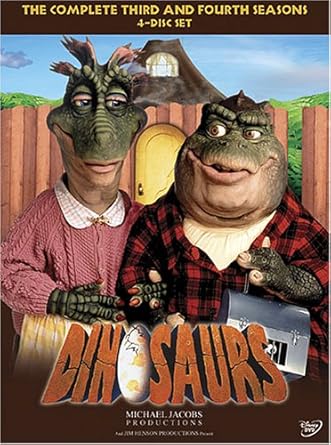
Anyone remember the show Dinosaurs? Here's the episode where the baby runs away to the forest rather than poop in the same place as everyone else, because, as he explains it to the other forest denizens (hereafter FD1 and FD2),..

Baby: They tried to make me go potty.

FD1 explains to the others: When nature calls you've got to go to this one particular room and sit in this special chair...

FD2: You're making this up!

FD1: No, wait, wait wait there's even more conditions than that - everyone uses the same chair!

(loud expressions of disgust)

FD2: But, wait, what if you have to go and someone's already using the chair?

FD1: Then you have to wait.

FD2: But what if you can't wait?

FD1: You have to!

Baby: I wanna go when I wanna go!

FD1: Well, that's how we do it out here. You can go any time you want, anywhere you want.

Baby: Anywhere?

FD2: Well, except over there - that's the volleyball court.

Start watching at 8:50, if the video doesn't automatically start there:


Here's the full scientific article, a report at BBC, and discussion at io9.

Tuesday, August 16, 2016

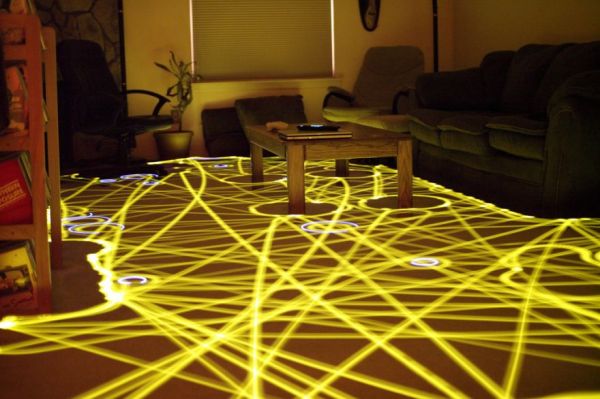
When the Roomba runs over dog poop.

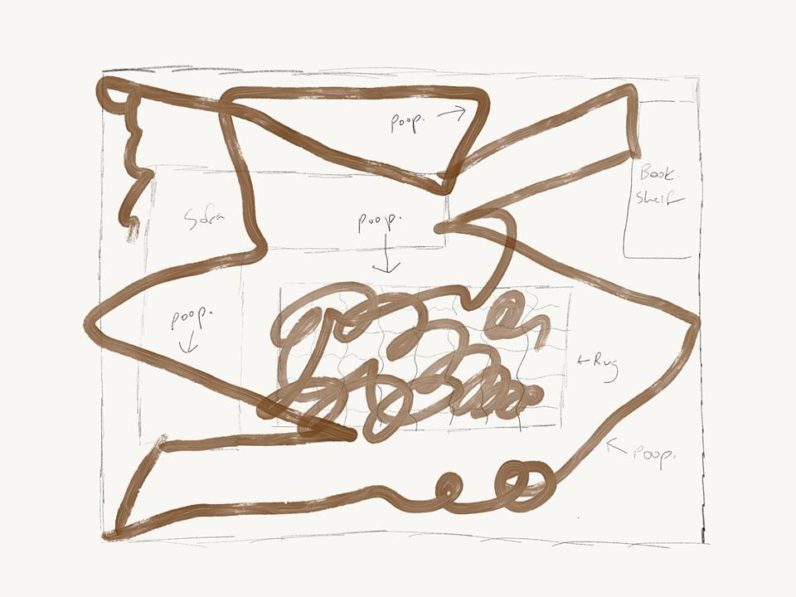
Little Rock, AR Facebook member Jesse Newton tells his disgusting story of the unfortunate intersection of puppy poop and a Roomba in a LOT of detail - excerpts below but read the whole thing.

Jesse's map of the Roomba track
Sometime between midnight and 1:30am, our puppy Evie pooped on our rug in the living room. This is the only time she's done this, so it's probably just because we forgot to let her out before we went to bed that night. Now, if you have a detective's mind, you may be wondering how we know the poop occurred between midnight and 1:30am. We were asleep, so how do I know that time frame?

Why, friends, that's because our Roomba runs at 1:30am every night, while we sleep. And it found the poop. And so begins the Pooptastrophe. The poohpocalypse. The pooppening.

Do not, under any circumstances, let your Roomba run over dog poop. If the unthinkable does happen, and your Roomba runs over dog poop, stop it immediately and do not let it continue the cleaning cycle. Because if that happens, it will spread the dog poop over every conceivable surface within its reach, resulting in a home that closely resembles a Jackson Pollock poop painting.

It will be on your floorboards. It will be on your furniture legs. It will be on your carpets. It will be on your rugs. It will be on your kids' toy boxes. If it's near the floor, it will have poop on it. Those awesome wheels, which have a checkered surface for better traction, left 25-foot poop trails all over the house. 

Then, when your four-year-old gets up at 3am to crawl into your bed, you'll wonder why he smells like dog poop. And you'll walk into the living room. And you'll wonder why the floor feels slightly gritty. And you'll see a brown-encrusted, vaguely Roomba-shaped thing sitting in the middle of the floor with a glowing green light, like everything's okay. Like it's proud of itself. You were still half-asleep until this point, but now you wake up pretty damn quickly.

And then the horror. Oh the horror.

So, first you clean the child. You scrub the poop off his feet and put him back in bed. But you don't bother cleaning your own feet, because you know what's coming.


Thursday, July 10, 2014

Toilet Museum Exhibit Lets You Wear a Poop Hat And Go Down a 16 Foot Toilet Slide, Just Like a Real Poop

science museum in Tokyo has opened an exhibit all about toilets and what humans put into them. Visitors can learn about the formation and makeup of feces, the importance of toilets for health, and how toilets work.

But visitors can do more than just learn information. They can have fun! Visitors are given cloth poop hats, and then flushed into the giant toilet: the exhibit includes a 5-meter (15 foot) long slide into a giant toilet. As the sign welcoming visitors says, "You Too, Can Become Feces!". BYW, grammar nazis, that's their punctuation, not mine.

There's also a choir of singing toilets - see the video:


via Neatorama

Tuesday, April 1, 2014

Because it's important to always be battle-ready: How to Poop Like a Samurai

From Art of Manliness, check out this post on the way of the Samurai, in which the author recounts lessons he learned as a kid from the book Autumn Lightning: The Education of an American Samurai:

As part of preparedness for battle, which could come at any time, even, say, when one was on the toilet:

The method his master taught for relieving oneself had been passed down for generations untold. When one would go to the outhouse, he would remove his right leg fully from his clothes. This was to give him full mobility. Yes, it would be odd to fight someone off when you were on the john, but imagine your feet being tied together when you were attacked on said john vs. your legs moving freely.

Secondly was body position and posture. The samurai would sit squarely on the seat, cross his leg so that his right ankle rested on his left knee (his left foot remained on the ground), place a hand on each knee, then straighten his back. Supposedly this aligns the bowels to help one from having to strain. You may think it seems like a bunch of malarkey, but this one actually works. If you have ever felt like there is a plumbing issue when you sit down, then pay attention. Take your time, have some patience, and you will get the yoga version of Draino on your system that has been passed down from samurai warlords of old. I have literally felt a swirling sensation during the act of evacuation. Try it out to see for yourself.

One downside is that our toilet seats are really geared towards sitting with both legs straight forward and on the ground. Another is that rarely is the seat exactly where your thigh is parallel to the ground. Most seats are too low for the average man, so it may be a strain just to get that leg up. Finally, if you really want to be technically correct in what you’re doing, you need to have a bokken in the bathroom with you. This is part of being prepared. Legs free is good. Legs free and armed is better.

More at the Art of Manliness blog.

And speaking of manliness, Dave Barry's Manliness Manifesto is a hoot.

Monday, March 24, 2014

Monday links

35 Excellent Facebook Fails.

Daily Affirmations from Skeletor, Evil Lord of Destruction.

The Time the U.S. Invaded a Japanese Submarine Base in Alaska.

‘Juden Raus’: Nazi-era anti-Semitic board game where you deport the Jews.

This is a hoot: check out Kevin Bacon's Footloose entrance on the Tonight Show.

What Does the Shape and Color of My Poop Mean?

ICYMI, Friday's links are here, including the gruesome original Pinocchio story and the 500 lb chicken from hell.

Thursday, February 20, 2014

Who thinks of this stuff? Baby-Poop Bacteria Help Make Healthy Sausages

The latest in probiotics (wiki), from Live Science.
...professional tasters confirmed all the sausages tasted like regular fuet, even though all were healthier, low-fat, low-salt versions. The scientists detailed their findings in the February issue of the journal Meat Science.
The scientists tried their creations as well.
"We ate them, and they tasted very good," Jofré told LiveScience.

The trick to making sausage healthier may be baby poop, researchers say.

Bacteria from baby poop can help make delicious sausages, which could transform savory meats into health foods much like probiotic yogurts, according to new research.

For millennia, cultures across the globe have relied on microbes to help create a dazzling variety of foods and drinks. The most familiar examples are the yeasts used to make wine, beer and other alcohol.

Many types of sausages — including pepperoni and salami — are made with the aid of bacterial fermentation, which helps give these sausages their characteristic tangy flavor and, in many cases, their chewy texture and intense red color.

Fermented sausages are made from mixtures of ground meat, salt, sugar, spices and curing agents stuffed into casings. They are typically fermented by either bacteria naturally found in the raw meat or commercially available bacteria added to the meat during manufacturing. The lactic acid these fermenting bacteria produce, together with the drying of the meat, suppresses the spread of germs that would otherwise spoil the sausages.

In recent years, scientists have discovered that foods such as yogurt that contain live probiotic bacteria can have a wide variety of health benefits. For instance, these microbes could help burn away belly fattreat depression, lower inflammation, prevent urinary-tract infections and fight infant gastrointestinal disorders such as constipation.

Scientists in Spain reasoned that probiotic bacteria could be used in fermented sausages as well. 

"Probiotic fermented sausages will give an opportunity to consumers who don't take dairy products the possibility to include probiotic foods to their diet," said study co-author Anna Jofré, a food microbiologist at Catalonia's Institute of Food and Agricultural Research's (IRTA) food-safety program in Girona, Spain.

For probiotic bacteria to work, they must survive the acids in the digestive tract. As such, the researchers focused on microbes found alive in human feces.

Baby bacteria

The scientists concentrated on 43 fecal samples of healthy infants up to 6 months old. The samples were taken from diapers, mostly provided by midwives in support groups for new parents.

The two kinds of bacteria used most often in probiotics, Lactobacillusand Bifidobacterium, are far more abundant in infant poop than in adult excrement. In addition, "infant feces are natural samples, easy to obtain," Jofré said.

The scientists tried fermenting six batches of sausages using three strains of bacteria found in baby poop and three other, commercial probiotic strains of bacteria. Studies they had done in the past established the strains they used from infant excrement were safe for people.

Specifically, the investigators made "fuet," a kind of Mediterranean fermented pork sausage commonly found in Catalonia in northeastern Spain. It resembles the Spanish fermented sausage known as "chorizo," although fuet does not contain paprika like chorizo does and is also usually shorter, thinner, less acidic and less fatty. (The sausages the researchers made had no feces in them, only bacteria cultured from the poop.)

Only one of the six strains of bacteria became the main, dominant microbes within the sausages: one of the strains from infant feces. In fact, this strain grew "to levels of 100 million cells per gram of sausage," Jofré said, "enough to produce health-promoting effects to people."

Moreover, professional tasters confirmed all the sausages tasted like regular fuet, even though all were healthier, low-fat, low-salt versions. The scientists detailed their findings in the February issue of the journal Meat Science.

The scientists tried their creations as well.

"We ate them, and they tasted very good," Jofré told LiveScience.

Future research needs to confirm if this strain of bacteria actually has probiotic effects. "Meanwhile, they can be used for the production of tasty fermented sausages," Jofré said.

No companies are currently interested in commercializing these sausages, Jofré noted.