In a good-sized, heavy bottomed saucepan, over medium-high heat, saute onion and celery in butter until soft.
Add chestnuts, chicken broth and bay leaves and bring to boil over high heat. Reduce heat to low and simmer uncovered until chestnuts are tender, about 30 minutes. Remove bay leaves.
In a blender or food processor fitted with a metal blade, puree soup until smooth. If you have an immersion blender, use that.
Return soup to pan; stir in half-and-half, salt, pepper and nutmeg. Heat through over low heat. Serve hot.
In case you were trying to work it out for yourself, the name of this phobia in Pig Latin is araskavedekatriaphobiapay.
Superstition, bigotry, and prejudice, ghosts though they are, cling tenaciously to life: they are shades armed with tooth and claw. They must be grappled with unceasingly, for it is a fateful part of human destiny that it is condemned to wage perpetual war against ghosts. A shade is not easily taken by the throat and destroyed.
Today is Friday, the 13th, which superstition holds is a day for bad luck. According to folklorists, there is no written reference to this belief before the 19th century. The earliest known reference in English occurred in an 1869 biography of composer Gioacchino Rossini, which described the irony of his dying on an "unlucky" Friday, the 13th.
The basis for the superstition may lie in the fact that 13 has long been held to be an unlucky number and Friday an unlucky day - hence the combination. It has been estimated that something like 20 million people are affected by this belief in the United States, many of them changing their normal routines on this day to avoid "the curse." The Dutch Centre for Insurance Statistics claims that "fewer accidents and reports of fire and theft occur when the 13th of a month falls on a Friday than on other Fridays, because people are preventatively more careful or just stay home." This seems to be confirmed by Dutch auto accident data.
This Nat Geo article discusses the phobia with Donald Dossey, founder of a Stress Management Center and Phobia Institute in North Carolina (and also a folklore historian and author of Holiday Folklore, Phobias and Fun): he says that fear of Friday the 13th is rooted in ancient, separate bad-luck associations with the number 13 and the day Friday. The two unlucky entities ultimately combined to make one super unlucky day.
Dossey traces the fear of 13 to a Norse myth about 12 gods having a dinner party at Valhalla, their heaven. In walked the uninvited 13th guest, the mischievous Loki. Once there, Loki arranged for Hoder, the blind god of darkness, to shoot Balder the Beautiful, the god of joy and gladness, with a mistletoe-tipped arrow.
"Balder died and the whole Earth got dark. The whole Earth mourned. It was a bad, unlucky day," said Dossey. From that moment on, the number 13 has been considered ominous and foreboding.
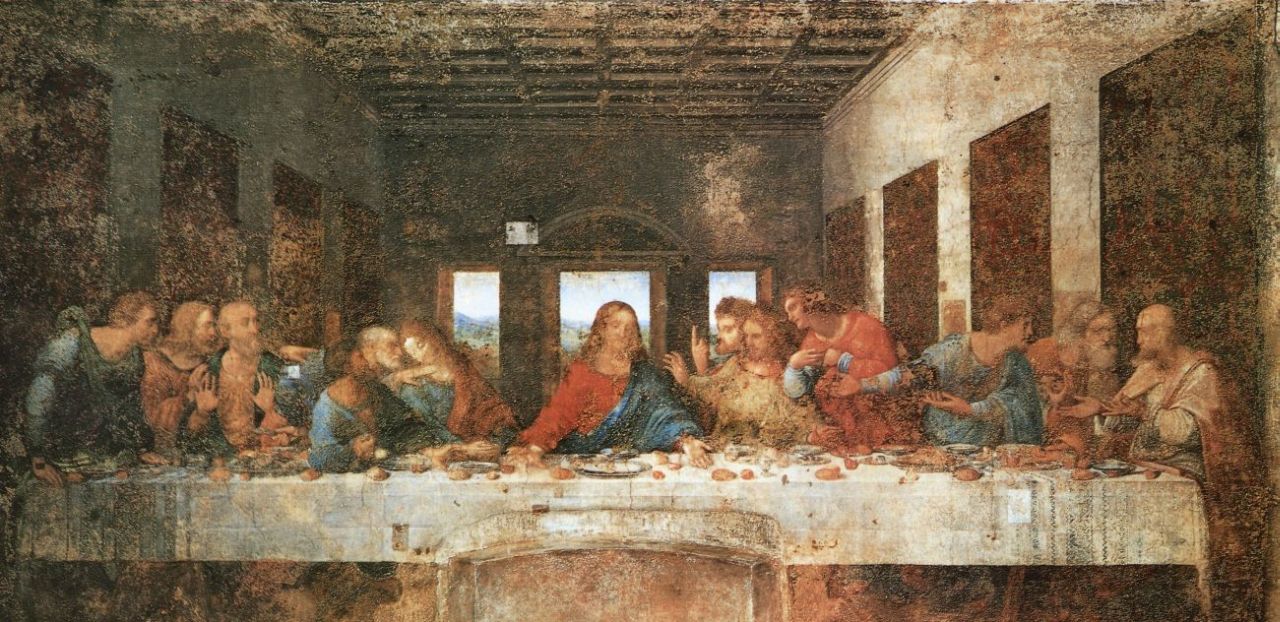
There is also a biblical reference to the unlucky number 13. Judas, the apostle who betrayed Jesus, was the 13th guest to the Last Supper.
Meanwhile, in ancient Rome, witches reportedly gathered in groups of 12. The 13th was believed to be the devil.
Thomas Fernsler, an associate policy scientist in the Mathematics and Science Education Resource Center at the University of Delaware in Newark, said the number 13 suffers because of its position after 12.
According to Fernsler, numerologists consider 12 a "complete" number. There are 12 months in a year, 12 signs of the zodiac, 12 gods of Olympus, 12 labors of Hercules, 12 tribes of Israel, and 12 apostles of Jesus.
In exceeding 12 by 1, Fernsler said 13's association with bad luck "has to do with just being a little beyond completeness. The number becomes restless or squirmy."
Judas, the apostle who betrayed Jesus, was the 13th person to arrive at The Last Supper
This fear of 13 is strong in today's world. According to Dossey, more than 80 percent of high-rises lack a 13th floor. Many airports skip the 13th gate. Hospitals and hotels regularly have no room number 13.
On streets in Florence, Italy, the house between number 12 and 14 is addressed as 12 and a half. In France socialites known as the quatorziens (fourteeners) once made themselves available as 14th guests to keep a dinner party from an unlucky fate.
As for Friday, it is well known among Christians as the day Jesus was crucified. Some biblical scholars believe Eve tempted Adam with the forbidden fruit on Friday. Perhaps most significant is a belief that Abel was slain by Cain on Friday the 13th.
I always try to make myself as widely understood as possible; and if I don't succeed, I consider it my own fault.
~ Dmitri Shostakovich (quoted in Machlis, Introduction to Contemporary Music)
The composer apparently does not set himself the task of listening to the desires and expectations of the Soviet public. He scrambles sounds to make them interesting to formalist elements who have lost all taste... The power of good music to affect the masses has been sacrificed to a petty-bourgeois, "formalist" attempt to create originality through cheap clowning. It is a game of clever ingenuity that may end very badly.*
~ Pravda (on the Shostakovich opera Lady MacBeth of Mtsensk, "Muddle Instead of Music," January 1936)
Shostakovich told me: "I finished the Fifth Symphony in the major and fortissimo... It would be interesting to know what would have been said if I finished it pianissimo and in the minor." Only later did I understand the full significance of these words, when I heard the Fourth Symphony, which does finish in the minor and pianissimo. But in 1937, nobody knew the Fourth Symphony.**
~ Boris Khaikin (1904-1978) (Discourses on Conducting)
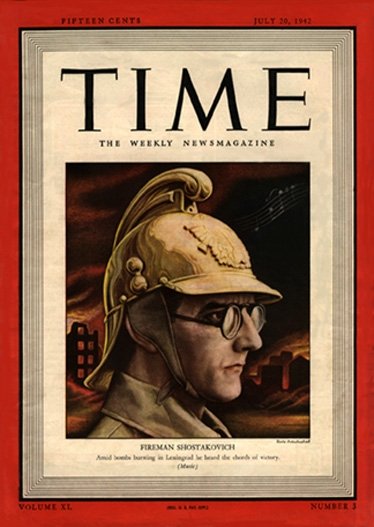
The cover of a 1942 issue of Time Magazine with the caption "Fireman Shostakovich: 'Amid bombs burning in Leningrad, he heard the chords of victory.' Refers to the Battle of Leningrad in which he served as a volunteer in the anti-fire brigades
There may be few notes, but there's lots of music.
Particularly during the Cold War, Shostakovich was anathema to many Western critics:
The Fifth Symphony of Shostakovich always has been singularly irritating to this chronicler... Whenever I hear one of his marches, my imagination fastens upon a picture of the parades in Red Square and the banners of Uncle Joe, and my irritation becomes powerful.
~ Cyrus Durgin (? - 1962) (Boston Globe, 25 October 1952)
To anyone who knew his music, a first encounter with Dmitri Shostakovich could not fail to be startling. In contrast to the elemental force, bombast, grandeur of his works, he was a chétif*** figure, the perennial student, unassertive and shy, who looked as though all the music could be wrung out of him in a couple of song cycles.
~ Yehudi Menuhin (1916-1999) (Unfinished Journey)
September 25 is the anniversary of the birth of Soviet composer Dmitri Shostakovich (wiki) (1906-1975), considered by some as the greatest symphonist of the 20th century. Born in St. Petersburg, Shostakovich was an early piano prodigy and studied composition at the St. Petersburg Conservatory during the early Soviet era.
At first recognized internationally as an exemplar of the best of Soviet musicianship, he ran afoul of the regime with his modernistic opera, Lady MacBeth of Mtsensk, which so outraged Stalin that he is said to have had a personal hand in writing the infamous Pravda editorial, "Muddle Instead of Music" that literally put the composer's life in jeopardy during the "Great Purge" of the late 1930s.
Shostakovich somehow survived, even though he was recurrently criticized by the regime for his “modernist” tendencies. During his subsequent tumultuous career, he produced an enormous oeuvre: 15 symphonies, concertos, a great quantity of chamber music, song cycles, piano music, and several operas. Generally considered a serious - almost tragic - composer, Shostakovich nonetheless wrote a large amount of “light” music, including even a stage work – Moscow Cheryomushki (1959) – that might be described as a Russian musical comedy.
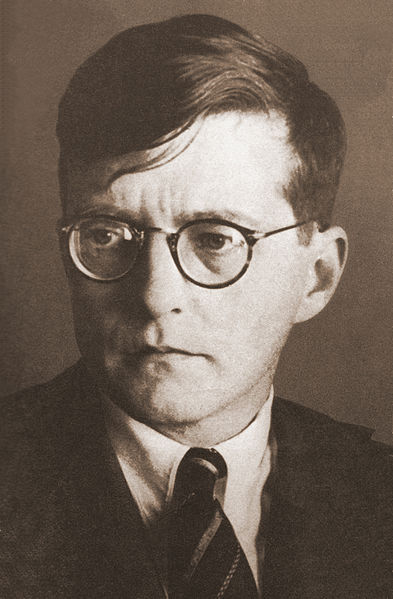
Harry Potter looks exactly like a young Shostakovich
For newcomers to the music of Shostakovich, I would recommend his 4th, 5th, and 10th symphonies, the two piano concertos, the "autobiographical" 8th strinq quartet, his several "jazz" and "ballet" suites compiled from light works of the 1930s, and his film score for The Gadfly, whose "Romance" was used to great effect as the principal theme of the TV series, "Riley, Ace of Spies."
During the last two decades, there has been a raging musicological debate about whether the music of Shostakovich reveals him as a loyal Soviet citizen or a closet dissident whose works portray a tormented man. No one really knows. He was clearly a quirky guy. In contradiction to the opening quotation above, he noted late in life,
"I've said what I said. Either you have it in you to understand, or if not, then it would be fruitless to try to explain anyway."
* N.B. In the first year of the Great Purge, this last sentence was a terrifying threat.
** After the uproar caused by Lady MacBeth of Mtsensk, Shostakovich "redeemed" himself with his Fifth Symphony (1937), designated "A Soviet Artist's Response to Just Criticism," still one of his most successful and popular works. However, his iconoclastic Fourth Symphony, which had been in rehearsal at the time of the debacle, was withdrawn and did not emerge again until 1961. It is now considered one of the master's most original works and a fascinating indicator of "the road not taken." By the way, Boris Khaikin was a Soviet-Jewish conductor.
*** Chétif - a French word meaning "puny."
Here is the romance from The Gadfly:
More typical of Shostakovich is the opening of his 4th symphony:
Unification Day is a holiday celebrated in the fictional universe of the science-fiction television series Firefly. It marks the day in which the Alliance forces defeated the resistance ("Browncoats") in the Unification War.
"The Train Job", the second episode of the series (although Fox originally aired it before the pilot episode "Serenity"), opens with Mal, Zoe, and Jayne in a bar during a Unification Day celebration. Malcolm's brown coat and his disinterest in celebrating Unification Day lead to a brawl.
Unification Day is a holiday mentioned in the backstory of the television series Firefly. According to Nathan Fillion (Mal), the holiday is on September 20th.
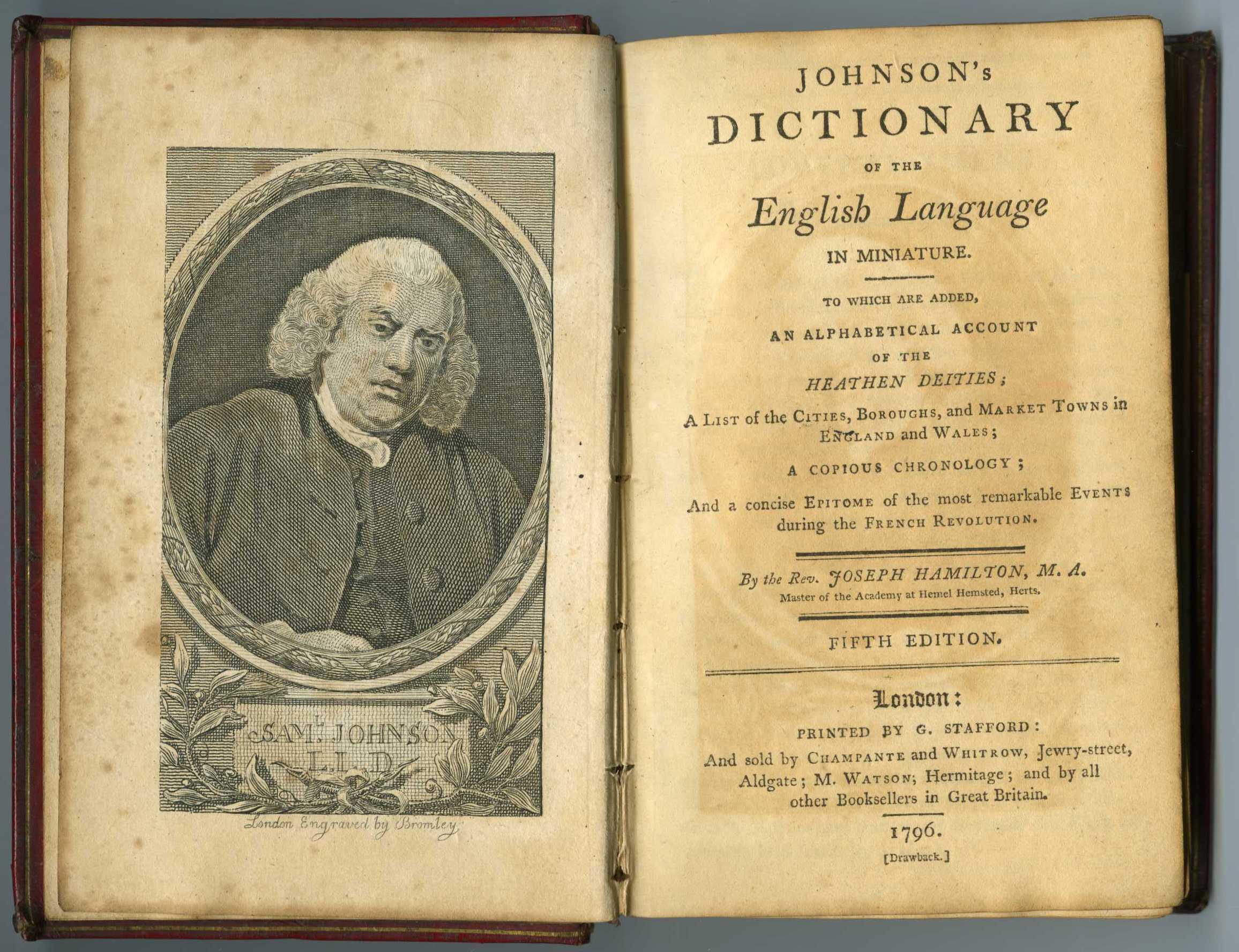
September 18 is the anniversary of the birth in 1709 of that quintessential 18th-century curmudgeon Dr. Samuel Johnson (wiki), the literary lion of Georgian London for much of his lifetime (1709-1784). A poet, critic, lexicographer, and wit, Johnson compiled the first respectable English dictionary between 1747 and 1755, following several years of writing critical articles for London magazines such as The Idler.
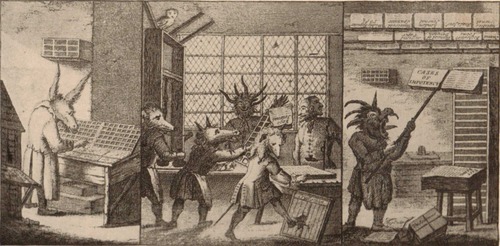
From The Grub Street Journal (Oct 30, 1732), this cartoon depicts the “literatory,” a sort of publishing factory driven by beasts without artistic inspiration. Such was the perception of Grub Street writers like Johnson and Savage, who did indeed scrape together a living from commissioned writing.
Born in Lichfield the son of a book dealer, Johnson studied at Oxford and ran his own private school - where the actor David Garrick was a student - before removing to London and its literary milieu in 1737. There, in 1763, he met his companion and biographer, the Scot, James Boswell (1740-1795), to whom we owe the recording of most of Johnson's voluminous observations.
He was no fan of Scotland:
"The noblest prospect which a Scotchman ever sees, is the high road that leads him to England!"
I having said that England was obliged to us for gardeners, almost all their gardeners being Scotchmen; Johnson: "Why, Sir, that is because gardening is much more necessary amongst you than with us, which makes so many of your people learn it. It is all gardening with you. Things which grow wild here, must be cultivated with great care in Scotland. Pray now," throwing himself back in his chair, and laughing, "are you ever able to bring the sloe to perfection?"
He would not allow Scotland to derive any credit from Lord Mansfield; for he was educated in England. "Much may be made of a Scotchman, if he be caught young."
"There is in Scotland a diffusion of learning, a certain portion of it widely and thinly spread. A merchant has as much learning as one of their clergy."
"What enemy would invade Scotland, where there is nothing to be got?"
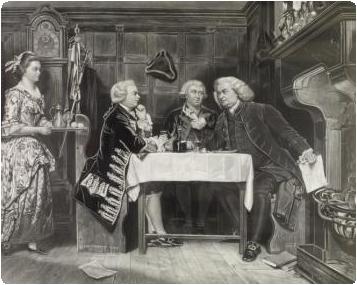
In “The Mitre Tavern” (1880), Samuel Johnson (far right) converses with James Boswell (center) and author Goldsmith. (source)
Asked by a Scot what Johnson thought of Scotland: "That it is a very vile country, to be sure, Sir" "Well, Sir! (replies the Scot, somewhat mortified), God made it." Johnson: "Certainly he did; but we must always remember that he made it for Scotchmen, and comparisons are odious, Mr. S------; but God made hell."
Mr. Arthur Lee mentioned some Scotch who had taken possession of a barren part of America, and wondered why they would choose it. Johnson: "Why, Sir, all barrenness is comparative. The Scotch would not know it to be barren." Boswell: "Come, come, he is flattering the English. you have now been in Scotland, Sir, and say if you did not see meat and drink enough there." Johnson:"Why yes, Sir; meat and drink enough to give the inhabitants sufficient strength to run away from home."
Johnson and Boswell in Edinburgh
"Your country consists of two things, stone and water. There is, indeed, a little earth above the stone in some places, but a very little; and the stone is always appearing. It is like a man in rags; the naked skin is still peeping out."
"A tree might be a show in Scotland as a horse in Venice. At St. Andrews Mr. Boswell found only one, and recommended it to my notice; I told him it was rough and low, or looked as if I thought so. This, said he, is nothing to another a few miles off. I was still less delighted to hear that another tree was not to be seen nearer. Nay, said a gentleman that stood by, I know but of this and that tree in the county."
[Of an inn in Scotland, SJ wrote...] "Of the provisions the negative catalogue was very copious. Here was no meat, no milk, no bread, no eggs, no wine. We did not express much satisfaction."
"He that travels in the Highlands may easily saturate his soul with intelligence, if he will acquiesce in the first account. The highlander gives to every question an answer so prompt and peremptory, that skepticism itself is dared into silence, and the mind sinks before the bold reporter in unresisting credulity; but, if a second question be ventured, it breaks the enchantment; for it is immediately discovered, that what was told so confidently was told at hazard, and that such fearlessness of assertion was either the sport of negligence, or the refuge of ignorance."
(Written by an Irishman) The author of these memoirs will remember, that Johnson one day asked him, 'Have you observed the difference between your own country impudence and Scottish impudence?' The answer being in the negative: 'Then I will tell you,' said Johnson. 'The impudence of an Irishman is the impudence of a fly, that buzzes about you, and you put it away, but it returns again, and flutters and teazes you. The impudence of a Scotsman is the impudence of a leech, that fixes and sucks your blood.'
Johnson also, of course, had little use for America or Americans:
"Sir, they are a race of convicts, and ought to be thankful for anything we allow them short of hanging."
"To a man of mere animal life, you can urge no argument against going to America, but that it will be some time before he will get the earth to produce. But a man of any intellectual enjoyment will not easily go and immerse himself and his posterity for ages in barbarism."
"I am willing to love all mankind, except an American"
"They teach the morals of a whore; and the manners of a dancing-master."
Of Thomas Sheridan:
"Why, Sir, Sherry is dull, naturally dull; but it must have taken him a great deal of pains to become what we now see him. Such an excess of stupidity, Sir, is not in nature."
Of the respective merits of the poets Derrick and Smart:
"Sir, there is no settling the point of precedence between a louse and a flea."
Of the criticism of one critic (Edwards) of another (Warburton):
"A fly, Sir, may sting a stately horse and make him wince; but the one is but an insect and the other is a horse still."
Of Lady Macdonald of Sleat:
"...she was as bad as negative badness could be, and stood in the way of what was good; that insipid beauty would not go a great way... and such a woman might be cut out of a cabbage, if there was a skilful artificer."
Of two disputants:
"One has ball without powder; the other powder without ball."
Of a man hired to sit with him during a convalescence:
"The fellow's an idiot; he is as awkward as a turn-spit when first put to the wheel, and as sleepy as a dormouse."
Of James Macpherson:
"He wants to make himself conspicuous. He would tumble in a hogstye, as long as you looked at him and called him to come out."
Of the new rich:
"Sir, they have lost the civility of tradesmen, without acquiring the manners of gentlemen."
Despite his legendary bile, Johnson did remark later in life,
"As I know more of mankind I expect less of them, and am ready to call a man a good man upon easier terms than I was formerly."
* My favorite quote from Lord Chesterfield's Letters to His Son(to his illegitimate son, that is; he (Chesterfield) was trying to raise him (the son) above his (the son's) lowly origins and inferior blood):
"I knew a gentleman, who was so good a manager of his time, that he would not even lose that small portion of it, which the calls of nature obliged him to pass in the necessary-house; but gradually went through all the Latin poets, in those moments. He bought, for example, a common edition of Horace, of which he tore off gradually a couple of pages, carried them with him to that necessary place, read them first, and then sent them down as a sacrifice to Cloacina*: this was so much time fairly gained; and I recommend you to follow his example.
It is better than only doing what you cannot help doing at those moments; and it will made any book, which you shall read in that manner, very present in your mind. Books of science, and of a grave sort, must be read with continuity; but there are very many, and even very useful ones, which may be read with advantage by snatches, and unconnectedly; such are all the good Latin poets, except Virgil in his "Aeneid": and such are most of the modern poets, in which you will find many pieces worth reading, that will not take up above seven or eight minutes."